The battle for Ukrainian identity
New Eastern Europe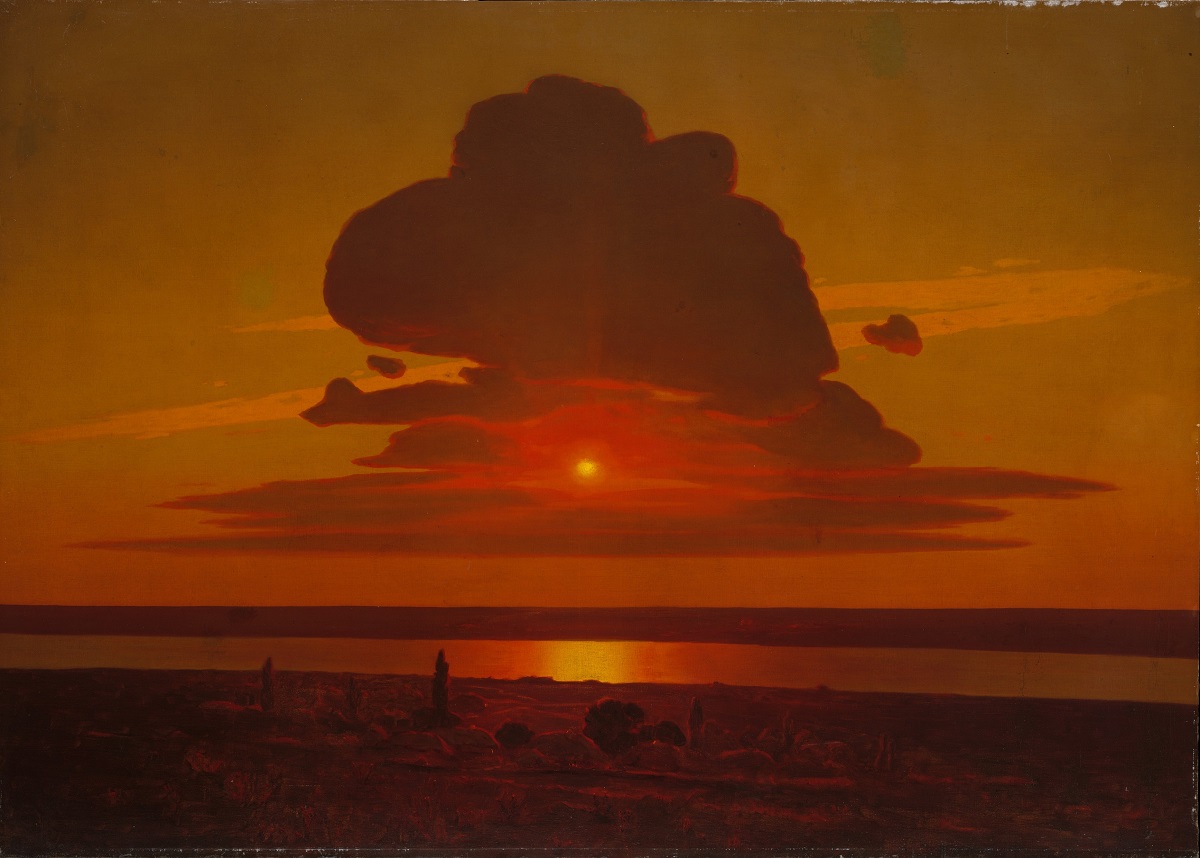
Russia’s war against Ukraine is being fought not only on the battlefield, but also in museums, archives and cultural institutions struggling to preserve the country’s historical and cultural memory. From the ruins of Mariupol to diaspora institutions in New York, a growing network of historians, archivists and cultural workers is documenting destruction while resisting the erasure of Ukraine’s past.
In the crowded 19th-century European Paintings galleries at the Metropolitan Museum of Art in New York, Red Sunset on the Dnipro stands out immediately. Its depiction of late sunlight over the Dnipro river, painted in deep reds and burnt orange tones, offers a striking image of the Ukrainian landscape. Over the past three years, the work has become one of the paintings I return to most often at the museum. The piece’s author, Arkhyp Kuindzhi (1841-1910) was born in the Karasivka neighbourhood in Mariupol on the shores of the Sea of Azov to Urum Greeks. He grew up learning Greek and Crimean Tatar, later Ukrainian, and then Russian. Although this canvas displays the stillness practiced by the Luminist School, it is impossible not to feel the powerful current of the Dnipro, the beating pulse of Ukraine felt by artists like Kuindzhi.
The vast, unpeopled Pontic-Caspian steppe, often referred to as the “Wild Fields”, was never merely a void on the map; it was a laboratory of freedom. As Neal Ascherson explores in Black Sea, this was a frontier where the “civilized” world of the Hellenic coast collided with the “barbaric” energy of the nomadic interior. For centuries, the Azov region acted as a sanctuary for the Cossack, dissenters who fled the gravity of empires to live in a state of restive independence. Yet, this very freedom made the region a target for imperial settlement. From Catherine the Great’s 1778 relocation of the Urum Greeks to the industrial quotas of the Soviet era, the history of the Wild Fields is a cycle of empires trying to bottle up a landscape that, much like Kuindzhi’s luminist horizons, refuses to be contained by a single label.
Casualties of empire
In Mariupol in March 2022, the Russian advance for Vladimir Putin’s land bridge to Crimea transformed initial border skirmishes into a brutal, claustrophobic siege. While the opening salvos on February 24th had methodically targeted the city’s air defence radars at the local airport and shattered the outer apartment blocks of the Skhidnyi district, the violence quickly turned towards the civilian core. By the second week of March, among the most horrifying symbols of this assault were a targeted maternity ward and a children’s hospital, accounted in Serhii Plokhy’s The Russo-Ukrainian War: The Return of History. Upwards of 50,000 casualties have been officially recorded by forensic imaging done by groups such as Human Rights Watch following the devastating airstrikes.
Plokhy described the aftermath of Mariupol as a “moonscape of rubble”. The Arkhyp Kuindzhi Art Museum was also a casualty of that “medieval siege”. A strike through the roof of the building damaged the integrity of the institution, setting the museum and neighbouring buildings ablaze. The truth of the war was irrefutable as the bombardments continued, highlighting that even language could not save you. Many of the Russian and Russian-speaking neighbourhoods were devastated in the carnage.
As peace between Russia and Ukraine has been on the discussion table recently, it is easy to be sceptical. During our interview, Corinne Muller from the Penn Cultural Heritage Center, highlighted that what comes next in this conflict remains precarious, as international actors balance solidarity against shifting economic and political liabilities. Many security experts noted that the temporary ceasefire agreed ahead of Russia’s May 9th Victory Day commemorations felt less like a genuine step towards peace and more like a short battlefield respite. The predictable fracturing and expiration of that 72-hour window – followed instantly by a devastating resumption of missile barrages against Kyiv’s civilian infrastructure and retaliatory drone strikes on Russian refineries –laid bare the transactional emptiness of the diplomatic theatre.
Nevertheless, a pause in the fighting did not halt the cultural dimension of the war. Galleries, libraries and museums continued their efforts to preserve Ukraine’s story amid ongoing destruction. While Russian forces used the lull to regroup, reports emerged that works by Ukrainian artists, including Kuindzhi, had been “relocated” elsewhere in Donetsk Oblast. After the Kuindzhi Museum in Mariupol was damaged, Russian forces removed countless works from cultural institutions targeted in the attacks.
On the art front
What becomes apparent in times of strife is that one must heed the silences and who is enforcing them. Rose Valland, curator and hero of the Second World War, knew this all too well as she was tasked with aiding the SS in their purge of western art from the galleries of Paris. As documented in Le Front de l'Art, her own account of the resistance, Valland secretly transcribed everything she could under the nose of her German occupiers, playing a dangerous game that could have cost her life to preserve the chain of custody for thousands of looted objects. The mantle of Valland and the Monuments Men is frequently claimed in the halls of 21st century western museums as a historical badge of honour. Yet, when the front line shifts eastward, that grand legacy often shrinks into bureaucratic hesitation, a form of selective institutional triage that treats the protection of localized, Eastern European archives as a secondary geopolitical concern.
This selective passivity has deep roots, quietly codified within the West's own academic history. Writing in the Metropolitan Museum Journal in 1975, shortly after the Met acquired Red Sunset on the Dnipro, the renowned art historian John E. Bowlt published a foundational study titled “A Russian Luminist School? Arkhip Kuindzhi's Red Sunset on the Dnepr.”
Bowlt was brilliant in isolating Kuindzhi’s audacious spectral contrasts and panoramic space, comparing his luminescent vision to the cosmic light of American masters like Albert Bierstadt. Yet, writing during the geopolitical freeze of the Cold War, Bowlt’s framework was inevitably bound by an imperial inertia. By categorizing the master under a singular “Russian” designation, western academia unconsciously participated in the erasure of the polyglot borderlands, setting a 20th-century baseline that treated imperial annexation as an artistic historical fact.
Alina Yefimova is the modern successor who shatters this baseline. Though it was in the autumn of 2018 that she first published her archival discoveries regarding the biography of Arkhyp Kuindzhi, her work had transformed by 2026 into a vital forensic weapon against the bloated, revisionist literature of the current Putin regime. It is the ultimate historical irony that this record was originally published within the pages of the state-aligned Tretyakov Gallery Magazine. Yet, that edition proved monumental for the memory of a son of Ukraine. The doors of art history were forced open not to an “Arkhip Kuindzhi” born in 1842 to a Russified family, but to the true historical record of 1841: a child registered at the Nativity of the Virgin Mary Church in Karasivka.
This finding laid bare Kuindzhi’s Urum Greek origins and polyglot upbringing in Greek and Crimean Tatar, effectively silencing Russia's contemporary imperial designs. The significance of Yefimova publishing this work, having personally studied the region at the Mariupol Museum of Local Lore, was that she extracted Kuindzhi from an imperial canon that had long reduced him to simply another painter associated with the Peredvizhniki (Wanderers) movement of the Russian Empire. Alongside fellow Ukrainian-born artists such as Ilya Repin, Kyriak Kostandi and Mykola Yaroshenko, Arkhip Kuindzhi was associated with the Wanderers. Yet his artistic imagination remained deeply rooted in the landscapes of Ukraine: the steppe that fascinated Nikolai Gogol and the quiet rhythm of the Dnipro river that runs through so much of Ukrainian history and culture.
Learning to fly
Conversations at the Penn Cultural Heritage Center at the University of Pennsylvania Museum helped me better understand connections across Ukraine’s cultural landscape that I had not fully seen before. One important issue in protecting Ukraine’s archives is that many records exist only as physical copies. Muller and her team confirmed that the lack of digitization has become a serious vulnerability amid the destruction and looting taking place in cities such as Mariupol, Kherson and Melitopol. The risk is not only that archival records and artefacts may disappear, but also that they could once again be stripped of their Ukrainian context and absorbed into a Russian imperial narrative. In this sense, the war extends far beyond the battlefield, reaching local churches, houses of culture and institutions struggling to preserve Ukraine’s cultural memory.
The physical institutions of Mariupol, the Kuindzhi Art Museum and the Museum of Local Lore, were not collateral damage. They were targeted precisely because the archives within them shed light on the historic reality of a sovereign Ukrainian nationhood, therefore it is no surprise that these locations and their contents presented a real threat to the Kremlin.
The gut-wrenching losses of Ukrainian identity have been recorded since the conflict began by a courageous team at the Ukrainian Heritage Monitoring Lab, or HeMo. Working tirelessly in conjunction with the Penn Center, HeMo also works in tandem with the Smithsonian Cultural Rescue Initiative, the Center for International Development and Conflict Management at the University of Maryland, and the Cultural Heritage Monitoring Lab at the Virginia Museum of Natural History. To prevent these scorched sites from being permanently erased from the global registry, the Penn team, alongside Brian Daniels and Corinne Muller, has erected a digital bulwark, transforming raw satellite telemetry and ground-level metadata into admissible forensic proofs.
Highlighted in his work, “International Heritage Organisations and the Case of the Mosul Cultural Museum, Iraq”, Daniels explains the methodology carried out by the Smithsonian Institute and the Iraqi State Board of Heritage and Antiquities to investigate other sites that had been harmed in the occupation by ISIS. The combination of FBI methodology and current preservation standards have culminated in a 12-step process for data and archive collection concerning at-risk sites called the “Forensic Heritage Approach”.
“While we hope that the need for such documentation in the future is rare, unfortunately the need for such documentation in the present, as well as accountability, remains great,” Daniels explains.
Vasyl Rozhko, founder of HeMo and co-founder of the Heritage Emergency Response Initiative states: “Remembrance is an act of resistance.” As the destruction continues, Vasyl and his team are working not only to preserve Ukrainian cultural memory, but also to draw international attention to the scale of the threat facing it. The erasure and appropriation of cultural heritage, they argue, should not take place without accountability.
The hours of forensic work, constant communication, and an ad hoc level of expertise with boots on the ground make this process arduous but incredibly necessary. The faces and the people that you meet, Muller tells me, are what we are really fighting for – people protecting their homes and their culture, their lives, and memories of those before. When asked about the practical challenges of conducting lab work in wartime Ukraine, Muller says that local partners described the process as “learning to fly while building the plane”. Despite limited resources and constant uncertainty, the partnership has built an extensive network dedicated to documenting the conflict and preserving damaged cultural heritage. Speaking with Muller, it becomes clear that many western institutions have underestimated the scale and effectiveness of the Ukrainian-led effort.
The New York Sich
The frontline of this archival war does not terminate at the borders of the Donbas or the shores of the Azov. It stretches directly across the Atlantic, finding a vital defensive redoubt within the cultural topography of Manhattan. Where traditional international bureaucracies move with agonizing slowness, the Ukrainian diaspora has long maintained its own horizontal network of resistance. Institutions like the Ukrainian Museum in the East Village and the Ukrainian Institute of America on Fifth Avenue function as modern, urban siches, fortified repositories of memory – rooted in the Cossack tradition of self-organization and defence and operating safely out of reach of frontline destruction.
The relationship is fundamentally asymmetrical, yet closely intertwined: Ukrainians defending their culture at home provide the evidence of its resilience and sovereignty, while diaspora institutions in New York help ensure that the wider world pays attention. As Elena Siyanko, the newly appointed Executive Director of the Ukrainian Museum, noted of the diaspora's contemporary mandate, the objective is “to not only represent Ukraine, but to also decolonize Ukrainian culture, continue speaking on the war, and raise awareness on the impact that Ukrainians from the diaspora have had in the arts”. This institutional push mirrors the theoretical frameworks of New York-based scholars such as Maria Rewakowicz, Head of Collections, who has long analysed Ukraine as a post-colonial space actively dismantling Russia's metropolitan influence.
For diaspora leaders like Lydia Zaininger, executive director at the Ukrainian Institute of America, stewardship of these spaces ensures that when grassroots groups like HeMo or independent researchers risk everything to extract an archive from the rubble, those files do not languish in a forgotten database. They become a public indictment on the walls of a global capital, reshaping the permanent canon of art history. Attending programmes at the institute offers an opportunity to engage more deeply with both the war and Ukrainian culture through discussions with authors such as Serhii Plokhy and Yaroslav Timofeyev, performances by musicians like Solomia Stakhiv, and conversations shaped by memories of Kyiv. Through this work, the institution has helped create a lasting cultural space for Ukraine on Fifth Avenue.
To walk back into the 19th-century European Paintings galleries at the Metropolitan Museum of Art today is to witness the quiet victory of this horizontal vanguard. When one looks closely at the updated label beneath Red Sunset on the Dnipro, the imperial inertia that John E. Bowlt documented in 1975 has finally cracked. The text no longer yields to the default vocabulary of an empire; it asserts the reality of Kuindzhi’s Ukrainian homeland. Even as the illusion of a precarious ceasefire shatters and tanks resume their advance across the grey zones of a fractured map, the permanent ink on a Manhattan museum label serves as a stark reminder: a nation’s borders may be temporarily besieged, but its past, when guarded by the immutable shield of the archives, remains absolutely invincible.
Zach Rogers is an academic writer and independent researcher based in New York City. He holds a Master’s degree in European and Mediterranean Studies from New York University and a Bachelor’s degree in history, focusing on cultural memory, archival security, and the legacy of the Soviet era in the post-colonial borderlands. His writing on Eastern European geopolitics and cultural history has appeared in New Eastern Europe and Europinion.