The songs that can unite Latvia
New Eastern Europe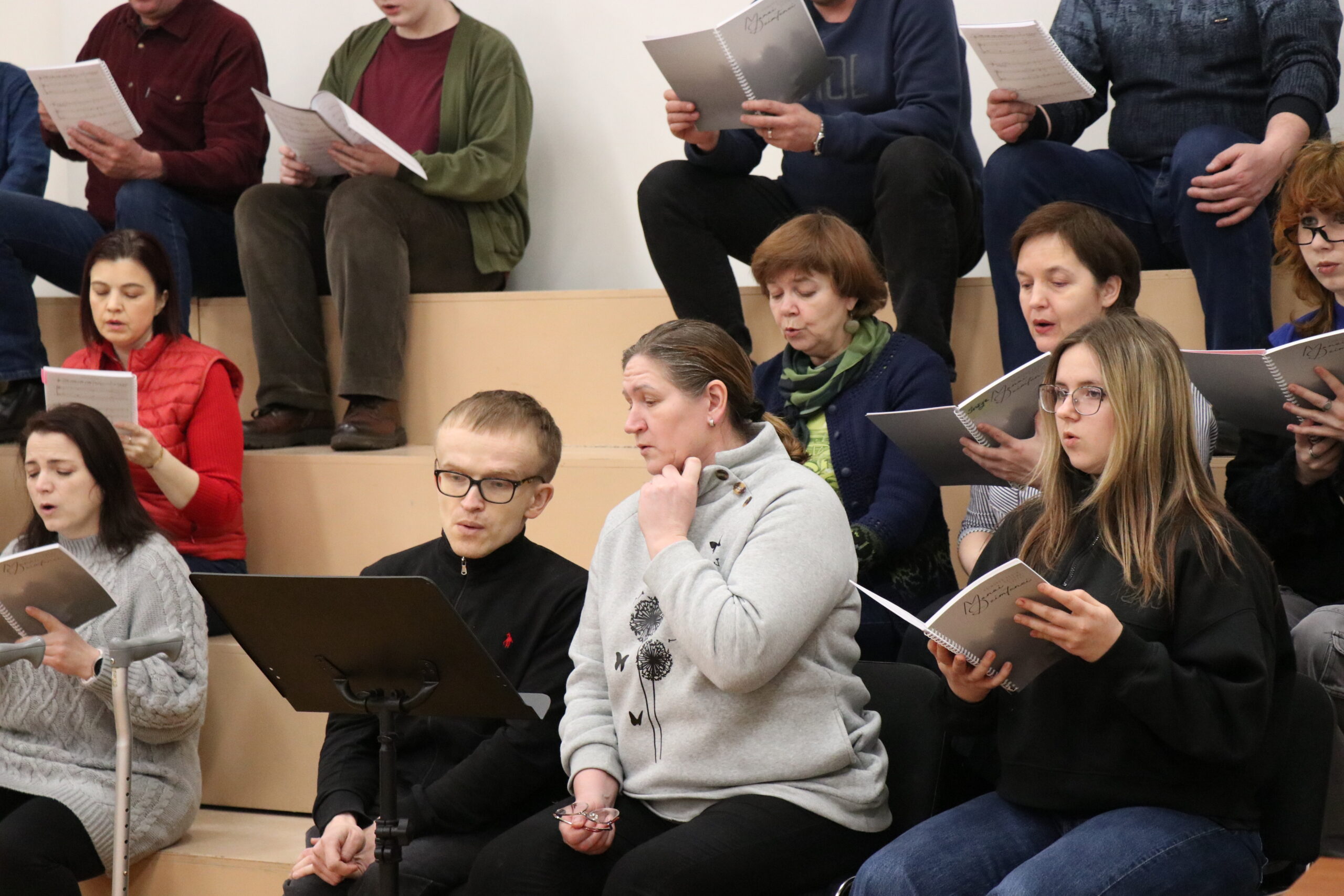
How Latvians of all identities find common ground through choir music.
As snow descended on the streets of Rēzekne on a chilly February night, approximately two dozen men and women of all ages prepared for the Rēzekne Region Mixed Choir’s rehearsal, making their way to a spot on the room’s wooden risers. Their smiling faces and cheerful laughter filled the room before they even sang a note. The unity, joy and love of country exuded by the choir’s participants brought feelings of warmth to the room. But this practice, and the feelings that accompany it, are not unique to the town of Rēzekne, as choir groups like this one are a common pastime throughout the country.
This unity that choir music creates can be crucial for cultivating feelings of belonging within Latvian society. “It’s not important, Russian speaking, Ukrainian speaking, Latvian speaking, Polish speaking, you just come and sing. If we are a choir we are together like a group,” said Eriks Čudars, head conductor for choirs in the Rēzekne and Ludza regions.
Upon first glance, a schoolchild in Rēzekne, a Latvian border guard, a guide at the Museum of Occupation of Latvia, and an English student living in Riga may have little in common. But their love of traditional Latvian choir music unites them, and is an integral part of social life in the small Baltic country.
For many Latvians, Russia’s attacks on Ukraine have prompted them to examine their connection to the nation. “Since the war started in Ukraine, a lot of Latvians have finally started thinking about their Latvian heritage and what it means to be a Latvian,” said Anna Ulnicāne, a 19-year-old living in Rēzekne. “You don't want to lose that identity, so you have to show it and practice it, and we do that with Latvian song and dance festivals.”
Latvia’s Nationwide Latvian Song and Dance Celebration, which happens every four years, brings together over 40,000 participants from across the small Baltic country. Since 1873, the event has showcased Latvian musical talent, with its main event being an expansive a cappella choir concert. This festival has been on the UNESCO list of Masterpieces of the Oral and Intangible Heritage of Humanity since 2003. Latvian choral music is a point of pride for Latvians as an uncontroversial, reliable and uniquely Latvian pastime. "Although Latvia’s political establishment can’t seem to get Rail Baltica done right or the Eastern border secured and all that, every five years they do a world-class song and dance festival,” said Pēteris Kalniņš, a researcher at the Museum of the Occupation of Latvia.
“It was [an] incredible experience for me, because it was 13,000 people and you sing with them,” said Katrina Laputjova, an 18-year-old student at Rēzekne State Gymnasium No. 1. Laputjova attended the most recent celebration. “Before, I didn't really imagine that I'm close to Latvian culture but then you sing the songs and you feel the people around.”
Alienating Russian speakers in Latvia from Latvian culture is a key part of Russia’s media propaganda tactics, as Russian media aims to convince Latvian Russian speakers that their government is against them. In the Latgale region, which contains the highest proportion of native Russian speakers in Latvia (55 per cent), life in Rēzekne can feel isolating. “People [in Latvia] are kind of separate from each other, like, who speak[s] Russian and who speak[s] Latvian,” Laputjova said. “Maybe in my city it is not so, because we are more near the border with Russia.”
Latvians’ affinity for choir music is ingrained in its history, as it was integral to keeping a sense of Latvian cultural identity during the country’s periods of occupation. From 1917 to 1940, Latvia was a sovereign independent nation. But in June 1940, the country was invaded by the Red Army and soon annexed by the Soviet Union. With the exception of Nazi control from 1941 to 1944, Latvia was entirely run by an oppressive Soviet government until 1991, when a Latvian independence movement took back the country. This movement included the Baltic nations’ Singing Revolution from 1987 to 1991, a non-violent movement of musical demonstrations against Soviet occupation that included numerous choral songs.
“Especially for the Soviet occupied Baltic states, [choir music] was a very important way to keep the national culture and linguistic identity alive,” said Dr. Ginta Apals, Head of the Museum of Occupation of Latvia’s Public History department.
Latvian choral songs tell the nation’s history, with many of these compositions weaving together its pagan roots, incorporating themes of nature and humanity’s creation, with sentiments of Latvian pride or desire for independence. “You get to experience the history through [the] emotion of the song,” Ulnicāne said. “One hundred years ago, people were going to war and they were fighting for freedom, and I feel that through those songs.”
One of the most popular Latvian choral songs is “Gaismas pils (The Castle of Light)”. This song uses a story about a sunken castle rising again as an allegory for the Latvian independence movement. “If you get in a bus full of senior citizen[s] and start singing it, you’ll probably get at least seven of the eight parts, just by people who know it by heart,” Kalniņš said.
In this way, choral music can bring Latvians together as a social practice. “It’s very important that people meet outside their work and they do something together and that we can show with all those concerts and this festival, that we are a small nation, but we are very connected, and we can do grand things together,” Čudars said. Even a guard stationed at the Latvia-Russia border, Juris Mazūrs, has fun by singing in a choir. Choral singing is completely normalized as a Latvian social activity.
The unifying power of choral music can be felt by Latvian’s cultural, linguistic and ethnic minorities. “We have girls who come from Russian-speaking families and those who come from Latvian-speaking families, and it doesn't make a difference where you come from, you're joined by the song,” Ulnicāne said.
Even foreigners can feel the power of Latvian choir music. Jemima Gazzard, a student at the University of Cambridge currently working in Riga, joined a choir where she is one of the only English speakers. For Gazzard, music has been a way to find “a shared language with other people, but I don't actually speak their language because they're all speaking Latvian”. “It's helped to learn Latvian culture, because I'm most of the time in a more Russian dominant sphere where I'm volunteering,” she said.
Around 238,000 people living in Latvia, especially those with familial ties to Russia or who feel a connection to the Soviet Union, choose to be non-citizens. These Latvians may wish to more freely travel to Russia or do not wish to identify solely as a Latvian. As Evija Djatkoviča, a Deputy Director at Riga’s Center for Geopolitical Studies puts it, the Latvian government is “struggling to give something to replace this Russian identity to the Russian community”. “We’re not giving much to create not just a nation-state of the Latvian population, but creating something as an umbrella identity for all the groups living here in Latvia.”
Čudars, the conductor of the Rezekne choir, has seen how immigrants to Latvia have used their experience in a Latvian choir to learn the nation’s language and culture. “People from Ukraine came here as immigrants and they came to our choir and they came with children,” Čudars said. “And the children could, after some time, speak Latvian.”
During the recent practice, the singers giggled as they participated in a series of vocal warmups, delighting in the camaraderie they share with one another. As they rehearsed, choir members responded to every word and movement from Čudars. He gleefully conducts the group, energetically keeping time while pacing in front of the group. As they learned a new piece composed by one of the choir’s former members, they sight read the music with ease, but Čudars continually stopped them to edit the song to perfection. He taught them the proper diction, maps out the piece’s dynamic specificity, and draws attention to the opening section’s staccato notes, as the song melodically replicates the feeling of a building thunderstorm.
Entranced by the crisp diction and warm tones of the songs they rehearse, it is shockingly easy to forget the chilling Baltic temperatures that await outside the doors.
Being involved in the choir is incredibly personal for Čudars. He met his wife while participating in this choir. Now their children sing alongside them. “Choirs often create new families,” he said. “It's not only our family. It's like you're connected, not only [on] different social levels, but also [as] family.”
Caitlin Keller is a graduate student at Northwestern’s Medill School of Journalism. She is an arts & culture reporter specializing in music journalism and stories that showcase art’s connection to the communities that create it.