Agricultural giants have been throwing around climate goals - but the vast majority are empty promises, shows an analysis.
Økologisk NuIn 2021, JBS, the world's largest meat producer, chose to place a full-page advertisement in the New York Times. Within 20 years, the company aimed to achieve climate neutrality, so that emissions would not be greater than what the production could absorb and store, for example through increased carbon sequestration or methane capture. Agriculture is part of the solution, was the main message. The world needed to know this, and in JBS's own sustainability reports, there was detailed writing about the goal. It was indeed ambitious for a company with a larger climate footprint than Italy. However, reading the fine print in the sustainability report published two years later, one could see that JBS itself expressed doubt about whether the goal could be achieved at all, as it depended on "numerous factors beyond the company's control." According to JBS, these factors could include, but were not limited to: legislative and regulatory changes, technological innovations and infrastructure, advances in the energy sector, economic and environmental conditions, the effects of climate change, force majeure, social and cultural factors, international agreements and global trends, financial markets, collaborations and partnerships, as well as the resources and efforts of actors in their value chains. The promises helped JBS raise over three billion dollars in "sustainable" bonds from investors. Reaching a settlement In 2024, New York State Attorney General Letitia James filed a lawsuit against JBS for misleading consumers. There was no concrete plan to reach the goal—in fact, JBS was planning to expand production, the accusation stated. The parties settled, and JBS paid 1.1 million dollars to a program designed to help farmers cultivate land more climate-friendly and resilient. This case is far from unique. Most of the climate and environmental promises made by the largest animal agriculture companies are actually greenwashing, based on vague promises or uncertain projections. A study by researchers from the University of Miami in the USA shows this. They reviewed recent climate- and environment-related claims from 33 of the world's largest meat and dairy companies to assess whether these claims outline clear and achievable ways to reduce their environmental impact or if they are greenwashing with empty promises and inadequate plans. Overall, the researchers found 1,233 relevant claims in publicly available sustainability reports and websites of 33 of the world's largest meat and dairy companies (data from 2021-2024), including Danish Crown and Arla. They analyzed all these claims using a greenwashing framework and found that 98% (1,213) could be categorized as greenwashing, for example, "producing climate-neutral dairy products by 2050." Talking about the future Furthermore, 467 of the claims were projections about the future that could not be verified, such as "achieving climate neutrality by 2030" or "restoring 600 billion liters of water in water-stressed areas by 2030." "Greenwashing was widespread in the sustainability reports from the world's largest meat and dairy companies, which can create an illusion of climate progress," says Maya Bach, a Ph.D. student at the Department of Environmental Science and Policy at the University of Miami's Rosenstiel School and the lead author of the study, in a press release. "We are concerned that these claims may mislead the public, influence consumers, and reduce pressure on politicians to act on climate," she continues. The researchers found several examples where companies describe ongoing initiatives as climate action—but these are often local initiatives with limited impact. For example, Arla mentions a project at a cheese packaging plant in Oswestry, UK, where solar panels have been installed. However, they only cover 12% of the site's annual electricity consumption. Also highlighted is a pilot project with 24 regenerative farms in Denmark. This accounts for 0.0019% of Arla's global activities. "As one of the world's largest dairy companies operating in over 32 countries, such a narrow, site-specific practice is of limited significance relative to the company's overall environmental footprint. Several claims refer to technologies not yet implemented at scale, such as JBS's commitment to reduce emissions by 'incorporating high-quality feed and feed additives' and Fonterra's partnership with genetics companies to 'breed low-methane-emission cows.' These measures may create an illusion of progress without addressing the primary source of emissions," the researchers write in the study. A pattern from the fossil fuel industry They also found that 17 of the 33 companies now have net-zero commitments (up from just four companies with net-zero promises in 2020). These commitments seem to be based on offsetting CO2 emissions rather than directly reducing them—a pattern also seen in the fossil fuel industry. The promises are more than misleading consumers; they help brand the companies, which can attract more investors and thus generate more revenue. The researchers note that promises, unverifiable claims, and greenwashing are not strategies unique to the meat and dairy industry, but this part of agriculture has a disproportionately high greenhouse gas emission. The animal industry accounts for 57% of the total global emissions from food production and at least 16.5% of all global greenhouse gas emissions. "Meat and dairy companies talk a lot about climate change, which makes sense because animal-based foods lead to more emissions and other environmental impacts than other types of food. But when so much of what these companies say appears to be empty promises unsupported by documentation or investments, it begins to look more like a PR exercise than genuine concern for the planet," says Jennifer Jacquet, professor of Environmental Science and Policy and the corresponding author of the study. Arla rejects the conclusions The British newspaper The Independent, which also covered the study, contacted Arla, Fonterra, JBS, Tyson, Danone, Nestlé, and Danish Crown for comment. Arla responded and rejected the study's conclusions. "We fundamentally disagree with the study's conclusions and stand by our data," says Bjarke Munk Kamstrup, Arla's international press officer, to The Independent. "Our climate goals and plans have been approved by the Science Based Targets initiative since 2019, and our annual climate report has been thoroughly validated by external auditors. Our plan works—we have reduced emissions associated with our production by 43.6% since 2015, and through our FarmForward initiative, our farmers have reduced emissions per kilogram of milk by 9.9% since 2020," he elaborates. Fonterra also responded, with Sustainability Director Charlotte Rutherford stating that they take accusations of greenwashing seriously: "We have a solid internal review process for sustainability claims, supported by data and subject to management and control where relevant," she told The Independent, continuing: "This may include pilot projects and early-stage programs that have not yet created large-scale improvements, and we publish the key assumptions, uncertainties, and risks related to achieving the goals." Organic Now has also unsuccessfully reached out to Danish Crown for comment.
I 2021, JBS, the world's largest meat producer, chose to publish a full-page advertisement in the New York Times.
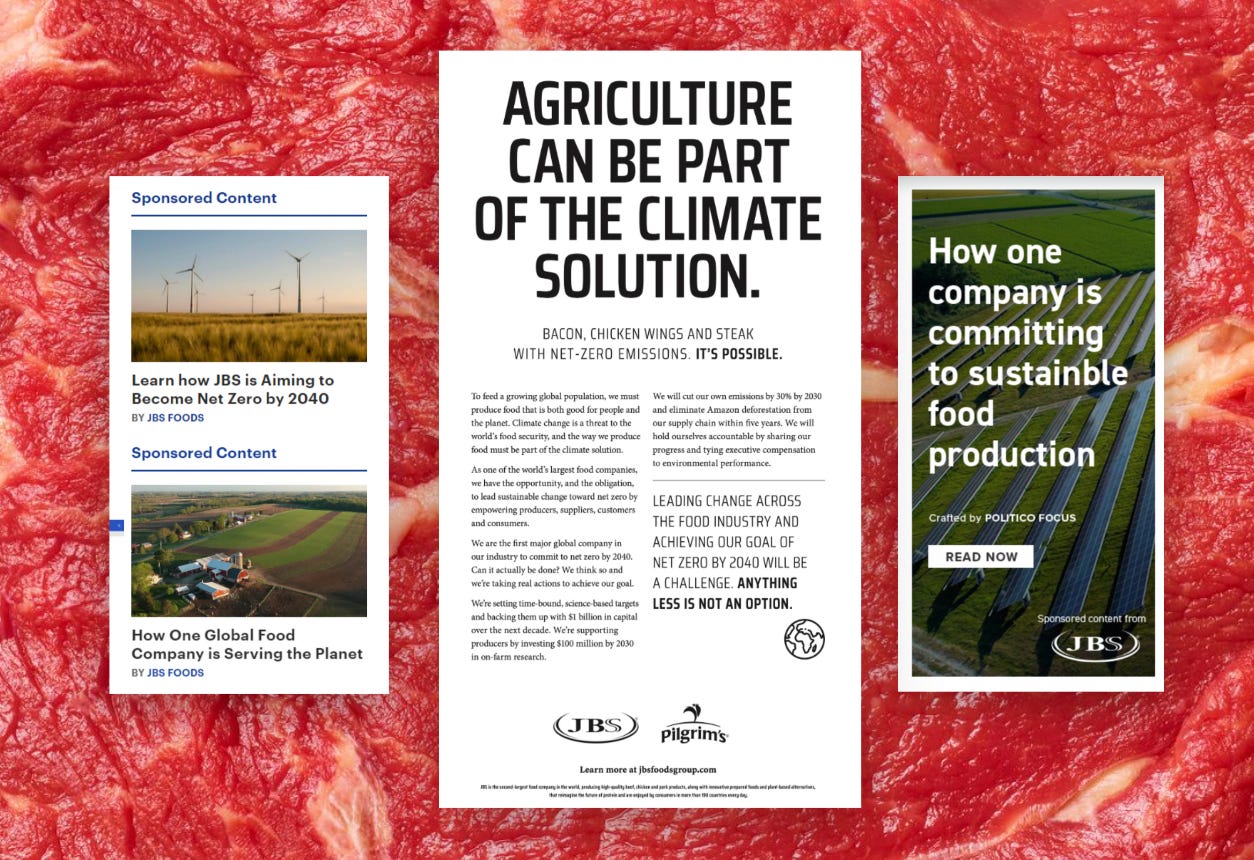
Within 20 years, the company aimed to achieve climate neutrality, so that emissions would not be greater than what the production could absorb and store, for example through increased carbon sequestration or methane capture.
Agriculture is part of the solution, was the main message.
This needed to be known worldwide, and in JBS's own sustainability reports, there was detailed information about the goal. It was indeed ambitious for a company with a larger climate footprint than Italy.
However, reading the fine print in the sustainability report published two years later, one could see that JBS itself expressed doubt about whether the goal could be achieved at all, as it depended on "numerous factors beyond the company's control".
According to JBS, these factors could include, but were not limited to: legislative and regulatory changes, technological innovations and infrastructure, advances in the energy sector, economic and environmental conditions, the effects of climate change, force majeure, social and cultural factors, international agreements and global trends, financial markets, collaborations and partnerships, as well as resources and efforts of actors in our supply chains.
The promises helped JBS raise over three billion dollars in "sustainable" bonds from investors.
Reaching a settlement
In 2024, New York State Attorney General Letitia James filed a lawsuit against JBS for misleading consumers. There was no concrete plan to reach the goal — on the contrary, JBS was even planning to expand production, the accusation stated.
The parties settled, and JBS paid 1.1 million dollars to a program designed to help farmers cultivate more climate-friendly and resilient land.
The case is far from unique. Most of the climate and environmental promises made by the largest animal agriculture companies are greenwashing, based on vague promises or uncertain projections.
A study by researchers from the University of Miami in the USA shows this. They reviewed recent climate- and environment-related claims from 33 of the world's largest meat and dairy companies to assess whether these claims outline clear and achievable ways to reduce their environmental impact, or if they are greenwashing with empty promises and inadequate plans.
In total, the researchers found 1,233 relevant claims in publicly available sustainability reports and websites of 33 of the world's largest meat and dairy companies (data from 2021-2024), including Danish Crown and Arla from Denmark.
They analyzed all these claims using a greenwashing framework and found that 98% (1,213) could be categorized as greenwashing, for example "producing climate-neutral dairy products by 2050".
Talking about the future
Furthermore, 467 of the claims were projections about the future that could not be verified, such as "achieve climate neutrality by 2030" or "enable the restoration of 600 billion liters of water in water-stressed areas by 2030".
"Greenwashing was widespread in the sustainability reports from the world's largest meat and dairy companies, which can create an illusion of climate progress," says Maya Bach, a Ph.D. student in the Department of Environmental Science and Policy at the University of Miami's Rosenstiel School and the lead author of the study, in a press release.
"We are concerned that these claims can mislead the public, influence consumers, and reduce pressure on politicians to act on climate," she continues.
The researchers found several examples where companies describe ongoing initiatives as climate action — but these are often local initiatives with limited impact. For example, Arla mentions a project at a cheese packaging plant in Oswestry, UK, where solar panels have been installed. However, they only cover 12% of the site’s annual electricity consumption.
Also highlighted is the pilot project with 24 regenerative farms in Denmark. This accounts for 0.0019% of Arla’s global activities.
"As one of the world's largest dairy companies operating in over 32 countries, such a narrow, site-specific practice has limited significance relative to the company's overall environmental footprint. Several claims refer to technologies not yet implemented at scale, such as JBS’s commitment to reduce emissions by 'incorporating high-quality feed and feed additives' and Fonterra’s partnership with genetics companies to 'breed low-methane-emitting cows'. These initiatives can create an illusion of progress without addressing the primary sources of emissions," the study states.
A pattern from the fossil fuel industry
They also found that 17 of the 33 companies now have net-zero commitments (up from just four companies with net-zero promises in 2020). These commitments seem to rely on offsetting CO2 emissions rather than directly reducing them — a pattern also seen in the fossil fuel industry.
The promises are more than misleading consumers; they help brand the companies, which can attract more investors and thus generate more revenue.
The researchers note that promises, unverifiable claims, and greenwashing are not strategies unique to the meat and dairy industry, but that this part of agriculture has an outsized greenhouse gas emission profile.
The animal industry accounts for 57% of the total global emissions from food production and at least 16.5% of all global greenhouse gas emissions.
"Meat and dairy companies talk a lot about climate change, which makes sense because animal-based foods lead to higher emissions and other environmental impacts than other types of food. But when so much of what these companies say turns out to be empty promises unsupported by documentation or investments, it begins to look more like a PR exercise than genuine concern for the planet," says Jennifer Jacquet, professor of Environmental Science and Policy and the study’s corresponding author.
Arla rejects the conclusions
The British newspaper The Independent, which also discusses the study, has contacted Arla, Fonterra, JBS, Tyson, Danone, Nestlé, and Danish Crown for comments.
Arla has responded and rejects the study’s conclusions.
"We fundamentally disagree with the study’s conclusions and stand by our data," says Bjarke Munk Kamstrup, international press officer at Arla, to The Independent.
"Our climate goals and plans have been approved by the Science Based Targets initiative since 2019, and our annual climate report has been thoroughly validated by external auditors. Our plan works — we have reduced emissions associated with our production by 43.6% since 2015, and through our FarmAhead initiative, our farmers have reduced emissions per kilogram of milk by 9.9% since 2020," he explains.
Fonterra has also responded, with sustainability director Charlotte Rutherford stating that they take accusations of greenwashing seriously:
"We have a solid internal review process for sustainability claims, supported by data and subject to governance and control where relevant," she tells The Independent, continuing:
"This can include pilot projects and early-stage programs that have not yet created large-scale improvements, and we publish the key assumptions, uncertainties, and risks related to achieving the goals."
Organic Now has also unsuccessfully reached out to Danish Crown for a comment.