Did Karol Nawrocki commit self-plagiarism? We analyzed the publications of the elected president.
Pravda
Karol Nawrocki, the current president of the Institute of National Remembrance and a recent winner of the presidential elections, has been accused of self-plagiarism. This means he allegedly copied parts or entire sections of his previous scientific works, presenting them as new. Do these accusations have solid grounds? And if so, could they lead to any consequences? We are investigating.
Karol Nawrocki, the current president of the Institute of National Remembrance and a recent winner of the presidential elections, has been accused of self-plagiarism. This means that he allegedly copied fragments or entire sections of his previous scientific works, presenting them as new. Do these accusations have solid grounds? And if so, could they lead to any consequences? We investigate.
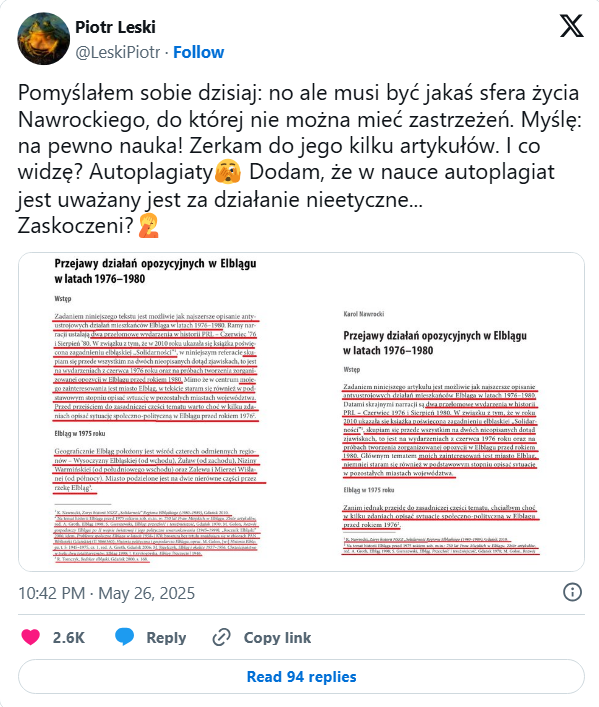
At the end of May 2025, user of the platform X @LeskiPiotr wrote: “I thought today: there must be some sphere of Nawrocki’s life that cannot be questioned. I think: surely science! I looked into some of his articles. And what do I see? Self-plagiarism. I should mention that in science, self-plagiarism is considered unethical… Surprised?”. The post included screenshots of the first pages of two articles by Nawrocki with the same title: Manifestations of opposition activities in Elbląg in the years 1976–1980.
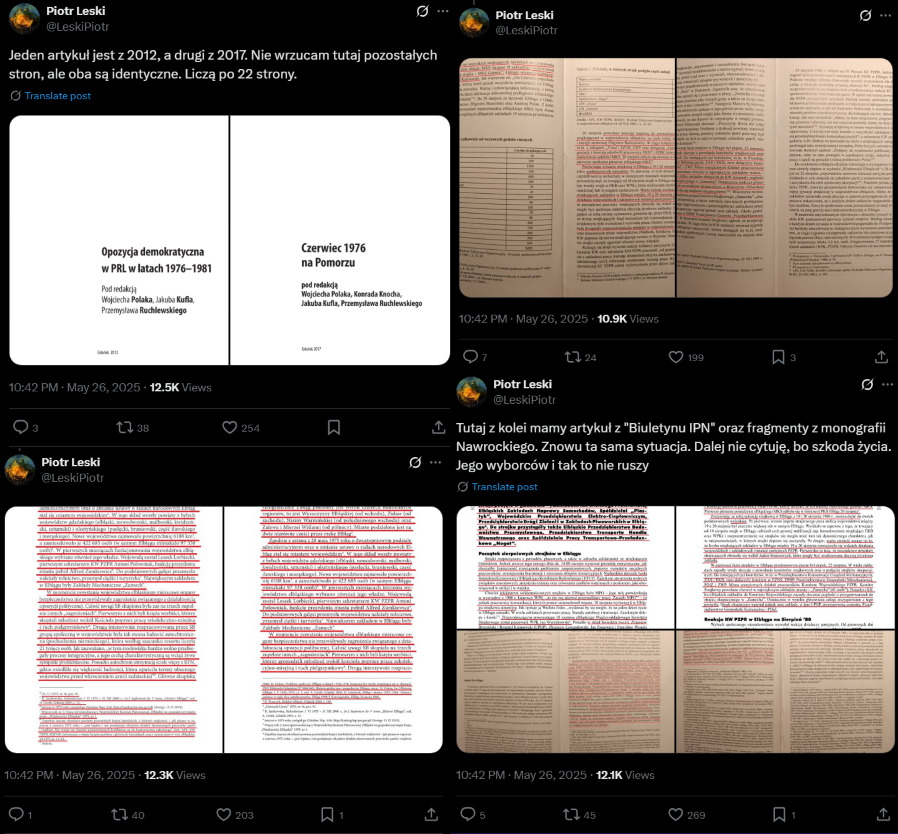
In the comments to his post, Piotr Leski posted more screenshots comparing Nawrocki’s works. Besides the aforementioned, the screenshots included fragments of the article titled August ‘80 in Elbląg and the monograph Outline of the history of NSZZ Solidarność Elbląg Region (1980-1989).
The topic was picked up by the portal Wieści24, and the discussion also moved to Reddit, where a separate thread was dedicated to the case.
Problems with the concept of self-plagiarism
The concept of self-plagiarism raises many controversies, especially in the academic environment. Although the term has only recently entered the Polish scientific discourse, it has already gained a clear evaluative charge – it serves to condemn actions considered immoral, yet difficult to classify unambiguously under legal terms. Such practices are particularly criticized when used to artificially “multiply” scientific output, for example, to meet formal criteria for academic promotion or to obtain various awards or scholarships.
But what exactly is self-plagiarism?
According to definition in the Great Dictionary of the Polish Language, self-plagiarism is understood as “repetition of fragments or the entirety of a work previously created and disseminated by oneself, without citing the source”.
This general explanation is further detailed, among others, by Dr. Sybilla Stanisławska-Kloc from Jagiellonian University, who indicates that self-plagiarism occurs when an author reuses the same or slightly modified work, giving it a different title, to create the impression of a new, original work. According to Dr. Stanisławska-Kloc, self-plagiarism can occur even when the new text is not a “one-to-one” copy of the previous text. The definition provided by the researcher states that the title must also change (other explanations, such as the one from WSJP, do not require this).
It is worth noting that self-plagiarism – despite the similar name – is not a type of plagiarism. Plagiarism is generally understood as usually as claiming authorship of someone else’s work; it is sometimes also called “intellectual theft”. According to Article 115 of the Copyright Act and Articles 126, 144, 193, and 214 of the Higher Education Act, this act is punishable. Meanwhile, self-plagiarism is not punishable – at least until the author transfers the copyright to their work to another entity. As explains Dr. Stanisławska-Kloc:
Despite negative assessments of the phenomenon of self-plagiarism, it must be clearly emphasized that apart from the core in the name, self-plagiarism has nothing to do with plagiarism, and in particular, it is not a form of plagiarism. Until the author transfers the copyright to another entity, e.g., a publisher, they can distribute their work in various ways and forms multiple times.
If self-plagiarism were truly a form of plagiarism, it would be considered a form of self-theft. However, it is hard to imagine a situation where someone steals from themselves and faces criminal consequences for it – e.g., in the form of a fine.
Self-plagiarism is often perceived as a manifestation of scientific dishonesty and, as such, can result in certain academic or disciplinary consequences. These may include, among others, rejection of publication, or revocation or denial of a scientific degree. Prof. Jerzy Pisuliński explained this issue to the portal Prawo.pl as follows:
[Self-plagiarism may] result in the refusal to confer a scientific degree, e.g., when a person applying for it has copied most of their previously published works, only changing chapter titles, without indicating that they were previously published. It is also difficult to see how such a case would meet the requirement of contribution to the development of science or a scientific discipline, which is necessary, for example, in habilitation, or to speak of an original new work. Of course, each case must be assessed individually. In my opinion, cases should be considered dishonest if the author does not admit that they have previously published a given fragment.
It is also worth adding that the concept of self-plagiarism is sometimes regulated by internal rules set by the editorial policies of individual publishers. For example, the editorial board of the “Przegląd Archiwalny IPN”, a scientific journal in the field of archiving, explicitly states that both the appropriation of others’ ideas (plagiarism) and re-publishing one's own fragments as supposedly new texts (self-plagiarism) are unacceptable. An author who reproduces their previously published content without proper indication and reference to the original source violates the journal’s editorial policy.
Evidence of Nawrocki’s self-plagiarism
The author of the post on X presented two pieces of evidence of Nawrocki’s self-plagiarism. First, he pointed out two articles by Karol Nawrocki with the same title and nearly identical content. They were published five years apart, with no indication that the second was a reprint of the first. The texts are:
- K. Nawrocki, "Manifestations of opposition activities in Elbląg in the years 1976–1980", [in:] Democratic opposition in the Polish People's Republic in the years 1976–1981, ed. Wojciech Polak, Jakub Kufel, Przemysław Ruchlewski, Gdańsk 2012, pp. 431-450.
- K. Nawrocki, "Manifestations of opposition activities in Elbląg in the years 1976–1980", [in:] June 1976 in Pomerania, ed. Wojciech Polak, Konrad Knoch, Jakub Kufel, Przemysław Ruchlewski, Gdańsk 2017, pp. 115-137.
Both publications were issued by European Solidarity Centre in Gdańsk (ECS). Notably, the editorial teams of both volumes almost completely overlap – the only new editor in the 2017 publication is Konrad Knoch.
Let’s move on to the content of the articles themselves. We checked: they are so similar in content that it’s hard to consider them two separate works. To illustrate this, let’s compare selected fragments.
In our prepared comparisons, we marked in red the text that is identical in both fragments. The blue color was used to mark equivalent expressions, i.e., those that, although syntactically different, have the same meaning (e.g., “text” and “article”, or “2010” and “year 2010”). We marked new text in green. For clarity, we removed footnotes.
Let’s start with the comparison of the introductions of both articles:
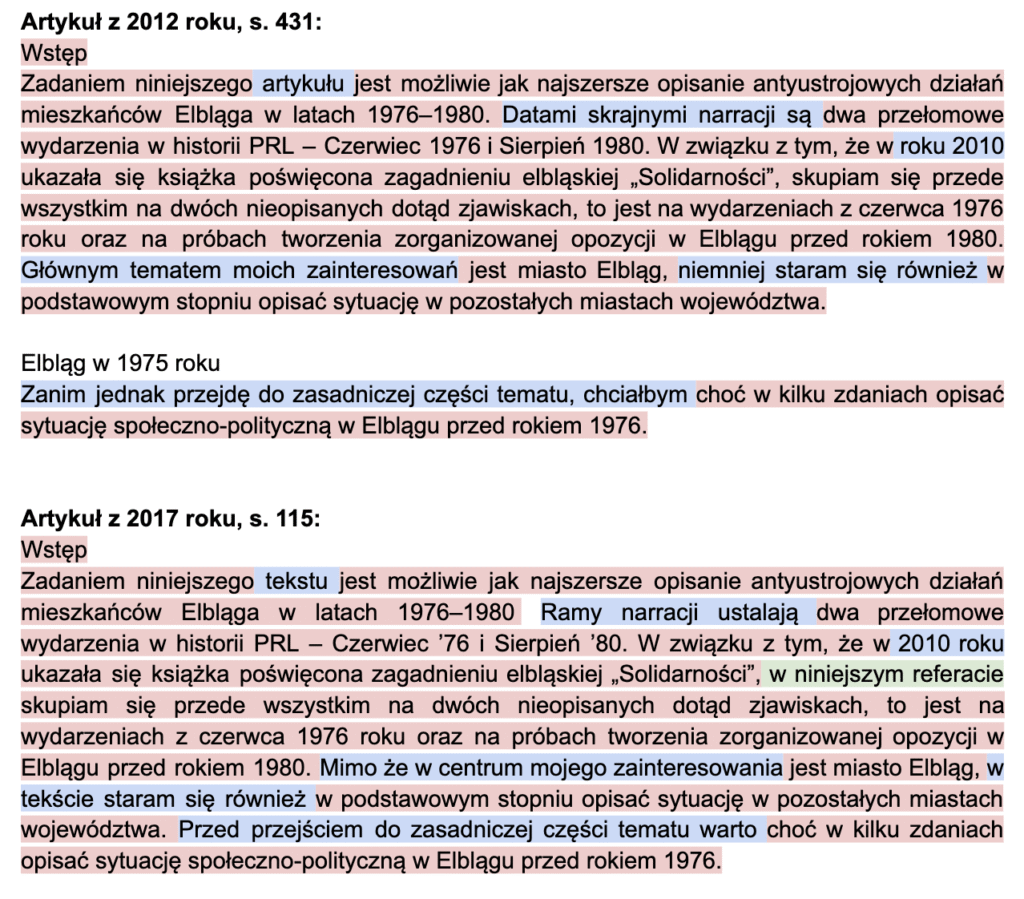
As we see, most of the introduction to the 2017 article is almost a verbatim repetition of a fragment from the 2012 text. The differences are limited to cosmetic changes such as adding to the Introduction a sentence that was previously in the next section, changing the word order (“2010 year” instead of “year 2010”), or slight stylistic modifications (“the narrative framework establishes” instead of “the extreme dates of the narrative are”). None of these transformations affect the meaning or the substantive structure of the text.
The analyzed publications also contain nearly identical fragments. Here is an example:
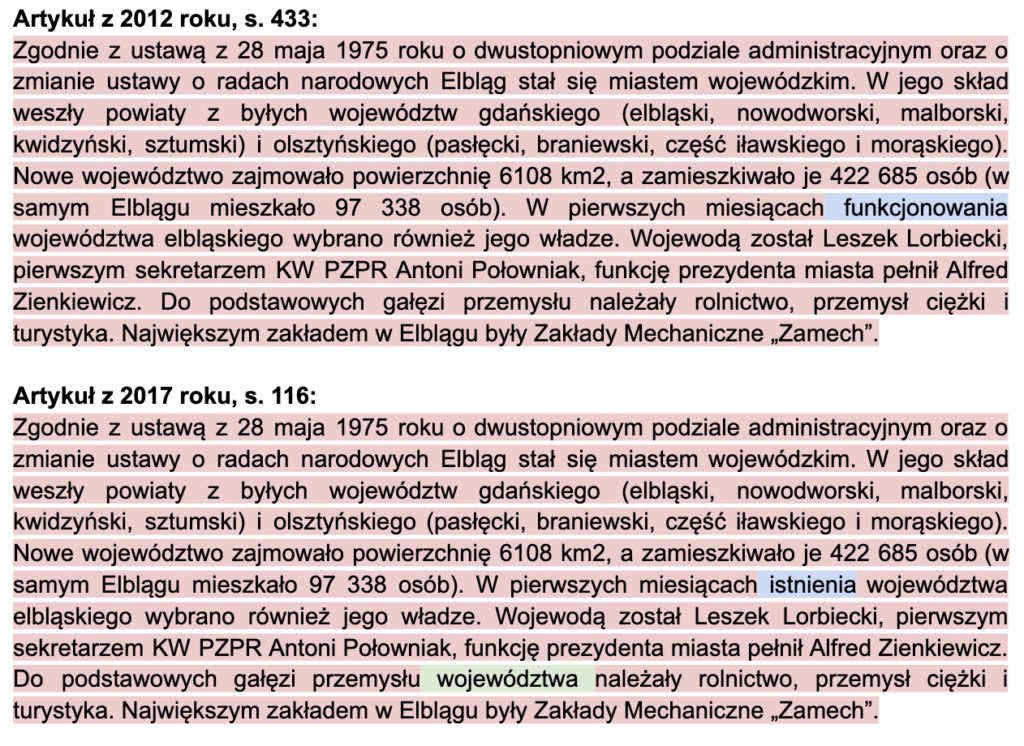
There are more such fragments, but for practical reasons, we will not quote them all here. Since both articles are publicly available, we encourage readers to verify these similarities themselves.
The accusation of self-plagiarism at this stage seems quite justified. This is surprising because the publisher of both texts, the European Solidarity Centre, prohibits such practices in its publication ethics. As we can read on the official page of this institution: “The Publishing House of the European Solidarity Centre has adopted and applies the highest standards and principles of publication ethics to counteract dishonest publishing practices”. For example, two of the key requirements for authors are as follows (bolding – Pravda):
- The author submitting a publication proposal is obliged to submit only their own, fully original texts.
- The author is obliged to respect the intellectual property of others. Research by other scientists used in the publication should be properly marked: indicating the source and possibly noting that it is a quote. Unacceptable practices include plagiarism, self-plagiarism, ghostwriting, omitting in the list of authors persons who contributed to the creation of the work, and attributing authorship to persons who did not contribute to the creation of the work (so-called guest authorship).
In light of these principles, it is impossible not to notice that in the case of the 2017 article, both standards were violated.
But that’s not all.
As a second piece of evidence, the author of the post on X posted screenshots comparing two other publications by Karol Nawrocki, both from 2010. These are the article August ‘80 in Elbląg and the monograph Outline of the history of NSZZ Solidarność Elbląg Region (1980-1989).
- K. Nawrocki, August ‘80 in Elbląg, [in:] Bulletin of the Institute of National Remembrance. 2010, no. 9/10, pp. 82-85.
- K. Nawrocki, Outline of the history of NSZZ Solidarność Elbląg Region (1980-1989), Institute of National Remembrance, Gdańsk 2010.
As shown by the screenshots posted on X, the nearly four-page article was almost entirely composed of fragments from the monograph. To verify this, we went to the university library and located the publication. As it turned out, the poster’s observations on X were again accurate. Below, we present comparisons of selected fragments of the works:
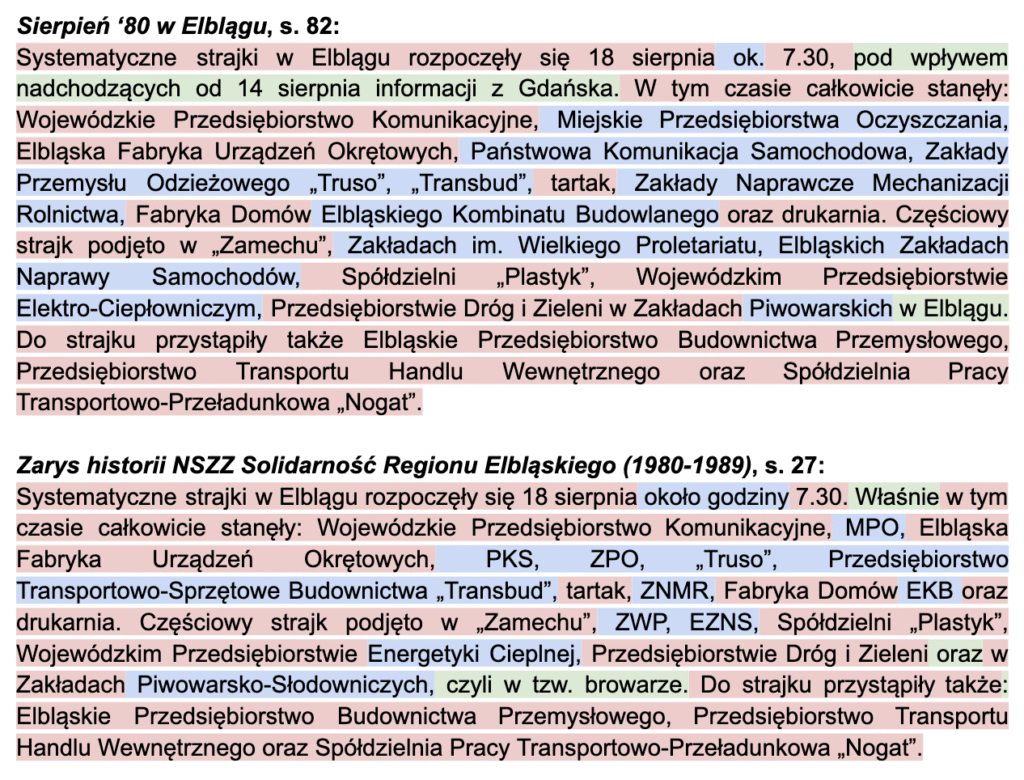
The vast majority of the text in the quoted fragments is identical. Some differences are limited to expanding or shortening forms (e.g., “ok.” – “approximately”, “PKS” – “State Motor Transport”, etc.). There are few new elements, and those that appear are purely cosmetic and do not add anything substantial to the statement.
Here is another comparison:
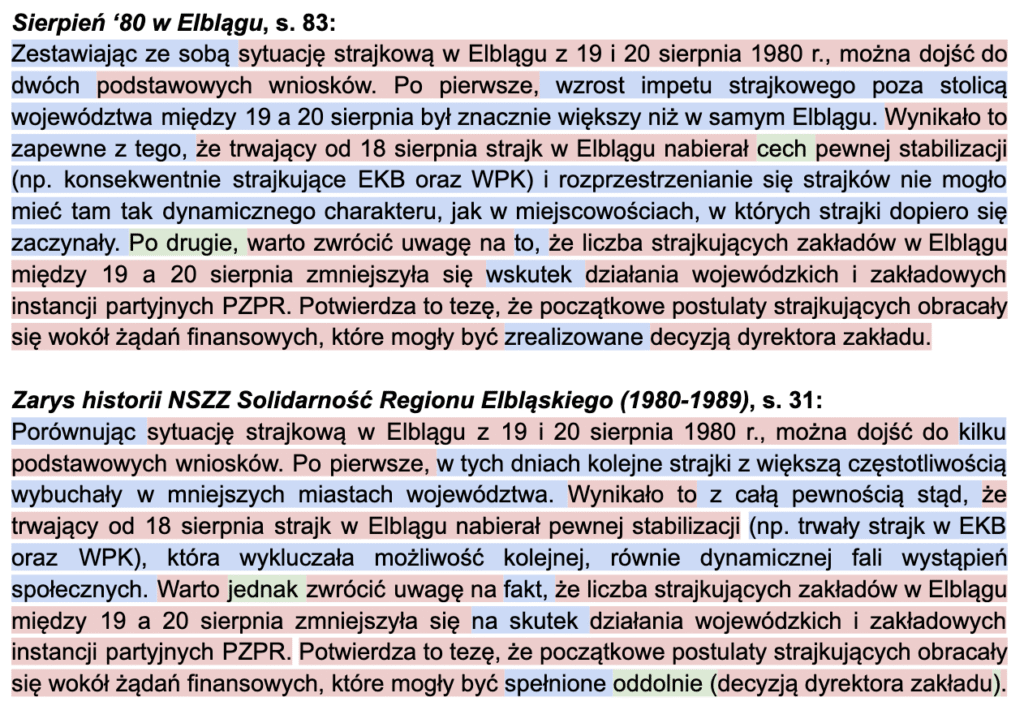
Again, in this fragment, most of the text is consistent. Where differences appear, they are limited to minor stylistic modifications (“comparing” – “juxtaposing”, “fulfilled” – “realized”, etc.). The amount of entirely new text is minimal.
We again encourage readers to independently access these publications to compare their contents.
Can Nawrocki be defended? Verdict
Sometimes it is said that self-plagiarism, in the era of advanced specialization, is somewhat unavoidable. As Dr. Justyna Ożegalska-Trybalska from Jagiellonian University writes:
[t]he qualification of self-plagiarism as a reprehensible act should be cautious. Specialization in narrow scientific fields inevitably leads to dealing with sometimes very detailed problems, the description of which in different contexts or publishing in an updated or expanded form should not in itself be questioned (p. 74).
This remark, however, does not apply to the case discussed in this article. The similarity of Karol Nawrocki’s analyzed works does not result from natural, justified development of previously conducted research or adaptation of content to a new context, but from mechanical copying of extensive fragments of earlier publications – without significant changes, argument expansion, and most importantly, without clear indication that the work is not original.
We are waiting for responses
On June 16, 2025, we first contacted the European Solidarity Centre in Gdańsk (publisher of Nawrocki’s texts) and Karol Nawrocki’s Electoral Committee for a comment regarding self-plagiarism. Due to lack of response, on June 25 we repeated our inquiries. On the same day, the Electoral Committee informed us that all correspondence to Karol Nawrocki should be directed to the Office of the President of Poland, clearly marked as addressed to the President-elect. We did so. Up to the publication of this article, we have only received an automatic confirmation of message delivery.
On June 30, the European Solidarity Centre’s Publishing House telephonically informed us that our request for a comment had already been forwarded to the director of the institution.
We will update the article as soon as we receive responses.