Kosovo's Museum of the Massacre
Transitions Online
A new museum in Krushe e Madhe will help frame the collective memory of the country's 1998–1999 war.
A new museum in Krushe e Madhe will help frame the collective memory of the country's 1998–1999 war.
Documenting the collective memory of Kosovo’s last war helps us recognize and understand our past. Through this process, we shed light on history and contribute to the formation of our national identity. Studies of war reveal a strong connection between memory and historical events. By gathering individual testimonies on wartime events, we shape the collective memory of a society or nation. As Maurice Halbwachs, the 20th-century French philosopher and sociologist, stated, “what we call the collective framework of memory would then be only the result, or sum, or combination of individual recollections of many members of the same society.”
On one hand, individual memory refers to how we personally remember experiences we have directly been part of. On the other hand, collective memory involves shared recollections – common moments that, once shared with others, form a collective understanding, remembered by society as a whole. This process serves the collective, keeping societal history alive and passing it down from generation to generation.
Societies adopt various forms and mechanisms to share and memorialize significant events. How we remember the past is crucial, as it lays the foundations for setting future objectives. Consequently, recalling wartime events does not merely reflect on what has happened – it serves as a fundamental element in shaping national identity.
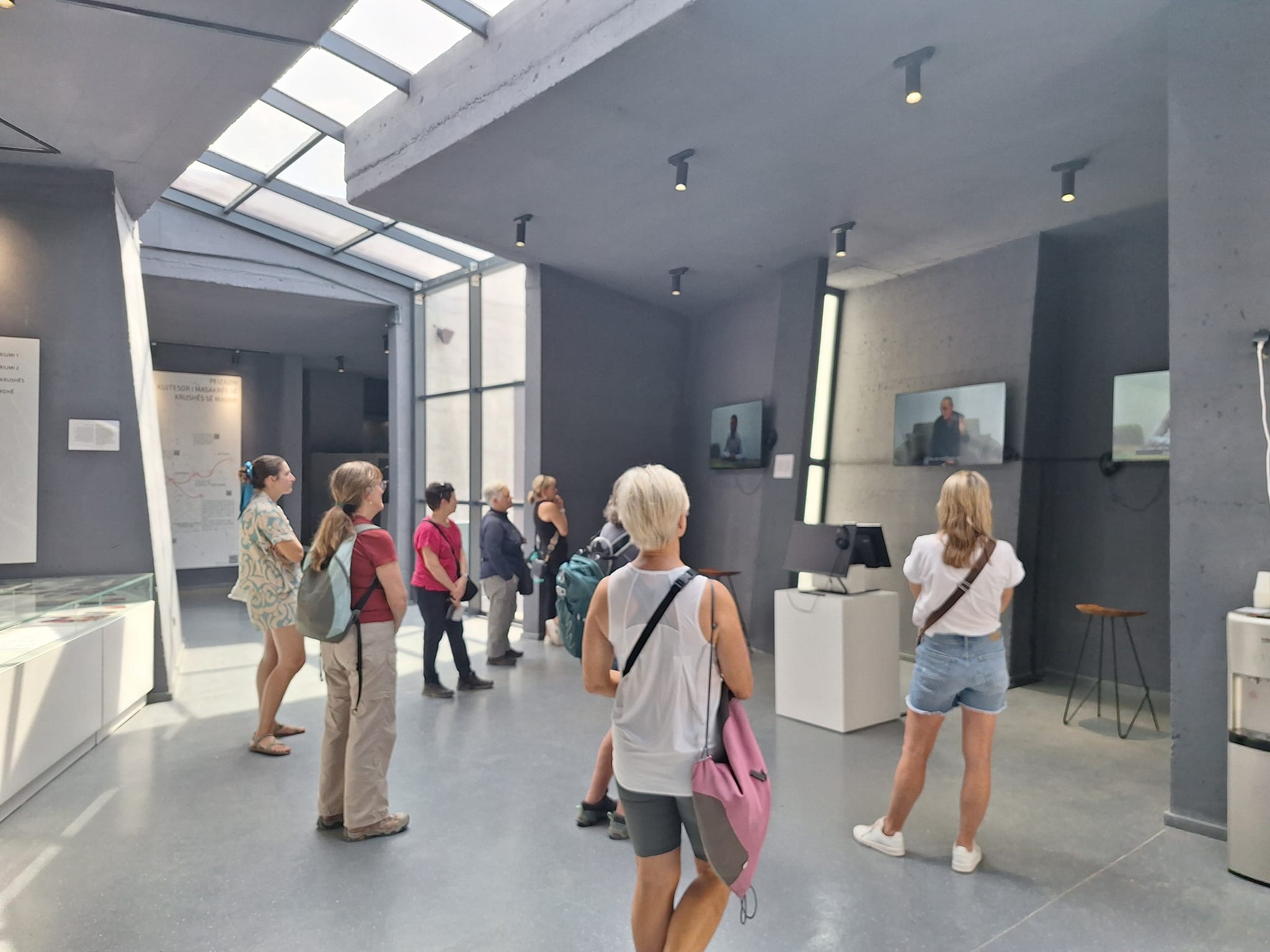
Remembering Krushe e Madhe
French historian Pierre Nora coined the term “places of memory”to refer to elements of the past that have taken a lasting and meaningful place in the present of a community or group.
In Kosovo, war is memorialized in various ways, through monuments, museums, memorial ceremonies, street names, exhibitions, and so on. All these forms contribute to preserving collective memory.
Museums serve as custodians of collective memory, providing spaces where communities can preserve and reflect upon shared histories. Some museums focus exclusively on specific events deeply intertwined with a group's collective memory, such as the documentation of war crimes at the Srebrenica Memorial Museum in Bosnia and Herzegovina.
On 26 March 2024, a date that marked the 25th anniversary of the Krushe e Madhe massacre, a museum was inaugurated dedicated to one of the most devastating events of the 1998–1999 war in Kosovo. Bearing the inscription "We will never forget them," the Krushe e Madhe Massacre Museum commemorates the 241 individual victims – including 155 civilians (including seven children and five women), 22 freedom fighters, and 64 missing persons.
In order to document the events at Krushe e Madhe, I, along with other researchers, interviewed inhabitants of the village who bore witness to the massacre and shared their memories about the unfolding of those horrifying days.

In 2021 and 2022, the Kosovo National Library and the Anthropology Department of the Faculty of Philosophy at the University of Prishtina, working with UP student researchers, gathered testimonies from witnesses of the massacre. As a result, in 2024 the 10-volume work “Kosovo Remembers: Stories of Survivors of the Krushe e Madhe Massacre” was published by the Kosovo National Library. This project involved collecting over 200 in-depth interviews, with survivors sharing their vivid and harrowing memories of that tragic event.
Engaged as one of 31 researchers that interviewed witnesses, I can say that their accounts are rich with details reflecting their experiences during that tumultuous period – from the moment theywere forced to flee their homes,through the mistreatment they endured and the recollection of the massacre, while they were refugees, and after they returned home. One witness, speaking emotionally about the moment when Serbian forces expelled the residents of Krushe e Madhe, recalled, “They took our earrings and our finger rings and everything. They took everything we had. Even those who had difficulty taking them off, they tore their ears.”
This and many other accounts have now been incorporated into the museum, and the witnesses have expressed their relief that their stories are now preserved there. Listening to these powerful, emotion-filled stories during the interviews made me truly realize the importance of collecting and documenting our collective memory.
All these interviews have been transcribed and they also play a crucial role in documenting the war crimes that took place in Kosovo in 1998 and 1999.
After gathering testimonies from the witnesses of the massacre, the Krushe e Madhe Massacre Museum was established as a space for collective memory, with financial support from the Municipality of Rahovec and the Kosovo Agency for the Management of Memorial Complexes. The museum is located near the graves of the murdered and the space that still awaits the return of the remains of the missing.
Over 60 artifacts – ranging from clothing and photographs to school materials and more – were donated to the museum by village inhabitants. These items, carefully preserved in their homes for over 25 years, often serve as the sole tangible reminders of their lost family members.
All these artifacts on display bear silent witness to the terror endured in Krushe e Madhe during the war, and the museum itself stands as a solemn, physical embodiment of collective memory, testifying to the atrocities committed by Serbian forces in that area.
The museum and its artifacts are arranged in a deliberate sequence that reflects the historical context of each period. Initially, visitors are introduced to the village's history from 1945 to 1999. They then encounter displays of artifacts alongside detailed descriptions that recount the harrowing experiences village residents endured on 25–27 March 1999.
At the center of the museum, a large plaque prominently marks the specific locations in Krushe e Madhe where people were massacred.
The exit from the museum is accompanied with sounds of rain, reminiscent of the time when villagers were forced to flee their homes. An iron bar stands as a powerful symbol of the separation of men and women by Serbian forces, prior to killing most of the men. Three screens display interviews with survivors, collected as part of the book project.

The museum’s final space takes a more positive approach by highlighting upbeat aspects of life today in Krushe e Madhe and celebrating the achievements of its children.
The exhibition of stories, artifacts, and evidence related to the massacre in this museum ensures the preservation of historical truth and the pursuit of justice. The atrocities at Krushe e Madhe were included in the indictment for war crimes against Slobodan Milosevic and several other Serbian political and military leaders at the time.
The museum is a permanent archive, a testimony of the war, and its opening is fundamental in preserving and ensuring that what happened there is never forgotten. Among other things, this museum serves as a symbol of respect, humility, and honor for the lives lost and family members of victims, who, to this day, continue to suffer the consequences of this atrocity.
The museum is not the only new institution in Kosovo dedicated to documenting the crimes of the 1998–1999 war. A new Institute for Crimes Committed During the War in Kosovo was set up in 2023, replacing an earlier body which was established in 2011, which was deemed dysfunctional, resulting in its closure in 2018. The new Institute is committed to avoid the problems of its predecessor and aims to continue the vital work of documenting all crimes and human rights violations committed against the civilian population in the recent history of Kosovo.
Preserving and documenting the collective memory of the war in Kosovo is a vital duty for our society and nation. This process not only safeguards historical truth but also reinforces our commitment to democratic values and human rights.
Following the Rambouillet Conference held from 6 to 23 February 1999 – and after Yugoslav President Slobodan Milosevic refused to sign the proposed agreement – NATO launched a bombing campaign on 24 March 1999, targeting Serbian military and paramilitary forces. During this period, Serbian forces committed numerous massacres in Kosovo, including in Krushe e Madhe. The bombing ended on 10 June 1999 with the signing of the Kumanovo Agreement which required the withdrawal of Yugoslav troops from Kosovo and the deployment of international peacekeeping forces. On 17 February 2008, Kosovo declared independence.
Ridona Berisha is a media monitoring specialist at Sbunker, a Kosovo-based organization for analysis, opinion, and fact-checking. She is also a researcher with several projects on the preservation of collective memory.