Does the EU want to allow children to "choose their gender" without parental consent? That's not true.
Pravda
After the publication of the EU's new strategy for equality of LGBTIQ+ people, many misleading information has appeared online. Some authors of posts suggest that the Union wants to allow children to choose their gender independently, and that Berlin already reports hundreds of such cases among minors. It sounds sensational, but is it true? We examine the source documents and check what the EU strategy actually says.
After the publication of the EU's new strategy for LGBTIQ+ equality, many misleading information has appeared online. Some posts suggest that the Union wants to allow children to independently choose their gender, and that Berlin has already recorded hundreds of such cases among minors. It sounds sensational, but is it true? We examine the source documents and check what the EU strategy actually says.
“The new EU LGBTIQ+ strategy for 2026–2030 aims to give children of all ages the possibility to choose their gender without parental consent” – reads one of the posts published on the X platform after the presentation of the new EU strategy. This is not an isolated case. Many similar comments suggesting that implementing the recommendations contained in the strategy will be mandatory for member states have appeared online. Such information is also echoed by some popular portals (including Radio Maryja or Tysol).
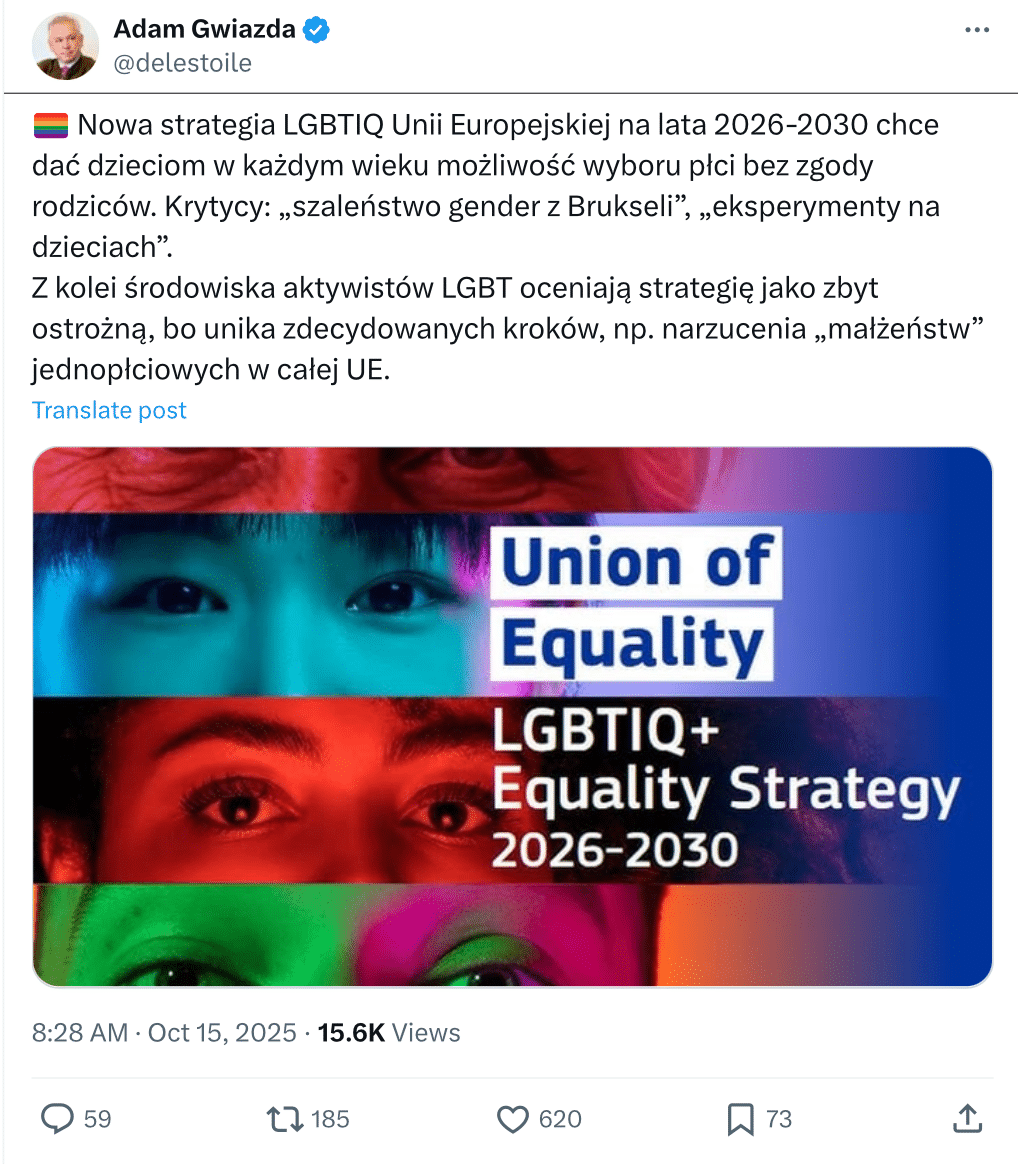
In response to Adam Gwiazda's post, the European Commission office in Wrocław stated:
The European Commission fully respects the exclusive competence of member states regarding the legal age of consent in the context of legal gender recognition. Any suggestions that we impose or enforce such measures on member states are false.
In brief
- In the 2026–2030 strategy for LGBTIQ+ equality, there is only mention of the absence of age restrictions, not of children independently choosing their gender without parental consent.
- The strategy is recommendational, not legally binding.
- Data from Berlin (2,407 gender change entries) concern formal document changes, not medical procedures.
- In Germany, minors can make such changes only with parental consent.
Strategy for LGBTIQ+ equality
To more effectively counter exclusion, the European Commission presented a new strategy for LGBTIQ+ equality for 2026–2030. The document expands on the previous strategy from 2020–2025 and foresees further actions aimed at ensuring that issues of equality and inclusivity are incorporated into all EU policies.
The new strategy focuses on three main areas:
1. Protection of LGBTIQ+ individuals – against violence, harassment, and discrimination, including through a cyberbullying fight plan, enforcement of anti-discrimination laws, support for NGOs, and analysis and possible restriction of so-called “conversion practices”.
2. Empowerment of LGBTIQ+ individuals – by increasing the effectiveness of national equality bodies, supporting recognition of rainbow families across the EU, and promoting inclusivity in the workplace.
3. Public engagement – by encouraging member states to adopt national equality strategies, improving data collection on LGBTIQ+ situations, and creating a dialogue forum between the European Commission and civil society organizations.
Parental consent? That’s not true
The document published by the European Commission has sparked significant controversy. One of the most discussed and criticized parts concerns legal gender change (p. 15):
Requirements for legal gender recognition vary significantly between member states. Some have adopted a self-determination model, while others still require medical procedures – which, as ruled by the European Court of Human Rights, may violate human rights. The European Commission will support the exchange of best practices among member states to facilitate the development of gender recognition procedures based on self-determination, without age restrictions.
The most emotional reaction was caused precisely by the last sentence, referring to the lack of age restrictions. Some commenters interpreted this as allowing children to legally change their gender without parental knowledge. However, this interpretation is not confirmed by the Commission’s document.
The strategy does not grant children independent rights to decide their gender, nor does it mention the absence of parental consent. The document is recommendational – encouraging member states to exchange experiences and develop their own solutions.
For example, in Germany, where the Self-Determination Act is in force, minors under 18 still need parental or legal guardian consent, and for children under 14, parents submit applications on their behalf.
It is worth emphasizing that the principle of self-determination means that a person can legally recognize their gender – i.e., change the entry in documents – without the need for medical certificates, psychiatric opinions, or proof of surgery. This is a simplified administrative procedure, not a medical change.
Distinguishing between “legal gender recognition” and “medical correction” is very important in this context. The former concerns only formal changes in official documents (e.g., birth certificate or ID card). The latter involves medical procedures – such as hormone therapy or surgical operations – which remain entirely separate issues.
Implementation of recommendations is not mandatory
The implementation of the EU strategy for LGBTIQ+ equality for 2026–2030 is not obligatory for member states.
The strategy is not a legal act of the European Union – it does not have the status of regulation or directive. This is a political document of the European Commission, which sets directions for actions but does not impose any legal obligations on member states. The Commission only encourages EU countries to undertake certain initiatives, such as exchanging best practices or developing gender recognition laws based on self-determination, but the decision to implement them lies solely with national governments.
Member states can voluntarily incorporate selected elements of the strategy into their policies, use EU funds supporting anti-discrimination activities, and cooperate within the framework of experience exchange.
The strategy does not impose any obligation to allow children to independently “choose their gender” or to change legislation regarding gender recognition. The European Commission also has no competence to interfere in family law or national administrative procedures. In short – the document is political and programmatic, not legislative; it is a plan of actions and recommendations, not a binding order.
Case study: Berlin
Along with the presentation of the new EU strategy, posts about the functioning of the so-called Self-Determination Act in Germany also started circulating online. Internet users claim that “in Berlin alone, 2,400 gender changes have been recorded, of which nearly 200 involved minors, including a four-year-old boy”.
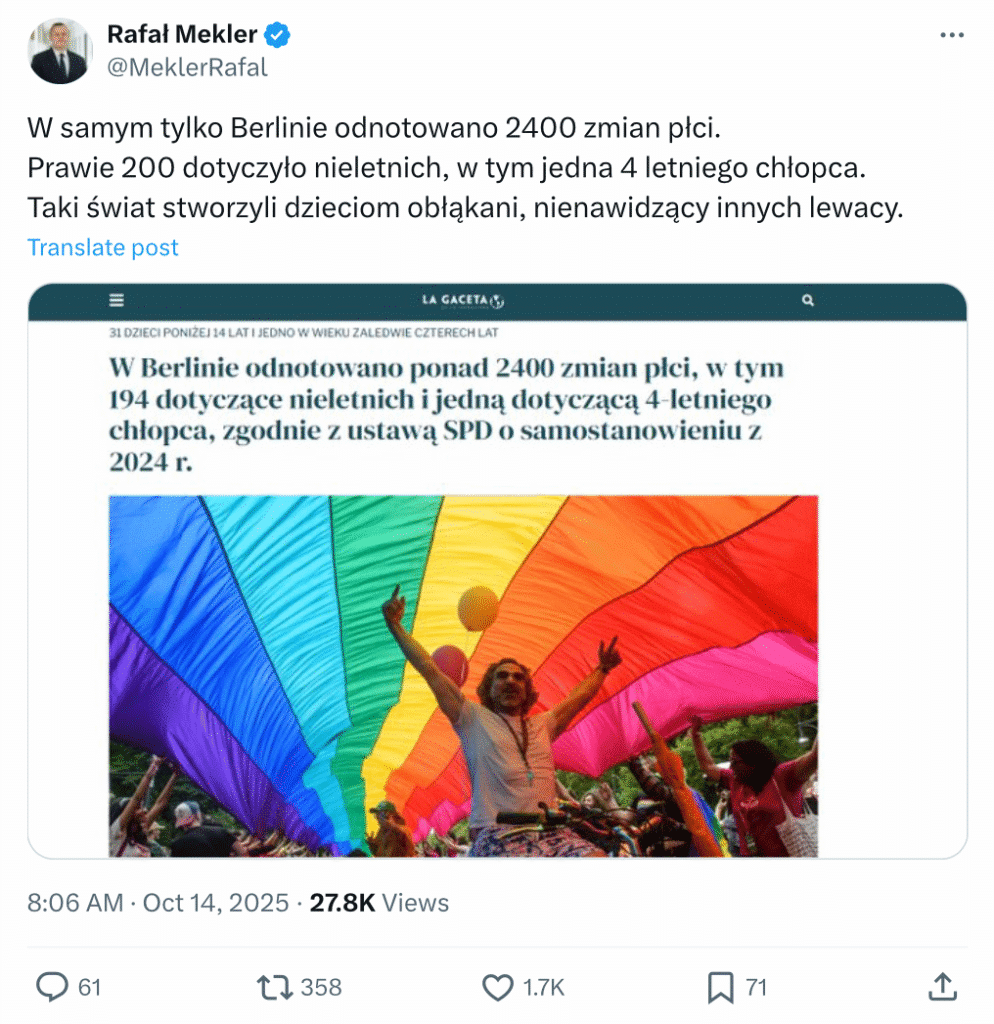
These data indeed come from official sources. The Berlin Senate Office, in response to a written inquiry from AfD MP Tommy Tabor, presented detailed statistics on the number of gender change declarations filed in the capital of Germany.
The document shows that since the law came into effect in 2024, the Self-Determination Act in Berlin has received a total of 2,407 declarations. In the age group 14 to 18, there were 162 cases, and in the category of children under 14, 31 cases, including one child under 5 years old.
However, it is important to emphasize that these data concern only legal gender recognition, i.e., changes in official documents, and not any medical procedures. According to German law, minors under 18 still need parental or guardian consent, and for children under 14, parents submit applications on their behalf.
More about the law itself can be read in the article by Demagog from 2024.
Summary
Although sensational reports have circulated in social media, neither the EU’s LGBTIQ+ strategy for 2026–2030 nor the German Self-Determination Act grant children the right to independently “choose their gender” without parental consent. The European Commission’s strategy is recommendational, not legally binding. It does not impose any obligations on member states and does not interfere with national laws regarding age, parental consent, or administrative procedures.
Data from Berlin, although accurate, relate solely to formal changes in gender entries in documents, not to medical procedures or surgeries. For minors, such decisions still require parental or guardian consent.
The circulating claims about children’s independent “gender choice” or the forced implementation of the EU strategy are unfounded. The strategy aims to support equality, protection against discrimination, and the exchange of best practices among member states.