This is what the Hungarian government has squeezed out of us in forint billions.
Átlátszó Erdély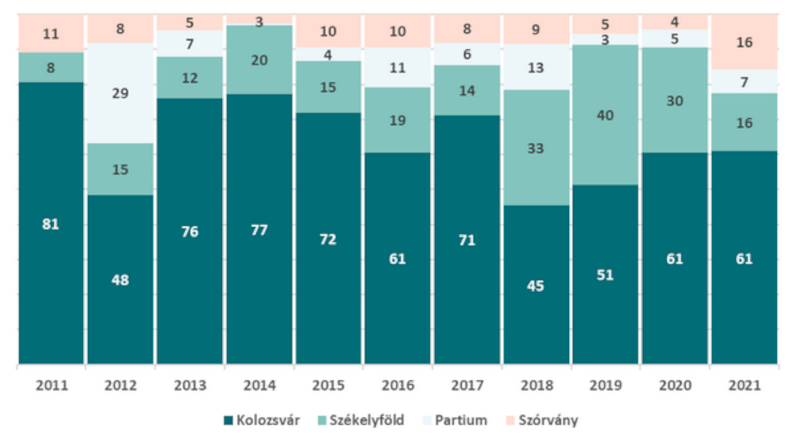
Our material is a research report prepared in a conversational format, which is also an edited, significantly expanded version of the Átlátszó Airday podcast discussion, supplemented with diagrams, tables, and references. Brief summary: The research underlying the material was conducted by the Wilfried Martens Centre for European Studies and the Kós Károly Foundation (2017), the Marie Sklodowska-Curie scholarship program led by Zsuzsa Csergő (2019-2020), and the New Europe College […]
This is our material presented in a conversational research report format, which also the edited, significantly expanded version of the Átlátszó Airday podcast discussion, with diagrams, tables, and references included.
Brief Summary:
- What is the difference between Fidesz and the previous center-left governments' national policy?
- During socialist governments, the RMDSZ determined who received support; after 2010, Viktor Orbán's personal decision dictates which projects get support and which do not.
- Today, the RMDSZ's top leadership is just a player within an opaque client system based on loyalty competitions.
- The Transylvanian Reformed Church District and other actors have periodically been in prominent positions, but in reality, no one has a stable position because support depends on unpredictable political deals and personal connections.
- The system lacks clear criteria and accountability, so resource distribution often relies on informal lobbying, promises, and ad hoc decisions.
- After 2010, support allocated to the Hungarians beyond the borders increased significantly until 2020, after which a decreasing trend is observed.
- The support system is multi-actor, but over the years, the Bethlen Gábor Foundation Zrt. has become the most important player.
- The funds primarily go to real estate investments, churches, higher education, and sports; interethnic dialogue or social integration support is rare.
- Support mainly reaches elite institutions, thereby reinforcing existing social inequalities.
- It encourages Transylvanian Hungarian institutions to strengthen ethnic boundaries, while institutional "bridges" that facilitate dialogue with the majority are rarely supported.
- In recent years, economic support has become more prominent, aiding private companies' investments—supporting private wealth growth and profit-making from public funds.
- The support system has adopted Hungary's authoritarian and clientelistic political logic, making Transylvanian institutions and actors more dependent on the NER and RMDSZ.
- If these supports decrease or cease, the institutions in Cluj-Napoca will mostly face crisis.
The research underlying this material was made possible by the Wilfried Martens Centre for European Studies, the Kós Károly Foundation (2017), the Marie Sklodowska-Curie fellowship led by Zsuzsa Csergő (2019-2020), and the New Europe College fellowship (2022). Assistance in compiling the database of BGA Zrt.'s individual supports was provided by Ármin Lambing, and the interactive map showing the territorial distribution of supports is by István Csata.
This project is a collaboration between Átlátszó Erdély and the Movement for a More Equal Transylvania – Action Sociology Working Group.
The report can be downloaded in .pdf format below.
Tamogataspolitika_riport_Kiss_Tamas_Sipos_Zoltan_Egyenlobb_Erdelyert_MozgalomDownload1. Research Background
Zoltán Sipos: – How did you get involved with the issue of support beyond borders, and what kind of research have you conducted on this topic?
Kiss Tamás: – I have conducted research on this in several waves. The first phase, starting around 2014-2015, focused on the Hungarian institutional system in Transylvania and the collective agency of the Hungarian community there, with Tibor Toró and Gergő István Székely. I was interested in how the so-called ethnic parallelism is organized—that is, the minority institutional system that allows Hungarians to maintain boundaries against the majority.
This was complemented by analysis of political processes, such as how negotiations with the majority actors occur and how the ethnic mobilization of the minority community is sustained. Beyond the Romanian framework, it was clear that we also had to consider the Hungarian-Hungarian relations, which fundamentally influenced the functioning of minority institutions and internal political processes, especially after 2010. The outcome of this research was the volume Unequal Accommodation of Minority Rights.
The next phase of the research began in 2019, led by Zsuzsa Csergő, again focusing on minority institutions but now within a comparative framework. In this study, the impact of national policy from the homeland was a key aspect. This led to our comparative analysis of the relationship between national policy and security policy, which I further explored as a fellow at the New Europe College. Here, I compared the effects of Orbán's national policy in Transylvania and Subcarpathia . As part of this research, with Ármin Lambing's help, we compiled a database of BGA Zrt.'s individual supports.
The third phase began when, within the Movement for a More Equal Transylvania, we established a working group on support policy and Hungarian-Hungarian relations. It is clear that 2010, with the rise of the Orbán regime, marked an institutional turning point in Hungarian-Hungarian relations.
The goal of this working group is to formulate what kind of support policy and Hungarian-Hungarian relationship system we envision if the Orbán government departs. We are preparing a professional document to discuss within the movement and later in the broader Transylvanian and Hungarian public sphere. This way, previous research can inform public policy.
2. Concepts of Nation, Paradigms of National Policy
Zoltán Sipos: – Hungarian governments since the regime change have always supported Hungarian communities beyond the borders with money and other means. One of the first measures of the second Orbán government was related to national policy, such as the preferential naturalization. They also thoroughly rethought the support system. In 2010, the Bethlen Gábor Foundation was established, and support levels increased annually until 2020. If we compare Orbán's national and support policies with those of previous Hungarian governments, what would you highlight?
Kiss Tamás: – It is crucial to see that support policy is only one element of the Hungarian-Hungarian relations, so it’s worth framing the differences between Fidesz and the "center-left liberal" elites from a broader perspective. I can summarize these differences in three points.
The first point concerns the definition of the nation, where right- and left-liberal views were diametrically opposed in the 1990s and 2000s. Both sides sought to reshape the concept of the Hungarian nation inherited from the state-socialist era of Kádár.
The center-left liberal side shifted towards what is called constitutional patriotism from the 1990s onward. This concept, originating mainly from Germany and playing a key role in EU identity politics, aimed to de-ethnicize the Hungarian nation in the eyes of liberal intellectuals, but only in a very narrow sense. They did not question the monocultural nature of the country or the dominance of the Hungarian language. The "de-ethnicization" primarily aimed to eliminate distinctions based on origin, and minority Hungarian communities' (ethnic-cultural) national identity was linked to this perceived danger.
This idea, in some ways, continued the processes from the state-socialist period. At that time, it was thought that anyone living within Hungary's borders belonged to the Hungarian nation. The Kádár regime propagated this not so much ideologically but through everyday social and territorial representations.
Before that, between the two world wars, the idea of revision was dominant, supported by official propaganda. After 1945, this changed, even in the most banal aspects. How is the weather forecast on TV? How is internal tourism organized and promoted? How is the social or welfare state created? All these were heavily influenced by the current state framework, leading to the routine and banalization of "Little Hungary".
Zoltán Sipos: – So now we should think that weather reports do not include territories beyond the borders?
Kiss Tamás: – Yes. It means that territories outside Hungary's borders simply did not appear in these representations. In theories of nationalism, one classic approach is the modernist view, which sees the nation as created by modernization—through mass media or bureaucracies organized at the nation-state level—that produce a shared sense of simultaneity across different geographical locations.
This is what happened under state socialism, which, whether we like it or not, was a defining period of Hungarian modernization. The development of the concept of the thousand-year border and the idea of the Carpathian homeland became prominent in the 19th century. But the socialist period was also formative, with the rise of mass media and mass tourism.
What about the news topics? Where do Hungarians go on holiday? Even if not explicitly stated, in many ways, the formation of national identity still occurs within these frameworks. During socialism, the education system also ignored the existence of Hungarian communities beyond borders.
Partly based on this, and partly to give some ideological framework, liberal intellectuals turned towards civic patriotism. This attempt did not become a dominant national ideology, but it was not entirely baseless. For example, in 2001, during the debate over the status law and dual citizenship in 2004, a significant part of the Hungarian population resonated with the MSZP's campaign. Of course, this involved other elements (such as welfare appeals or fears of immigration), but fundamentally, it reflected the duality of Hungarian national consciousness and patriotism.
Meanwhile, the right-wing led by Fidesz was interested in so-called ‘virtual’ nation-building. This meant reconstructing the unity of the Hungarian nation not through territorial revision or repatriation of Hungarians beyond borders, but through an institutional structure that is non-territorial, rewriting the concept of the nation that had become routinized during Kádár's era.
The tool for this was the status law, which in 2001 created a legal link between the Hungarian state and minority Hungarian communities. Later, in 2010, facilitated naturalization and in 2011, voting rights were introduced, directly involving minority Hungarians in the Hungarian political community. In short, the first major turning point was the contradiction between constitutional patriotism and virtual nation-building.
The second debate concerns how the Hungarian state should relate to the asymmetrical integration efforts of minority elites.
It is important that the 'virtual' nation-building strategy initially—besides establishing a legal relationship with the Hungarian state—included support for autonomy aspirations. However, these did not lead to tangible results, and realpolitik moved past them already in the 1990s.
In the case of RMDSZ, a key debate in the mid-1990s was whether it was possible to form a government without resolving the autonomy issue, which was at least declaratively a primary goal of Hungarian political elites. The Romanian Hungarian political class's answer was a clear yes, even if autonomy aspirations remained formally part of the ethnic framework program.
Thus, Hungarian elites—while maintaining institutions of ethnic politics and voting—integrated into the Romanian political field without creating formal legal guarantees for ethnic power-sharing.
This situation persisted until 2010 or perhaps 2014, creating another major split between the right and the left. The center-left liberal side explicitly supported these asymmetrical integration efforts, arguing that minority Hungarians should primarily integrate into Romanian, Slovak, Serbian political communities—even if autonomy was not granted.
In contrast, Fidesz for a long time supported the so-called "autonomist" opposition. Practically, this meant that the center-left (MSZP and SZDSZ) supported the status quo, backing the leadership of RMDSZ represented by Béla Markó, forming a close alliance or at least a coexistence. Conversely,
Fidesz actively intervened in the power relations within the Transylvanian political elite
by supporting opposition factions inside (Tőkés faction, Reform Compact) and outside (MPP, EMNP) RMDSZ. This was done with varying conviction until around 2014.
The third major split is visible in support policies and institution-building. For center-left governments, accepting the status quo meant leaving resource allocation decisions to the dominant minority political elites. They also did not want to generate new institutional processes or radically change the minority institutional system. Support from Hungary was seen as supplementary.
However, Orbán radically broke with this practice already between 1998 and 2002, for example by founding the Sapientia University, which completely transformed Hungarian higher education in Transylvania. During this period, media relations also began to change.
This is what we inherited from the pre-2010 period. But importantly, in these issues, the previous right-wing leadership was no longer continued by Fidesz after 2010. The most significant element was that autonomy aspirations were simply removed from the political agenda.
This means that after the fall of the Orbán regime, a return to the previous status quo is no longer possible. One aspect is that autonomy aspirations have also become empty in the eyes of the Orbán governments. Today, Budapest considers the question of autonomy irrelevant. It does not matter to them whether the Hungarian community integrates into the political life of the country or not.
Instead, the central goal has shifted to integrating Hungarians into a virtual national space—not only symbolically and politically but increasingly from an economic perspective—making the Hungarian beyond-border Hungarians a Budapest-centered resource management entity.
Within this framework, support for minority institutions is an investment, keeping the Hungarian community within the orbit of the Hungarian economic space and human resource management. This will be further complicated when Hungarian elites are viewed as intermediaries for Hungarian capital placement. We will see that there is a contradiction between the two economic-political visions: the Budapest-centered human resource management aims at ethnic boundary maintenance, while the intermediary role requires some openness towards the majority.
3. Support Policy Periods, Practices, and Actors
Sipos Zoltán: – Let’s look back a bit at the support decisions. I vividly remember how the support lists would go to Béla Markó, then RMDSZ president, who would carefully review and correct them with a pen. I imagine that during the socialist governments, this was basically how it worked: RMDSZ decided, then the decision was approved in Budapest. In contrast, the Fidesz government brought a radical change by making the decisions, and probably even the proposals, no longer originate within RMDSZ. The question is, how does this system operate? There are many rumors about how to access large sums of support. What do you know about this? Does it mean that these large decisions, especially the major ones, are the result of political decisions and lobbying?
Kiss Tamás: – You’re right. It’s important to state that the system was not democratic in any way when Béla Markó’s pen decided support allocations.
It can be said that before 2010, RMDSZ managed to monopolize not only the distribution of resources from the Romanian state but also those from Hungary. Erika Török, who played a significant role in cross-border issues during the Gyurcsány and Bajnai governments, referred to Markó, Béla Bugár, and József Kasza as the "chosen princes".
The paradox was that, under the pressure of Hungarian unity, national elections provided some legitimacy, but their actual power and internal democracy were limited, and their democratic legitimacy was mostly formal and procedural.
Unfortunately, there is a high chance that after Orbán’s fall, this system will be reinstated. Currently, RMDSZ is the only organized political force that has successfully colonized a significant part of the minority institutional system.
Today, cultural, scientific, professional, or church institutions, as well as local communities, have much less room for maneuver against politics than during Béla Markó’s time. Now, RMDSZ organizes many cultural events, has fully absorbed teachers’ advocacy organizations, controls the media under its influence, and most of the intellectuals (including literary figures) are "fed" from its hand. In most Székelyföld municipalities, there is not even formal opposition.
Therefore, when considering how to reform the support system after Fidesz, we must remember that returning to the previous status quo is not an option. Allowing RMDSZ’s monopoly over resource distribution to re-establish would only reinforce existing ethnic authoritarian tendencies.
Back to your question: we can start from the fact that before 2010, the RMDSZ leadership had a kind of monopoly over resource distribution, although at that time, professional considerations and logic were more respected than today. This changed radically with Orbán’s rise to power in 2010.
During the first government cycle (2010–2014), RMDSZ and its affiliated foundations, civil organizations, and "associated companies" were almost completely excluded from the support recipients.
Initially, the education and training support administered by the School Foundation was taken away, and the status offices operated by RMDSZ were abolished. Entities linked to RMDSZ could not compete for support until 2014. In this first cycle, among those close to RMDSZ, the Jakabffy Elemér Foundation, associated with István Székely (a Fidesz contact person within RMDSZ), received the largest support requests (~€60,000), along with the Bernády Foundation and the Transylvanian Hungarian Data Bank, which received minimal amounts (~€6,000 each).
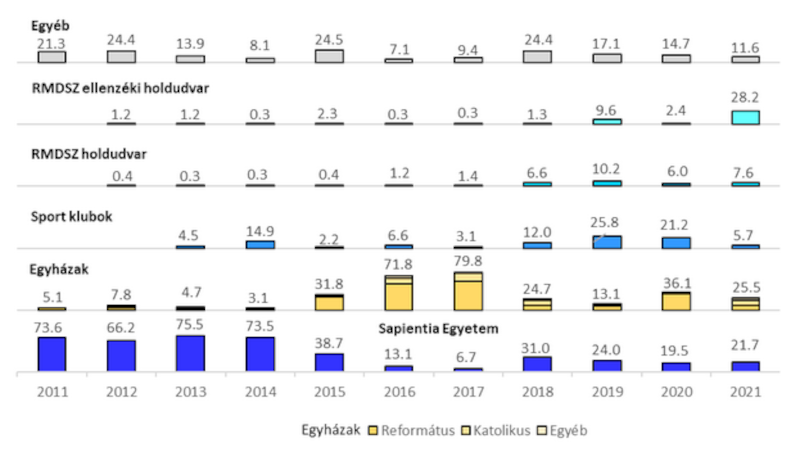
During this period, the Democratic Centre of the Hungarian Hungarian National Council (EMNT) was also established. While EMNT and the newly formed Hungarian People's Party of Transylvania (EMNP) received significant external funding from the BGA Zrt., the main beneficiaries of individual support requests were not opposition civil organizations (such as Áldás Népesség, EMNT, Házsongárd Foundation, Kincses Foundation, Hungarian Civil Organizations Federation, MIT, Marosvásárhely for the People, MÜTF, Siculitas, Youth Foundation of Székelyudvarhely, UFF). They received a total of about €335,000, while other organizations, such as the church entities (Erdélyi Református Egyházkerület – EREK, Szent Ferenc Foundation, Protestant Theological Institute), sports clubs (including the Csíkszeredai Football Club with €3.7 million), and other organizations (e.g., the Romanian Hungarian Teachers' Union with €1.9 million, Kallós Foundation with €300,000, and Bástya Association with €220,000) received much higher amounts (see the figure below).
The second government cycle began in 2014 with a clear shift: the support system was opened to RMDSZ’s circle of influence. The EuroTrans Foundation (outside the BGA Zrt. framework) became involved in naturalization procedures.
In this cycle, several organizations received significant support, including the School Foundation (about €10.7 million for real estate development, university faculty housing programs, and other projects), Transylvania Trust (linked to Deputy Secretary General Csilla Hegedűs, with €1 million for the Bánffy Castle in Bonchida), and Pro Regio Siculorum (linked to Sepsiszentgyörgy Mayor Árpád Antal, with €484,000 for the launch and operation of the Székelyföld Policy Institute and the Imre Mikó Legal Protection Service). The second cycle's total support was substantial.
However, the clear winner was the Reformed Church, specifically EREK.
The amount allocated to the Reformed Church between 2015 and 2018 was €166.2 million, of which EREK received €145.6 million. The largest items were real estate construction and renovation, and the launch of the Transcarpathian Kindergarten Development Program.
Real estate investments were heavily concentrated in Cluj-Napoca: notable projects include the renovation of the Reformed College, Apáczai Lyceum, Theological Institute, Bornemissza-Szilvássy House, Babos Palace, the purchase of the Collegium Iuridicum (law college), and the development of residential properties in Atony. Besides Cluj, major investments also took place in Marosvásárhely, such as the main building of the Marosvásárhely Reformed College (the main building of the Farkas Bolyai Lyceum) and the Gecse Dániel Medical College.
Zoltán Sipos: – Why did the Kató Béla-led Erdélyi Református Egyházkerület become such a prominent recipient?
Kiss Tamás: – Several explanations are possible. One is a rational decision based on empathy towards the Hungarian government. In Romania, due to corruption, legal uncertainty, and other issues, there is a lack of trust in institutions, and in this context, Orbán’s government relies on the "trustworthy" Reformed Church.
But a more insightful explanation might be the personal relationship between Orbán and Kató, which could involve a logic beyond personal ties—namely, loyalty competition. This is a power technique also described by Hannah Arendt in The Origins of Totalitarianism.
The system involves the leader, Orbán, constantly pitting different power groups against each other for control over a specific area. This occurs in other sectors and also in minority Hungarian support policies. If we look back to around 2010, it was a relatively small, less complex system.
At that time, three actors had significant influence over Hungarian-Hungarian relations: László Kövér, who favored Jenő Szász and the MPP; Zsolt Németh, who patronized the EMNP, Tibor Toró, and his circle; and Zsolt Semjén, who favored interest groups within RMDSZ, such as Gergely Olosz, and to a lesser extent Sándor Tamás and Árpád Antal.
Since there was no consensus within Fidesz on which political faction to support, this loyalty competition and the internal opposition within RMDSZ prevented the emergence of a viable opposition after 2010. Over time, the circle of Fidesz actors expanded as new politicians built competing client networks.
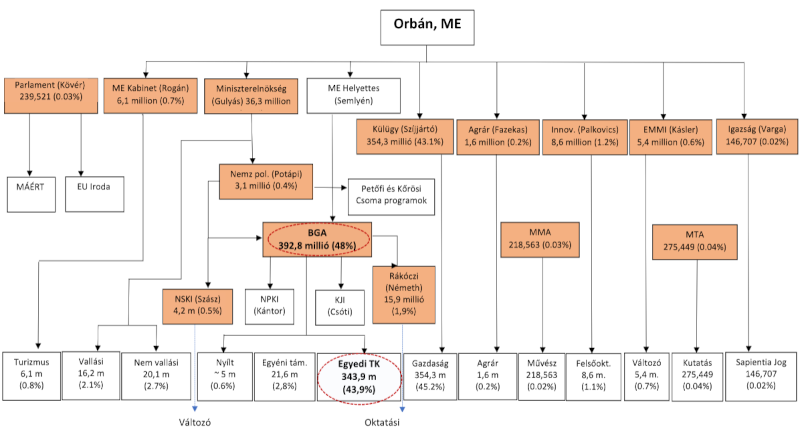
The second figure shows the structure of support in 2020 based on the 2020 budget law. Only the items and institutions involved in distributing support to Hungarians beyond borders are included. The bottom row shows the type of allocated support, with the rows above indicating subordinate actors. The system is theoretically centralized, with payments made through BGA Zrt. However, in 2020, BGA Zrt. was responsible for only 48% of all disbursements, with 43% (€343 million) being individual support requests (not open calls).
Support also flows through economic channels via the Ministry of Foreign Affairs led by Péter Szijjártó, and several smaller actors manage significant sums. For example, the Prime Minister’s Office, led by Antal Rogán, spent €6.1 million on tourism support; the Prime Minister’s Office, led by Gergely Gulyás, allocated €16.2 million to religious organizations and €20.1 million to non-religious organizations.
Other ministries also have dedicated "border support" budgets, such as the Ministry of Agriculture led by Sándor Fazekas, the Ministry of Innovation led by László Palkovics, and the Ministry of Justice led by Judit Varga, as well as the Miklós Kásler-led EMMI. The National Scientific Research Institute (NSKI) led by Jenő Szász and the Rákóczi Association under BGA had separate budgets, and organizations like NKPI led by Zoltán Kántor or KJI led by György Csóti also run their own programs. The figure does not include non-budgetary actors, such as the Mathias Corvinus Collegium, whose Transylvanian branch is directly managed from Hungary’s MCC, which earns dividends from MOL and Richter shares.
Actors in Transylvania, including the RMDSZ leadership, must position themselves within this system, where no one has a guaranteed place.
Perhaps the best example is MCC, whose Transylvanian head is Botond Talpas, around whom a generational power group within RMDSZ is forming. It is known that Talpas obtained this position despite significant lobbying by Kelemen Hunor and the RMDSZ leadership, hoping to gain influence over MCC. There is no open conflict between Talpas and Kelemen, but if the generational group led by Talpas controls MCC, the dependence on Budapest is much greater than if the RMDSZ leadership directly managed it.
Returning to your question: in this loyalty competition, the Transylvanian Reformed Church District and Bélá Kató once played a privileged role. This position partly stemmed from personal relations with Orbán, but also from the system’s logic, where Orbán was competing with RMDSZ leadership, including the EREK.
Sipos Zoltán: – Bélá Kató retired, and now, looking at the support lists, the situation is quite different from 4-5 years ago.
Kiss Tamás: – Yes, you’re right. Personal relations are definitely important. Kató’s main advantage was direct access to Viktor Orbán, while other power groups could only influence through indirect, clientelistic (personal) channels. They did not have positions to connect directly with Orbán.
This third cycle has now shifted, and Kelemen Hunor has the most direct access to Viktor Orbán. But this was not always obvious; it did not start that way. So, in this personalized relationship system, Kató Béla once held a strong position, which is no longer the case for the Reformed Church today. However, this change began during Kató’s tenure (see Figure 1).
Sipos Zoltán: – Going back a bit to support decisions: we see that the Bethlen Gábor Foundation has an annual budget, announces thematic programs that are public and open to applications. However, support amounts are relatively small—just a few million or tens of millions of forints. At the same time, larger sums are decided at the level of the Prime Minister’s Office. Rumors suggest Viktor Orbán himself makes decisions over certain amounts. We don’t know exactly how this works, but it appears that during such decisions, the Prime Minister’s Office allocates funds into the Bethlen Gábor Foundation. These are large investments, including major real estate projects. Why does it work this way? And what are the consequences of this largely unpredictable system, where it’s impossible to know at the beginning of the year which major project the Foundation will support?
Kiss Tamás: – I conducted interviews on this topic. I can only speak in anonymized terms, but I believe I have a good understanding of how these decisions are made in practice. Essentially, it depends on where actors are positioned within the clientelistic structure—they lobby where they can, where they have connections.
Actors with no formal connection to the system, the BGA Zrt., or the formal support organigram, can still influence through visits, dinners, events, celebrations, statue unveilings, hunting trips, shared drinks—lobbying happens in these contexts.
Voicing promises, then the Hungarian side submits a decision request or begins lobbying someone to submit a decision. Sometimes, despite promises, no lobbying occurs. Then, BGA Zrt. receives an instruction to send out a call for applications for the support for the beneficiary.
The applicant in Transylvania fills out and submits the application, and in lucky cases, receives a notification of success. But sometimes, they do not get any notice, which could mean the lobbying was unsuccessful or something changed after submission. In such cases,
the application essentially does not exist.
This system lacks transparency and accountability. There are no clear criteria or preconditions for success or failure. It’s also unclear at what levels or with whom decisions are made—perhaps with Viktor Orbán himself or close associates, or elsewhere. Everyone tries to succeed from their position because there are no formal procedures, transparency, or appeal options.
Sipos Zoltán: – A source familiar with the Bethlen Gábor Foundation told me how the kindergarten and nursery program was created during the 2016 Christmas largesse, when the Foundation’s support was at a peak (see Figure 3). They prepared this program and expected a budget of 1-2 billion forints, lobbying for it. Just before Christmas, on the last working day, the decision was submitted to Viktor Orbán. For some reason, Orbán liked the idea and allocated much more money for this project. A frantic lobbying effort began at the Bethlen Gábor Foundation, with churches beyond borders calling in the last working day before Christmas to urgently submit applications, as the money had to be contracted as soon as possible. I tell this to illustrate how such important public policy decisions are made.
Kiss Tamás: – Yes, I’ve heard various accounts of this case. Primarily, the Reformed Church and Bélá Kató’s EREK were the main beneficiaries. Orbán probably liked the idea, but then the Catholic side also raised concerns that not everything should go to the Reformed, which partly increased the budget. But in fact, the Catholic Church did not want to administer kindergartens. That’s why the Hungarian Teachers’ Union (RMPSZ) became involved.
The problem, however, is that we are now in the realm of rumor sociology, which I find very distasteful. The real issue is that we are sitting here, exchanging anecdotes about support policy, because the system’s operation indeed produces this kind of decision-making and this lack of transparency.
4. Amounts, Priorities, Beneficiaries
Sipos Zoltán: – Looking at larger support sums, what themes and purposes do support allocations serve for the Hungarian government? And what is largely missing from these supports—what is not supported or barely supported?
Kiss Tamás: – It’s worth systematically reviewing what we see in the numbers. In my research for the New Europe College, I used two data sources:
- The closing laws from 2010 to 2020, which allow us to quantify the budgetary allocations for activities and supports related to Hungarians beyond borders. This data can be numerically analyzed.
- Additionally, with Ármin Lambing’s help, we compiled a database of individual support requests submitted to BGA Zrt., which details the amount paid, the legal entity of the applicant, and the purpose of the payment. These are support requests from scanned documents available on BGA Zrt.'s website, not pre-existing datasets.
For the period after 2021, I did not compile databases with such detail; I only have access through materials prepared by Átlátszó Erdély. Based on the closing laws, we can track the sums in the national budget (see Figure 3) and the changing influence of the actors managing these funds (see Figure 4). Support increased significantly during the third Orbán government (2014–2018), from €93 million to €439 million, reaching a new peak of €826 million in 2020. This growth is also significant in real terms for 2011 values.
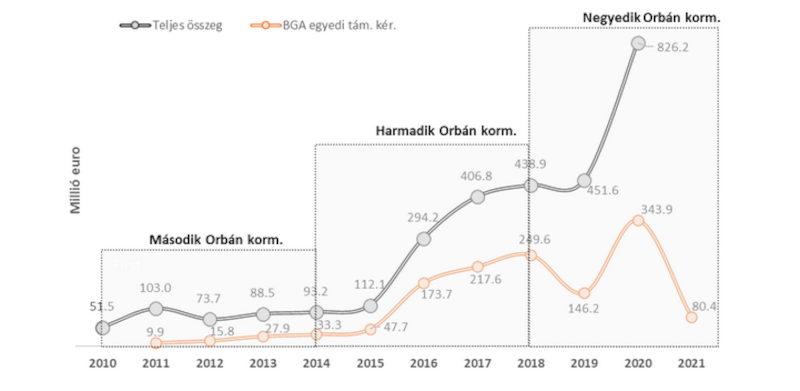
The BGA Zrt. was established in 2010, but support related to Hungarians beyond borders was mostly concentrated at the Ministry of Justice and Public Administration during the Bajnai government, led by Tibor Navracsics, which did not pursue clientelistic ambitions beyond borders, and support was gradually phased out (see Figure 4).
The reform of the support system during the first cycle increased BGA Zrt.'s importance, but at that time, only 45% of disbursed amounts were individual support requests. This was not because open calls had a larger share, but because individual supports like educational and training grants still made up a larger part of the smaller total budget.
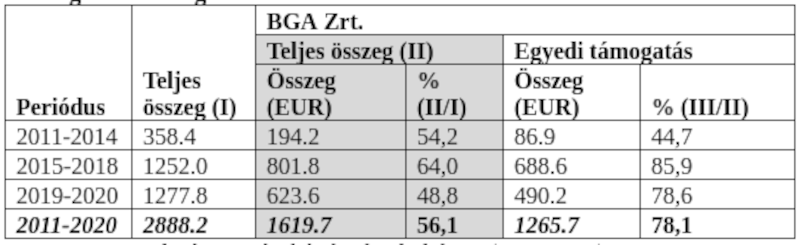
The second government cycle saw the largest share of support through BGA Zrt., with over 64% of the more than €1.2 billion disbursed passing through it. Of this, 85% was paid as individual support requests. In the third cycle, BGA Zrt.'s share decreased again, mainly due to economic supports managed through the Ministry of Foreign Affairs, administered in Transylvania by the Pro Economica Foundation linked to RMDSZ.
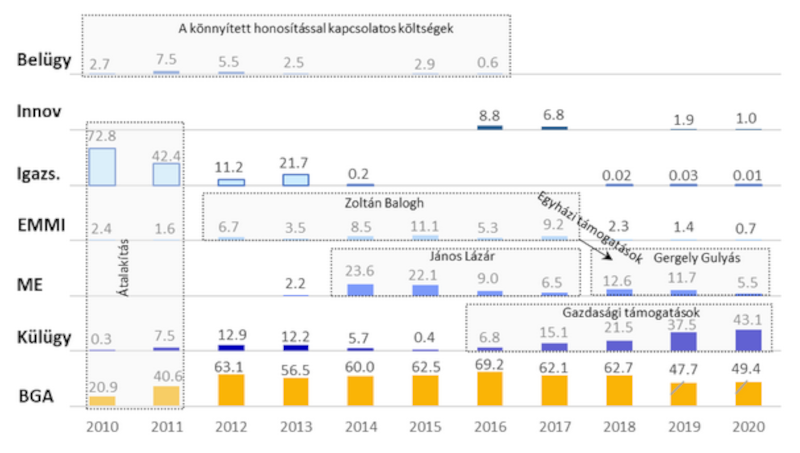
It is also worth examining the influence of actors outside BGA Zrt. (see Figure 4). The legacy of the Gyurcsány-Bajnai era includes the management of Hungarian identity documents and naturalization through the Ministry of Interior, which had a separate budget line and department during the first cycle (and was not involved in clientelism beyond borders). Support for actors with border-crossing ambitions, such as Bishop Zoltán Balog, who during 2014–2015 controlled over 8.5% and 11.1% of the total support, mainly allocated to his church network, can also be tracked.
Similarly, János Lázár, during the same period, controlled over 23.6% and 22.1% of the support allocated to Hungarian minorities. From 2018, Gergely Gulyás, head of the Prime Minister’s Office, inherited both ecclesiastical and secular support roles, managing significant funds for various organizations. Since 2016,
the rise of Péter Szijjártó has been a major development,
who now plays a key role in distributing economic supports. This process started in Transcarpathia and Vojvodina and only significantly expanded into Transylvania after 2020.
The most important developments in the third and fourth Orbán governments are the strengthening of economic supports, which can be seen as a new national policy concept. If we look at the current structure, the main component is economic support, which can be viewed as capital placement by the (accumulating) state. Its beneficiaries are primarily Hungarian large entrepreneurs in Hungary and in Transylvania, native capitalists, and domestic client networks.
This form of support involves Hungarian public funds directly increasing the profits of for-profit companies. We find this problematic, but there is also a more empathetic interpretation, such as by Zsombor Csata, a socio-economist, who argues that compared to paternalistic institutional supports, the presence of Hungarian companies in support of Hungarian-Hungarian cooperation is a much more elegant, more citizen-oriented, and symmetrical way.
We can analyze the unique supports of BGA Zrt. from several perspectives. These include:
- In which country are the supports spent, i.e., where are the beneficiaries based? For Romanian supports, in which towns or regions are the beneficiaries registered?
- What are the sectors of activity of the beneficiaries? What types of supports are these?
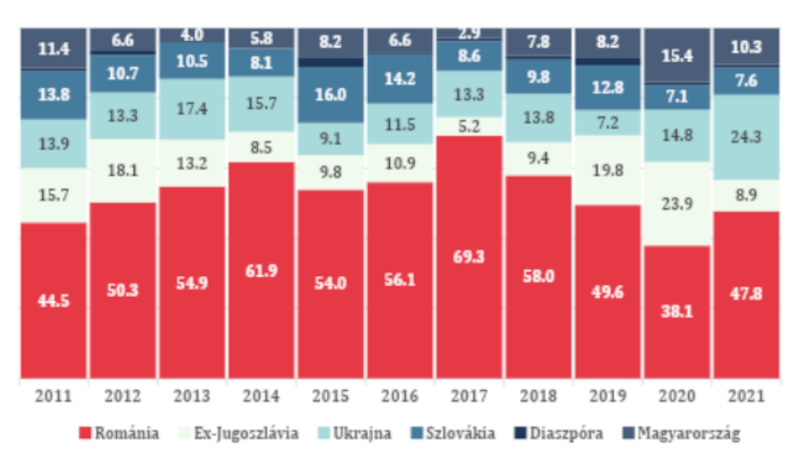
Between 2011 and 2021, 53% of the sums allocated as individual supports through BGA Zrt. went to Romania. Serbia, Croatia, and Slovenia received a total of 14%, 13.5%, and 10%, respectively; Ukraine received 13.5%, and Slovakia 10%. Support in Hungary accounted for 9%, and 1% was spent in the diaspora.
Per capita, support for an individual Hungarian in Transylvania was about €640. In Vojvodina, it was €900; in Kárpátalja, €1,900; in Croatia, €2,400; and in Slovenia, €4,400. Support to Slovakia was about €260, slightly below the Transylvanian level. The highest proportion of support to Romania was in 2017, with 69% of the total.
In Romania, significant regional disparities are evident: 60% of total support went to organizations based in Cluj-Napoca, 24% to Székelyföld (Hargita, Kovászna, Maros), 8% to Partium, and 8% to scattered settlements. Meanwhile, in Cluj, only 3.4% of the Hungarian population lives, while Székelyföld has 53%, Partium 24%, and scattered settlements 19%.
Cluj’s privileged position is amplified by the presence of many national institutions, including Protestant (Reformed) bishoprics and RMDSZ foundations. However, support for real estate projects in these institutions and the fact that these organizations operate in Cluj (employing people, etc.) justify considering the city a real beneficiary. In rural areas, organizations registered there receive only 4% of the support, even though nearly half of Hungarians in Transylvania live in villages.
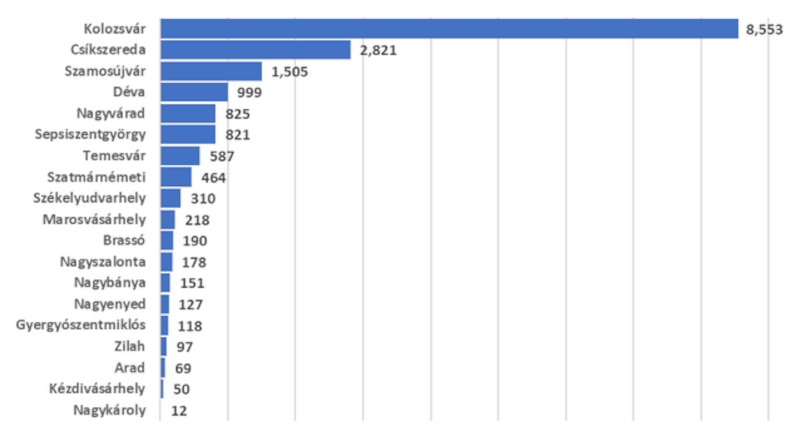
In terms of support per capita, the highest levels are in Cluj, followed by Csíkszereda, Szamosújvár, Deva, Oradea, and Timișoara. Deva appears on the list because it hosts the headquarters of the Saint Francis Foundation led by Csaba Böjte, although its activities are not limited to that town.
Regarding the nature of organizations, religious organizations and churches received the largest share—40% of BGA Zrt.'s individual supports. The main beneficiaries include the Reformed Church (Erdélyi Református Egyházkerület) with €191.7 million, followed by the Diocese of Királyhágómellék (18.6 million euros), and the Roman Catholic dioceses of Szatmár and Oradea (14.7 and 11.7 million euros). The Evangelical Lutheran Church received €7.4 million, the Unitarian Church €4.6 million, and the Archdiocese of Alba Iulia €5.7 million.
The majority of these supports went into building renovations, including many kindergartens. Many of these renovations involved educational institutions, increasing the role of churches in education. It should be noted that these renovations mainly targeted urban elite high schools, which are among the most privileged educational institutions, thus actually increasing educational inequalities through the renovation and equipment support allocated via the church.
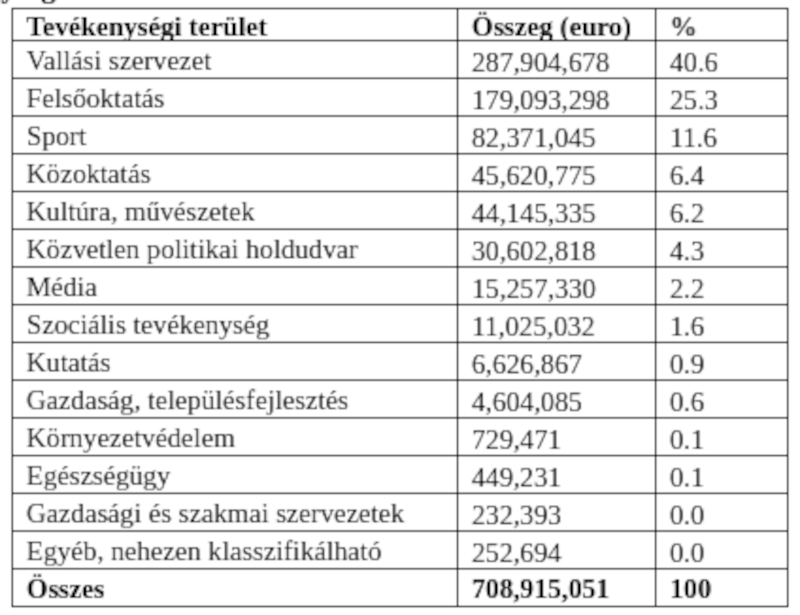
Supports related to higher education received 25.3%, with the Hungarian state-supported Sapientia University in Transylvania being a constant recipient (€164 million support). Support also went to the development of the Erdélyi Hagyományok Háza in Sepsiszentgyörgy, including the purchase of the former Melody Hotel on Cluj’s main square (€10.1 million). Support for the Marosvásárhely Medical Faculty and related housing projects also received significant funding (€10.1 million).
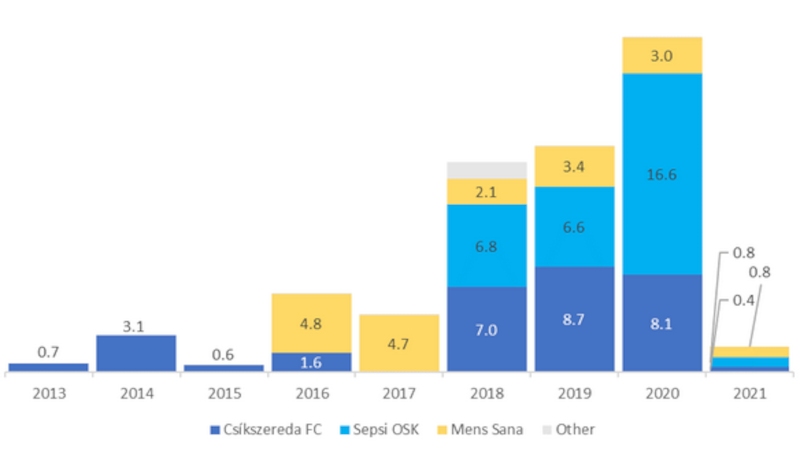
Sports received 11.6%, with major players including Sepsi OSK (€30.1 million), Csíkszereda FC (€30.1 million), and Mens Sana Foundation (€18.8 million). It’s worth noting that the sums allocated by BGA Zrt. only cover part of sports support. For example, the Sepsiszentgyörgy stadium with 8,500 seats, operated by Duna Aszfalt Zrt., was built as a private investment. The primary recipients of Fidesz-preferred sports supports in Transylvania are football and hockey clubs.
Support for pre-university education organizations accounted for 6.4%, including the Romanian Hungarian Teachers’ Union (€29.1 million), which manages part of the kindergarten program and educational supports until 2023. The church-related renovations and equipment purchases also significantly support education, although the table does not include educational support, which falls under individual grants from BGA Zrt. (see Figure 2).
In the culture and arts category (6.2%), notable supports include the Székelyföld Legendarium (Visus Cultural Association, €7.4 million), Timișoara Fortress Association (€3.3 million), and aristocratic "heritage protection" projects (castle hotels), such as the Roy-Chowdhury-Mikes Foundation (€2.8 million) and the Kálnoky Foundation (€2.7 million).
Organizations directly in the political orbit, such as the School Foundation (€24.7 million), EuroTrans Foundation (€1.6 million), and EMNT (€2.2 million), also received significant support. Most media support (about €14.9 million) went to the Erdélyi Médiatér Association. Support for social services was led by the Saint Francis Foundation (€3.1 million), Caritas Alba Iulia (€1.1 million), and the Csibész Foundation (€900,000). Between 2011 and 2021, 642 Hungarian minority organizations in Transylvania received support from BGA Zrt., with 56 organizations receiving over €1 million.
Sipos Zoltán: – If we abstract from the specific supported entities, we can say that most of this money goes into concrete infrastructure—buildings, real estate. Support for education, social cohesion, and interethnic "soft" programs is underrepresented.
Kiss Tamás: – Exactly. Of the total between 2011 and 2021, about 28% went into real estate renovations, and 26% into building or purchasing real estate, totaling 54%. Add to this about 2% for equipment purchases.
Operational support accounts for 26%, mainly because institutions like Sapientia University and sports academies are funded by Hungary. About 10% of the total support is for educational programs, but a significant part of real estate investments also serve educational purposes, even if not classified as "soft" projects.
Pure "soft" programs—project-based supports—constitute only about 7% of the total, with an additional 1% for event support.
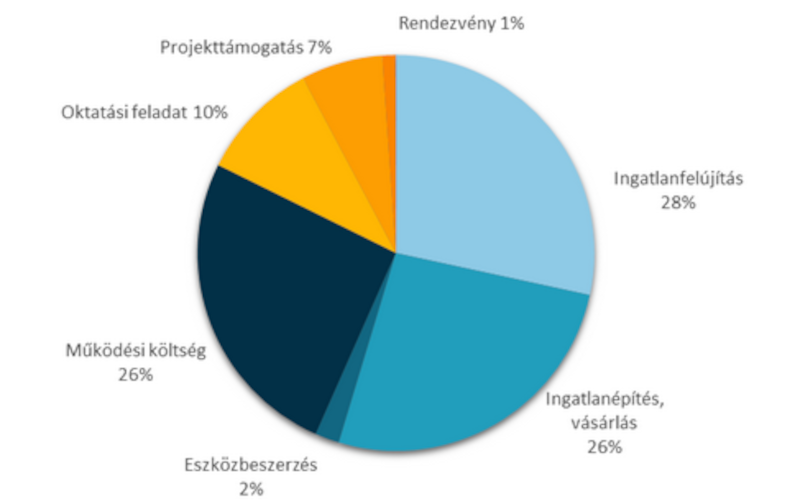
Again, I emphasize that in recent years, the system has shifted towards economic supports, which pose new problems because they essentially increase private company profits.
5. The Political Economy of National Policy
Sipos Zoltán: – Ultimately, these are also going into real estate, as these developments usually involve halls, hotels, or production lines.
Kiss Tamás: – Yes, but I want to highlight that these will no longer be public property or community assets of the Transylvanian Hungarians. Other supports, like church-owned school buildings or Hungarian houses maintained by associations, can still be interpreted as such. But castles, hotels, or production lines are private property.
In other words, public money from Hungary is supporting the growth of private wealth and profit-making among Romanian and Hungarian business circles. It’s also clear that many of these do not create jobs but serve private interests. I consider it a very problematic idea that the enrichment of aristocratic families’ private estates, restoring the glory of their former castles, and turning them into profitable businesses would be in any way in the public interest. It might serve symbolic revision or imperial grandeur among the Hungarian right, but no family’s private interest can be equated with the interests of the Hungarian community in Transylvania.
Support for private interests is justified only by the fact that some families have a historical prestige, but this is a distorted form of symbolic connection that we must finally free ourselves from.
But returning to a more objective analysis of the support policy logic, especially against the backdrop of support for private wealth and aristocratic fantasies, I want to emphasize that the current distribution system would be much better replaced by a standardized, accountable scoring system. While designing such a system (especially when defining public policy priorities), care must be taken to avoid reproducing social privileges.
Finally, the fifth point concerns the functions of minority institutions and their role in ethnic boundary maintenance. In the research led by Zsuzsa Csergő, two functions and two types of institutions were distinguished: those producing internal solidarity (and boundary creation against the majority) (bonding) and those creating links and bridges towards the majority (bridging).
Almost all Transylvanian Hungarian institutions (99%) produce internal solidarity and ethnic boundaries, while institutional bridges are almost entirely absent. There are some multilingual theaters, literary projects, a few leftist events, interethnic camps, and roundtables, but these are just drops in the ocean.
In Hungarian national policy, the metaphor of the "bridge" is even more controversial because it refers to the multiethnic party in Slovakia, Most-Híd. What we mean (and what Most-Híd also aimed at) is the creation of institutional spaces for dialogue with the majority, where both sides can participate as more equal partners.
This allows actors to articulate and negotiate how this relationship should look across society. Institutional bridges also serve to prevent marginalization of minorities or, as in the case of the Serbian Hungarian community, to avoid institutional ghettoization.
The RMDSZ’s monopoly remains until smaller, direct bridges are created—those that enable horizontal dialogue between Romanians and Hungarians outside party politics. This includes educational actors with other educational actors, scientific or cultural actors with each other, and so on.
The key point is that RMDSZ is the most opposed to this. The Hungarian government’s position is ambivalent: it may need a mediating layer, but it also wants the majority of the Hungarian community in Transylvania to integrate into the Budapest-centered human resource management system, to operate within this Hungarian network, even if they do not necessarily move to Budapest.
7. Consequences, Expected Developments
Sipos Zoltán: – What happens if these supports run out? We see that perhaps 2020 was the last peak, and since then, the trend has been downward. There is a chance that if Hungary experiences a government change, supports will cease or significantly decrease. What impact could this have on the Hungarian institutional system in Transylvania?
Kiss Tamás: – We need to look at what was before 2010. As outlined, we are mainly talking about clientelistic integration, at least within the political class. Hungarian politicians are not only integrated into the NER but also into the Romanian political field on a clientelistic basis, connecting the broader minority institutional system.
As we saw, the volume of Hungarian supports in Hungary increased from 2014 onward, during a turbulent political period in Romania. After Klaus Iohannis was elected president, the peak of the anti-corruption campaign occurred until 2017, which—let’s be honest—went well beyond the rule of law and turned into a damaging anti-corruption populism.
This reduced the funds mobilized from Bucharest, as the anti-corruption campaign criminalized not only corruption but also many other forms of political partisanship, through which the Hungarian political class in Transylvania integrated into the Romanian political field.
Sipos Zoltán: – So, in essence, it was not always about corruption but about the informal ways of securing local implementation—like building a bridge or a road—that were suddenly labeled as corruption.
Kiss Tamás: – Exactly. Moreover, the informalities and political bargains also affected the implementation of various decisions and laws. For example, the issue of restitution. There was theoretically a legal decision and a public policy direction that led to large-scale restitutions.
Some restitution cases, however, were later criminalized. The restitution of the Mikó College building is a notable example, where Attila Markó was accused of corruption, even though he was a political actor involved in the restitution process.
Overall, it became clear that RMDSZ could no longer protect its politicians involved in previously natural bargaining processes. This practically paralyzed the system, significantly reducing RMDSZ’s resource allocation capacity.
The NER has essentially entered this vacuum.
Until now, Hungarian resources for Transylvania were marginal for the Hungarian political class. Now, it is likely that if a political shift occurs—and I believe it has already begun—clientelistic connections will change direction. Budapest will lose importance.
For RMDSZ, however, Bucharest remains, as things stand, an intact and uncontested power center. This change is already underway. For example, the media coverage of the Parajda salt mine visit by the Romanian president shows how the visit was represented. Hungarian politicians could not even bring water for the Romanian president this time.
I regularly visit Székelyföld for interviews, talking with institutional, local, and development policy actors. For them, it is quite clear that Bucharest is just as important as Budapest.
Support from Hungary appears more significant in Cluj than in the Hungarian-majority areas, partly because the support effects are less perceptible there.
In Székelyföld, the Hungarian elites own many public institutions and can apply for various Romanian sources based on territory. Thus, the people in Cluj are more "dependent" on Hungarian funds, while the importance of this issue is much smaller in Székelyföld or Partium.
The main losers will be the Cluj-based institutional and political-elite structures intertwined with the NER.
It is paradoxical that the intelligentsia often considers itself a pioneer of communication with Romanians. Yet, their institutions will suffer most from the decline of the NER, not Székelyföld, not Hungarians in general, and not even RMDSZ.
The core of the Transylvanian Hungarian intelligentsia and especially the Cluj-based institutions may be undermined by this. It will be very difficult for them to adapt, but this should not be projected onto the entire Hungarian society in Transylvania, as rural and regional local governments in Székelyföld will manage this transition much better than the Cluj elite.
Cover photo source: Viktor Orbán’s Facebook page