The Story Decides Where It’s Going to Take You
Transitions
No cheap solutions: Food, books, and history in the Balkans. An Interview with Darko Tusevljakovic.
No cheap solutions: Food, books, and history in the Balkans. An Interview with Darko Tusevljakovic.
Darko Tusevljakovic was born in Zenica, Yugoslavia (now Bosnia and Herzegovina) in 1978. He studied English language and literature at the University of Belgrade and then published his first novel in 2010. Since then he has published a total of five novels and three short-story collections, and his writing has netted him four major awards. Before winning the NIN Prize in 2025, he also won the prestigious Ivo Andric Prize for short stories (2023), a European Union Prize for Literature (2017), and, at the very start of his career, the Lazar Komarcic award for science fiction.
In addition to writing, he has worked as an editor and translator for the highly regarded Serbian publishing house Carobna knjiga since 2016. His translation of Graham Greene's The Heart of the Matter was recognized by the Literary Society of Vojvodina as the translation of the year in 2020. His fiction has so far been translated into English, Italian, Bulgarian, Albanian, Romanian, Slovenian, Spanish, Greek, and Macedonian.
John K. Cox: As a writer, what do you hate to talk about in an interview?
Darko Tusevljakovic: Naturally, what I hate most is the question of what I hate most to talk about in an interview.
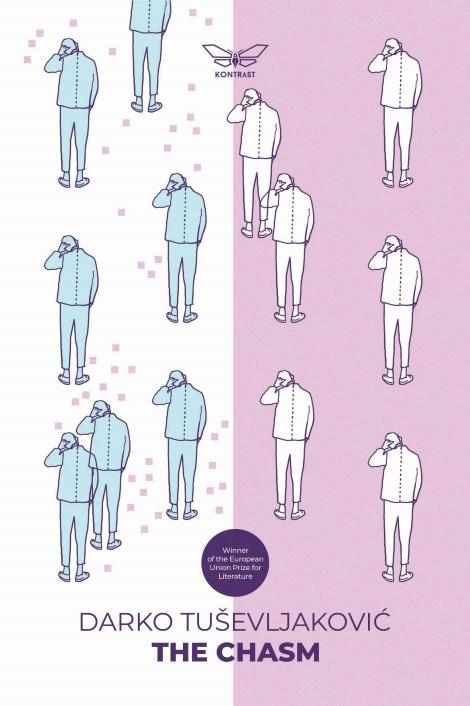
You have had one book appear in English translation, The Chasm, in 2020. What work would you like to see come out next in the Anglosphere?
I think my latest novel, Karota, could connect with readers who aren’t rooted in the soil of the Balkans. I say this despite, or maybe precisely because, such readers don’t share the experiences that the rest of us do, if we’ve been nourished by this soil. A good portion of the book deals with the early 1990s, when a previously large country, Yugoslavia, began to come apart at the seams. In this book I describe the fate of a group of boys from diverse ethnic groups, whose games, which are sometimes violent in their own right, are spoiled by the intrusion of the far more serious violence from the grown-up world, so that their childhood is rudely interrupted. The book describes the moment of fracture, the violent and unwanted interruption of one way of living and the beginning of another one. Another theme is migration, the way that leaving one territory for another one, the way changing one’s surrounding and context, affects a person. These things can shape someone; they can enrich them or disadvantage them. In that sense, I think that readers who are not too well informed about the breakup of Yugoslavia could recognize a universal problem that is today present everywhere in the world, even while it’s closely bound up with our Balkan experience.
You are also a translator, and many of your works are being translated, too. What makes a translation, or a translator, good?

Ah, that’s an awkward question, because the answer cannot be exact. There’s always that one element that it’s hard to put your finger on, something elusive, which is easiest to sum up in a sentence like this: they simply must be talented. Aside from talent as a necessary foundation for creative work – and I certainly consider translation to be creative work – then a translator also has to have a good knowledge of both languages they are dealing with. Often people erroneously emphasize the source language, by saying that the translator must have a stellar command of the language of the original text. This is, of course, true, but I would always add that they have to know the target language equally well. All too often I come across translations into Serbian in which it’s obvious that the translator is fluent in the source language but has problems with their mother tongue.
What will winning the NIN Prize, Serbia’s most prestigious literary award, do for you? What's it like to share the stage with writers like Danilo Kis, Dubravka Ugresic, David Albahari, Goran Petrovic?
Now I can put my drinks on a tab in the pub! Ha! … Well, of course it has put my work and me in a new light. [Karota] will now truly reach every interested reader, which can only be good for it and for me. I’m already getting tons of comments from people who have only now, after the NIN Prize, become familiar with my work, although this is my eighth book. The tradition and influence of the NIN are truly enormous in these parts. For decades now the NIN Prize has been the quintessence of a literary award, first in Yugoslavia and then in Serbia … and it’s a kind of “event” on the national level. Viewed in that way, there’s no greater recognition that a writer in Serbian can gain. So I can only be happy about this. I hear a lot of comments about how now that I’m a NIN laureate, I have a great responsibility, and my next work will be hard to write because of the award. But I have the opposite impression – that it will be easier than before. In other words, “Hey, I won the NIN Prize, and I can do what I want.”
Which of your novels is the most political? How so, and how has it been received?
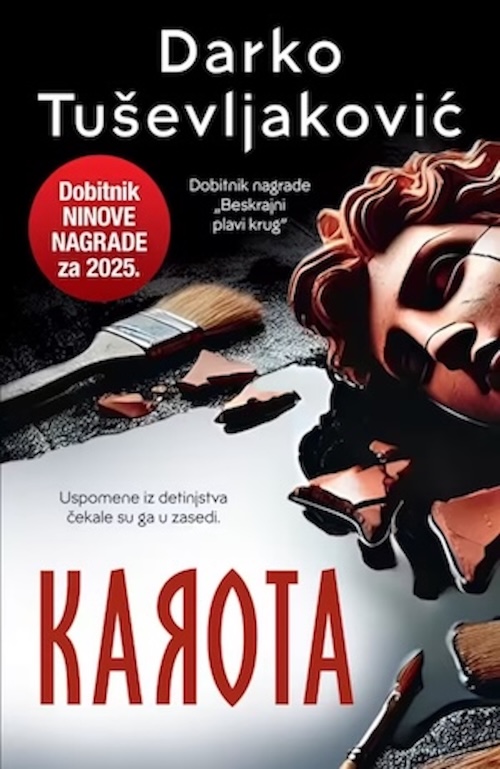
Karota is probably my most political novel. In it, the moment of the dissolution of the country and the moment when the war started to boil over in Croatia play important roles; a big section of the plot is set in exactly that time and place, and the characters are closely linked with those events, whether they instigate them or suffer their consequences (and it often happens that both of those things happen). Again, I don't believe that this is a political novel, because I truly wanted to avoid taking any “cheap” political stands, since they’re a trap that's easy to fall into. But the truth is that the novel does take up sensitive topics from our recent past. Karota is the story of the conflict between Serbs and Croats, but in telling it I never once mention the characters' national identifications, because I wanted to underscore the fact that I was not simplifying the characters, or their actions, or affixing a "label" of that sort on them. Actions and thoughts are what characters are supposed to be built of, and not considerations like who their father was or what church they go to. When you're writing about a conflict like ours, I think it's crucial not to reach for easy or cheap solutions.
Many readers reach out to me to say that they lived through similar experiences. Many of them see themselves in the events I have describe, and they recognize the emotion that the novel delivers. This means a great deal to me. On the other hand, there are those who wish that the book could explain the past for them and offer some definite answers about the war by explaining who was culpable for what, but I'm afraid a novel can't offer that. It was not my intention to do that.
Do you consider yourself a Serbian writer? Why or why not.
I feel certain that you would not pose this question to an American writer. No one would, for instance, ask Jennifer Egan or Jonathan Franzen if they consider themselves American writers. Because somehow that’s implied. But I understand why that’s a question that’s always asked of us people from the Balkans. Our recent (and, to be sure, also our older) history is full of geopolitical uncertainties, questions of national, territorial, and religious belonging, so that the phrase “Serbian writer” doesn’t mean the same thing today as it would have 50 years ago for example, or 150 years ago. But in my case the answer is simple and isn’t fraught with national or, God forbid, nationalistic issues: I consider myself a Serbian writer because I have been living in Serbia for decades and am a citizen of Serbia. That should be quite enough.
You were born in Bosnia but now live in Serbia. What were the circumstances, in those fateful years, of your move(s) to Belgrade?
I was born in Bosnia, but I lived there only briefly. As a baby, we lived in Montenegro, and then I attended kindergarten and elementary school in Croatia, where the war caught up with us. It interrupted our family’s journey up the Adriatic coast. It was on account of the war that we went from Zadar, the city I describe in the novel Karota, back to Bosnia, where my mother was born and where her relatives lived at the time. Many people, when the war broke out in Croatia, didn't believe that these conflicts would spill over into Bosnia, but that did happen, very quickly, so that a year later we had to leave Bosnia, too. My parents left Sarajevo in a military convoy and crossed over into Serbia, while my sister and I stayed behind. We were under blockade in the city of Zenica in central Bosnia with our grandparents, for about eight more months. Finally, the International Red Cross managed to get us out, on an improvised route. We went by jeep through the mountains and ravines of Bosnia to the Croatian city of Split. From there we flew to Zagreb and then went to Hungary in a van, where, finally, after three days of travel, we were met by another team of the Red Cross from Belgrade. I remember thinking, as I got out of the jeep, that my mother and father had shrunk – eight months had passed, and in that time I grew faster than ever. So it happened that my sister and I were met in Belgrade by these tiny little people instead of the big tall ones I had in my memory.
Rumor has it you are in love with your “chushkopek.” I think you have some explaining to do, mister.
The chushkopek [čuškopek] is a magical machine, the utilization of which is designated as the first step in the preparation of the even more magical product called ajvar. In this region, canning things and making preserves are a very important parts of our tradition. Sauerkraut, tursija (mixed pickled vegetables in a pot), jams and jellies – all of these things have been made in our households for generations, and a special category of these favorite products of ours consists of those that have as their main ingredient sweet red peppers. Among them, the most popular is ajvar, which is technically a roasted and then sweated spread of ground red pepper and spices (salt, oil, vinegar, hot pepper, and according to one’s taste, also ground eggplant). Ajvar comes to us from the neighboring countries of Bulgaria and North Macedonia, but Serbia is also famous for it, especially its southern regions. In my family we’ve made ajvar for generations, and as soon as I was in a position to start making it, I got the recipe from my mother and the above-mentioned chushkopek from my mother-in-law. A chushkopek, for the record, is a pepper roaster. Since we as a nation love to split into factions about every issue from sports to politics to history, we are also gastronomically divided: there are those who hold that real ajvar cannot contain any added eggplant, and those who love including eggplant because it adds a certain mildness and creaminess to the ajvar. Why is ajvar, and its preparation, good for a writer? Well, because it gives us a reason to get up from the computer and do some useful physical activity. Besides that, it connects us to a community, since this is not a job that anyone does alone. It’s done collectively. The making of tursija is also a well-nigh ritual task.
A final question about your writing: When you have an idea or an image you want to work with, do you know in advance if it will be part of a poem, a short story, or a novel?
I don’t think there’s any hard and fast rule here. Sometimes you know that a short story will emerge from the idea you have; it simply, in advance, seems to you that the volume of ideas is such that that is the form that would be the best fit. Sometimes you know that an idea is complex enough to branch out into a novel. And sometimes you have no idea, and the story will decide where it’s going to take you. For instance, once I was struck by a notion about an app that will locate the perfect partner for someone, but then those perfect partners disconnect from the remainder of the world; it was obvious to me that this premise held enough potential to produce a novel. Never mind that I shaped it first into a novella, and only later developed it into an even longer form! On the other hand, the novel Jegermajster I started to write with only one image in mind: a couple at the shore is trying to figure out how they got there, and from that a story grew spontaneously into a text of over 200 pages. An idea from a dream linked up naturally with the beach scene – and voila, a novel. But if I had stuck with that coastline, with that one scene, maybe it would have ended up as a little story just a few pages long. Therefore, sometimes everything depends on where the story takes you. I think ideas carry potential inside them: some of them will be better realized via a small format, while some have enough “meat” for a long format. Here’s the rub, though: the writer isn’t necessarily aware of that in advance.
How would you characterize the relationship between writers and publics and publishers from the former Yugoslavia? As the countries and, officially, the languages, diverge politically, what would you say is happening "on the ground"? When literature is shared and appreciated across these (new) borders, is the common thread one of "Yugonostalgia," or something else?
Some of the former Yugoslav states really do share a language in the sense that, while minor lexical and grammatical differences exist, we all understand each other perfectly well and we can read each other’s works without translations. For me, this means that it’s a unified cultural space in that way. I wouldn’t say that this perspective necessarily goes as far as Yugonostalgia, but rather simply the desire to share ever more experiences through literature, to satisfy our powerful curiosity for reading and creating. Why would you fence yourself off inside your own country if you understand perfectly well the people who live and create outside of it? What’s more, with everybody sharing the relatively cramped space of the Balkans, you find that you also share similar contexts, you recognize yourself in others, and you can identify with the troubles and joys of the author on the other side of the border. In fact, you are frequently facing some similar dilemma. How then can one not view this as a single cultural space? On what basis should we divide ourselves up inside it? At a time when the planet has become smaller than ever before, here we go, talking about divisions! If we go on like this, we will ultimately be left with the little pieces of ground the size of our feet that we can call “ours.” Everyone will have one square foot of soil, and those will be our “countries.”
How would you say the wars in ex-Yugoslavia affected your writing?
Well, I don't believe I’m weighed down by war-related themes or subjects related to the breakup of my former country. Somehow it seems like an expectation for us to write about it, but it isn't our only theme, nor should it be. I deal with the war when a story requires it, and to the degree it is necessary in that story. Sometimes this means just echoes of the past, reminders of the war years, of refugees or the deep crisis in which Serbia found itself in the 1990s. Reminders of the protests, the reign of Slobodan Milosevic, and things like that. Some of that is in my stories and novels, but it's never the dominant theme. It's more a part of the background or the set, the atmosphere, giving the appropriate context for the plot.
Vegemite or Marmite?
Ha! This is always changing. For a long time, Marmite was in first place, but recently I have become fonder of the Australian version, mostly because of the consistency. It spreads more easily. But I do not protest at all when everybody who comes to visit me brings a jar of one of these spreads so that I can “put some oomph in my breakfast.”
John K. Cox is a professor of East European history at North Dakota State University in Fargo. He specializes in Balkan and Central European intellectual history since 1815. He has published dozens of literary translations, including books by Danilo Kis, Biljana Jovanovic, and Judita Salgo, and is currently translating Isidora Sekulic.
This interview was supported by the Fund for Central & East European Book Projects, Amsterdam.
Latest News

Czechia Moves to Break Cycle of Period Poverty
by Jules Eisenchteter
07 Jan 202607 Jan 2026

Defending Nature at a Cost
by Nikolija Codanovic
05 Jan 202611 Jan 2026

Our Best Stories of 2025
by Transitions
23 Dec 202512 Jan 2026

We Stood It. We Had No Choice.
by Petr Horky
22 Dec 202522 Dec 2025