Why "Nius" has no place in the Federal Press Conference!
Volksverpetzer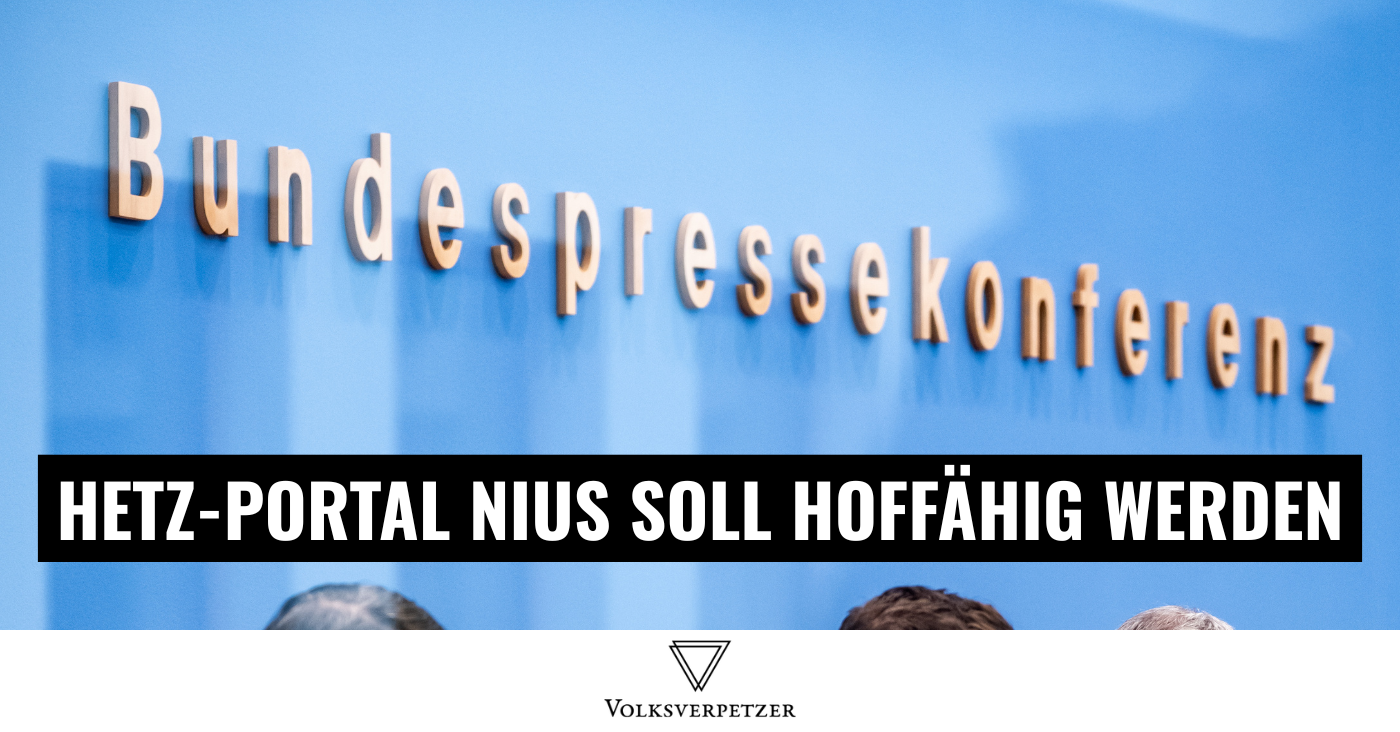
A controversial figure at the federal press conference raises questions: Should media outlets with a controversial past or ideological orientation be represented there? How can the independence of the press be maintained and disinformation effectively combated? The debate about "Nius" and its actors is not yet settled.
The deputy head of the protest portal “Nius,” Pauline Voss, wants to join the Federal Press Conference. That is not a good idea. Freedom of the press does not apply to disinformation.
Is this journalism – or can it be ignored? The online medium “Nius” has been accompanied by this question since its launch in 2022. Some say that the right-wing populist portal run by former “Bild” boss Julian Reichelt “of course” belongs to the “free media landscape in this country” – for example, the notorious public broadcasting critic Alexander Teske (book “Inside Tagesschau”).
Others view the portal critically – for example, journalist Malene Gürgen. In 2023, she wrote in the “taz” under the headline “Fundamental principle twisted facts” that the portal, financed by the CDU-affiliated billionaire Frank Gotthardt, offers “a stage for right-wing hate speech.” Who is right now?
In this discussion, which was recently fueled by Kiel’s Prime Minister Daniel Günther of the CDU, a personnel matter has now burst onto the scene: Pauline Voss, deputy editor-in-chief of “Nius,” has applied for admission to the Federal Press Conference, the association of parliamentary correspondents working in Berlin (a few are also in Bonn), who regularly report on federal politics.
Voss would be the third representative of “Nius” in the registered – and independent of the federal government – association, with Julius Böhm and Ralf Schuler already involved.
The membership committee of the BPK has approved Pauline Voss’s admission. The membership was notified last Thursday. According to Paragraph 11, Section 1 of the statutes, the decision becomes effective unless objections are raised within ten days. The deadline runs until March 15. Several such objections already exist, so the membership committee must reconsider the personnel matter. The outcome is open.
“Voluntary self-surrender” of the BPK?
The journalist and right-wing extremism expert Silvio Duwe, who regularly contributes to the ARD magazine “Kontraste,” accuses “Nius” & Co. of “hate and intimidation campaigns.” On Bluesky, Duwe, who is not a member of the BPK himself, comments on Pauline Voss’s application for membership:
“Associations where journalists organize themselves should have an interest in drawing a clear line between critical journalism and propagandistic and conspiracy-ideological actors. The BPK has apparently decided on voluntary self-surrender instead.”
An employee of public broadcasting, who has been organized in the Federal Press Conference for many years, accuses “Nius” and its editors of “maintaining enemies among public broadcasters and their actors (including BPK members) and exaggerating mistakes in a libelous manner, sensationalizing without seeking statements.” The colleague does not want to be named for this statement at this time.
Considering the more than 900 members of the BPK overall, the number of a handful of people involved in the portal for alternative media seems small. An editor of the AfD-affiliated internet radio Kontrafunk is a member – he previously worked as a chief correspondent for ARD in Berlin. The far-right “Junge Freiheit” also has a correspondent in the BPK, as does the left-wing “Junge Welt.” Roland Tichy has guest status, and a colleague of his is an official member. In early 2025, a journalist from “Epoch Times”, a far-right fake-news media outlet, was admitted to the association.
Discussion about Reitschuster and Warweg
However, these few actors can be very loud: In 2021, the “Süddeutsche Zeitung” described how some participants misuse the BPK event: Some journalists and bloggers – “especially Boris Reitschuster and Florian Warweg are repeatedly mentioned” – use the event very successfully as a stage for conspiracy myths and fake news. Deutschlandfunk asked about this in a report
“Has the Federal Press Conference become a stage for self-promoters and spreaders of disinformation? Has the Federal Press Conference been ‘hijacked’?”
The right-wing blogger and former Moscow “Focus” correspondent Reitschuster is no longer a member of the BPK. The association ended his membership at the end of 2021 after he moved its headquarters to Montenegro.
Warweg, on the other hand, was never a member of the BPK – but he has been using it as a stage for years. Until early 2022, he had participation and questioning rights as a member of the Foreign Press Association (VAP), then as a correspondent and online chief of the Russian state-funded channel RT Deutsch. After the start of the Russian invasion – and the ban of RT Deutsch in Germany – Warweg fought in 2023 before the Berlin Regional Court to be treated by the BPK “like a member” – without formal membership. Warweg has since switched to the conspiracy-ideological “Nachdenkseiten”.
“Lifelong BPK”
Since early 2026, he has been working for Holger Friedrich’s newspapers “Berliner Zeitung” and “Ostdeutsche Allgemeine”. In the first issue, published at the end of February, Warweg introduced his activity in the BPK on one page, headline “The Silent Censorship”. He wrote that the Federal Press Conference increasingly fails to meet the claim of being a place of critical public discourse. A few days ago, it was announced that the BPK had withdrawn its appeal in the Berlin Regional Court regarding Warweg’s membership.
Warweg celebrated on X: “So now I can legally and de jure participate in government press conferences and other BPK press conferences with questioning rights without restriction.” His lawyer explained to him: “Mr. Warweg, that means lifelong BPK for you.” This special status “also has advantages,” Warweg stated. He still needs to “consult whether we leave it at this status or if I apply again for full membership.” In other words: The Federal Press Conference appears quite powerless in his case. And not only in this one.
Böhm and Schuler already involved in “Nius”
Back to “Nius”: The two mentioned representatives of the protest portal, Julius Böhm and Ralf Schuler, have already been involved with their former employer, the “Bild” newspaper, in the Federal Press Conference and have taken their membership with them. Pauline Voss, who previously worked for the “Neue Zürcher Zeitung,” is the first to submit the application for “Nius” herself.
In 2025, Pauline Voss played a significant role in the campaign against NGOs. The thesis behind her video published on “Nius” in June 2025: Non-governmental organizations are financed by the government to create a “countermeasure” “against their own population,” even “fighting” them – as the “Süddeutsche Zeitung” quoted Pauline Voss.
The YouTuber Jasmin Kosubek, a former long-time host on the Russian propaganda channel RT Deutsch (“The Missing Part”), then presented Voss for an hour in her podcast and claimed that non-governmental organizations conduct “state-funded political agitation.” Kira Ayyadi wrote in contrast on “Belltower News”, a portal of the Amadeu Antonio Foundation: “The extreme right tries to dismantle democratic civil society. An important helper is ‘Nius,’ from the media network around Julian Reichelt.”
Freedom of speech for the “Stürmer”?
In January 2026, the Lower Saxony Ministry of the Interior posted a photo of the Nazi extermination camp Auschwitz on Holocaust Memorial Day, along with the sentence: “It did not start with gas chambers, but with words.” Voss took a screenshot of this post and shared it with the remark: “On Holocaust Memorial Day, the SPD Ministry of the Interior comes up with nothing better than to misuse the victims for agitation for freedom of speech and to suspect ‘words’.”
Former CDU Secretary General Ruprecht Polenz commented that Voss criticized the note, “that words preceded the gas chambers. She does this in the name of freedom of speech and claims it also for the ‘Stürmer’ – because its words, in her view, had nothing to do with the gas chambers.”
The then and current BPK chair Mathis Feldhoff said in 2021 that there are no “established or non-established colleagues” in the association and also “no right or wrong questions.” The Federal Press Conference is the “heart of freedom of expression.” He does not want to comment on the current case of Pauline Voss – just as he generally does not comment on “internal member questions.”
Agenda: Kremlin propaganda?
But how does the association of parliamentary correspondents draw the line to disinformation and ideology, as well as to the numerous right-wing portals that sell themselves as “alternative” or “free” media? How about – also on the agenda with Florian Warweg in the BPK – Kremlin propaganda?
A few years ago, the association sharpened its statutes as a consequence of the discussion about Reitschuster and Warweg. It now states: “The press conferences of the Federal Press Conference serve to impart political information, statements, and positions in a factual, fact-oriented, and fair manner. The Federal Press Conference thus contributes to a liberal, critical, and independent discourse in democratic public.”
Ann-Katrin Müller from the “Spiegel” capital bureau, referring to the passage about “factual, fact-oriented, and fair” reporting, says: “I do not see how this can succeed if right-wing populist actors are given more space for their rowdy and partly conspiracy-ideological questions.”
Motto of the Federal Press Ball: “Strengthen Press Freedom”
In April, the 73rd Federal Press Ball will take place, organized by the Federal Press Conference. This year’s motto is: “For Democracy – Strengthen Press Freedom.” The press ball magazine includes a “Press Freedom Dossier.” It addresses, among other things, how autocrats discredit media and question their credibility. It shows how the United States, as well as Hungary, Poland, Slovakia, and several other countries, have been demonstrating for years how democratic institutions are hollowed out and especially how press freedom is increasingly restricted. It also describes how Donald Trump initiates lawsuits against unwelcome journalists and media outlets. “This cannot happen in Germany,” the magazine states, “thinking with a disbelieving look across the Atlantic – and being mistaken in this assumption.”
Strengthening press freedom must also mean protecting an venerable institution like the Federal Press Conference from attacks by ideologues and propagandists. Specifically, this implies that “Nius” does not belong in the Federal Press Conference. And some other media represented there should at least be considered as suspected cases. It is about protecting the Federal Press Conference from disinformation, ultimately saving it. How to implement this demand must be discussed promptly by the association.
Transparency notice: The author of this text has been a member of the Federal Press Conference since 1994, initially as a parliamentary correspondent in Bonn for the “Sächsische Zeitung,” from 1999 to 2021 as a political correspondent for the “Tagesspiegel,” and since then as a freelance journalist. He was among those who filed objections in 2022 against the admission of Florian Warweg. And has now also done so in the case of Pauline Voss.
Article image: Michael Kappeler/dpa