How Subprefect Gârbaciu turned public events into a political platform
SudvestTârgu Jiu, April 1, 2026 — The dismissal of the former deputy prefect of Gorj, Iani Gârbaciu, has sparked a debate about how government representatives use local events, public resources, and official exposure to promote their personal image or relationships with a certain party. A photograph taken in Turceni, in March 2025, provides an example […]
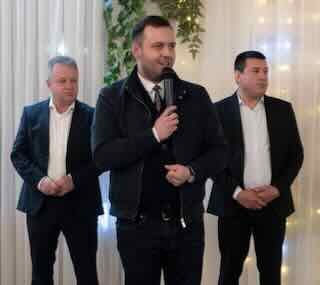
Târgu Jiu, April 1, 2026 — The dismissal of the former Deputy Prefect of Gorj, Iani Gârbaciu, has sparked a debate about how state representatives use local events, public resources, and official exposure to promote their personal image or relationships with a certain party. A photograph taken in Turceni, March 2025, provides a relevant example: Gârbaciu appears alongside Deputy Ion Iordache and the city mayor, both PNL, at an event funded by the city hall, where no other political formation was invited.
Meanwhile, the recent accusations made by Gârbaciu against the prefect Șerban Predescu — regarding alleged political pressures and restructuring based on party criteria — received a firm and detailed response in the program “Dialogul Zilei”. – Gorj Online
The Turceni event — public visibility within a unilateral political framework
The photo taken at the Women's Day event in Turceni (March 8, 2025) shows three speakers lined up in front of a large audience: Deputy Ion Iordache, the PNL mayor, and Deputy Iani Gârbaciu. According to the city hall's official website, the event:
- was funded from the local budget,
- had a festive character,
- was organized by the local authority,
- included speeches by the three.
No other political party was invited, and given the position he held, Gârbaciu's appearance in an exclusively political-party setting raises a clear issue: impartiality of the public office.
In practice, a Deputy Prefect participates in community events.
However, positioning on stage, aligned with the leaders of a single political formation, at an event financed with public money, creates an appearance of partisanship that is hard to ignore.

Why does this image matter — a brief legal explanation
The Deputy Prefect position is appointed politically but exercised institutionally, not partisan.
Constitution of Romania, art. 123
The Prefect and Deputy Prefect are representatives of the Government and guarantee neutrality of the institution regarding politics.
Administrative Code
Prohibits any actions that may create the appearance that the prefecture institution favors:
- a city hall,
- a political party,
- a local elected official.
Law 188/1999 – Public Officials Statute
Includes principles of:
- impartiality,
- objectivity,
- integrity,
- acting in the citizens' interest.
Participating in a politicized event is not illegal, but exclusive, repeated, and visible association with a particular political camp can affect the credibility of the institution the Deputy Prefect represents.
What Prefect Predescu says: “All of Mr. Gârbaciu’s statements are false”
In the program “Dialogul Zilei” (Gorj Online, March 30, 2026), Prefect Șerban Predescu dismissed the accusations of the former Deputy Prefect.
Regarding accusations of political pressures:
“All of Mr. Gârbaciu’s statements are false.”
– Șerban Predescu, Gorj County Prefect
Regarding restructuring:
Predescu explains that the personnel reduction was imposed by a national normative act:
“The restructuring is a national measure, imposed by Ordinance 7/2026, with a 25% reduction in positions. In Gorj, we went from 46 to 36. No decision was based on political criteria.”
He emphasizes that departures were made through:
- transfer,
- retirement,
- competition.
There were no politically motivated dismissals.
Regarding Gârbaciu’s activity:
The prefect mentions performance issues in managing operational situations, including an incident that led to sanctions:
“There was a water pipe failure, poorly managed, which resulted in a fine from the Environmental Guard.”
Regarding the communication style of the former Deputy Prefect:
“Mr. Gârbaciu’s style focused on personal image, with live streams and posts, at the expense of institutional activity.”
Personal visibility — between public communication and political self-promotion
Gârbaciu was extremely active in the public space:
- live broadcasts on Facebook and TikTok,
- speeches at events with electoral undertones,
- participation in local ceremonies alongside PNL leaders,
- constant media presence on social networks.
This style, although effective for personal profile, is risky for a high-level public official.
Core issue:
A Deputy Prefect is not a messenger for a party.
He is the representative of the Government in the territory.
When public exposure becomes predominantly political, the institution itself can be perceived as part of an electoral battle.
What the Gârbaciu case reveals about local administration in Romania
The situation is not isolated.
It is part of a broader reality, common in Romanian administration:
- Appointments are political.
- Responsibilities require neutrality.
- The practical reality leads to confusion between the public role and partisan interest.
The Turceni photograph and subsequent reactions show an administration where legal boundaries are often interpreted flexibly, and the perception of partisanship becomes inevitable.
g Conclusion — A case raising questions about transparency, impartiality, and accountability of public functions
Gârbaciu’s accusations have not yet been supported by documents.
However, criticisms regarding his public exposure are supported by:
- official appearances,
- photographic evidence,
- his own public broadcasts,
- testimonies of the prefect.
For the citizens of Gorj County, the essential issue is not the personal conflict between two officials, but the central question:
Can a Deputy Prefect appear as part of a unilateral political event, funded with public money, without affecting the neutrality of the institution he represents?
The legal answer is clear:
The public function requires impartiality.
The civic answer depends on how the community chooses to interpret these behaviors.
Verified information is your shield against lies
If you’ve reached this point, it means you are one of the Oltenians who do not settle for half-measures. The article you just read required hours of research, cross-checks, and the courage to challenge state institutions.
At Sudvest.ro, we have no behind-the-scenes “moguls”, political parties, or local barons. We only have you. Our independence depends solely on community support.
We do not ask for a donation, but for a partnership. If you believe that Oltenia needs journalists who know how to count public money and bring the truth to light, support us to continue. Any amount helps an investigation move forward.
Invest in honest journalism through the Eurolife Association:
 Lei Account (RON): RO93 RNCB 0149 1519 0979 0008
Euro Account (EUR): RO66 RNCB 0149 1519 0979 0009

Editorial Note: Sudvest.ro commits to correct, objective, and source-verified information. In the spirit of transparency and professional ethics, we offer the right of reply to any individual or legal entity who considers that the information presented in this material is incomplete or erroneous. Opinions and correction requests can be officially sent to the email address: salut@sudvest.ro.