THE DISASTER AT UM Sadu: How 20 million euros "melted" from workers' pockets. The forest along the railway and the humiliation at Bumbești-Jiu
SudvestBy Marius Daea In Bumbești-Jiu, time is not measured in hours but in layers of rust and shoots piercing through railway ties. Here, where the Carpathians begin to tighten the banks of the Jiu River, lies the Sadu Mechanical Plant — a state giant that, on paper, produces national security, but in reality, produces a form […]
By Marius Daea
In Bumbești-Jiu, time is not measured in hours, but in layers of rust and shoots piercing through railway ties. Here, where the Carpathians begin to tighten around the banks of Jiu, lies the Sadu Mechanical Plant — a state giant that, on paper, produces national security, but which, in reality, produces a slow and silent form of despair.
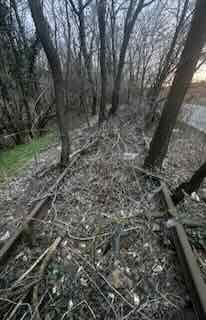
If you walk along the industrial railway lines connecting the plant to the rest of the world, the scene is almost poetic, if not tragic. Young trees have grown directly between the rails, embracing the steel that once carried wagons loaded with munitions. And in the middle of this post-apocalyptic landscape, someone has “planted,” with absurd precision, a concrete electricity pole. It is the perfect monument of incompetence: an investment that blocks another investment, a symbol of a system where the left hand not only doesn’t know what the right is doing but seems to actively sabotage it.
Pay Slip: A Fiction of 20 Million Euros
For the 517 employees of the plant, the drama is not visible on the rusty rails, but on the piece of paper they receive every month: the pay slip. On this document, the Romanian state plays a cynical theater. Every month, for the past thirteen years, workers have had their pension and health contributions withheld. The figures are there, written in black and white, deducted from their gross income.
However, beyond the accounting window, the money evaporates. Official documents obtained by sudvest.ro reveal a black hole of nearly 100 million lei (approximately 20 million euros). This is the total amount that UM Sadu has withheld from people's pockets but has never transferred to pension and health budgets.
It is a form of forced “loan,” a withdrawal of financial organs from an aging workforce, to keep alive an industrial organism that refuses to adapt. A worker who has sweated over a decade in production sections might discover, at retirement age, that the state considers him a spectator, not a contributor.
Forgiveness as Vice
The story of UM Sadu is also the story of a governmental indulgence turned into vice. From 2001 to today, the Romanian state has erased the plant's debts with an almost ritual frequency. Three major “forgiveness” acts have wiped over 207 million lei (over 41 million euros) from the playing field.
In any other economic universe, such an infusion of clemency would lead to a rebirth. At Sadu, it led to a fatal relaxation. Every time debts were forgiven, the plant, with a perseverance worthy of a better cause, began accumulating new ones. Today, the total debt has again reached the threshold of 143 million lei (28.6 million euros).
This figure is not just an accounting statistic; it partially represents the debt to the local community. The 11.5 million lei (2.3 million euros) owed by the plant to the town of Bumbești-Jiu are schools that haven't been modernized, unpaved streets, and a local future under sequestration by an industrial neighbor that no longer pays its share.
The Geopolitics of Failure
The plant's management invokes major forces: Serbian embargoes on gunpowder, the collapse of steel suppliers from Galați. These are explanations that sound noble in a report, but do not explain why the forest has grown over the railway.
In a county like Gorj, already plagued by the decline of mining, UM Sadu should have been an anchor. Instead, it seems to be a wreck dragging behind it, in the depths, not only the money of the state but also the social security of those who still believe in the sound of the siren at seven in the morning.
In the end, we are left with the image of that concrete pole in the middle of the railway lines. It does not only carry electricity; it carries the certainty that, at Sadu, the road to the future has been blocked precisely by those who should have lit it.

THE RADIOGRAPHY OF FAILURE: Figures that bury UM Sadu
For full transparency, we present the situation of the debts accumulated by the Mechanical Plant Sadu, according to official documents (as of 28.02.2024), converted at an estimated rate of 1 EUR = 5 RON:
1. Money withheld from employees and not transferred to the state (Withholding at source):
-
Pension Contribution (CAS): 55,324,281 lei (~11,064,856 euros)
-
Health Contribution (CASS): 23,939,732 lei (~4,787,946 euros)
-
Income Tax (salaries): 20,581,184 lei (~4,116,236 euros)
-
TOTAL money withheld from people: 99,845,197 lei (~19,969,038 euros)
2. Debts to the community and the state:
-
Debt to the Local Budget (Bumbești-Jiu): 11,500,000 lei (~2,300,000 euros)
-
Other fiscal obligations to the State: 32,126,964 lei (~6,425,392 euros)
TOTAL CURRENT DEBT: 143,472,161 lei (~28,694,432 euros)
3. History of “Forgiveness” (Debts forgiven by the Government 2001-2022):
-
Total debts forgiven: 207,339,648 lei (~41,467,929 euros)
- CHECK THE UM SADU AND BUMBESTI JIU TOWN HALL DOCUMENTS HERE
The verified information is your shield against lies
If you have reached this point, it means you are one of the Oltenians who do not settle for half measures. The article you just read required hours of research, cross-checking, and the courage to disturb state institutions.
At Sudvest.ro, we have no “moguls,” political parties, or local barons behind us. We only have you. Our independence depends solely on community support.
We are not asking for a donation, but for a partnership. If you believe that Oltenia needs journalists who know how to count public money and bring the truth to light, support us to continue. Any amount helps an investigation to go further.
Invest in honest journalism through the Eurolife Association:
 RON Account: RO93 RNCB 0149 1519 0979 0008
EUR Account: RO66 RNCB 0149 1519 0979 0009
- Editorial Note: Sudvest.ro commits to correct, objective, and source-verified information. In the spirit of transparency and professional ethics, we offer the right of reply to any individual or legal entity that considers the information presented in this material to be incomplete or erroneous. Opinions and rectification requests can be officially sent to the email address: salut@sudvest.ro.