🌿 EXCLUSIVE: "The Fruit of the Earth" has spoken! What will the harvest be like in 2026? The ancient secret read in a mysterious plant
SudvestFor generations, in the villages of the Southwest of the country, complicated weather forecasts or satellites are not used to determine how the agricultural year will be. Our elders have a natural "barometer," a rare plant full of significance: the Fruit of the Earth. Today, we analyze an image received from our readers and interpret the signs that nature shows us…
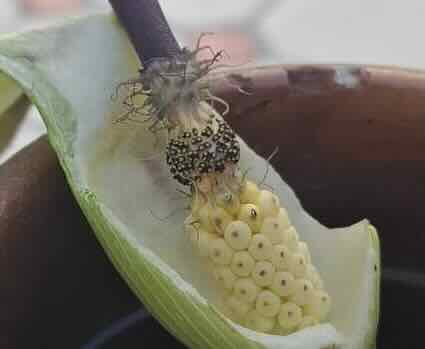
For generations, in the villages of the South-West of the country, people haven't used satellites or complicated weather forecasts to find out what the agricultural year will be like. Our elders have a natural "barometer," a rare plant full of significance: the Fruit of the Earth. Today, we analyze an image received from our readers and decipher the signs that nature sends us.
By [Marius DAEA/Editorial Office South-West.ro]
Every spring, under the foliage of the forests in Oltenia or at the edge of shady gardens, a plant appears that seems straight out of legends: The Fruit of the Earth (Arum maculatum in scientific terms, but a "harvest calendar" for the Oltenians).
It is not an ordinary flower. Our village elders say that this plant "speaks" about the abundance or shortages awaiting us in the barns and cellars. It is not science, it is a spiritual and observational heritage of thousands of years.
 Interpretation of the “Fruit”: What does the plant in the picture tell us?
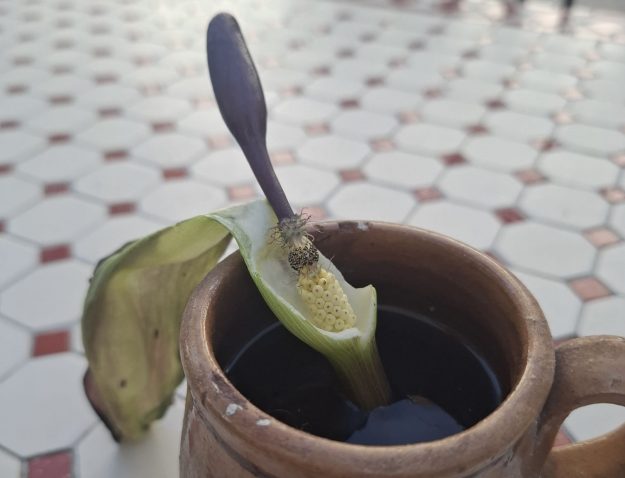
If we look carefully at the photo received at the editorial office, we see the plant cut open, revealing the interior “ear of corn.” Here is how its elements are deciphered, according to Oltenian tradition:
-
The grains at the base (Corn and Wheat): We observe at the bottom a cluster of yellow grains, well-defined and full. In popular tradition, this represents the cereal harvest. The fact that they are dense and “fat” is an excellent sign: a bountiful year is announced for corn and wheat! Barns will be full if the land is worked with love.
-
The middle part (Fruits and vegetables): The intermediate zone, where the grains seem more sparse or finer, indicates the state of the vegetable gardens. Here, the plant tells us that extra attention and perhaps more water will be needed to have the desired yield.
-
The purple stalk (Wine and Vine): The long, dark-colored stalk (the upper part, like a purple tongue) represents the grapevine's fruit. The longer, more vigorous, and darker it is, the more the wine will be “black,” stronger, and more abundant. In our picture, the stalk appears healthy and straight – good news for winemakers!
-
In this close-up image, the Fruit of the Earth reveals its secrets exactly as our grandmothers deciphered them on spring mornings. Look carefully at the perfect compartmentalization of the interior “ear of corn”: The golden grains at the base: They are large, round, and well-developed. Elders say this is the clearest sign for corn. The fact that they are so prominent this year gives us hope for a bountiful agricultural year, with plenty of corn for animals and warm polenta on the table. The middle zone (dark grains): This represents the wheat and cereal harvest. Notice their density? Tradition says that if this area is “full,” the harvest will be tough but fruitful. The wheat will be heavy in the spike, and the flour will be of good quality. The vigorous stalk above: Here, the “wine” is “read.” The dark color and firm texture promise a fall with sweet must and wine that “keeps” through winter. It is amazing how a simple wild plant can concentrate, in a single form, all the hopes of the Romanian farmer. Looking at this photo, what do you think? Is a prosperous year ahead for your farm?
 “Grandma used to say...” – What do you know about the Fruit of the Earth?
This plant is surrounded by an air of mystery. Some elders say that if you find it “blind” (without the interior fruit well formed), the year will be dry. Others consider it a protector of the household.
We want to hear your story!
-
Have you heard of the “Fruit of the Earth” from your grandparents in Oltenia, Mehedinți, or Dolj?
-
How is the plant “read” in your village? Are there other signs?
-
Do you believe in these old predictions or see them as beautiful legends?
Leave us a comment below! The most beautiful stories and interpretations will be published in a future article, because tradition must not die, it must be told!