Kosovo’s Serb Students Caught in Limbo
Transitions
Parallel education for the Serbian minority has evolved into a durable political instrument, leaving students to navigate a future shaped less by choice and more by unresolved political divisions.
Parallel education for the Serbian minority has evolved into a durable political instrument, leaving students to navigate a future shaped less by choice and more by unresolved political divisions.
NORTH MITROVICA and PRISTINA, Kosovo | Nemanja Dicic walks slowly away from the campus of the University of North Mitrovica, where he studies sociology. The cafes nearby are among the few places he frequents. “We don’t have much to do here, but we’re used to it,” he told Transitions.
He was born in North Mitrovica after his family was displaced from Lipjan, a small town in central Kosovo, to the Serb-majority north in the aftermath of the 1998-1999 war.
Dicic expects to graduate this year and his main concern now is whether to continue his studies in Belgrade or pursue opportunities abroad.
His university issues diplomas within a parallel education system based on Serbia’s curriculum. To achieve his goal of a job in public administration in Kosovo, he would need to undergo a verification process through a temporary government commission.
“There’s a sense of transience,” he added.
Roots of Segregation
Nearly two decades after Kosovo declared independence, the integration of Kosovo Serbs who continue to operate within a Serbia-administered education system remains one of the country’s most persistent challenges.
The Serbian parallel education system in Kosovo comprises more than 100 primary and secondary schools funded by Serbia and operating under the Serbian national curriculum. Serbia’s Ministry of Education provides these schools with textbooks, diplomas, and official documentation, while teachers and support staff are supervised and managed from Belgrade.
During the Yugoslav period, the University of Pristina offered instruction in both Albanian and Serbian and formally operated in the same premises, but participation was often unequal and, in practice, segregated.
In the early 1990s, after Kosovo’s autonomy was revoked, Albanian professors were dismissed for refusing to abandon the Albanian-language curriculum and sign loyalty pledges to Serbian authorities.
As a result, Albanian-language education was driven underground, with Albanians establishing a parallel system in improvised facilities.
Following the war, with the establishment of a United Nations mission in Kosovo (UNMIK), Albanian students and staff returned to official school buildings.
Meanwhile, Serbian-run faculties were relocated to Serb-majority areas of Kosovo or to southern and central Serbia. Unlike the earlier Albanian parallel system, however, these institutions have continued to operate within public facilities and are directly funded by the Serbian state.
Education was only one component of a broader network of parallel structures, which also included courts, security and administrative bodies, schools, healthcare, and other public institutions. The education parallel system is the main component of Serbia’s remaining parallel institutions.
“My father is a teacher, and he used to say that a parallel education system would create a deep and lasting division,” Dicic said.
His institution is officially called the “University of Pristina, temporarily located in North Mitrovica,” even though it is no longer based in the city it is named after and has no formal connection to it. Dicic describes a reality within the university that operates entirely outside the framework of the Kosovo state.
“The very name of the university insists on keeping the past alive. But I don’t think anyone actually wants to be relocated to Pristina,” he said.
Educational policies and practices in Kosovo remain heavily shaped by a prolonged and unresolved political impasse, reflected in the existence of two completely separate systems.
“Our university must remain within the system of Serbia,” said Nebojsa Arsic, the rector of the University of North Mitrovica.
Ten faculties operate within the university and, according to Arsic, more than 13,000 students, the majority of them Kosovo Serbs, have graduated over the past decade across all three levels of study.
Normal, for Now
As Serbian schools continue to operate in Serb-majority parts of the country despite Pristina’s repeated claims of the need to integrate them into the national education system, many Serbs are now worried about the implications of a new law.
Last month, Kosovo began implementing a new Law on Foreigners, which would make it impossible for some university staff to remain in Kosovo for more than 90 days, as they lack Kosovo citizenship or valid Kosovo-issued documents.
However, following reactions from the international community, the government agreed to a compromise, postponing full implementation and granting one-year residence permits to Serbs without Kosovo-issued documents.
Arsic said the arrangement allows the university to continue “operating normally” within the Serbian system for now.
Inside the university, however, many young people describe a sense of uncertainty and limbo.
Luka Pecenkovic, a philosophy student originally from Cacak in Serbia, spoke about the lack of space for young voices in Kosovo.
“Now we face basic questions: under which system will we study, how will we live, and whether we will even remain here,” he said.
In his view, Serbia should prevent the integration of his university into the Kosovo system.
“The founders of the university, the Serbian state, have turned their backs on us. We have to stop pretending everything is normal,” he added.
Support, direct and indirect, from the international community has contributed to this long-unresolved issue, helping sustain the Serb-run parallel system. The 2003 higher education law promulgated by UNMIK further formalized this separation, enabling the establishment of a university for Serbs in the northern part of Mitrovica, a city divided by the Ibar River into a southern, mainly Albanian part, and the almost entirely Serbian section on the far bank.
Erasmus+, an EU program supporting education, training, and youth across Europe, is among the initiatives from which the university benefits, enabling it to participate in programs funded by the European Commission.
Elizabeth Gowing chairs a Kosovo government commission established to verify the diplomas of University of North Mitrovica graduates who seek employment in public administration. She said the commission provides a degree of stability while at the same time keeping the unresolved status of the university in the public eye.
“The Diploma Verification Commission is a temporary, affirmative measure, never intended as a long-term solution,” Gowing said. “It should maintain attention on the need to secure a sustainable solution for citizens of Kosovo who wish to pursue higher education in one of the country’s official languages.”
After declaring independence from Serbia in 2008, Kosovo made little effort to integrate the parallel Serbian system and offered few opportunities for inclusion. Beyond regularly issuing invitations to develop a unified curriculum, which have just as regularly been rejected by the Serb side, there were no further meaningful efforts.
The EU continues to support Kosovo Serb students through various higher education programs, including opportunities for students to spend time at universities in other countries.
Afraid of History
Kosovo’s education system is predominantly Albanian-language, but it also offers instruction in Bosnian and Turkish in different parts of the country.
“Kosovo is ready to integrate the Serbian community into the Republic of Kosovo’s education system, and we invite representatives of the Serbian community and the Serbian education parallel system to participate in drafting the curricula,” the Ministry of Education said in an email. “However, they have so far refused to cooperate.”
One of the most frequent concerns raised within the Kosovo Serb community about integrating the two education systems is that children would be forced to learn a “slanted” version of history, because history, especially the recent history of the former Yugoslavia, is taught in entirely different versions. In Serbian-language textbooks, Albanian civilian victims of 1998–1999 are not mentioned, while only Serbian victims are included. Serbia is also portrayed as a victim in the process of the violent disintegration of the former Yugoslavia.
In the municipality of Gracanica, just outside Kosovo’s capital, Pristina, a primary school continues to operate under the parallel system. Teachers there are open and direct when discussing the future. “We can’t predict what will happen decades from now, but I don’t see any change in the curriculum,” said Verica Cvetkovic, a young teacher.
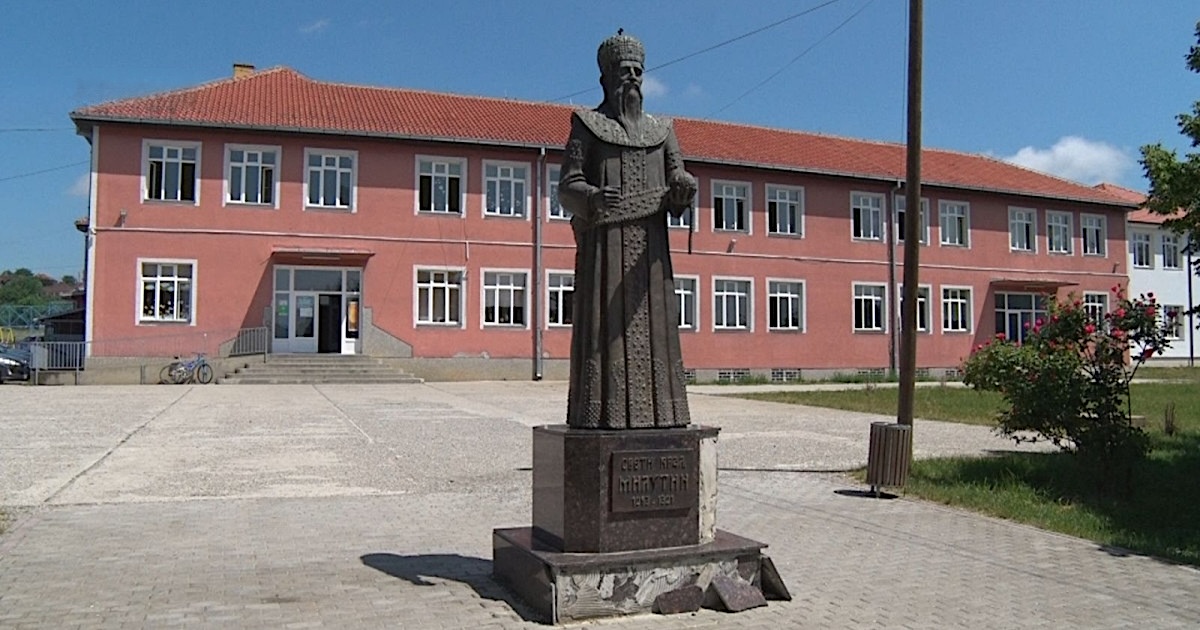
While most Serbian parallel structures have been dismantled or reduced over the years, education and healthcare remain two key sectors directly funded by the Serbian state, through which Belgrade continues to exert influence over the estimated 53,000 Serbs living in Kosovo, according to census data, although many Serbs in the north boycotted the 2024 census.
Blazo Dragovic, head of the school administration for Kosovo within Serbia’s Ministry of Education, rejected any prospect of integration. “We will remain independent of the authorities in Pristina and continue operating under the system of Serbia’s Ministry of Education,” he said.
“Maintaining the Serbian curriculum in 103 schools across Kosovo’s Serbian enclaves gives Serbs an important reason to remain in the territory,” he added.
The parallel education system run by Serbia in Kosovo serves thousands of young people, and its integration within Kosovo’s framework inevitably raises direct political implications.
The EU-facilitated dialogue on the normalization of relations between Kosovo and Serbia has largely avoided addressing education-related issues.
Dukagjin Pupovci, head of the Pristina-based Kosovo Education Center, an organization focused on education policy, argues that the status quo is unsustainable. “The integration of the parallel Serb education system requires in-depth dialogue with the Serbian community,” he noted.
Pupovci added that the EU, as the sponsor or participant in agreements such as the mutual recognition of diplomas in the Western Balkans under the Berlin Process, should take a more active role in ensuring their implementation. “This situation cannot continue indefinitely,” he reiterated.
Flora Ferati-Sachsenmaier, research coordinator at the Max Planck Institute for Dynamics and Self-Organization in Goettingen, Germany, who has worked extensively on minority issues in the Balkans, said that Belgrade’s policies are effectively holding the education system “hostage” in both Kosovo and Serbia.
“Maintaining a parallel Serbian education system in Kosovo, while also preventing the Albanian minority in southern Serbia from fully integrating into the Serbian education system, has caused long-term consequences that are difficult to reverse,” she said.
Serbeze Haxhiaj, an investigative journalist and news editor based in Pristina, is currently an editor at Radio Television of Kosovo and a journalist for Balkan Insight. Her work has appeared in The Financial Times, Der Standard, Neue Zurcher Zeitung, Voice of America, World Politics Review, Euractiv, and Al Jazeera. She is the recipient of numerous awards, including an EU Investigative Journalism Award in the Western Balkans and Turkey in 2020.