We have probably grown up. What we are playing today is such a melancholic rebellion.
Kapitál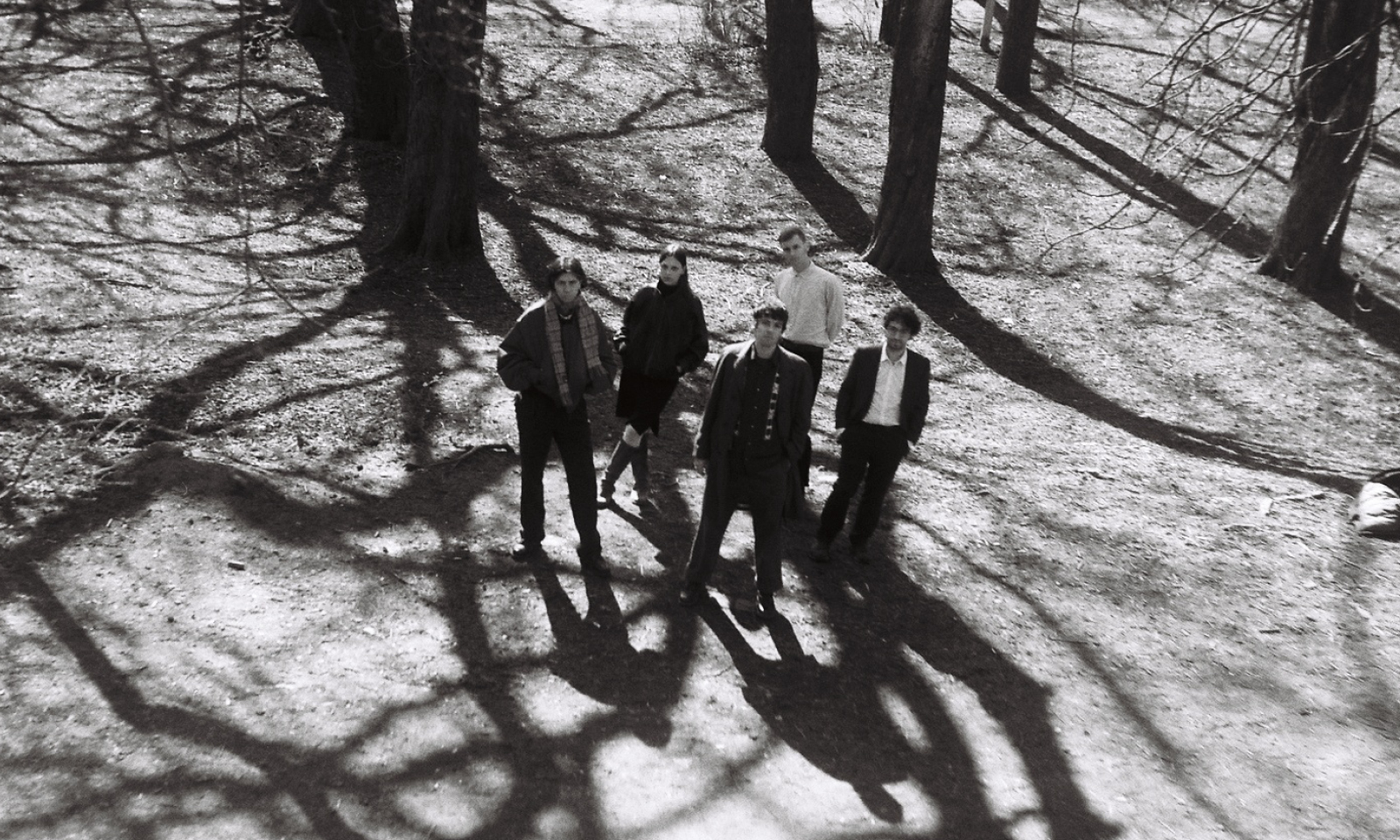
I meet the band Hothouse at Pink Whale on Labor Day, quite a fitting symbolism. We talk during the pre-show sets. Sergei can steal the show with his trumpet, just as he stole the interview, Gregory and Martin are desperately animated, tearing at their guitars. Bianca and Filip disagree on everything, but her bass and his drums don't mind. Hothouse sounds just as it is.
I meet the band Hothouse at Pink Whale on Labour Day, quite a fitting symbolism. We talk during pre-show sets. Sergei can steal the show with his trumpet, just as he stole the interview, Gregory and Martin are desperately animating, shredding guitars. Bianca and Filip disagree on everything, but her bass and his drums don't mind. Hothouse sounds just as it is.
I'll start broadly. When I played your music, a parallel came to mind with the Czech film Kouř (1989) by Tomáš Vorel. Darkened, larger and everyday struggles of working-class heroes, a revolution should bring a better world. Almost forty years after it, here is Hothouse, and you can't just air it out. A better world is far away, frustration takes its toll.
Martin: When nineteen-nineties kids like us make alternative music that isn't cheerful, it naturally reflects current problems. And it doesn't have to be obvious, more through the mood that can be felt from it.
Gregory: Finally, We Are Well, Stable (2025) is a more implicitly political project than the previous EP Light Was Brighter (2022), even though the lyrics were more critical there. Now we tried more to create abstract collages – which stem from personal experiences within the system – rather than just dry criticism.
Do you take turns writing lyrics?
Martin: Most lyrics are Gregory's. But when I try to write something myself, the lyrics remain untouched. We have different ways of expression, so it's quite challenging to review each other's manuscripts.
Gregory: Sometimes we also write together. The lyrics for the track Give and Receive are entirely Martin's; I only added parts to make it a dialogue. I probably won't manage to frame them thematically, we just refer to events that fascinate us in their brutality and absurdity. It definitely involves depicting some primal urges, human cruelty, bullying, and other violence. And we also critically address animal rights – that's what the song Horns is about.
Each of you also has another profession. How do these influences meet in your music?
Bianca: Wow, Gregor and I clicked from the start, in terms of music and films, and we've always been quite culturally broad. I often included various references in videos and visuals. Maybe that's also a way our image aligned.
Martin: It's automatic; we're no longer in our twenties, so we can respect each other. We give each other space, each comes with something different. Sometimes we work on things longer because it simply takes time to settle. Luckily, we're still quite driven to push things forward.
Gregory: We also do things for a long time because we have enough other projects. We work, and Bianca has to commute between Vienna and Prague for exams, so we don't have them as regularly as we could.
Filip: Sometimes we realize after a while that a track doesn't work. Between creation and live performance, there's a relatively large time window. I like the approach that might differ from other bands – a track must be refined before we play it live; it matures.
Martin: But that's not a rule either. There are about four things on the album that we assembled during a single meeting. Maybe if there were fewer of us, more things would come out like from a template, but with us, nothing can be predicted. For example, Gregory carries the entire track in his head, and then we quickly put it together. It's more interesting, dynamic, and fun that way.
You really started as an experiment in spring 2021, as evidenced by your first recorded piece?
Gregory: That's just our first streaming track, released by friends from Ukraine. The three of us met in Brno and layered guitars into loops, it sounded like a bad Velvet Underground. Post-punk, occasionally cut with metal. Jazzy, bossa nova, noise-rock… Back to films: I was really into Lynch's soundtracks at that time. Lynch was inspired by composer Mancini, who also did the soundtrack for Experiment in Terror (1962). That's why Spring Experiment is also taken from the main riff of that track.
Bianca: Gregor and a friend, a drummer, found a rehearsal space. I was lucky that the guys respected that I was just starting to play bass. We just wanted to play. Now, when I listen back to those things, I think it's mega that we got from such playing-not-playing to where we are now, to what we play today.
Filip: Bianca caught up with her intuition for basslines. She invents them incredibly quickly; I find it fascinating that she always gets it right on the first try.
Gregory: She hates straight lines. I also wanted to mention that only Sergei and Filip are formally trained musicians. From the beginning, we were forging our way through New Wave because we wanted to play in a way that really shouldn't be.
Filip: In older lineups, it was as if two wings stood against each other – the trained and the punk. But sometimes, the rules of harmony need to be completely "broken": we put together something cool and leave it at that. A mix of romantic and weird, but it "fucks".
Sergei: I wouldn't say that any music theory can restrict you because when you have nothing to say, it doesn't matter whether you know notes. If you have something to say, it will only help you. You know how to play harmony, dissonant or consonant, because you know the instrument.
The title Finally, We Are Well, Stable references a Czech sociological study about migrant women working in precarious conditions. How is your music solidaristic?
Gregory: I was attracted to the title precisely because of its absurdity. The respondent claims that through work she achieved some stability and is doing well now. Sure, you need money for that, but how much is it? Besides fulfilling basic needs, it's different for everyone. But there are also those who are completely financially secure and still don't have enough.
Martin: I think that even if you're such a secured person, how can you be stable when so many terrible things are happening in the world? And no one reaches such prosperity without somehow stealing from it – you pay taxes, use cheap migrant labor, etc.
Gregory: And someone will say "finally, it's good!", more money, but then the prices of everything go up. A cyclical process, maybe the next album will really be called Prosperity.
Generational prosperity. Do you ever feel that such statements and gestures remain just in our bubble?
Gregory: Hopefully not, but when you shoot at your own, I think the European left has a somewhat unhealthy perception of criticism. This way, more deeply rooted traditions can be knocked off the table, which still need attention. We're splitting apart, and yet there's a lot of topics in the Czechoslovak space that need solving – for example, gatekeeping or the excessive number of men on the scene. Honestly, I can hardly name a single female or queer metal band. Multiculturalism also seems imaginary, but I see that at least Ukrainian collectives are forming here – despite the war.
Bianca: Maybe one day we'll reach a point where it will be so bad that we'll build a shared consciousness from it.
Martin: I think dividing people into left and right is a relic. Whether it's housing, class inequality, war, AI. We're just pulling on some rope that doesn't really exist.
Filip: By the way, I probably wouldn't sign that we're all from the same bubble. For example, Bianca and I would probably hardly agree politically on anything; we're not from the same socio-economic background.
Okay, at least we have a range of discourse here. Despite all the bad, what drives you forward, what is your hopecore?
Filip: Well, that sounds cheesy... I really enjoy that we play together. I was really looking forward to today. We chat in the van, listen to music, and then go for some good breakfast. Just a trip with friends.
Gregory: I really enjoy this rockin' in the free world, from Bratislava to Germany. Despite everything, I see great hope in younger people and collectives. New bands are emerging, and DIY spaces are forming; things could improve here if we try.
Bianca: With touring, it's about 50/50 for me, but that's my personal experience. I think I enjoy the culture, books, movies, more introverted things.
Filip: Oh, and music! Two months ago, I saw Anne von Hausswolff, and it was fucking amazing. The next morning, I woke up about two hours earlier, jumped out of bed, and wanted to do a bunch of things, I was so energized.
Bianca: Yeah, I recently listened to Sleep in the metro, immediately wanted to play with some mega gain and distortion.
Martin: (In the background, radio plays) I really like that we have a Nirvana soundtrack for this.
You will play at Colours of Ostrava, and your last album was recorded under the label Kabinet Records. Is Hothouse among your projects the one with the "conventional" stamp?
Gregory: Well, definitely not conventional for my family.
Sergei: My dad likes Hothouse; he likes and likes every post.
Martin: Yet, apart from minimal teasers on socials, we don't do any marketing. It seems to me that even without much effort in that direction, people talk about us, and we're still invited to play somewhere.
Gregory: We're not really talking about some interface between mainstream and underground. I think it's far from conventional also because of the track structures. We started with heavy music and played more at punk festivals.
Bianca: But even there, we didn't quite fit. Maybe we've also grown a bit. Not that punk isn't for adults, but we no longer want to just play tuc-tuc.
Martin: I don't know if it's purer. It's a melancholic rebellion, just a trace of a certain period in the band. The new stuff we're working on sounds completely different.
Gregory: Although I enjoy playing lo-fi music, deliberately buried in the mix, you can't do that forever. But maybe I'm not a core guy enough to make music only on tapes for 100–200 people by my fifties. Priorities have changed, and now we're a more ambitious underground. For example, making vinyls is costly. But if we had a contract somewhere else and had to release three albums in three years, we couldn't do it. We have a good employer.
Bianca: By the way, I’m a bit annoyed that no one asks me in interviews what it's like to be the only girl in a band with four guys. Kim Gordon privatized that.
You have the space.
Bianca: Sometimes it's annoying. Goodbye!


The text is part of the PERSPECTIVES project – a new brand for independent, constructive, and multiperspective journalism. The project is funded by the European Union. The expressed opinions and positions are those of the author(s) and do not necessarily reflect the views of the European Union or the European Education and Culture Executive Agency (EACEA). The European Union or EACEA do not assume any responsibility for them.