How Trump forced Germany into rearmament
Krytyka Polityczna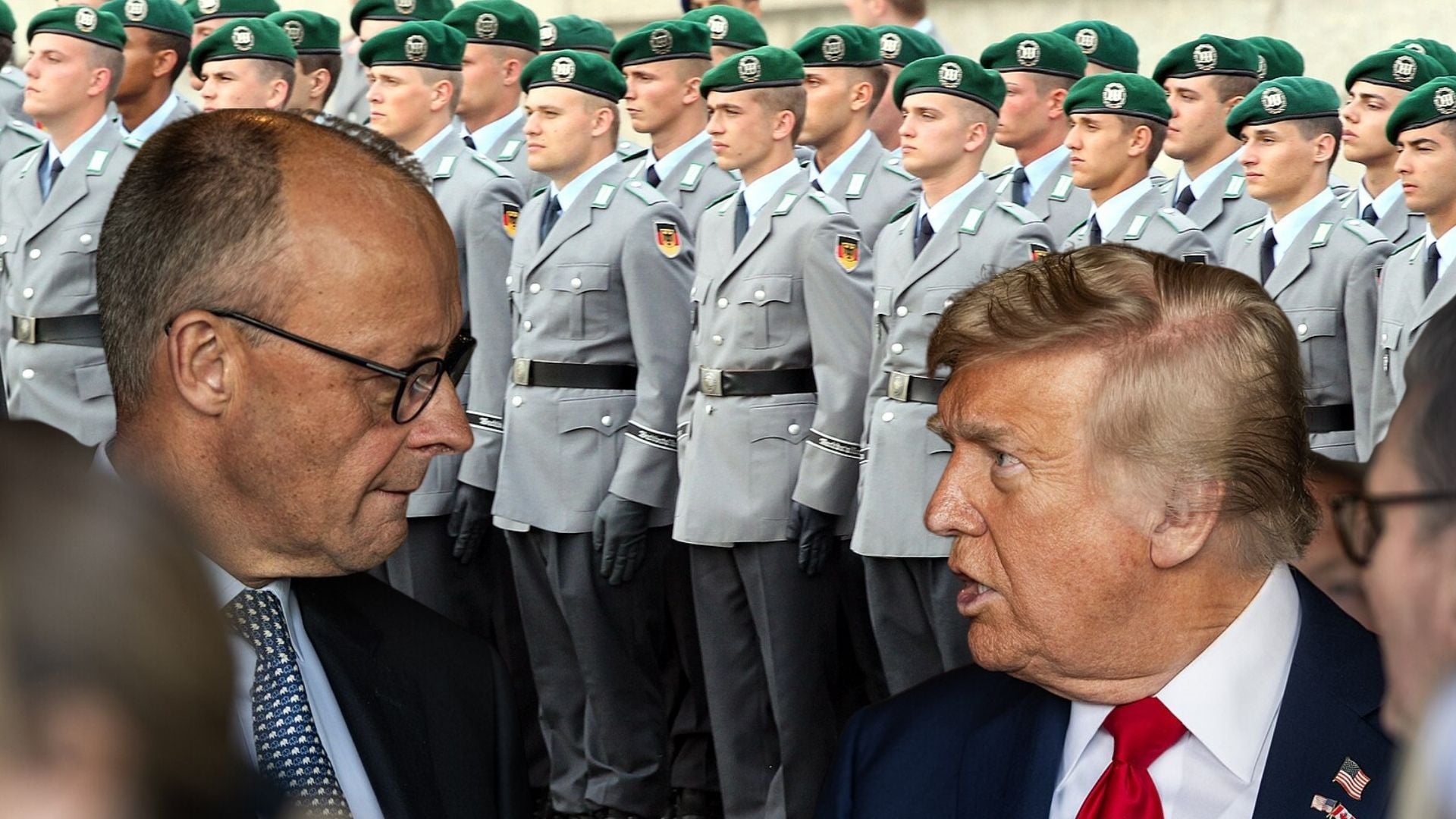
Berlin wants to build the largest conventional army in Europe. The question is not only whether Germany will be able to defend the continent, but also whether Europe will benefit from this militarization. The post How Trump Forced Germany into Armament first appeared on Krytyka Polityczna.
Germany is arming on the largest scale since the end of the Cold War. They have become the largest aid provider for fighting Ukraine. But not because they are afraid of Russia, but because they have stopped believing in the United States. The true Zeitenwende, an epochal turn in German security policy, did not begin after Russia's invasion of Ukraine, but after Donald Trump returned to the White House.
Trump more important than Putin
In February 2025, U.S. Vice President J. D. Vance insulted the mainstream Europeans at the Munich Security Conference. Two weeks later, the same politician participated in the spectacle of humiliating Volodymyr Zelensky in the Oval Office, eagerly assisting President Donald Trump.
Chancellor Friedrich Merz, a long-time transatlanticist well connected with American business, from the beginning of Trump's term had doubts whether, as The Atlantic put it, “Americans in a moment of trial will not throw European allies to the dogs.” After a gangster-style showdown at the White House, he became convinced that they cannot be relied upon. Also, because 20 days later, taking advantage of the old balance of power in parliament and at the expense of significant concessions to the Greens, his own views, and the expectations of the hard-line Christian Democratic electorate, he pushed through a revolutionary change: the Bundestag removed the giant expenditure on broad defense from the “debt brake” rules.
It was then that the Zeitenwende announced by former German Chancellor Olaf Scholz immediately after the full-scale invasion of Ukraine by Russia really got underway. Because before that, it somehow could not. There were many reasons. Previously, the government was led by Social Democrats with their Ostpolitik tradition, pragmatic policy towards Russia, and a baggage of “Moscow links.” Their tripartite government was unstable, and the Bundeswehr was extremely underfunded.
The governing Christian Democrats since 2025 have more Moscow-skeptics among their ranks—and significantly fewer pacifists. Chancellor Friedrich Merz himself is friends with the CEO of the defense giant Rheinmetall AG. The decisive factor in the change, however, turned out to be Trump. Who paused aid to Ukraine (not completely, but nonetheless), repeatedly suggested that Americans will not die for Europe, and finally unleashed a war with Iran, the effects of which are beginning to hit European voters’ wallets (the worst).
Germany is learning to live without America
In less than a year, the German Chancellor's relationship with the USA has undergone a long transformation—from pragmatic trade negotiations in the interest of the German automotive industry, through moderate praise for the removal of Ali Khamenei and the weakening of Iran’s nuclear potential, to statements that the ayatollahs… humiliated the American nation.
The reasons for this evolution, apart from the anti-Trump and anti-Iran social moods, seem clear: the German conviction deepens that allied aid from Americans cannot be relied upon anyway, and that military presence in Germany is not a favor from their side but a mutually beneficial arrangement. Even a few thousand fewer US soldiers near the Spree will not significantly reduce Germany’s security, at least as long as the base in Ramstein remains an indispensable logistical and communication hub for US operations in Europe, but primarily in Africa and the Middle East. A bigger problem is the cancellation of the planned arrival of Tomahawk missiles, which Biden had promised—they were meant to fill the gap in long-range deterrence, which Germany and Europe will probably develop on their own in about a decade. They probably won't arrive, and that’s a problem, but also another signal that they need to figure out how to manage without the USA.
However, this does not mean that Germany is ending military cooperation with the USA. A significant flow of money from their budget will still go toward purchasing F-35 aircraft or Israeli Arrow 3 missile defense systems. The US advantages: nuclear deterrence and satellite reconnaissance cannot be quickly or easily replaced, but talks with France about expanding its nuclear umbrella to Germany have been explicitly announced. And after the US blinded Ukraine’s eyes and ears near Kursk last spring, Germany’s determination to develop its own reconnaissance satellites has increased.
In January 2026, a law was passed that radically simplifies defense procurement procedures. Only for satellite communication and reconnaissance, 35 billion euros will flow from the German budget by 2030. The public procurement lists and official military strategy mention air defense systems, including counter-drone systems, drones themselves, long-range missile artillery, but also traditional artillery ammunition on a mass scale. Since 2022, the government has ordered weapons worth 111 billion euros; last year's German military budget was already the highest in Europe and the 4th in the world, and by the end of the decade, it aims to catch up with the budgets of France and the UK… combined. And these are countries that spend most of their defense funds on maintaining very costly nuclear arsenals.
Ukrainian drones versus Rheinmetall
At the same time, cooperation with Ukraine takes on a completely new quality. In January 2022, the head of the German Defense Ministry from the SPD embarrassed the civilized world by offering five thousand helmets to Ukrainians waiting for a Russian attack. A year later, during a visit to Kyiv, Rheinmetall’s CEO asked President Zelensky how he could help; he replied: “Build me an ammunition factory in Ukraine.”
Armin Papperger was of course not doing charity work (“We will do it, but where will the money come from?”), but he became a spokesman for Germany’s support of Ukraine’s defense against Russians (which, according to German intelligence reports, they tried to eliminate him). The following year, he announced a series of joint ventures with Ukrainians, aimed at producing, among other things, ammunition and air defense systems, although only one repair plant for armored vehicles has materialized so far.
In December 2025, both countries signed a government-level initiative called Building with Ukraine; with 2 billion euros of German grants, Ukrainian drone manufacturers produce drones on German territory, facilitating the transfer of battlefield know-how. This exchange has been ongoing for a long time. The Ukrainian branch of the startup Stark, which produces vertical takeoff drones, and the Munich-based Tytan Technologies, which supplies AI-based drone interception systems, are examples.
The comparison of Ukrainian startup experiences and new defense companies with the giant whose history dates back to Kaiser Wilhelm (from the Third Reich and forced labor of concentration camp prisoners at Mittelbau-Dora) is interesting because Rheinmetall’s CEO recently made a somewhat un-diplomatic, yet symptomatic statement. “What kind of innovations do we have in Ukraine? No technological breakthrough. They make innovative small drones and then big hype. Well, it’s great that they do. But these are not technologies on par with Lockheed Martin, General Dynamics, or Rheinmetall (…). And who is the biggest drone producer in Ukraine? Their housewives. They keep 3D printers in the kitchen and make drone parts from them. But that’s not innovation.” Zelensky responded on X that if every Ukrainian housewife can make a drone, then every one can become Rheinmetall’s CEO. But instead of exchanging insults: German old money— Eastern European Aryans, the economic-military background of this dispute was more important.
Because indeed, alongside companies like Fire Point or Skyfall, which produce hundreds of thousands of drones monthly, part of the Ukrainian local production consists of simple workshops assembling machines from imported Chinese rotors, motors, cameras, or processors. However, first, this is a powerful innovation: dispersed and mass production of cheap weapons, whose quality depends on quantity. Second, on the Ukrainian front, it is precisely unmanned vehicles (and recently also robots) that create battlefield conditions where a soldier can survive more easily under a thermal blanket, on a bicycle, or even on horseback (!) than in an armored vehicle or tank. Third, while the West exhausts expensive artillery shells in the Persian Gulf, wealthy allied countries of the USA have begun to appreciate (and order) counter-drone defense systems precisely in Ukraine.
Startupization of war
Let’s return to Germany. Initially, it seemed that both the Bundeswehr’s arms program and aid deliveries to Ukraine would rely on brands like Rheinmetall, ThyssenKrupp Maritime Systems, Krauss-Maffei Wegmann/KNDS, or the legendary—thanks to the “German autumn” of the 1970s—Heckler & Koch. These are deeply rooted in Germany’s industrial ecosystem (even if subtly promoted for image reasons), possess all licenses and permits, contacts in the Ministry of Defense and Chancellery, and above all—they produce large, heavy, expensive items that can be placed in the yard of barracks and that the state simply… can buy. The technological revolution associated with AI and changes on the battlefield, however, have given rise to new competitors vying for funding.
It also turned out that the old giants promise a lot but do not always deliver: Rheinmetall is intensively scaling up artillery shell production (producing nearly twice as much as… the entire United States), but is seriously delayed, for example, with the short-range air defense system Skyranger; many of its factories still await automation, so they operate in a craft mode. Moreover, the demand for some “traditional” (and expensive) equipment from Ukraine is lower than expected, leading to discussions about the right direction of procurement for the Bundeswehr as well.
Thus, the competition for funds to fight Russia involves not only several (a dozen) large industrial companies but also a network of startups and firms at the intersection of software, AI, and defense manufacturing (including some already large, like Helsing or Quantum). This situation has significant advantages: the lobbying that might prevent Germany from returning to appeasement of Moscow is growing; similarly, it creates a European base for industrial innovation. From a democratic perspective, it is better when greater pluralism prevails in such a sensitive (military-industrial complex!) field rather than a corporate oligopoly, which over a hundred years ago led Germany down the path of aggressive militarism.
On the other hand, the expansion of the “startup culture,” including in defense, fosters the dismantling of traditional industrial work structures, which in Germany are still relatively strong—with its trade unions, stable employment, decent wages, and predictable career paths for skilled workers, as well as for Mittelstand companies. What is good for the innovation ecosystem may not be conducive to job security—and all these wannabe unicorns, with their Californian work culture and venture capital funds, could permanently reshape the labor market. For better or worse.
Why it might not succeed
The German arms machine has started moving seriously. That does not mean that Germany will actually have the “strongest conventional army in Europe” in a few years, and their military strategy with the lofty title Responsibility for Europe is not the first government agenda to aim to transform Germany and the entire world.
There are many obstacles on the way to this goal. The military is not only equipment but also people; the planned 260,000 soldiers and 200,000 reservists (currently 182,000 and 60,000) would require de facto reinstating conscription—and mandatory, even if not universal—and today, there is no political support for that; even sending out surveys to young people on this matter raises controversy.
The second issue is money: removing defense from constitutional limits does not eliminate dilemmas: cannon or avocado, more specifically: reconnaissance satellites or care for seniors (expenditures on one and cuts on the other have been announced by the government on the same day…). Although many factories are shifting production (e.g., from double-decker wagons to parts for Leopards, Pumas, and Boxers, as in Görlitz), new jobs will probably not compensate for those lost, for example, in the automotive industry.
Third, as the classic of Polish historical podcasts says, “war is a system,” and it is not armies that lead it but the whole country—yet, for example, Deutsche Bahn can simultaneously transport at most one and a half heavy brigades of troops (about 50 are needed to deter Russia in Europe). In winter 2022/23, ammunition for the Ukrainian front was stored in warehouses—lacking wagons and capacity of the German network; Americans ultimately transported it by sea. Germany would be the main logistical hub in case of a conflict on NATO’s eastern flank. According to a DGAP report, investments in railways and roads for defense purposes alone—after decades of general infrastructure neglect—would need to amount to at least 30 billion euros. Finally, the entire German bureaucracy, with its sluggishness and dysfunctions, is an inexhaustible source of memes, and the Bundeswehr, as military historian Sönke Neitzel says, is its most perfect caricature.
Will Europe once again depend on Germany?
But what if Germany actually succeeds? Today, cooperation with neighbors is an obvious necessity for Berlin. And what if they become stronger, and the situation around—less volatile? Should we in Poland rejoice at German arms buildup in the context of the war beyond the eastern border and the uncertain American presence?
Although Poland—contrary to what the right-wing scares about—does not face the threat of losing Szczecin or Wrocław to Germany (as France did with Alsace and Lorraine, or Austria with the Anschluss), some elements of the current German defense buildup are very problematic.
First, the not-so-subtle success indicators (e.g., the percentage of GDP to be spent on defense within NATO) can lead to buying what is easy to show to accountants, allies, and the public (tanks, multirole aircraft), but which may not be the most needed. Poland has this problem too, but Germany has especially large gaps, ambitions, and money to spend, plus a powerful lobby of domestic producers of large, expensive, and spectacular weapons. The reaction of their industry leader to the Ukrainian drone revolution vividly shows how deeply the German mindset is rooted: we’ve been making tanks for a hundred years, these are the best tanks in the world, see—you can even pour beer from a mug placed on the barrel without spilling, as our leopard roams the rough terrain. As a result, Europe in a few decades might again be full of expensive, resource-consuming, and other resource-draining armaments, like during Brezhnev’s era. But unlike half a century ago, these will be easy to destroy with cheap junk from Chinese or Iranian housewives.
Listen to the author’s podcast:
Secondly, focusing on developing own producers—and the financing model based on national expenditures—although it roots defense in society, fosters the expansion of national champions rather than European cooperation. Germany again has plenty of public aid funds and its own large corporations; this promotes Germanization of production rather than European integration. An example is the Future Air Combat System project: the German Airbus division, relying on building its own know-how and federal budget funds, entered into a dispute with French Dassault Aviation over detailed division of labor and intellectual property, effectively killing the idea of a Franco-German sixth-generation multirole aircraft. Similarly, billions spent on space projects compete with EU ideas.
Furthermore, the traditional German opposition to Eurobonds for defense (the SAFE program is only a substitute for truly joint defense expenditures) could push less wealthy EU countries into a debt spiral and—horribly—social spending cuts. Local “Alternatives” in Western countries are just waiting for the opportunity to sell voters a 2-in-1 package: savings on health, family support, and clean streets plus disarmament and peace in Europe (the civilized part, east of the Oder).
Is there any way out? To deepen inequalities in Europe, dependence on a single country’s industry, and social tensions, as well as wounded national dignity?
For the growing Germany, no better idea has been found than anchoring them in something bigger than themselves. Their division is neither realistic nor a good idea, considering the political moods in the neighboring states of Poland. An anti-German coalition of Europeans is an average poor solution in the context of Russia and the USA, which already want to divide and pit Europe against itself.
A “community of coal and steel” in the EU today is hard to imagine, but it could start with a common defense procurement market. Not across the entire EU, but among countries sharing a common vision of geopolitical threats. The Baltics, Scandinavians, Poles, maybe Dutch—could negotiate joint purchases and offsets. Such a coalition would be attractive enough for Germany to join and strong enough to balance the gravitas of their industrial traditions, production capacities, and budget.
Germany has begun serious armament— but not to acquire living space or reclaim ancient German lands from Mosa to Niemen. Perhaps, for the first time in a hundred years, the “German question” offers Europe more opportunities than threats.
The material was produced as part of a journalistic scholarship by the Polish-German Cooperation Foundation.

The post How Trump Forced Germany to Rearm first appeared on Krytyka Polityczna.