The mouse's revolt against the lion – are Hungary's pro-Russian days over for good?
New Eastern Europe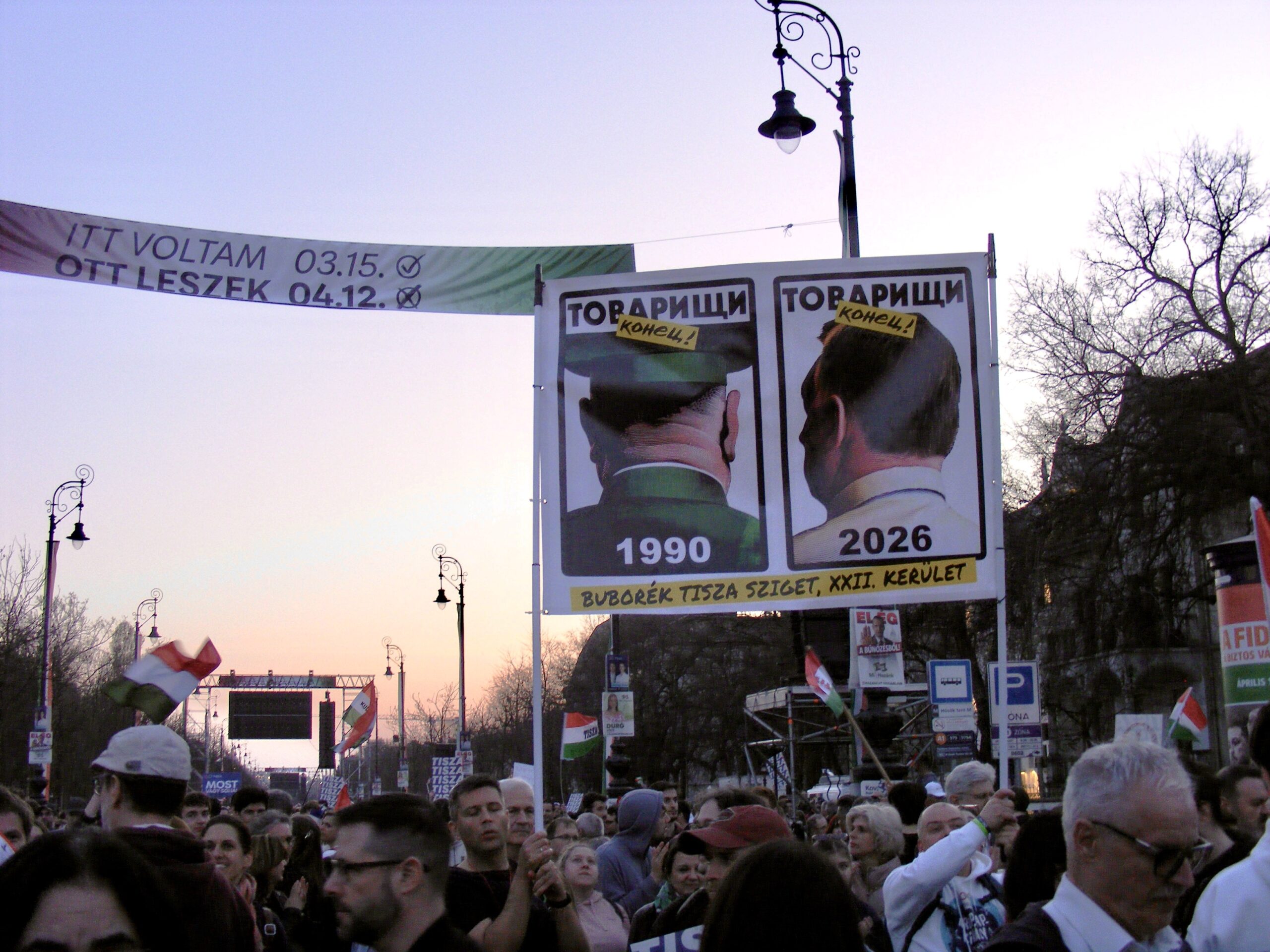
The recent victory of Péter Magyar in Hungary suggests that Budapest’s pro-Russia policies are coming to an end. This closeness with Moscow has a long legacy that is ultimately related to how Hungarians have viewed their relationship with the state over many decades.
"Russkies go home! Russkies go home!"
The chant reverberated through the crowd as Péter Magyar stepped onto the stage to announce that Viktor Orbán had called to concede defeat after sixteen years in power. Around me, supporters waved signs with Vladimir Putin's face crossed out or caricatures of Orbán hidden inside a Russian matryoshka doll. The symbolism was clear: Hungary not only ousted Orbán but revolted against his Russia-friendly vision.
The April 12th vote handed Magyar's Tisza party over two-thirds of parliamentary seats with a record turnout of around 80 per cent – a result even Orbán's Fidesz party had never achieved. The outcome amounted to a resounding yes to the European Union and NATO, and a dramatic slap in the face for Orbán's hostility to Ukraine. Magyar reinforced this during his first press conference as prime minister-elect: "Ukraine is the victim of this war (and) it is the job of any Ukrainian government to protect its territorial integrity and sovereignty," he said. "If Vladimir Putin calls me, I will pick up the phone. But I will not call him myself. But if we were to speak, I can say, I will ask him to please stop the killing."
Given Hungary's own history under Soviet domination, the question is why it took so long to get here. How did a country, whose attempted revolution in 1956 against Soviet forces was admired worldwide, tolerate a Russia-friendly government for sixteen years? The call of "Russkies go home!" originated then, resurfaced during the 1989 collapse of communism, and made a comeback only now, as Magyar portrayed himself as a “freedom fighter” (a term Orbán himself loved) against Orbán's authoritarian tendencies.
Ironically, the young Orbán once spoke that way as well. Indeed, in 1989, he issued the first public call to Russian soldiers to leave Hungary: "If we do not lose sight of the principles of 1956, we can elect for ourselves a government that will initiate immediate talks regarding the quick withdrawal of Soviet troops. If we have the mettle to want all this, then, but only then, we can fulfil the will of our revolution."
"I was only 11 years old in 1989, but I vividly remember listening to Viktor Orbán's speech together with my family," says former opposition politician Gábor Vona, who in 2018 ran against Orbán and won almost a fifth of the vote. "Everyone was so hopeful that things would finally be different and we would be part of Europe."
Orbán's 16 years in power suggest that a significant proportion of the Hungarian public swallowed his reasoning on Russia and the betrayal of Hungary's historic turn to the West in 1989. This can be explained at least in part by the enduring psychological legacy of communist rule itself: cynicism toward politics, dependence on strong leaders, and a weakened belief in collective agency itself.
Even though Orbán and his Fidesz party built their image around the legacy of 1956 as one of the cornerstones in their narrative of national sovereignty, as prime minister, he drifted in the direction of Russia. At first, this change was in line with the European Union's pragmatic relationship with Russia, as in the 2010s, it was not unusual for European leaders to hold bilateral meetings with Vladimir Putin or sign fossil fuel trade agreements. Hungary, too, concluded trade agreements with Russia, mainly connected to oil and other forms of energy supply.
Eventually, the ties became genuinely warm. An emblematic example of this is Péter Szijjártó, the former Minister of Foreign Affairs and Trade of Hungary, receiving the Order of Friendship decoration from Russian Foreign Minister Sergey Lavrov in 2021, three months before the invasion of Ukraine.
A perfect storm?
It was the war in Ukraine that brought matters to a head, as Hungary emerged as the most pro-Putin voice in the EU. Orbán made consistent arguments that sanctions against Russia hurt the EU more than their eastern neighbour. Though he eventually signed up to each sanctions package, he softened the sanctions where possible, and managed to remove important Russian figures, like Patriarch Kirill, from the EU sanctions list. That won his government praise in Moscow and scowls in Brussels. Furthermore, the Fidesz 2026 election campaign portrayed Zelenskyy as a bogeyman, intent on dragging Hungary into war in Ukraine. The apparent intention was to distract Hungarian voters from domestic failures like the dysfunctional health services or rampant corruption. A few weeks before the election, Orbán even went as far as to declare: "We must choose who will form the government: Will it be me, or Zelenskyy?"
Orbán's increasingly stark antipathy to Ukraine began to seem irrational to many voters. Vona, for example, mentioned a popular conspiracy theory that "Orbán is simply indebted to the Russian leadership in a way that we don't know the details of. What he is doing is simply no longer in Hungary's interest."
Others believe the reason stems from Orbán's role as an icon of illiberalism and a bet on power politics. Early in his tenure, Orbán appears to have concluded that the world order would shift away from a rules-based system to a power-based one. In this scenario, a small country like Hungary would benefit, he reasoned, from good relations with the giant next door. This is supported by the call transcript obtained by Bloomberg between Orbán and Putin on October 17th 2025, in which the former Hungarian prime minister offers his "help in any way" and compares the two countries' relationship to that of a "mouse" aiding a "lion" in need. Orbán increasingly seemed to view himself not merely as Hungary's leader, but as a civilizational strategist operating on the same geopolitical chessboard as Trump, Putin and Xi.
It is also important to note that a system like Orbán's is increasingly pricey to uphold. From regime-friendly businessmen to rural party foot soldiers, everyone expects their efforts to be rewarded. The core voters who might feel more and more embarrassed to publicly declare their party allegiance need to be placated with tax breaks or loan packages, which also serve as tools to keep up the hope of progress in broader society. These expenses became more and more problematic and vital at the same time, as Orbán's government always looked for short-term solutions and economic quick fixes, making the financing of this growing system of profit-seeking impossible. This was not a problem until Hungary received an unthinkable amount of funds from the EU. To put the scale into perspective: over fifteen years, Hungary, relative to its GDP, has received EU support amounting to more than twice what Western European countries received through the Marshall Plan after the Second World War. However, as Orbán cemented in his system, EU funds began to dry up. This was no surprise for the former government, and its increasing closeness to Russia became a strategic necessity to find the next generous donor.
The willingness of Orbán supporters to buy into his narrative began to appear as a case of cognitive dissonance. "The main message of 1956 I try to convey to my students is that, against all odds, it is always worth fighting for humanity and for freedom, under any circumstances," said Ábel Pintér, a high school history teacher and a long-time supporter of Fidesz. He even campaigned for the party while most of his peers – well-educated people in their 40s – were defecting en masse. The teacher resolves the contradiction of Orbán's policies by attributing everything to energy dependency: "There is a pipeline with two ends: one in Moscow and the other in Budapest. ... It is not so easy for us to switch to other sources of energy or replace them with alternatives."
Communist legacies
Chiefly, though, Orbán expertly exploited lingering traumas from the brutalization of Hungarian society during the decades of communist rule.
After the Second World War, the newly established Soviet-backed leadership of Hungary immediately launched a project of removing people from their familiar agricultural environments by centrally allocating them into factory jobs, undoing decades of tradition in their families and communities. The communist party-state atomized local communities by banning gatherings and groups independent of the government. Hungarians at every turn encountered the need for favours from a party member, creating a system of indebtedness and clientelism.
Indoctrination taught them that only the party knew what was good for the nation – yet nobody could ever be sure what the next move of the party would be. Moreover, the party cracked down ruthlessly on alternative value systems such as Catholicism, in contrast to Poland. The lack of real moral and ethical substance in the socialist system led to widespread cynicism.
After crushing the brief flare of hope represented by the 1956 uprising, communist leader János Kádár effectively offered Hungarians a bargain: abandon rebellion, and the state would leave them largely alone. Society became depoliticized, and people focused on their families and inner circle. They consoled themselves with thoughts such as "there is no true freedom anywhere in the world". History was taught in schools as a flow of deterministic economic and societal processes, not as the result of the acts of individuals. A deep despair lay just beneath the slow improvement in the quality of living, leading to one of the highest rates of suicide in the world.
Under the large, protective wing of the paternalistic state, solidarity between citizens became unnecessary and obsolete. According to the European Values Survey, first conducted in 1982, 85 percent of Hungarians believed there is nothing besides their family they would sacrifice themselves for – a far higher level of societal indifference than in most Western European countries. Almost half of Hungarians even believed that parents do not need to make any sacrifices for their children.
These societal deficits did not disappear with the 1989 regime change. The resulting lack of faith in collective agency made Hungarians especially vulnerable to leaders like Orbán, who rebuilt a cynical system of political dependency and patronage reminiscent of the communist era. Indeed, many Hungarians even came to believe that 1989 was merely a deal politicians made among themselves. This was different in Poland with Solidarity's mass protests, and even in Romania, where the regime change was a violent affair. The sense that the people themselves had fought against the communist system was lacking among Hungarians. It was for this reason that many attributes of the communist system never ended. It is surprisingly easy to find Hungarians who even reminisce about the era of the party-state, sometimes even claiming that life was better before the regime change.
Given this history, it becomes less surprising that Hungarians did not revolt against Orbán sooner, even when he went on to contradict his own revolutionary ethos. Agency was eradicated from society as a whole.
How does the massive electoral mobilization of the last election fit into this picture?
To be sure, more and more young people who had not lived under communist rule became eligible to vote, and their values are starkly different from those of older generations. They are overwhelmingly pro-EU, and Fidesz's campaign, built on cheap loans and tax breaks, proved to be ineffective on them.
But the older generations are another story. "If there were no economic crisis today, and people were living just as well as they were before 2021, when we still had EU funds, they would have no problem at all with Orbán-style illiberalism or anti-democratic tendencies," Vona says, dejectedly.
For the change to resonate at the roots of the acquiescence to Fidesz, a national psychic shift that addresses the traumas of the past is needed. It is critical that Magyar has already set a date, October 23rd, the 70th anniversary of the 1956 revolution, for releasing the files of the communist secret police in full, decades after Czechia and other post-Soviet countries took the same step. Along with plans to investigate and punish extensive Orbán-era corruption, this could begin teaching Hungarians something decades of dictatorship and illiberalism tried to erase: that individuals possess agency, that political choices matter, and that not everything is preordained.
Lili Anna Lempek is an aspiring Hungarian journalist currently studying Philosophy, Politics, and Economics at the Corvinus University of Budapest. She is a mentee of Dan Perry in the Rațiu Forum Journalism Programme, supported by LSE IDEAS.