When reality catches up with the theater
Kapitál
On Thursday, June 25, Minister of Culture Martina Šimkovičová visited the Slovak National Library in Martin, which she described as one of “the most significant cultural institutions in Slovakia”. At that time, the fourth day of the Dotyky a spojenia festival was already underway in Martin, which is among the largest and oldest theater events in Slovakia. Do you think she honored it with her visit?
On Thursday, June 25, Minister of Culture Martina Šimkovičová visited the Slovak National Library in Martin, which she described as one of the „most significant cultural institutions in Slovakia“. At that time, the Dotyky a spojenia festival was already underway in Martin for the fourth day, which is among the largest and oldest theatre events in Slovakia. Do you think she honored it with her visit?
If you follow cultural events in Slovakia and the situation around the Fund for the Support of Arts, you know that the Dotyky a spojenia festival was also among the projects that the FPU Board initially canceled and then delayed the payment of funds due to the event based on a multi-year contract. Three months before the start of the 21st edition, the festival suddenly lacked half of its planned budget. How can work be done under such conditions? For Slovak culture, this is a reality (not only) of the last two years.
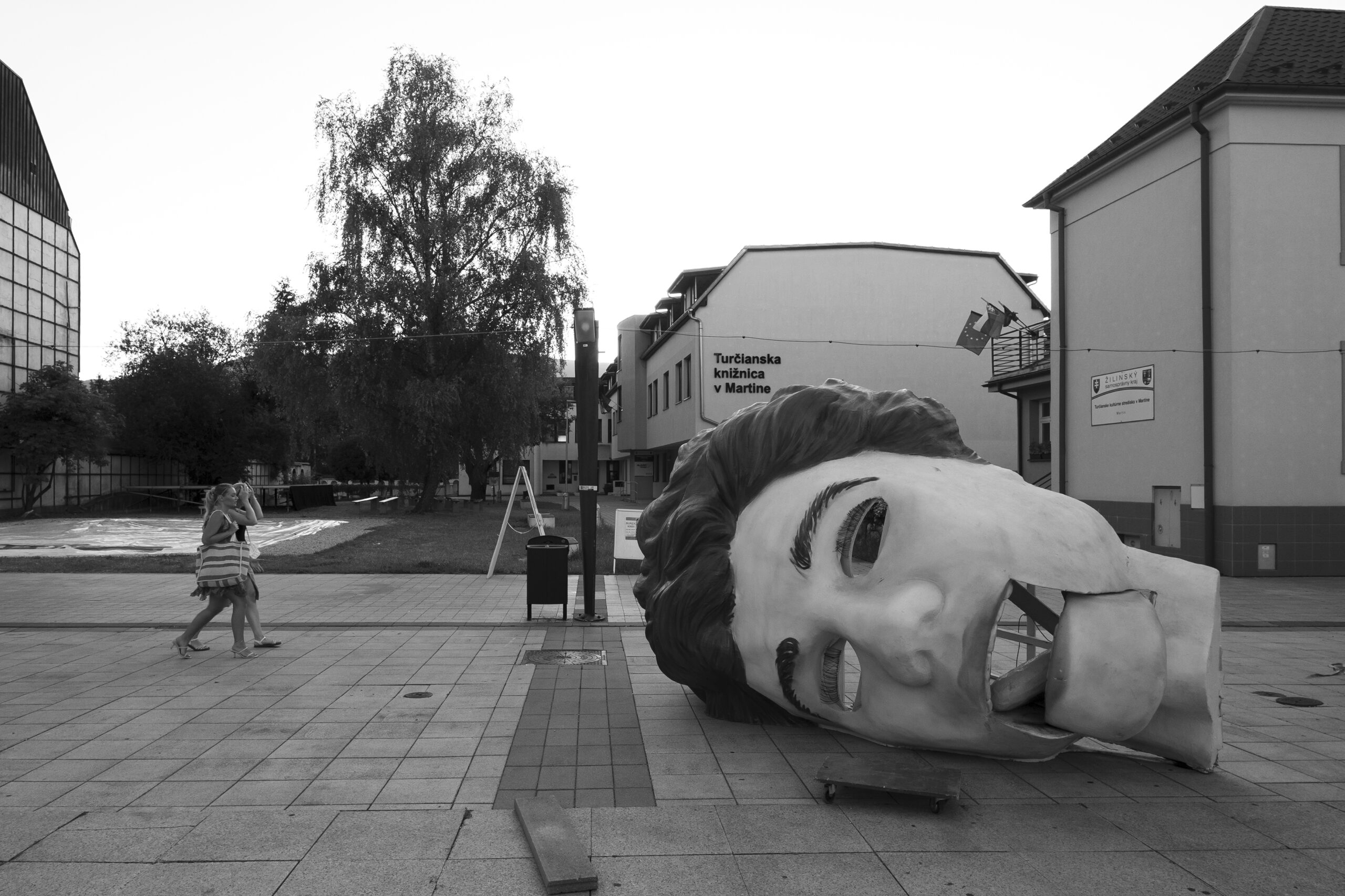
In the end, Dotyky a spojenia took place thanks to the immediate support of 50,000 euros from the city in response to the Fund’s actions, the private sector’s response, and over 10,000 euros contributed by civil society through a start-up campaign. The Fund eventually released the money, allowing the festival to proceed in the planned scope. Besides the main program, which consisted of a dozen Slovak productions selected during the year by the dramaturgy board, the festival always included a section for young audiences (five productions) and a Junior section (six productions). All complemented by discussions, workshops, creative workshops, and concerts directly on Martin’s square. This year, the festival added a special program section called The Big Zero with a finger on the taboo, which directly responded to the situation around the FPU. The dramaturgical team included five productions by independent theatre entities that the FPU Board rejected support for, despite recommendations from the expert committee. Words like solidarity, humanity, resilience, and defiance appeared most often not only in festival interviews but also frequently within the productions themselves. Especially after watching the final ten, audiences surely wondered whether culture and art are mirrors of the world or rather signals of changes and tensions that we do not yet fully see.
Writing a collective story
“The whole festival is a miracle of cooperation,” said Sonja Jánošová during a discussion with selected critics, which takes place on the last evening of the festival. Collaboration and solidarity manifested not only in the difficult pre-festival weeks but also in the past theatre season. In the main program of the festival, we saw it in partnerships between established and independent theatres, in productions involving so-called collective acting, or in the message conveyed. We often left the theatre in Martin with the realization that everyone is involved in one story and bears collective responsibility for its development. In Slovakia, recent years have shown us that culture is a model of cooperation, demonstrating that society functions only when multiple voices participate simultaneously. And that its resilience primarily depends on solidarity, not on the isolation of individuals or institutions.
Much more powerful than these direct references were moments when the present found its way into the productions themselves. Adapted and original texts were sufficiently expressive without the need for explicit updates – their strength lies precisely in their ability to speak to the present even without a literal “translation” into today's language. Watching the production Pokladík (Every Breath You Take) about stalking and crossing personal boundaries, it was hard not to think of the murder of Zuzana from Gelnica. Particularly chilling was Rebekka Poláková’s monologue about breaking up with a partner, which escalated into physical violence. During the festival, a call from the Human Rights Coalition titled Not a single one!, highlighting the systemic failures of the state in protecting women from violence.
Similarly, reality painfully infiltrated the reception of OTY. After the premiere last autumn, journalist Zuzana Golianová, who was dismissed from Slovak Radio, said she still hoped that public media in Slovakia would withstand such developments. However, at the festival in Martin, she watched OTY with “a lump in her throat”. Emotions were also felt in the audience – several women, especially journalists, had tears in their eyes during the final applause. This proved that for theatre to be convincing, it does not need to put current slogans or symbols on stage. It is enough that reality catches up with its themes on its own.
Similarly, the present unexpectedly entered the performance Beautiful Garden, It Remained After It. Originally, it was to premiere in a dilapidated late-Baroque manor in Horné Lefantovce, and the festival organizers in Martin sought a similar dilapidated site for it. Suddenly, however, the festival itself began to decay due to the FPU, making it quite justified to stage the performance on a theatre stage. Although the production tells the story of the Czech baroness Sidónia Nádherná from Borutín, its message transcends the historical context. When a line is spoken that “working in a park is more than just cultivating beauty,” this can also be read as a metaphor for culture and art. Art is often reduced to an aesthetic gesture or leisure luxury, forgetting that it is primarily work – long-term, systematic, and often invisible. Just as a garden does not grow without daily care, culture cannot exist without people who patiently create, maintain, and protect it.
Mobilization and resilience
Crises often force us to think differently, “out of the box”. We then turn to unconventional methods, unexpected solutions. Dotyky a spojenia has a well-established festival structure, with always sold-out halls and a full square during the evening program. Even the “disruption” caused by the FPU did not derail the established festival tracks. Experiments had to be sought more in directorial approaches. For example, director Júlia Rázusová has long been striving for this, presenting two productions in Martin (OTA, Nosorožec). As she stated in an older interview for the magazine kød – specifically ø theatre: “Within my research, I am interested in where the integral physical action is, which can bring something new to the stage situation but at the same time does not illustrate the spoken ideas.” Her productions are characterized by inventive staging – the performative component is always important to her, as is unusual work with sound and rhythm, layering dialogues, and playing with symbolism. In OTY, she brought a composed score for typewriters, and in Nosorožec, characters instead of cigarettes smoke pieces of cauliflower.
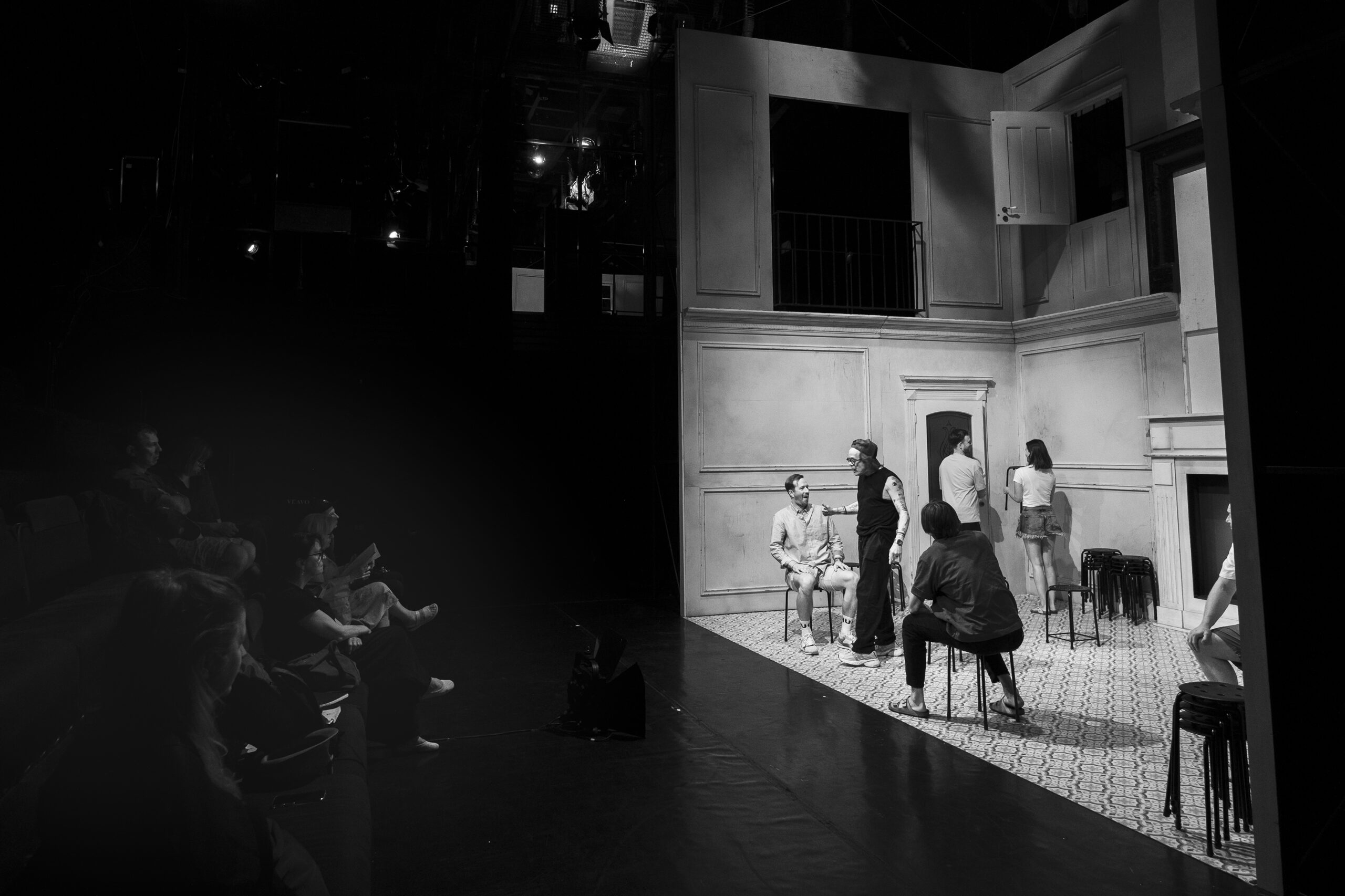
A formal refreshment for the festival was also the intermedia performance ALEX by Adam Dragun, which brought a collage of mobile communication, videos, reconstructions, interviews, live cinema, and live action. The contemporary experience of the world is similarly fragmented – certainties dissolve into overlapping versions of reality that often contradict each other. At the center of the performance is a burned-out dramaturg searching for the meaning of their work. Gradually, it becomes clear that the loss of meaning may not be an individual failure but rather a symptom of a system that ceases to support people.
Today, culture is increasingly in a position where it must defend its own existence. It is necessary to constantly prove the justification of cultural work, resist uncertain institutional environments, and seek new ways of cooperation. “The conditions in which Slovak theatre culture currently finds itself will probably be recorded in theatre history as a period of existential uncertainty, but also a state of mobilization and resilience,” write members of the dramaturgy board Elena Knoppová and Alexandra Rychtarčíková in the introductory text of the festival catalog.
Words like mobilization and resilience perhaps most accurately describe this year’s Dotyky a spojenia. The festival did not only speak about cooperation, civic courage, or the need to defend democratic values through productions. The same principles were reflected in its organization, the solidarity of the theatre community, and the willingness to find solutions despite uncertain conditions. The festival was thus not only a showcase of what Slovak theatre created in the past season but also proof that culture is not only a reflection of society but also one of the places where its resilience is built every day.