Habeš is so old that I have already managed to die there and come back to life.
Kapitál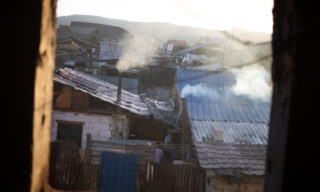
The road from the center of Sečovce to the excluded settlement is direct. Nevertheless, I have to pass through it several times, detouring around parked cars on both sides and waiting at the crosswalk until some of the speeding vehicles let me cross. Sečovce has always been a transportation hub. However, instead of the neighing of horses and the clattering of draft teams, I hear engines of cars, trucks, or buses during my walk. The cacophony is periodically complemented by the barking of furious dogs that run out at me from behind fences. This assault on the senses is a daily part of the residents' pedestrian route to the town and back. On the way, I also pass grocery stores. The closer to the settlement, the more the range of products decreases and the prices increase. In the last house before the settlement, there is a charity community center. From there, well-trodden paths lead through the fields to the excluded area, isolating it from the rest of the town .
The road from the center of Sečovce to the excluded settlement is direct. Nevertheless, I have to cross it several times, detour around parked cars on both sides, and wait at the crosswalk until some of the vehicles passing too quickly let me go. Sečovce have always been a transport hub. However, instead of the neighing of horses and the clatter of draft horses, I hear engines of cars, trucks, or buses during my walk. The cacophony is periodically complemented by the barking of furious dogs that run out at me from behind fences. This assault on the senses is a daily part of the residents' pedestrian route to the town and back. Along the way, I also pass grocery stores. The closer to the settlement, the more the range of products decreases and the price rises. In the last house before the settlement, the charity community center is located. From there, well-trodden paths through the fields lead to the isolated area, which separates it from the rest of the town.
"How old is Habeš?" I ask the children near the prefabricated building where they just rehearsed Romani dances. They look at me surprised because they didn't expect this question. Not at all after I just explained to them what brought me back to Sečovce. After a few numerical guesses, an eleven-year-old Zdenko responds: "Habeš is so old that I have already died and come back to life."
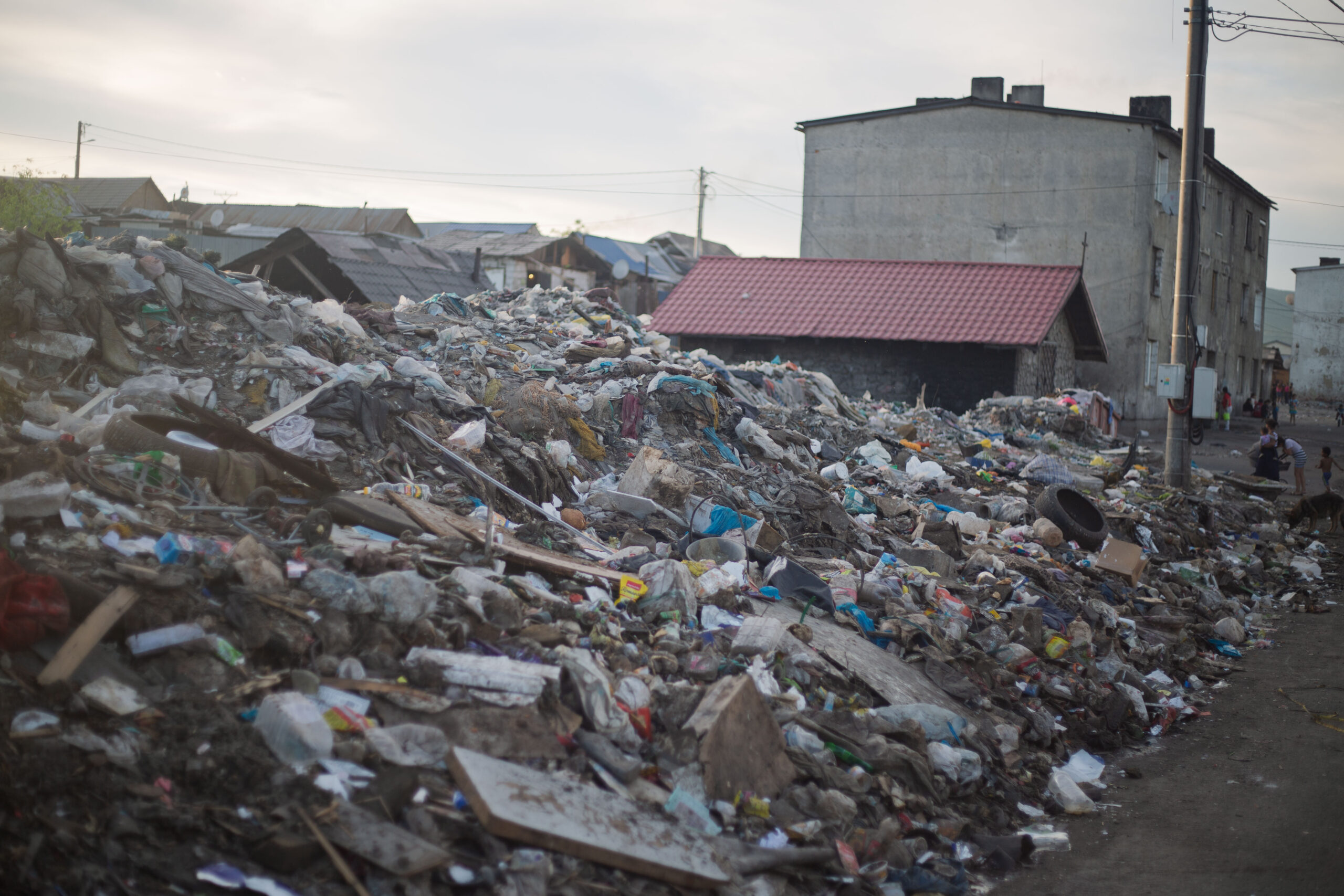
Habeš, as locals call the settlement in Sečovce, I visited for the first time last summer. Together with the Art Activist association, we prepared workshops and creative activities for children attending the community center. The children welcomed us with inexhaustible energy and love. In large numbers, they collaborated with us on various activities and games. Later, they showed us around the settlement. They showed us their homes. The so-called "chyže" made of sheet metal, bricks, or waste materials stretch out on a gentle hill. All without building permits, water, or sewage. The only source of water in the settlement still consists of two taps in front of one of the three apartment blocks. In several places, there are heaps of garbage, and dogs roam around the settlement, which even some of our local friends are afraid of. During conversations with municipal police and other residents, the current state of the settlement, where about 2,300 people live, sounded like a problem that has been stuck for several years and is completely hopeless.
At the end of last year, an interview with anthropologist Andrej Belák was published in Denník N on the topic of repeated fires in settlements. Belák attributes the society's insufficient compassion for tragedies to a lack of awareness of why Roma and Romani people find themselves in excluded environments: "We have 400 to 500 such localities here, but I have never come to a village where someone from the residents would suspect how the local settlement was created," he describes in the interview. The history of these localities often reveals long-term processes of marginalization and ongoing failures in providing basic needs for their inhabitants. Compared to majority settlements, examining the causes that led to social exclusion of residents is highly relevant. The settlement in Sečovce, like many others in Slovakia, lacks not only dignified infrastructure for drinking water, sewage, and waste – it seems to suffer from amnesia, which prevents seeing the past or at least the main milestones that led to its gloomy present. Unlike memorials found in almost every city or village, Habeš has only a concrete pedestal. Once, a statue of Christ on the cross stood on it. Today, it is empty.

I don't feel ashamed of where I live
One of my friends in Sečovce is Erik. We met during the summer Sečovce workshops organized by Art Activist. Erik plays drums, studies at a vocational high school, and helps at the community center. Together with his mother, other siblings, and a cousin, they live in one of the three apartment blocks in Habeš. When we arrive at their apartment, Erik's sister turns down the TV. While the other siblings eat and play on their phones, we talk with Erik's mother Lenka. She works as a health education assistant in the settlement. She found this job after several years of caring for her children alone. Since Erik was four, she had to go fetch firewood, cook, clean, raise children, and run the household with almost no money. She recalls the difficult period when they still lived in a "chyža" with some nostalgia. When she found employment, they moved into the apartment building.
Their apartment is well-maintained, but the building is on the verge of being in a state of disrepair. The scrapes on the facade reveal the foundations of the building or the worn edges of the stairs. For Lenka's colleagues, the doctors, it is often incomprehensible how she manages to come to work so neatly dressed despite the conditions she lives in. Prejudices against the cleanliness of the settlement's residents are among the most frequent stereotypes I encountered during conversations with non-Romani city residents. When Erik and I visited the newly opened café, the waitress couldn't believe that such a "handsome" guy as him could live in Habeš. One of Lenka's colleagues recently came to visit. She wanted to see for herself how it is possible to keep the apartment clean without running water. However, the conditions in the settlement continue to anger Lenka herself: "We live in the 21st century and we don't have water here?" she asks, which about half a million Slovaks are struggling with in Slovakia. She is also bothered by the mud, which during rainy days is almost impossible to avoid. In the settlement, there is only one concreted road. Erik is also bothered by the unpleasant smell that often emanates from heaps of waste.
At one point, I ask Lenka if visits like mine bother her. She tells me she is glad when people are interested in their situation: "I'm not ashamed of where I live. If I had another option, I wouldn't stay here." She has lived here since childhood. Her grandfather was once a vajda (leader or spokesperson of the Romani community). She remembers the settlement from her childhood as more colorful compared to today's monotony. When I ask if she knows of any photographs from those times, she shakes her head. Apparently, no one has any. So I have to imagine the past only based on residents' memories. Once, Romani people lived in picturesque houses here. They were built differently than today. Cows grazed in the fields above the settlement, and manure was spread on the house frames, which, once dried, was plastered with lime and finally painted. The dwellings looked cozier and more beautiful.
What has changed the most according to Lenka over the years? She says it is mainly the decline of respect for the elderly. She also mentions the increase in the number of cars and the presence of mobile phones. She is also bothered by the dullness of current life. There used to be discos twice a week: "Now there's nothing here. Absolutely nothing. A dead-end," she sighs. Even May Day is no longer celebrated today. Lenka recalls that May Day used to be celebrated in Habeš as well. "It was better in the past than now. People here just wait – what they'll do, what they'll cook... it wasn't like that before. People used to rejoice. But now, whether you have or not, how you live, you just go on because you have to."

Similar persistence in a state without any perspective brought me closer to several families. One of the couples Erik introduced me to was Dušan and Helena. Six years ago, when Dušan was returning from work in the city, he had a stroke. Since then, he can hardly move the right side of his body. He also has difficulty speaking. They live in a small chyža, which consists of two smaller rooms – a kitchen and a bedroom. Helena cares for Dušan alone. The only water source is about 100 meters from their gate, at the nearest shop on the other side of the settlement. Erik occasionally drives them by car to the center so they don't have to buy only overpriced food. Helena shows me insistently plastic bags full of medicines that Dušan must take. Both are afraid that health complications might also affect Helena. They probably don't want to imagine the consequences of such a scenario.
The case of Helena and Dušan is specific because they moved out of the settlement in the past. Six years ago, they lived in an apartment in the city. After some time, however, the landlord started renovating the apartments, and after the reconstruction, they couldn't afford the increased rent. With their income, they had little choice, so they returned to Habeš. They applied three times for municipal rental housing, all unsuccessfully. The settlement mainly lacks social facilities. Even the ambulance refuses to come to their home, which further complicates their access to medical examinations. Helena remembers the settlement as a cleaner place. It used to be tidier. The yards of individual houses were "clean as glass" in spring. She recalls fruit trees and wells. But most of all, she laments that solidarity and mutual help have largely disappeared from the settlement. Why? She points to bread and vegetables in the trash and describes how little everyone has. Today, everyone in the settlement just guards their own. She concludes the conversation somewhat disappointed but with determination in her voice: "The world is good. People are not good."
If they could, they'd shoot us
Erik always walked a step ahead of me in Habeš. But when he opened the door without knocking and entered deeper into the apartment or dwelling without any hesitation, the gap between us always widened a few steps. I couldn't get used to the immediacy of visits even after the first two days. I greeted him from the door, hoping that my "good day" wouldn't scare the family I was just visiting. Erik always urged me inside, not understanding why I didn't go straight to him. It was the same when we visited one of the older residents of the settlement. Zdeno Farber had spent almost his entire life there, and during socialism, he was one of the Romani activists in the commission dealing with the "Gypsy question."
"Listen here," Mr. Farber says as he sits on the bed and gestures for me to sit on the chair opposite. Reflecting on the past in the settlement, he describes a very different picture than what we witness today. The settlement was cleaner, Romani houses more beautiful, and where the three apartment blocks now stand, non-Romani residents lived. He still remembers the names of individual families. The houses had large gardens with fruit trees, and even Romani people at that time grew vegetables or fruit. In summer months, they used to sleep outside under the trees. "It was so clean. No dirt. No filthy dagdze (local dialect for somewhere, author’s note)," he recalls. Conversely, in winter, when potatoes were submerged in water and placed on the machine, older men and women would tell stories and experiences from their lives. When he still remembers what, for example, his grandfather "tore," he is moved to tears.
The construction of apartment blocks in the settlement represented a radical intervention into the functioning and living conditions there. The original national concept planned for dispersal of the Romani population. Since the 1970s, there have been mentions at the city committee level of demolishing the settlement and replacing it with a new housing estate in the same area. It is uncertain whether the plan was to also house members of the majority population in the new apartments, but the apartments were reportedly allocated mainly to Roma, whose homes were demolished for the construction. Mr. Farber claims he handed over the keys to them. Moreover, the construction took place just before the revolution. The vision of the housing estate was not realized, and only some people moved into the apartments. Despite the original socialist plan, most of the Romani population remained concentrated in one place.1
In documents from the Sečovce city committee, I read that in dealing with the so-called Gypsy question, the most common approach was to work with documentation of adults' attendance at work and children’s attendance at schools or kindergartens. Similar to today, one of the former regulations was to suspend benefits for working parents of children with higher absenteeism. Records of temporary measures, such as filling muddy roads with gravel, repeated deratization, or repairs of wells, which aimed to address the most urgent problems of the settlement, are also noteworthy. Despite the official recognition of the Romani minority as a national minority in Slovakia in 1991, the reality for Romani men and women after the revolution was harsh. In the early 1990s, many Romani citizens lost their jobs, which had been guaranteed by the regime until then. Without work and with growing hostility and racism in society, a period came when, according to non-Romani respondents, the situation in the settlement deteriorated into truly poor social conditions. "Now democracy has come, and people started stealing. They robbed old people," Mr. Farber pauses briefly, "so much so that they hate us so much that if they could, they'd shoot us. It's enough if one person does it, but they haven't even written that Marek or Vlado did it, but they broadly blame us. 'Roma from the settlement killed a Gádžo and shot him, and that's it. But not specifically,'" describes Mr. Farber how media helped perpetuate discriminatory stereotypes in society. It raises the question of what "beauty," which Mr. Farber describes as the period in the settlement before the construction of the apartment blocks, truly means in the context of the dark 1990s and gloomy today.

Settlement as a counterworld
One afternoon, I again visit children at the community center. Before the raindrops, together with one of the older girls, Eva, we hide under the shelter of the gazebo. We draw, she teaches me Romani words, and like all other children, she tirelessly asks why my partner didn't come with me this time. On the fourth day in a row, I explain that she is in Poland for a while, which slightly reassures her. "I was afraid you weren't together anymore," she explains her curiousness with enthusiasm. When I further tell her that of the friends I visited in Sečovce last summer, I am now only left in Prague, her eyes show horror. It’s almost as if I’m talking about their death. I prefer not to remind her that my family lives in four countries and I don't have time to visit even my little niece. I realize that the lifestyle common in my social circle seems like a nightmare to Eva. When I try to understand her reactions and questions, I start to think my life is actually a bit scary. Eva can't even imagine such a loss of closeness in the family. The immediacy in relationships, as people have in Habeš, I have not experienced in such intensity before. I was beginning to understand Erik's words from a phone call during his short stay in Germany. He told me how much he misses Habeš and that although he likes to travel, after just a day in Košice, he is already looking forward to home.
The longing to return home is the focus of Jaroslav Skupnik in his essay Reflected Worlds. Even if the settlement does not provide decent housing or basic living conditions, it functions as a certain "counterworld" against the majority society. It affirms the residents' life values and their own identity, which they often do not find anywhere else. "Its inhabitants, after material prosperity, also long for it, but often prefer to stay in the world of the settlement and return to it despite its miserable conditions, because they are not alone there, they are not monsters, but people."
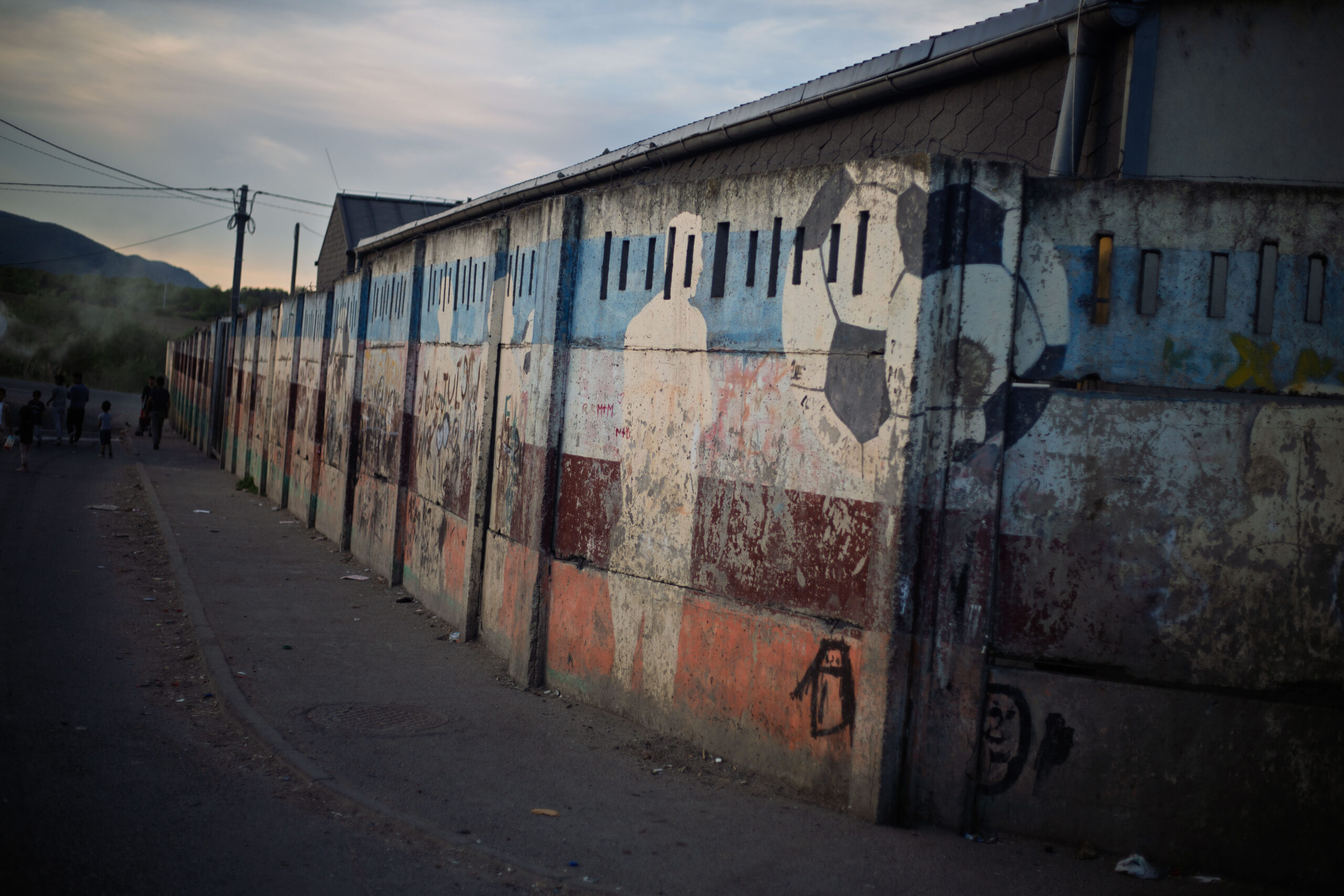
Understanding the situation of people living in excluded localities requires more than just knowing the historical context. This was attempted by Andrej Belák in the mentioned interview, and similarly, historian Ondrej Ficeri responded to my questions. Moreover, settlements in Slovakia are still emerging, each with its own history, making it even more complicated to generalize their origins. The history of the settlement in Sečovce is so extensive and under-researched that I only managed to find a few clues leading to its current state. From the above sources, however, it appears that its marginalization has lasted over a century. It is hard to say how long the fates of its residents have been in an isolated state without any future prospects.
The settlement of Habeš, in many aspects, is characterized by distance. But this distance is not only measured in kilometers or hundreds of meters separating it from the nearest bus stop, town center, or the edge of Sečovce. It is also a distance that prevents residents from truly being heard or reaching the same living conditions and starting line in life as others. The most painful problem of the settlement may not even be segregation, but neglect. What has allowed its inhabitants to preserve their own forms of coexistence and social organization also seems to be what weakens and impoverishes the settlement for decades.
During our conversation, Mr. Farber suddenly told me the following story: "He died and then started knocking. On the coffin. The family came to pray, and suddenly they heard knocking. They took him out, and he had his hands as he should." Even the current state of Habeš may at first glance give the impression that the settlement no longer shows any signs of former life. Despite the amnesia that has affected it, memories of a more dignified past still survive. Layers of problems – smell, waste, discriminatory stereotypes, or daily existential struggles – bury not only the past but also the key values that define home for the inhabitants, while for the rest of the majority society, these problems are invisible.
For those willing to get closer and check whether signs of life still emerge from beneath all the layers, knocking is perceptible. The question remains how to convince those who do not want to hear it.

Names of some respondents have been changed for their protection.


The text is part of the PERSPECTIVES project – a new brand for independent, constructive, and multiperspective journalism. The project is funded by the European Union. The expressed opinions and positions are those of the author(s) and do not necessarily reflect the views of the European Union or the European Education and Culture Executive Agency (EACEA). The European Union or EACEA do not accept any responsibility for them.