"All wars concern us." How young people in the Czech Republic and Slovakia perceive war
Kapitál
How do young people perceive the current world full of uncertainties, violence, and conflicts? What does solidarity mean, and how can we demonstrate it in a time when the old world is fading away and the new has not yet emerged? Answers to these questions reveal their personal and collective strategies for survival.
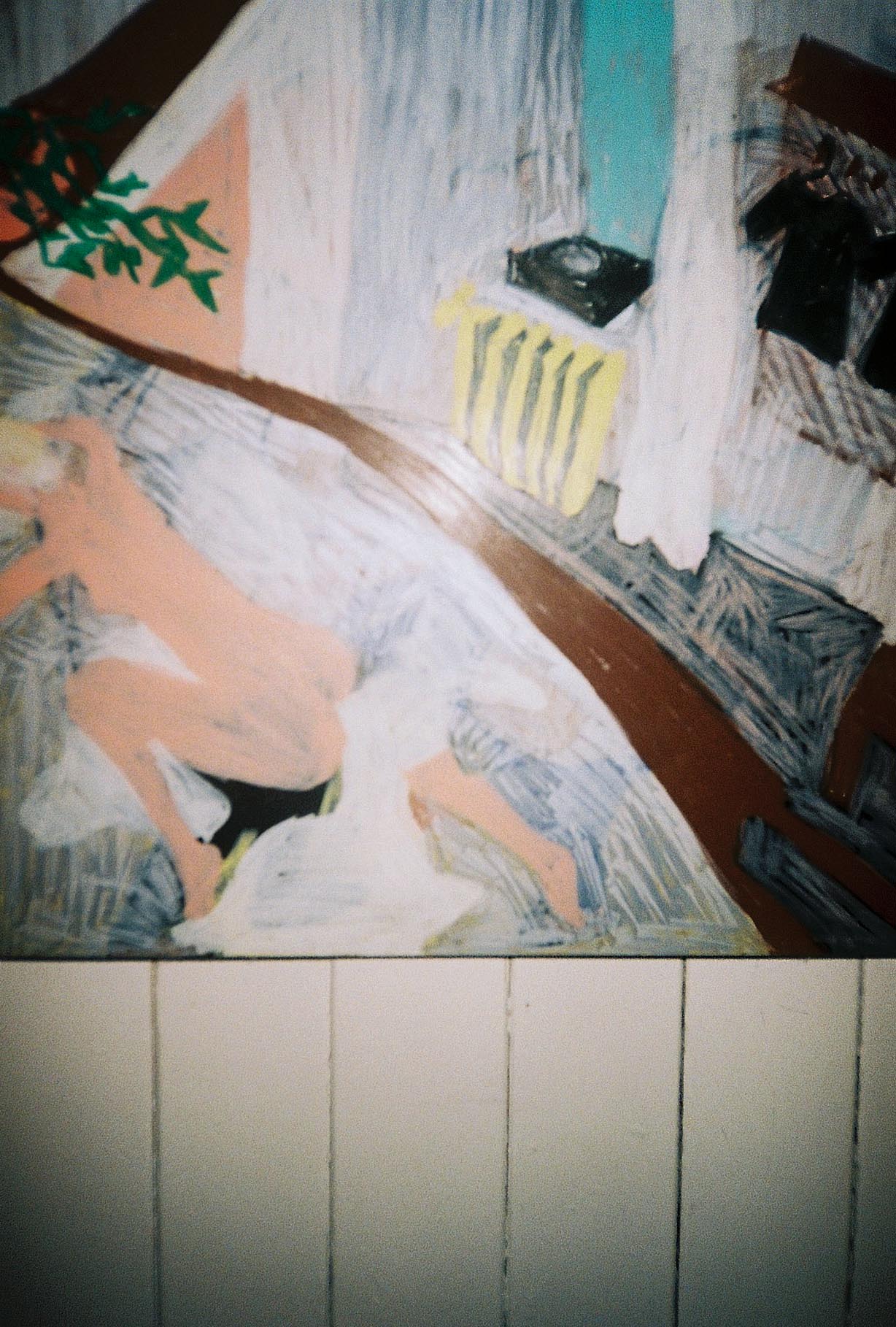
"I won't have a better life than now," writes artist Martin (25) about his work on the cover image. "I'm young, healthy, studying at a school I enjoy, have a good relationship with my family and a girlfriend I love. I pay low rent, have plenty of free time, and access to drinking water," he continues. Martin's painting captures his student room as a memory of a time when he lacked little in life. "I realize that all the things in the painting can disappear, and some of them will definitely disappear," he expresses a sense of uncertainty characteristic of the current young generation.
We find ourselves in a limbo, when "the old world is dying and the new world has not yet been born." Slovenian philosopher Alenka Zupančič relates to this Gramsci's idea, finding a parallel with the current disintegration of the global order. The idea of international law was meant to ensure that even powerful states obey common rules. Despite its shortcomings, it was an important guarantee of global stability. Today, however, the symbolic power of law is replaced by direct power, through which some actors set the rules instead of obeying them.
This changes the perception of the world I grew up in. A long period of peace in Europe created a sense that armed conflict is more of a relic of the past. After the Cold War, we inherited the idea of a globalized world based on lasting peace and international cooperation. We grew up convinced that violence, colonialism, and power hierarchies that shaped the world belong to the past. Today, however, war is again entering European reality and shaking the sense of security we have become accustomed to.
Unlearning War
"The stories we tell ourselves shape our memory and how we understand the world," writes Lebanese-Canadian author Céline Semaan in the context of oral memory of war. She was born in 1982 during the bombing of Beirut. Her mother chose a French name as a guarantee of life in the West, knowing that the war would not end soon. In the preface of her book A Woman is a School, the author describes the process of "unlearning war" (unlearning war) – freeing the mind from oppression and dominance to which people living under long-term violence are subjected. It is precisely in uncertain conditions that ideas about one’s identity and future are conditioned by the stories we tell about ourselves and our pasts.
According to Semaan, it is important not to adopt narratives of oppressors but to preserve truth in songs and stories of those whose history was meant to be erased. This does not mean denying violence but seeking ways to not reproduce its logic in our own lives. "Unlearning war means not attaching oneself to anything – not to religion, identity, home, or property, not even to community. Because war erases everything. And what remains of you when you lose everything?"
I do not want to pretend I know more about war than those who experience it or those who have been reporting on it for a long time. But I know one thing for sure: my position is not neutral, and my sense of security is not free. I discussed how to critically perceive this position with my peers, who describe various forms of engagement, solidarity, activism, and collective resistance.
While in the first part of this two-part series I mapped young people's attitudes towards national defense, the army, and patriotism, the second part crosses the borders of the nation-state. From the question of how to prepare for potential war, I move to what to do in response to violence in our communities, relationships, and everyday life.
Solidarity with Everyone Who Suffers
"I don't believe the world is divided into East and West. I believe it is divided into those who are allowed to destroy and those who are forced to bear the consequences," writes poet and historian Karim Wafa-Al Hussaini. His words raise the question of selective solidarity, meaning the way we perceive suffering more intensely when it occurs geographically or culturally close to us.
Refusing to divide suffering into close and distant is one of the starting points of the Emergency Solidarity Network (ESN), founded in Prague by Kris (27) and Marek (27) along with others. Before ESN, they were part of the initiative United for Gaza, but gradually felt the need to expand their activities beyond a single conflict or region. In less than two years, ESN organized benefit events supporting people in Palestine, Lebanon, and Ukraine, as well as the Roma community affected by fire in Veľký Šariš. "It's not that we are not interested in local people. We try to help everyone in need – regardless of origin. We must be in solidarity with everyone who suffers," they explain to me.
Kris notes that "people often mobilize only when suffering is physically close." He fully realized this after the Russian invasion in February 2022. "We were at a cabin outside the city and offline. After a few days of reading the news, I remember feeling overwhelming fear for my life. I felt immediate danger – much greater than when it broke out in Gaza. And that annoys me! All wars concern us," he points out, highlighting the different ways of experiencing both conflicts.

Marek agrees that solidarity should not depend on the nationality of victims or the geopolitical proximity of the conflict. "It's important to notice the abuse of power regardless of where it happens. If we don't care about that just because it's far from us, it might come back to haunt us," he adds. He also considers it important that resistance to a specific aggression does not mean condemning an entire nation. "The Russian state is not the same as all Russians. We need to be able to condemn the aggressor without automatically condemning every person based on their origin." After the outbreak of full-scale war in Ukraine, it became clear how easy it is to confuse state responsibility with individual origin. While Czech universities offered free places or other support to Ukrainian students, Russian students who lost financial stability due to the war or could not return home often remained dependent on individual aid.
"If we only defend those who are similar to us, we are not defending human rights. We are defending our own identity," Marek continues in his reflection on selective solidarity. A similar debate is opened by Kashmiri writer Jalees Hyder, who argues that Western solidarity often stems not from compassion but from guilt. We live in a society that profits from conflict. Evidence can be seen, for example, in the Czech arms industry leaving traces in many conflict-ridden regions. The magazine Voxpot or the international NGO Amnesty International have long pointed out the systemic links between the Czech economy and the war machinery.
According to Hyder, with awareness of this complicity, we cope through performative remorse, which allows us to feel emotional connection to conflict without taking political responsibility. "Instead of acting, we choose performance," he writes. Solidarity thus becomes a commodity. Something to share, admire, or aestheticize, but rarely translated into real action.
Consciously Choosing Ignorance
"I thought about how I can get involved in the current situation and contribute something of lasting value beyond a short-term gesture," explains Teodor (22), the originator of the documentary Ceasefire. Through a portrait of Palestinian-Jordanian artist Nawras, he explores not only the search for home and the strength of community but also captures the dynamics of Bratislava's activist scene and the importance of intercultural friendships. The film premiered in Bratislava at the One World 2025 festival and, thanks to its success within the Queer Cinema for Palestine network, has been screened in over 60 countries worldwide.
Nawras lives in Slovakia and has never visited Palestine. Her family carries the experience of displacement – the so-called Nakba (meaning catastrophe, disaster, ed.) during the First Arab-Israeli war in 1948, during which approximately 750,000 members of the original Palestinian population were displaced or expelled from their homes. Many found refuge in Jordan but remained unable to return. Israeli historian Ilan Pappé explains in his book Ethnic Cleansing of Palestine that this institutional denial of the Right of Return is a key pillar of Israeli state policy. For Palestinians, returning to their homeland is essentially closed off through military checkpoints and legislative restrictions, making their exile a permanent and definitive state.
For Nawras, Palestine remains a place known mainly through family memory and stories captured in the documentary. "A problem of someone somewhere becomes a story of a specific person with whom we can empathize, even if we do not share their experience," Teodor explains, highlighting how art can create a sense of closeness to experiences distant from us.
For Teodor, the topic of war is associated with physical anxiety. "I often don't feel comfortable when actively following the situation. I feel physically unwell, anxious, sad. I know many of my friends from activist circles get depressed from it," he admits. That is why he consciously creates distance from the constant influx of current information, for example, by limiting the number of accounts he follows. "I don't need to see the same thing six times," he describes, how to avoid being paralyzed by the scope of global problems.
He sets a similar boundary for himself as Kris. "I have strict separate accounts, which I follow on our collective and personal Instagram profiles. I don't follow anything political on my personal profile. I want to be sure that when I look at my feed, I don't see a dead child first." Marek adds that being overwhelmed by violent content can lead to numbness or desocialization. "I've seen enough, it served its purpose," he emphasizes, adding that he doesn't need to follow more suffering to understand its gravity.
"My children have nightmares about war, even though they've never experienced it," Semaan writes, confirming the assumption that war also affects those who haven't experienced it directly. It penetrates our inner selves due to the brutality constantly present on our screens. Psychologist Ahona Guha shares a similar experience: "Since the United States and Israel attacked Iran, my therapy rooms have been flooded with clients talking about the threat of a world war and that we are at a dangerous breaking point in history." This trauma disrupts our sense of security and predictability of the world and confronts us with one of the deepest human fears – the fear of death.
I Don't Want to Go Crazy
The question remains which sources to follow in this flood of information. Kris and Marek try to read reports from the "front line," such as Palestinian journalist Bisan Owdau or photojournalist Motaz Azaiza. They also emphasize the importance of verifying facts. "Independent journalists need to be checked because they are not backed by anyone. Videos are often shared that are years old or taken out of context," Kris warns.
Both consider collectives that bring perspectives missing in mainstream media important sources of information. For example, the group of activists and Orthodox Jews Radical Bloc, helping people at the Israeli-Palestinian border, or the group Resistance Support Club, which in a series of articles for Alarm mapped the complex mosaic of Ukrainian resistance through personal stories of anti-authoritarian fighters, international volunteers, and civilians in front-line areas.
Constant monitoring of violence and subsequent numbness are also related to what philosopher Byung-Chul Han describes in the canonical book The Burnout Society. Excessive stimuli lead to hyper-attention, resembling the vigilance of a frightened animal in the wild. Staying in it too long results in exhaustion and an inability to process experiences deeply. Limiting the amount of news may not mean escaping reality but maintaining the ability to respond.
Similarly, anthropology student Jan (27) believes that our awareness should not lead to emotional breakdown but to the ability to act and strive for change. "I don't want to go crazy and then write on my gravestone that I cared about everything," says the humanitarian activist and member of NaZemi, which is dedicated to solidarity economy and degrowth. That is why he follows news pragmatically, selects sources carefully, and does not need to read the same information repeatedly.
Our conversation is drowned out by loud pop music. In the café, besides me and Jan, there are two baristas. It's hard to say whether they play music so loud because it helps them work well or simply because they don't want to hear our conversation. Jan explains the power dynamics that, in his view, determine who and under what conditions can speak about conflict. He is convinced that the debate in our media space repeatedly gets stuck on two clichés. The first is a kind of test of moral legitimacy, where anyone defending Palestinian rights is expected to condemn Hamas and all forms of violence. The second cliché is personification of guilt in the person of Israeli Prime Minister Benjamin Netanyahu, creating an illusion that his replacement will solve deeper systemic problems. According to Jan, after a new prime minister, Israel can again appear as "the good one," even if its policies remain equally oppressive.
The World Needs War to Survive
Jan believes that "our economic system is a war machine." He does not see war only as a political failure but also as a consequence of an economic system based on continuous growth. "When the system hits its limits, the only way to continue growing is to push everything around," he emphasizes. Throughout history, three interconnected mechanisms sustain this system: colonization, exploitation, and war. Armed conflicts drive specific sectors of the economy through arms contracts, and post-war reconstruction creates profit and increases GDP. "In the end, we all contribute to war," he adds.
After October 7, 2023, he co-founded ProtiDehumanizaci, an educational platform organizing public lectures and discussions about Palestine at Masaryk University in Brno, as a counterbalance to the dominant, often one-sided public discourse. The impulse for the initiative was the conference Your Name is Israel, held directly on campus, which at the time he and others considered an uncritical propaganda event. As an alternative, they organized a three-day educational cycle, during which Palestinian woman and humanitarian expert Lamis Khalilová Bartůšková spoke at the Czech university for the first time since the beginning of the Gaza genocide.

Jan describes this experience as a confrontation with the power structures of the university, when they faced resistance from the administration and open racist remarks from some students. "I thought that more information would change that. Now I think the problem is deeper. There are power structures that determine what can be discussed at all," he admits, expressing frustration and disillusionment. As a result, the group's activities gradually shifted from education to organizing protests and other solidarity actions.
"If peace is to be long-lasting, it is not enough to simply reject war. Conditions that enable its emergence and reproduction must be changed," he explains, emphasizing his focus on degrowth. He sees the economic system as the source of many problems, so it is not enough to only address the consequences. He considers it essential to change the conditions that create them. Jan's critique builds on older critiques of capitalism, expansion, and violence, such as that of Rosa Luxemburg from the early 20th century. Colonialism and imperialism are not seen as deviations from capitalism but as processes intertwined with its functioning, as the system needs to constantly penetrate new areas, acquire new markets, resources, and labor to grow.
He sees one solution in building alternative economic and community structures from below: cooperatives, unions, or local mutual aid networks. This form of economic democracy would allow people to decide about their needs and resources, not the market and capital.
People Are Our Mountains
Jan does not base his preparation for crisis on supplies or evacuation plans but on building trust. "I know who I can call. That is my preparation." He adds that in a crisis, a person can rely on the network of relationships built before they are needed.
Kris and Marek also think about readiness mainly through relationships: "We want to live in a community somewhere outside Prague. Ideally, we want to get there before something happens." In a crisis situation, they believe they could unite and mobilize with people around them. "We definitely wouldn't feel alone," they say. They have even designated a specific meeting point in case of communication network failure.
Teodor claims that "nobody around here would go to fight for the country because they don't believe in it." If protecting the country meant protecting the people living in it, he believes there are other ways than holding a gun. "I don't know where the line is between readiness and paranoia. Maybe I would prefer to be unprepared and feel good than think about it every day and stress over it," he explains. He and his friends do not deal with backpacks or supplies but rather talk about where they would go and how they want to live, considering leaving Slovakia for studies as well.
"Dying in a war for your nation is a homoerotic patriarchal fantasy that has nothing to do with me. But defending specific people, that is something completely different," Jan emphasizes. He rejects the idea that the purpose of defense is sacrifice for an abstract idea of the nation. Kris thinks similarly: "I don't have a relationship with the state but with the land. I would be willing to fight for that." For Kris, the idea of defense is primarily connected with a sense of home and a specific place rather than borders of a state. This attitude echoes the anti-colonial slogan of revolutionary leader Amílcar Cabral, "The people are our mountains," which reminds us that the strength of a committed and politically united community can be the strongest shield in times of crisis.
Marek's family actively supports ESN; his older sister, for example, prepares catering for benefit events. His mother once worked as a guide in Israel and Palestine. Although they are not religious, Marek mentions that for the first Christmas after October 7, 2023, they skipped traditional celebrations – similar to Christians in Bethlehem, who, as a sign of solidarity with Gaza residents and mourning the genocide, canceled all festivities.
The attitude towards war often breaks down in our private homes based on generational experiences and deeply rooted prejudices. Even close people can become sites of ideological conflict. Jan illustrates this with a conversation with his father, who is critical of Israeli policy but also holds a view typical of his generation: he perceives support for Israel as "paying a debt" that Europe owes the Jewish people for the Holocaust. When they discussed this, Jan asked his father why Palestinians should bear responsibility for that debt. Although their views differ, they managed to understand each other without agreeing.
Kris's family does not support either Ukraine or Palestine. He openly calls his father a xenophobe and racist. His mother explains Kris's activism as a result of having "probably too much free time." Kris has learned to separate political beliefs from his family relationships: "If I judged them as people based on their political views, I would probably hate them. I prefer to respect them as people."
Too Dead to Live, Too Alive to Die
Talking about war is a spectrum. It resembles experiencing the loss or death of a loved one. First, we experience shock and denial, then deep sadness, exhaustion, or a desire to return to what was before. Later, we come to acceptance and perhaps reflection. Some approach the topic cautiously, others are immersed in it for months. Everyone seeks their own way to cope with a reality that has shattered their idea of a safe world.
The new world that Gramsci speaks of – although it seems distant – will not emerge automatically as a result of history but as a result of our current actions. Many initiatives and collectives are proving this, seeking ways to respond to violence and uncertainty in today’s world. Resistance Support Club connects cultural activism with concrete aid to Ukraine, including drone support. Neohnutí supplies vehicles for humanitarian aid and evacuation in Ukraine. Repair Together involves volunteers in rebuilding war-damaged Ukrainian villages. Koridor UA ensures humanitarian logistics directly to Ukraine. The initiative Včera bolo neskoro organizes benefit, educational, and protest activities supporting people in Palestine and creates space for political solidarity beyond immediately threatened territories. This is just a selection of many initiatives in the Czech Republic and Slovakia seeking their own ways of solidarity and engagement.
In uncertainty, everyone seeks their own way to stay sensitive, whole, and capable of action. Byung-Chul Han writes about the necessity of not becoming a dead subject, someone who is too alive to die and too dead to live (too alive to die, and too dead to live). All respondents and respondents of this text, whether in its first or second part, seek the same core: a way to survive hysteria without resigning from the world.
In the previous part, we discussed national identity, patriotism, and various views of young people on the army, defense, and militarization of society.

This text is part of the PERSPECTIVES project – a new brand for independent, constructive, and multiperspective journalism. The project is funded by the European Union. The expressed opinions and positions are those of the author(s) and do not necessarily reflect the views of the European Union or the European Education and Culture Executive Agency (EACEA). The European Union or EACEA do not accept any responsibility for them.