"Is this what safe living looks like?" 67% of Poles support deporting Ukrainian men.
Krytyka Polityczna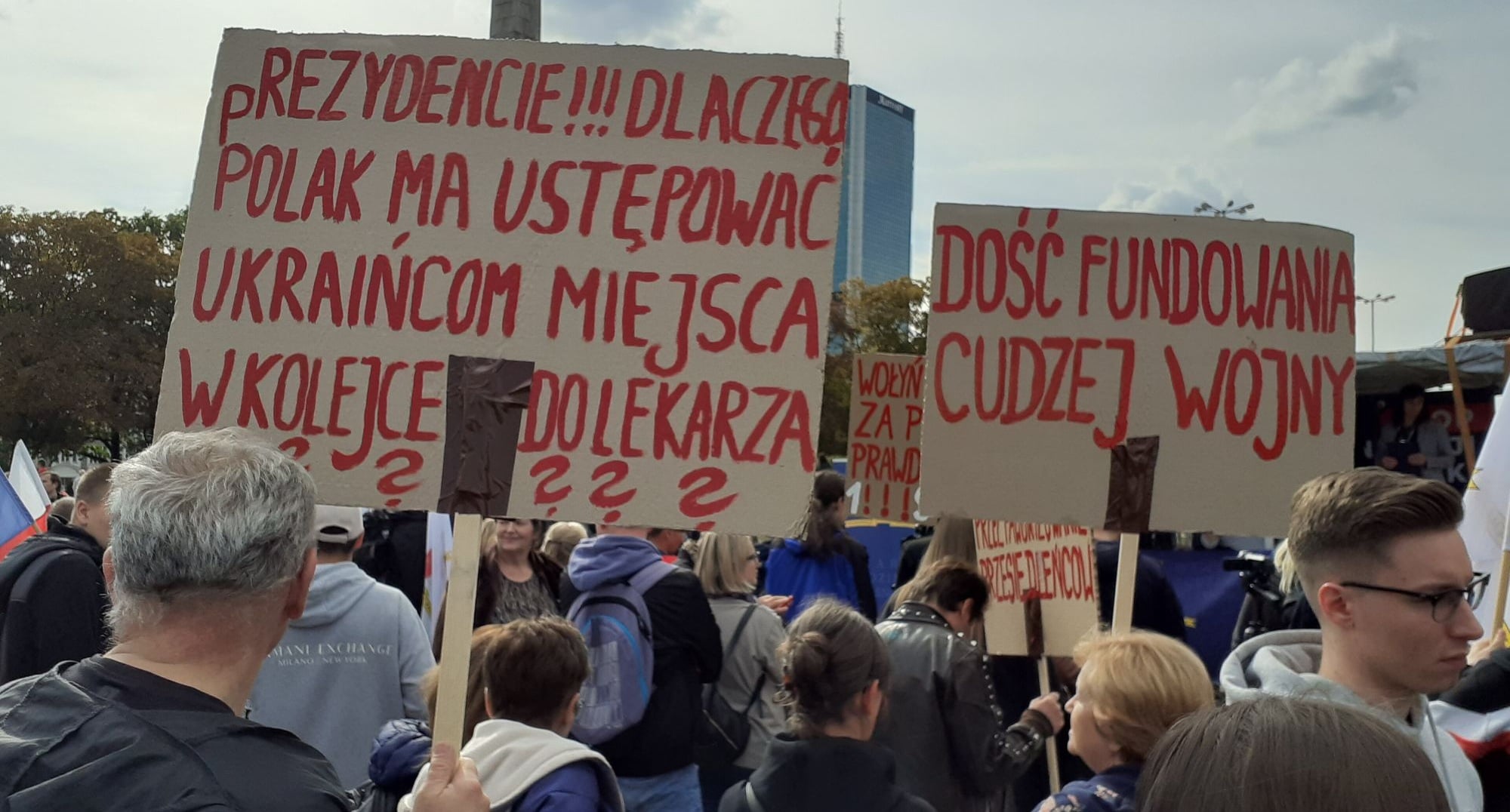
News that someone drunk in a small town was shouting at Ukrainian women to "f*** off from Poland" does not discourage me from going outside. But a poll for "Rzeczpospolita" does. And it prompts me to thoroughly update my English-language CV. The post "Does this look like a safe life?"? 67% of Poles support deporting Ukrainian men first appeared on Krytyka Polityczna.
On one of the first days of March 2022, I was giving a tour around the center of Warsaw to the parents of my childhood friends. At eight and ten years old, we were inseparable: climbing over fences and telling each other urban legends about the nearby cemetery. Then they moved to another district and in a world without cell phones and social media, we lost touch for years. I haven't seen their parents for at least two decades.
We met because these sixty-year-olds were fleeing Warsaw from the war to their daughters living in London. Happy owners of pounds and British visas, they only wanted a walk from me to calm their nerves after leaving Kyiv, shelled by the Russians. I showed them Łazienki, Koszyki, tried to tell something about the Royal Route – but the conversation kept returning to the war. Until suddenly, my friends' father started a new topic: Lena, do you know why Poles are now so well receiving Ukrainians?
I prudently remained silent, waiting for a person far from politics and the intricacies of Polish-Ukrainian relations to clarify the situation. Internally, I sighed and rolled my eyes, expecting a tirade about the Polish-Lithuanian Commonwealth, Giedroyc, or at most, the Piłsudski–Petlura alliance.
– Because they haven't been corrupted yet by migrants! Because unlike the rest of Europe, they didn't bend and drove that wildness out of the forest, from the border with Belarus! Ukrainians are white, hardworking people, not freeloaders – that's why Poles are happy!
I remember I tried ineffectively – out of astonishment – to argue, but to no avail. Both were deeply convinced: there is a visible and invisible border separating the Western world of security and prosperity from Barbarism, and Ukrainians have a place in this safe world, while people from Syria, Afghanistan, or Sudan – not. Although they didn't say these words directly, their certainty was based on racial differences.
Between Usnarz and Ceuta
I recently recalled this scene while reading comments from my Ukrainian – but also some pro-democratic Belarusian and opposition Russian – friends about the crisis in Ceuta. Some sincerely were outraged that Spanish border guards do not shoot those crossing the wall. Others lamented the softness of Europeans, whose social generosity and leniency encourage more Africans to such actions.
Listen to the podcast:
When asked directly whether Ukrainians, Belarusians, and Russians have a place in Europe – and if they came without a visa and are trying to apply for refugee status at the border? – they answered unequivocally: of course they do. After all, they are legal people. The fact that mechanisms for their immigration, such as humanitarian visas or temporary protection, were specially created, and are not an ancient human right, somehow escaped the attention of Eastern European border guards.
A few years earlier, the crisis at the Belarusian border was similarly commented on, if not by most, then by a significant part of my Ukrainian friends in Poland – and these were people more left-leaning and liberal than average. The fact that under Usnarz Górny they were on the side of border guards, not refugees, was undoubtedly an element of solidarity with Poland as a host country. But there was also a barely concealed boost of self-esteem: oh, this is the bottom – and we ended up quite high on the ladder of newcomers.
About a decade before Ceuta, roughly the same reaction to my texts about the EU migration crisis – calling for looking at it from a different perspective than Viktor Orbán’s – was from journalist colleagues and analysts in Kyiv. When I argued that tomorrow Ukrainians might find themselves in the same situation as Syrians, they responded with unwavering confidence: first, they won't; second, Ukrainians are different. A better kind of migrant.
These threads are amusingly and bitterly contrasted with the Polish discussion about Ukrainian migration in recent months. Life brutally teaches my compatriots that race is not skin color – it is a social construct.
Black people are us
After several months of radical support in 2022, which turned into positive discrimination of Ukrainian war refugees in some relations with the Polish state (unconditional access to the NFZ, 800 plus regardless of work, state-funded accommodation in Polish homes so people wouldn't crowd into hastily converted warehouse halls), the carnival of solidarity ended.
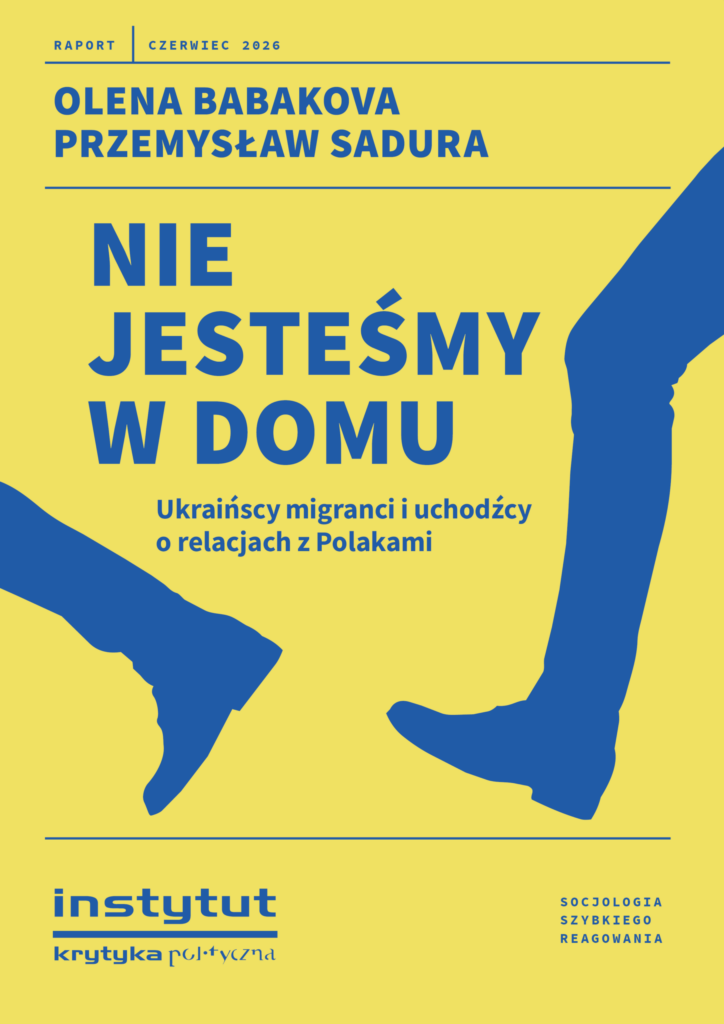
Subsidies for hosting refugees were first limited to sensitive categories, and in 2024 abolished. The 800 plus was linked to work and paying taxes after the vulgar debates of the 2025 presidential campaign. As shown by a survey by the Institute of Political Critique, it was precisely then that most Ukrainians in Poland felt that Poles' attitude towards them drastically worsened – because they started encountering more insults and attacks in public transport, at work, and in neighborhoods. Access to the NFZ was abolished in March 2026, even for the elderly and infirm.
Although Ukrainians bring obvious benefits to the Polish economy – about 80% of them work, and their health contributions more than covered the costs of treatment for those who did not pay any – Polish politicians, reflecting the expressed preferences of Polish society in polls, indicated Ukrainians their place. The place of strangers. The place of those towards whom it is permissible.
In the statements of the Ministry of Interior and Administration, you will not find information about deportations of drunk Britons or Scandinavians, who overdid it during bachelor parties in Kraków or Gdańsk. But you will find dozens of reports about deportations of Ukrainians, Colombians, or Georgians. You will not see mass condemnation of Polish entrepreneurs who employed foreigners without contracts or forged documents – instead, you will see moral panic in the media about illegally working foreigners. Who, again, need to be deported. Such people are also not rented apartments. They can be insulted on the bus. The most notorious cases are condemned and provoke prosecutor’s reactions, while quieter ones often do not even lead to an investigation. If a child has problems in a Polish school – they need to be transferred elsewhere. Moreover, too many Ukrainian children in Polish schools are also considered a problem.
As a Ukrainian worker told one of her Polish colleagues: “In Ukraine, I thought that black people are Africans, but it turned out that black people are us.” After the solidarity carnival of 2022, Ukrainians in Poland found themselves in a situation long experienced by migrants from Asia and Africa – in the position of inferior people, who normally have fewer rights.
Discrimination has long been mainstream
It is absurd to blame everything on the extreme right. Yes, there are not many recorded cases of violent attacks on Ukrainians due to their origin, language, or accent compared to a community of 1.7 million. But treating Ukrainians as a lower sort has long been mainstream. A recent confirmation is a recent survey by IBRiS commissioned by “Rzeczpospolita” about support for PiS’s programmatic promise: deport Ukrainian men of conscription age who are not legally employed in Poland.
Kaczyński and Bocheński, proposing this idea, probably relied on their own closed sociology. But even understanding this, 67% support for deportation shocked me. It is true, the PiS project does not specify whether deportations would include all, or perhaps exclude holders of the Pole’s Card and spouses of Polish citizens. And what about people under the care of minor children in Poland? What about those with long-term EU resident status, whose high social and economic rights are protected by EU law? What does “lack of legal employment” mean – that someone was caught violating, or that a person became unemployed?
These nuances are of colossal importance, but the respondents in the survey do not know the answers either. Still, only about 10% chose “I have no opinion” or “It’s hard to say.”
Krytyka Polityczna has already written about why the PiS idea is wrong – blackmailing employers with deportations will make them the masters of their Ukrainian workers’ lives (one might say – peasants). In Polish law, illegal work is a very flexible category. It includes work completely without permission and contract, but also cutting women’s hair when the permit and declared contract say “men’s hairdresser”; work on a contract for a specific task, when the documents specify a commission; and simply working on an agreement that the employer forgot to report to ZUS.
But two-thirds of Poles, as can be seen, would send such people “to the front” (perception of the Ukrainian army as heroic and serving in it as the worst punishment fits well in many minds). The moral majority, however, does not see a contradiction in the fact that in a survey published just a few days earlier for (the same) “Rzeczpospolita,” only 27% of Poles declared readiness to “go to the front” in case of war .
Experiments on refugees
Honestly, I am terrified by the results of this survey. Hate online, news about attacks on Ukrainians, or my own experience of hearing “Ukrainian whore” on a bus – do not scare me. Thugs are everywhere (which does not mean that reflection on why they are so active precisely against Ukrainians is unnecessary). It makes me see the future in dark colors.
First, because within a year from Maks Korz’s concert, we went from deportation for an offense (which was already an exaggeration and criticized by human rights defenders) to discussions about deportations for lack of legal work – work that makes one free, a great name for a program, isn’t it? If social moods evolve this way, what will happen next?
Second, you cannot count on the state as a guarantor of common sense: in migration matters, it follows the instincts of the crowd. Who doubts that Donald Tusk will remember this survey? As with 800 plus, decisions may be made not only without regard for human rights (which we are already used to), but also without an economic calculation.
Third, these numbers confirm well that a Ukrainian in Poland can never be entirely sure that everything will be fine until they get citizenship – and all political forces promise to make it more difficult. I think that KO has not yet published its bill proposal precisely because they want to do it closer to the elections, to show the electorate: we can be tough too!
Just as the premature satisfaction of Ukrainians with migrants from Białowieża Forest and the Moroccan desert was, so too may be the premature intoxication of Poles with their own achievements in pointing foreigners to their place. As Professor Ryszard Szarfenberg recently wrote in OKO.press, new social assistance programs for Poles, providing tedious verification of the situation and income of the poorest, are a direct reflection of the philosophy of the 800 plus reform for Ukrainians – which left low-income and irregularly employed people in the worst situation. Migrants were simply used as test material.
For migrants and refugees from Ukraine, the situation is sad regardless of their residence status – which can always be revised, even the citizenship decision, unless issued by the president. The unpredictability, or rather the increasing negativity of the Polish public opinion and political debate, makes it only a matter of time before further rights are restricted, and the right to stay is additionally conditioned. For Ukrainian migrant workers before 2022, moving to Poland was about seeking a better life; for war refugees – a safer one. But is this what a good and safe life looks like?
The post “Does this look like a safe life?”. 67% of Poles support deportation of Ukrainian men first appeared on Krytyka Polityczna.