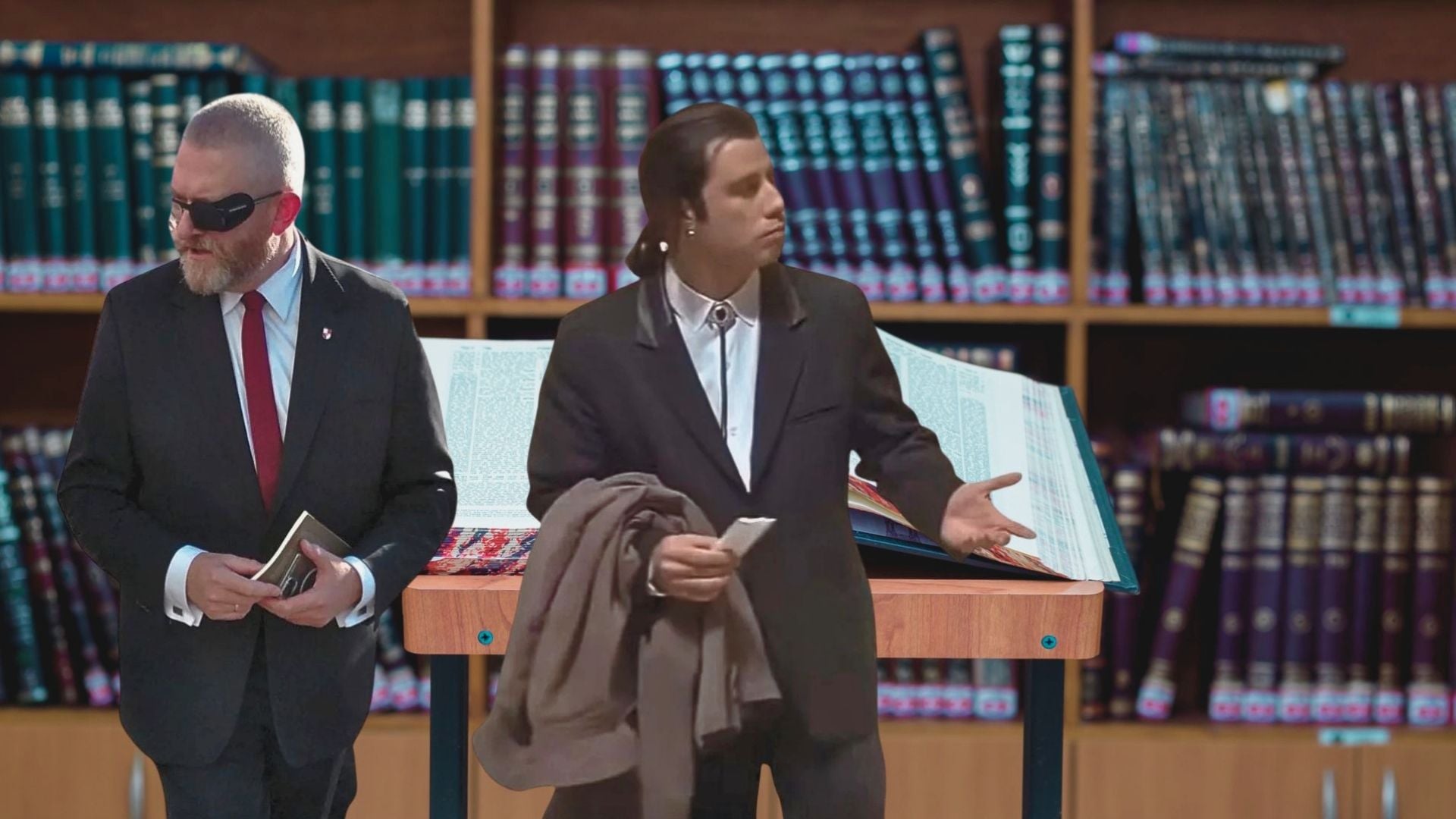
Similarly, the Talmud, which is a written form of the Oral Torah, should be viewed. In anti-Semitic images, it is portrayed as a secret instruction for gaining world domination. In fact, it is an extensive record of centuries-long rabbinic debate: it contains arguments and counterarguments, interpretations, stories, aphorisms, and reflections of religious authorities. It is not a catalog of unequivocal commands but a record of disputes about how to understand and practically apply Jewish law.
– It should be emphasized that from the perspective of Judaism, the Talmud is not even a holy book – says Piotr Kowalik. – Only the Tanakh, that is, the collection of books that became the basis of the Old Testament, is considered inspired. The Oral Torah itself, embodied in the Talmudic tractates, is not a set of laws but rather a process that began at Sinai. A process of continuous inquiry, analysis, and interpretation of Jewish law in the context of a constantly changing world.
In the Talmud, you will find reflections on literally every topic that absorbed ancient scholars – from fundamental religious-moral issues, through medical advice, to quite trivial or plainly mistaken observations. On one hand, there are lofty maxims, such as: "He who saves one life, as if he had saved the entire world" (Sanhedrin 37a) or the famous rule of Rabbi Hillel: "What is hateful to you, do not do to your neighbor, this is the whole Torah" (Shabbat 31a). On the other hand, there are folk wisdoms, such as the belief that running can weaken eyesight (Shabbat 113b), a warning that eating warm bread attracts fleas (Pesachim 111a), or a caution about the harmful effects of... drinking water at night (Pesachim 112a). These fragments do not constitute binding law—they are simply a record of the mentality, knowledge, and superstitions of the era.
– The Talmud is rich in allegories, anecdotes, and folkloric motifs – explains Kowalik. – Some passages may seem bizarre, naive, or even childish. This results from the fact that the Talmud is an authentic record of human thinking, with all its mistakes, logical traps, and shortcuts. These extensive, non-normative fragments of the Talmud are called aggadah (Hebrew: story).
To make it a bit more complicated: the Talmud is actually not one but two. We distinguish between the Jerusalem Talmud and the Babylonian Talmud. The first was produced in the Land of Israel, and its codification was brutally interrupted by Byzantine persecutions. Some Jewish adherents share the belief that the Jerusalem Talmud will only be completed by the anticipated Messiah. The more significant in halakhic tradition is the second, the Babylonian Talmud. It is the one we usually mean when we talk about "the Talmud." The excerpts cited in this text come precisely from the Babylonian Talmud.
The codification of the Talmud as a response to existential threat
As Kowalik explains, the emergence of the Talmud between the 2nd and 6th centuries CE was an attempt to respond to the crisis that Judaism faced at that time. After the destruction of the Second Jerusalem Temple by the Romans in 70 AD, Jews lost the central place of their religious life. Many laws contained in the written Torah related specifically to temple worship: with the temple's loss, there arose a need to assign new meanings to certain religious commandments. Moreover, the heritage of the Oral Torah was in existential danger amid persecutions that Jews faced from the Romans during this period. Jewish religious authorities concluded that it was time to codify Tora she-be’al pe to save it from oblivion.
– Several decades after the destruction of the temple, the Bar Kokhba revolt took place – says Kowalik. – The Romans were then determined to remove Jews from their land, and consequently, they waged war against Judaism itself. During that period, many leading rabbinic authorities were murdered. Judaism was threatened with extinction. The rabbis realized that the living, oral tradition, passed down from master to disciple, had to go beyond the circle of initiates. It needed to be written down because no one knew what the future held.
The central part of the text is the so-called Mishnah (Hebrew: repetition, recitation). The codification of the Mishnah by Judah ha-Nasi was preceded by the arrangement of this material by the tannaitic rabbis Meir and Akiwa in the 2nd century. The Mishnah is divided into six orders, corresponding to the six most important spheres of Jewish life. It includes treatises on agriculture, holiday observance, civil law, criminal law, sacrifices, and ritual purity.
– The Mishnah was a very important stage in the codification of the Talmud – continues Kowalik. – However, it mainly related to issues concerning the Land of Israel. Meanwhile, due to Roman persecutions, Jewish life moved into the diaspora. Under these new conditions, there was again a need to reinterpret and comment on commandments and to seek new solutions for Jews as a community.
After the Bar Kokhba revolt, the center of the Jewish world moved to Babylonia. There, another part of the Talmud was created, called the Gemara (Hebrew: completion). The Gemara is a record of rabbinic discussion on the Mishnah. Rabbis analyze its laws, compare them with other traditions, present arguments for and against, tell anecdotes, interpret biblical texts, and discuss various practical issues. It is precisely the Mishnah and the Gemara that form the core of the Talmud. Its content is not limited to them: as Kowalik explains, later rabbinic commentaries are also found within the pages of the Talmud, up to the authorities of the 19th century.
Kowalik shows me a page of the Talmud containing a fragment of the tractate Beitza (Hebrew: egg). In the center is a fragment of the Mishnah, and below are the Gemara notes. On the margins, rabbinic comments are visible, including notes by Rashi and his successors.
– I have here a copy based on the classic model, which is the Talmud published by the Wdowa and Romm publishing house at the end of the 19th century in Vilnius – says Kowalik, showing me the book. – The text itself has the structure of an onion: we see how tradition grows in layers. Today, no one adds new content to the pages of the Talmud or modifies its graphic layout. However, this does not mean that the process of Talmudic shaping of Jewish tradition has ended. In full editions of the Talmud, after the end of a tractate, there are additional comments by contemporary religious authorities, and some are published as separate books.
The Talmud is the favorite subject of anti-Semites – from ancient Rome to Grzegorz Braun
The crisis related to the destruction of the Jerusalem Temple and the mass persecutions of Jews by the Romans was compounded by an additional factor: the emergence of Christianity. The religious movement initiated by a Jew from Judea quickly spread throughout the ancient world. In the Roman Empire, Christianity was declared the state religion by the Theodosian edict of 380 AD.
A religion that grew out of Judaism from the very beginning promoted anti-Jewish theses. The narrative contained, for example, in the Gospel of John, accused Jews of collective responsibility for the crucifixion of the Christian Savior. In the First Letter to the Thessalonians, Paul of Tarsus warned his fellow believers against Jews, arguing that "they killed the Lord Jesus and their own prophets."
The strengthening position of Christianity in the ancient world was associated with increased violence against Jews. In 414 AD, in Alexandria, a mob incited pogroms against local Jewish believers, destroying their property and places of worship, which led many of them to leave the city. Similar incidents occurred in the 5th century in Syria, Mesopotamia, and Minorca: Christians seized Jewish prayer houses to convert them into churches, and Jews were generally forced to convert to Christianity under threat of death.
From the perspective of ancient Judaism, Christians did something that we would now call cultural appropriation: they took over the Jewish spiritual tradition, filling its symbols with entirely new content. They also attributed the role of deceivers to the Jews, accusing them of falsifying the true content of Revelation. It is therefore not surprising that the polemic with Christianity contained in the Talmud sometimes takes on sarcastic or even provocative tones.
– The Talmud contains words of sharp criticism against Jesus – says Kowalik. – It depicts him as a magician educated in Egypt or an illegitimate child of a Roman soldier and Miriam. However, these critical fragments require context: they are records of a fierce polemical dispute that took place between Judaism and the early Church in the first centuries of our era.
It is precisely because of the critical references to Jesus that the Talmud eventually became a focus of interest for Christian anti-Judaism. In 1272, in Paris, 24 wagons of Talmud manuscripts were publicly burned. A similar event took place in Rome in 1553. After the so-called disputation with the followers of Jacob Frank in 1757, Bishop Mikołaj Dembowski ordered the confiscation and public burning of copies of the Talmud in the market square of Kamieniec Podolski. Over a thousand books were destroyed at that time.
– The anti-Talmud movement in the Church was initiated in the 13th century by Nicholas Donin, a convert expelled from the Jewish community – says Kowalik. – In revenge, he addressed Pope Gregory IX with a list of 35 accusations, accusing the Talmud of blasphemy, distortion of the Bible, and teaching false morality. Donin made a clear diagnosis: the Talmud is the main obstacle to converting Jews. Its destruction was meant to open the way for their Christianization, which led to the first public disputation in France and the confiscation of books.
Despite the passage of time and the weakening of religion's role in the West, the Talmud remains a sore point for anti-Semites, who persistently distort its meaning and highlight controversially sounding, out-of-context fragments. And the Christian anti-Talmudic narrative in its sources is continuously adapted to the ever-changing political context.
In 1933, the Nazi Party completely banned the printing and possession of the book in Germany, burning copies, among others, at Bebelplatz in Berlin. The Nazi policy was based on the belief that the Talmud expressed a lower, biologically determined nature of Jews. Today, accusations of the Talmud's "demonic" message resurface in statements by figures like Grzegorz Braun or Dan Bilzerian. Such narratives skillfully omit not only the historical context of the work's origin but also its polyphonic, and at times even internally contradictory, character.
Meanwhile, the actual relationship of Jews to the Talmudic tradition is complex. Although the Talmud warns against visiting Christian temples, Poland's Chief Rabbi Michael Schudrich entered the Kraków Basilica of Our Lady during the funeral of President Kaczyński, consciously prioritizing respect for the deceased leader over the strictness of tradition, which drew criticism from more conservative religious authorities.
Today, all major streams of Judaism – Orthodox, Conservative, and Reform – recognize the Talmud as an important source of religious law. Its open, debate-based nature, rooted in centuries of discussion, means that different branches of Judaism have developed divergent positions on issues important from a contemporary perspective, such as the role of women, same-sex relationships, or rules for using electronic devices. Yet all living Jews base their religious views on the same sources.
It's high time to learn the truth
Paraphrasing Maria Janion: the theses propagated by anti-Semites say very little about Jews themselves. Instead, they reveal a lot about the mindset of those spreading anti-Semitic slander. The same applies to the Talmud, which is simply a record of Jewish mentality from the early Middle Ages. Only in the minds of anti-Semites do its out-of-context fragments become proof of the supposed conspiracy theory of world domination.
The Talmud is an impressive work: a single edition usually consists of dozens of volumes. It is written in ancient dialects of Aramaic and Hebrew, which few people today are fluent in. Perhaps this is where the misconception comes from that the Talmud is some dark collection of Jewish secrets accessible only to a select few initiates. In reality, it has been translated into dozens of languages, and its message can be understood by anyone willing to dedicate some time and effort—by, for example, obtaining a copy published by Pardes. There are also videos and recordings available online that reliably discuss the Talmud.
So, one could say that in the anti-Semitic imagination about the Talmud, there is a subversive grain of truth. For in this work, Jews reveal to the world a fundamentally banal fact: they are human beings just like everyone else. They can do good and evil, and most of their choices—like most choices of other people—lie somewhere between these two extremes. And just like others, they are much more often engaged in everyday, mundane matters than pondering the most fundamental philosophical questions.
Finally: a large part of Jewish women and men are secular, including declared atheists. This is especially true in the Polish context. For millions of people of Jewish origin, the content of the Talmud is as foreign as it is to the average Pole. The belief that Jews as a collective would be guided by some "Talmudic principles" is absurd and only demonstrates ignorance on the part of the person who makes such claims.
The post Can you eat eggs cooked on the Sabbath? The whole truth about the Talmud first appeared on Krytyka Polityczna.