The Great Green Wall was supposed to transform the Sahel. Will it remain an empty promise without local communities?
Krytyka Polityczna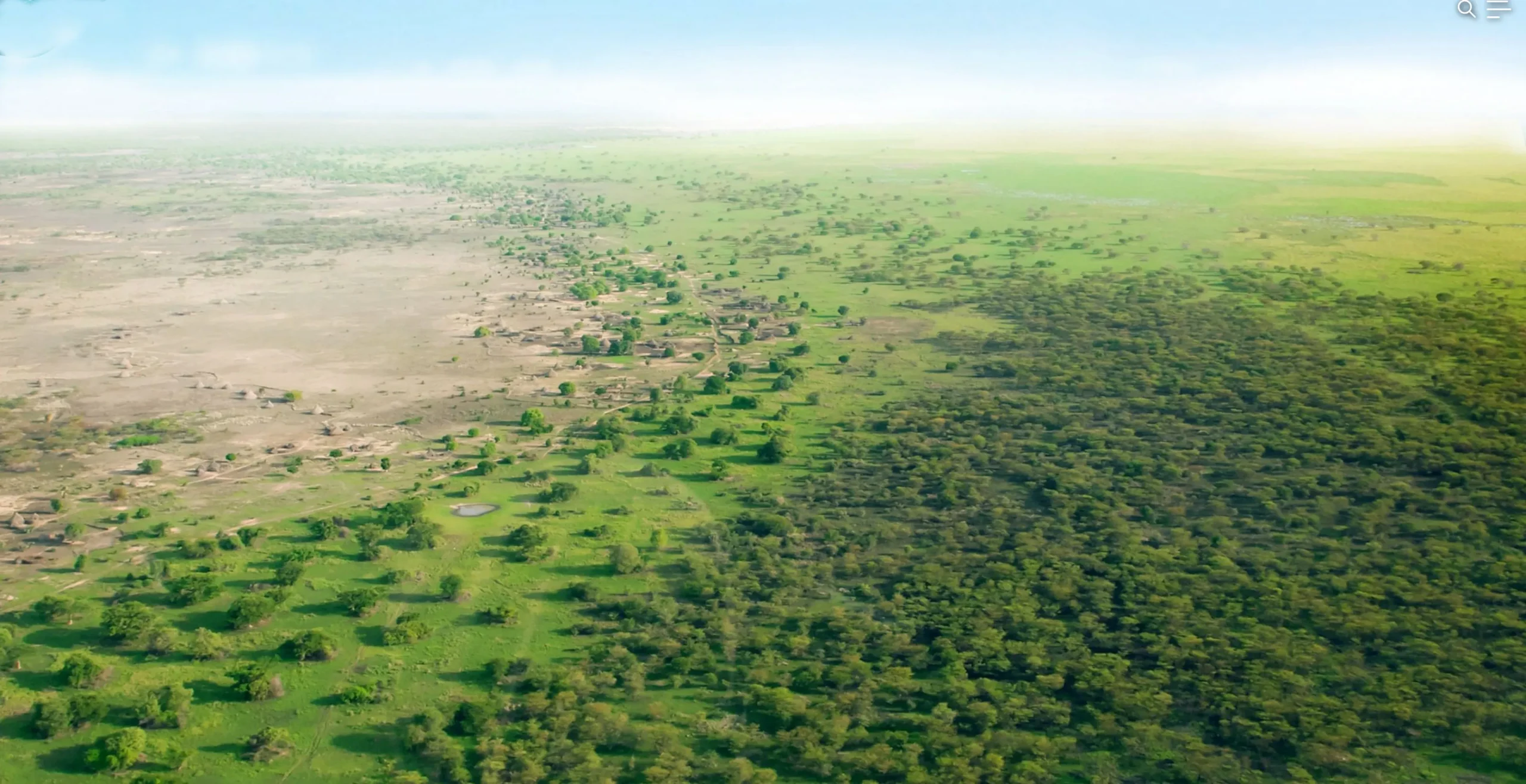
Billions of dollars are not reaching their destination, seedlings are dying, and international institutions are getting lost in coordination. In Gambia, Niger, and Senegal, residents are showing that land restoration should start not with planting trees, but with empowering local structures. The post The Great Green Wall was supposed to transform the Sahel. Without local communities, will it remain an empty promise? first appeared on Krytyka Polityczna.
In the 1950s, British biologist Richard St. Barbe Baker proposed creating a belt of trees to separate the Sahel countries from the encroaching desert. This is how the idea of the Great Green Wall was born. However, the formal shape of the project only took form in 2007, when it was adopted by the African Union.
It was planned to restore 100 million hectares of degraded land, absorb 250 million tons of CO₂, and create 10 million green jobs by 2030. Over time, however, it turned out that instead of a single strip of forest, a mosaic of thousands of local projects is emerging, implemented under very different political, social, and environmental conditions.
Today, around the Great Green Wall, two narratives clash. The institutions responsible for its implementation, such as the African Union and UN agencies, emphasize progress and the project's potential, while some independent researchers point to delays, coordination problems, and limited effects. Which of these stories is closer to the truth?
Green project, European interests
Europe has an interest in the success of the Great Green Wall. The project's success could reduce migration from Africa, develop economic cooperation, and strengthen its position in the region. Critics, however, point out that behind the language of green transformation are also concrete economic interests. Species planted as part of the project—such as Senegalese acacia, baobab, or balanites—provide raw materials valued on global markets. In this way, environmental restoration intertwines with the logic of export and trade.
Is the old colonial spectacle still playing out in Africa? Although one of the main financial partners of the Great Green Wall is the African Development Bank, a significant part of the decisions regarding the project's direction are still made outside local communities.
Dr. Monika Różalska from the Faculty of International and Political Studies at the University of Łódź and a member of the Jagiellonian Center for African Studies emphasizes that Europe still tends to treat Africa as a single, homogeneous entity. Meanwhile, the countries participating in the project differ in environmental, economic, and social conditions, as well as administrative and technical capabilities. This further complicates cooperation with international donors.
Money got stuck along the way
During the One Planet Summit in 2021, $14.3 billion was pledged for the implementation of the Great Green Wall. Two years later, only about $2.5 billion had been disbursed.
In 2025, researchers from universities in the Netherlands, Senegal, and France published an analysis of the project's progress in Senegal in the scientific journal Land Use Policy. They believe that trees are growing more slowly than expected, and only one out of 36 analyzed areas was greener than it would be naturally. The authors highlight that a significant portion of the previously declared funds never reached local communities.
“While billions of dollars were pledged for the construction of the African Great Green Wall, much smaller sums were actually spent on the ground. As a result, a huge gap has emerged between the declared funds and the funds spent at the local level,” reads the report.
Similar conclusions are drawn from the experiences of activists and observations of researchers.
“Despite declarations and commitments from the UN, the World Bank, and the European Union, the actual funds allocated to the project remain insufficient,” says Monika Różalska. She adds that the large number of donors and organizations complicates coordination, monitoring progress, and controlling expenditure.
External experts and co-authors of change
Amidst spectacular declarations and missed opportunities, local initiatives are emerging around the Great Green Wall.
For Kemo Fatty, founder of Green Up Gambia, the Great Green Wall has never been primarily a tree-planting project. He grew up in a family of farmers in northern Gambia, where soil salinity and lack of water caused the land to cease supporting residents. For this reason, his brother moved to Europe. Between 2015 and 2017, a series of droughts in the Sahel region coincided with the rule of dictator Yahya Jammeh, contributing to the exodus of thousands of Gambians. “They even claimed they were not migrants, but climate refugees,” Kemo said in an interview published on the G20 Global Land Initiative website.
Green Up Gambia adopted a different approach than European donors and institutions trying to solve Sahel’s problems from the outside. Instead of starting with tree planting, the organization begins with conversations with residents. During civic gatherings, village leaders, elders, farmers, women, and youth meet around one table. They jointly identify the problems of their community and decide what actions are most needed.
As Fatty explained, there is concern that many environmental protection projects are implemented from the top down. Experts arrive with ready-made solutions, and residents are only executors of others’ decisions.
“We do not want to treat residents patronizingly. Too many projects look like experts come from outside and make all the decisions. Farmers follow orders but never become co-authors of change,” he said.
The organization advocates for creating community funds managed by residents themselves and for local leaders to be responsible for project implementation.
This approach stems from Gambia’s own experiences. For many young people, migration has become the only way to survive. As Fatty recalls, agriculture has started to resemble “a game of chance,” where success depends solely on luck. That is why Green Up Gambia combines environmental actions with improving residents’ living conditions.
The organization’s slogan is: “move from planting to growing”, which in free translation means: it’s not enough to plant a tree—you must ensure it grows. In addition to tree nurseries, social gardens are developed, mangrove restoration is underway—forests growing on wetlands and salty coasts—and agroforestry projects are implemented to provide residents with food and additional income sources.
A similar logic can be found in other Sahelian countries. In Niger, Mali, Burkina Faso, and Senegal, effective measures include retention basins, local water management systems, and supporting natural tree regeneration. Monika Różalska also points to Ethiopia, where about 15 million hectares of degraded land have been restored, and Nigeria, where about 5 million hectares have been rehabilitated.
As the researcher emphasizes, instead of one green belt, today a network of local initiatives is emerging. “As a result, instead of a real wall, a dispersed collection of local interventions is forming, improving environmental conditions where favorable conditions meet, but not leading to a uniform transformation of the entire Sahel,” she says.
Africa does not need saviors
The term “desertification,” popularized in 1949 by French botanist and forester André Aubréville, has become part of a narrative blaming local farmers and herders for land degradation in the Sahel. Repeated by some international organizations, donors, and scientists, this story overlooked the role of climate change, natural variability of rainfall, and political instability. Meanwhile, satellite image analyses, conducted among others by NASA, show that since the mid-1980s, much of the Sahel has gradually greened. This is the result of both climate change and, partly, grassroots actions by farmers—from water retention to agroforestry.
Perhaps the biggest problem with the Great Green Wall is not the lack of seedlings or money. Equally important is the question of who designs solutions and who tells the story of Africa.
“Power must be in the hands of the local people who are on the ground,” said Fatty in an interview with Pioneers Post.
In another interview, he pointed out another dimension of this dependency: “Too often, others tell our stories for us. We rarely have the opportunity to say: ‘This is how we want to tell our story.’ Usually, journalists come and present reality from their own perspective.”
Perhaps that is the greatest lesson to be learned from the Great Green Wall. The ongoing rebuilding of the Sahel begins not when billions of dollars arrive, but when residents regain agency and decide for themselves about the future of their land.
The post The Great Green Wall was supposed to transform the Sahel. Without local communities, will it remain an empty promise? first appeared on Krytyka Polityczna.