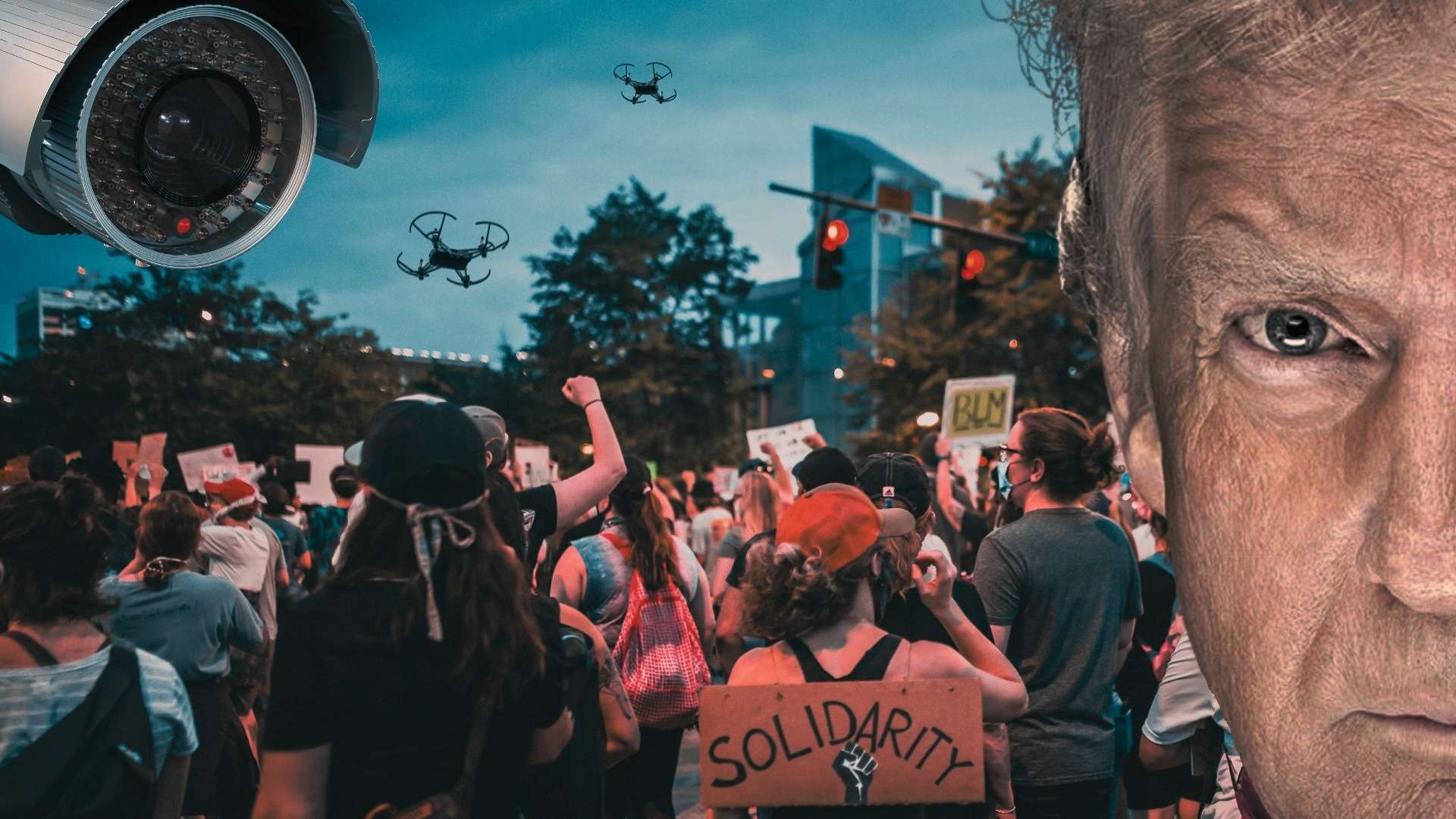
Trumpists have found the perfect pretext to expand the apparatus of repression and surveillance networks. The more the state focuses on combating a given threat, the more the existence of that threat is desired. The post Red Panic 2.0. Trumpists at war with "leftist terrorism" first appeared on Krytyka Polityczna.
In mid-July, U.S. Secretary of State Marco Rubio organized a meeting of representatives from 67 countries, aimed at establishing a new coalition. This time, alongside the fight against jihadism and "narcoterrorism," leftist terrorism was identified as the main threat. The latter received the most attention from Trump's allies, announcing the start of an institutionalized, international crusade aimed at "far-left political terrorism", with particular emphasis on anti-fascism. They announced defending the "civilization" from the supposedly encroaching global leftist influence network, equating pro-democratic and pro-climate demands with Marxist revolution. As Stephen Miller stated, we are dealing with a "cancer" leading to the gulag, which must be ruthlessly destroyed.
The liberal center reacted with moderate outrage. The successive internal successes of socialists disturb the main stream of Democrats, who see them as an internal enemy, which surprisingly aligns with the narrative of Trump, Rubio, and Miller about an "enemy within the house" in the form of progressive activists. However, a much more interesting development is the ongoing transformation of the USA into an authoritarian state, exercising strict control over citizens through infrastructure provided by private tech corporations. To understand this reconstruction, superficial calls for defending democracy are not enough, even if they are fully justified. Therefore, we will examine what new elements the anti-left offensive brings, and what is merely a reconfiguration of the machine that has been operating for a quarter of a century.
War on Terrorism and the State of Mass Surveillance
Since 2001, the paradigm of American politics, law, and largely also the economy has been the doctrine of War on Terror, i.e., the war against international Islamist terrorism. Although some commentators find Trumpist comments about a civilization war shocking, this narrative was forged during the administrations of George Bush and Barack Obama. It was under their terms that networks of secret prisons were established, where people were tortured, preemptive arrests sanctioned, international military infrastructure restructured to combat terrorism, dozens of agencies and think tanks specialized in analysis, tracking, and targeting for killing were created, along with radical legal reforms granting extraordinary powers to the executive branch, and finally—budgets of private and state "anti-terror" institutions were inflated to absurd proportions.
Over these 25 years, the definition of "security" has been radically narrowed. Previously understood as a sense of stability and the ability to obtain support from society, it has turned into paranoid fear of the foreigner, who can literally be everywhere, hence—preemptively—all people on Earth should be subjected to surveillance, not just American citizens. This has indeed happened. Just a few years ago, revelations by Assange and Snowden about the American surveillance network capable of tracking virtually every internet and phone interaction caused global outrage. A decade later, they are considered the norm.
The brutal symbol of this change is the American drone war
Entire metropolises in Middle Eastern, South Asian, and African countries have been under permanent observation by specialized military drones. Years before the world heard of ChatGPT, algorithms created patterns of life of local populations, recording every step and identifying potentially dangerous individuals for killing. At least several thousand civilians, including hundreds of minors, have been killed this way.
In many areas of Afghanistan and Pakistan, children stopped going to school, and adults avoided funerals, fearing they would be killed by a drone. Daily life became a nightmare, and the constant hum of unmanned aerial vehicles drove people into paranoia. In the drone war, factors increasing the risk of being killed by Hellfire missiles included making suspicious phone calls, changing the usual route home, participating in large gatherings, or transporting gasoline cans. Drone operators have reported in interviews that they want to gouge out their eyes after what they observed from remote cockpits. The total digital control state built by the Trump administration is just the culmination of this process and—according to Aimé Césaire's theory of the imperial boomerang—a transfer of some methods used in foreign wars "back home".
The machinery of national and international surveillance developed by successive Republican and Democratic administrations consumes billions of dollars annually. It employs millions of people and provides lucrative contracts to the defense and IT industries, creating mutual dependencies between state institutions and big business. It thus becomes self-sustaining—requiring the continuous presence of an enemy to survive.
This issue was noted by Italian philosopher Giorgio Agamben, who in 2015, at the height of anti-terrorist panic, openly presented the paradox of liberal democracies: the more the state apparatus is focused on fighting a given threat, the more the existence of that threat is desired. This is because increasing capital-symbolic investments in this aim require justification. In other words, at best, rulers must silently allow enemies to grow stronger, and at worst, actively support or produce them. Unlike the Hobbesian model, where the state is supposed to end the war of all against all, the "security state" feeds on citizens' fear and must constantly sustain it.
Jihadism remains a strong scarecrow, but it has been exploited to the limit in the media
It also has a fundamental flaw—it's the very enemy that the Obama and Biden administrations fought against, and yet, a government aiming to create a new society must differentiate itself. Radical Islam is no longer enough to pacify its own nation or redirect public funds to big tech (which, again, started over two decades ago, not with Trump). Political and business elites urgently needed a new enemy to serve the gigantic and increasingly costly surveillance infrastructure and to pursue their own interests. The left was an ideal target.
The left as a phantom enemy
It can be said that dealing with progressive movements—from breaking unions to persecuting intellectuals—is embedded in the DNA of the American legal system. Some commentators claim this is already the sixth wave of anti-socialist scare tactics in American political history. Its roots go back at least to the Palmer Raids of the 1920s, when the Department of Justice launched a nationwide campaign against alleged socialists and anarchists, mainly targeting immigrants from Italy and Jews from Eastern Europe.
Soon after, the paranoia of McCarthyism emerged, targeting anything associated with leftism. The culmination was the large-scale COINTELPRO program from 1956-1971—FBI agents infiltrated, disinformed, ridiculed, fabricated charges, provoked internal conflicts, and sometimes deliberately contributed to murders within Black radical communities, leading union figures, pacifists, feminists, environmentalists, liberal artists, lawyers, and indigenous activists. Simultaneously, from the 1970s onward, the U.S. systematically armed and supported far-right Latin American military juntas through Operation Condor. Besides destabilizing the political and economic landscape of the continent, the direct result was the death of at least 50,000 people (some sources cite 80,000) and the imprisonment of 400,000, with 30,000 considered missing.
The second Trump administration attempts to create a COINTELPRO and a version 2.0 of Operation Condor
The fundamental difference lies in the political realities. In the past century, the anti-communist campaign fought—often in regular military clashes—against the Soviet sphere of influence and organized international anti-imperialist movements, wielding power and posing a threat of seizure of power, whether directly in the U.S. or in many other countries. Today, the enemy is purely phantom, fabricated for the needs of an anti-terror apparatus pushed to the brink of absurdity. As Agamben notes, in a security state, the opponent must be very broadly defined to justify increasingly comprehensive surveillance of the population (especially communication and data) and to coordinate fear. This feeling of rage and fear, rather than political participation, becomes the new basis of citizenship.
Is it any wonder that a few days after the international summit, a government report appeared on Cuban communist influences in the U.S., labeling—besides New York Mayor Zohran Mamdani and streamer Hasan Piker—a labor union at Amazon as a "leftist agitator" linked to Cuba? In the right's imagination, Castro's state started to act like the famous immigrant Schrödinger's cat—while immigrants are simultaneously unemployed and stealing jobs, Cuba is supposed to be a meaningless, fallen country financing thousands of powerful, leftist initiatives across the United States and beyond.
Already in September 2025, the memorandum "Combating domestic terrorism and organized political violence" (NSPM-7) redirected resources from various agencies, from FBI to IRS, to dismantle the abstract forces of "Antifa." Acts considered "terrorism" included criticizing capitalism and U.S. policies, demanding gender and racial equality, or expressing opposition to the traditional Christian family model. Extremism was redefined. Instead of acts (bombings, kidnappings, murders), the focus shifted to opinions, emotions, and language used.
With the new law, the justice system gained free rein to construct charges against dissenters
In recent months, acts such as roadblocks, anti-government graffiti, possessing a megaphone, or distributing anarchist leaflets have been considered signs of terrorism. Even if some of these actions can be linked to a specific law, categorizing them alongside bombings or murders creates entirely new possibilities. There is no need to build narratives about communist plots for years. A few social media posts are enough to mobilize the entire repression apparatus against actions that were just recently considered misdemeanors or not illegal at all.
Hiperpolitics, AI, and the state's alliance with tech oligopolies
This new phase of "red panic" makes sense in the context of what Anton Jäger called hyperpolitics. After the era of mass, total politics of the early 20th century, a sense of emptiness set in, especially after the crisis of triumphant neoliberalism of the 1990s and 2000s. It brought increasing apathy, which combined with the development of social media created a volatile mix. In the emerging model of power, there is no place for building lasting, inclusive institutions based on moral, religious, or class communities. Instead, there is a need for constant emotional stimulation, experiencing short-term, incidental eruptions of outrage. Focus on long-term strategy, i.e., the traditionally understood model of politics, is replaced by controversies, improvisation, senseless displays of force, finger-pointing at enemies.
Therefore, the anti-left crusade does not bother with arguments but systematically employs grotesque exaggeration. A symbolic founding moment of this discrediting of opponents is the widely promoted book Unhumans by Jacek Posobieć and Joshua Lisiec from 2024. Critics say it echoes Nazi tradition, arguing that leftists are the titular non-humans, "ugly, deformed freaks." Miller now uses this argument, describing anti-fascists as "deformed" and "abnormal." The goal is not to fight these "non-humans" but to keep supporters in a state of obsessive arousal, destabilization for its own sake, as a method of governance.
Another qualitative change in the "red panic" of 2026 is that it occurs during a period of full integration of Leviathan with tech oligopolies. Instead of a clunky steel and mass media complex, power now relies on propaganda created in real-time for upcoming elections and current interests of Silicon Valley billionaires. Posts on White House channels coexist symbiotically with mass-generated "anti-woke" AI-slop and manifestos of paladins like Alex Karp. The same oligarchic class, on state orders, is building a vast surveillance system, treating privacy as bureaucratic waste. People who came to power criticizing leftist authoritarianism memes with Orwell are creating a control system that makes Assange’s and Snowden’s revelations look like innocent jokes.
Part of the anti-left turn is also the demonization of protests against data centers harmful to local communities. Peaceful citizens are arrested for trivial reasons, such as exceeding time limits at demonstrations or… clapping. Just as anti-communist actions of the 1950s led to the dismantling of several large unions over imaginary or real links to the Communist Party, in 2026, this paves the way for business elites of AI/IT. Moreover, since early August, the largest market players can purchase early access to posts by Trump and other officials to use in financial operations. Sounds like a far-fetched cyberpunk from the early 80s? It means it will work perfectly in the realities of hyperpolitics.
Global fight against the left in defense of big capital interests
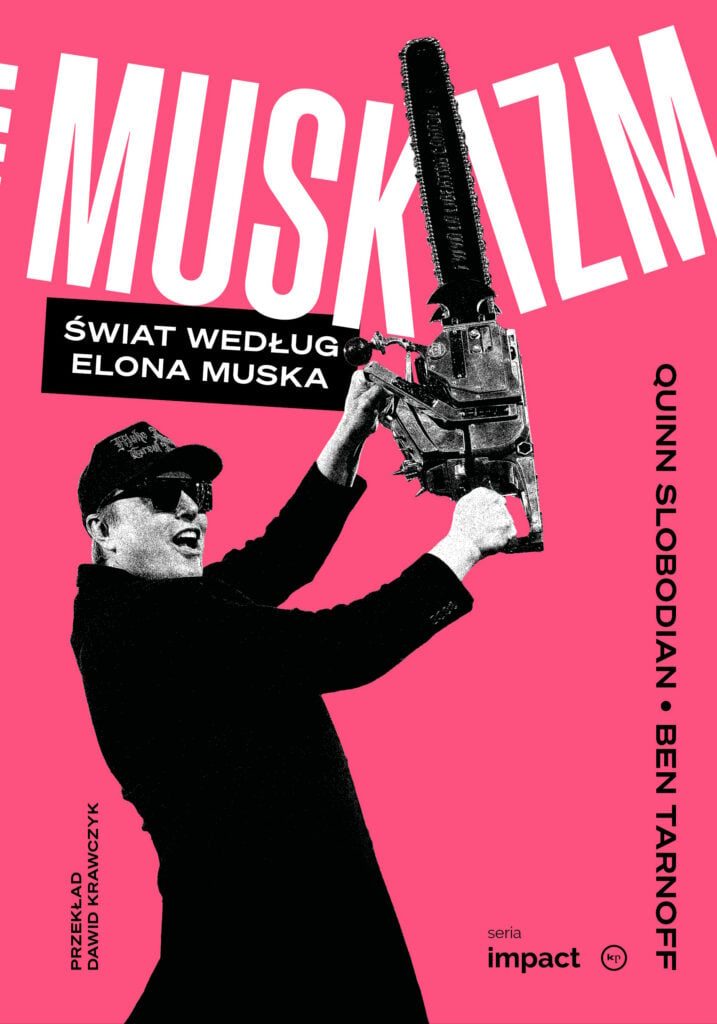
There remains the purely economic dimension on a global scale. Quinn Slobodian, author of the recently published book Muskism, noted that the goal of building supranational institutions was never to create a free-market utopia. The architects of the post-war order, and later the neoliberal status quo, aimed to design international legislation in such a way that global economic exchange would be separated by a permanent wall from the claims of sovereign states and their citizens. Commercial law, arbitration treaties, or conditions for support from the International Monetary Fund and the World Bank were constructed to block local decision-making, reducing states to porters of capital.
From this perspective, convening an international assembly on so-called leftist terrorism is a direct continuation of corporate insurance strategies. The ultimate goal for the U.S. Secretary of State is not to eradicate niche activist groups with inappropriate views but to impose on U.S. allies (voluntary or otherwise) strict rules that consider pro-worker, anti-capitalist demands as genuinely subversive threats. Trumpism would thus be not just the final nail in the coffin of the liberal order but a reconstruction of its cultural dimension and the culmination of its economic aspect. Opposition to it is simply to be criminalized.