The Democratic Party is being replaced by a left-wing wave.
Krytyka Polityczna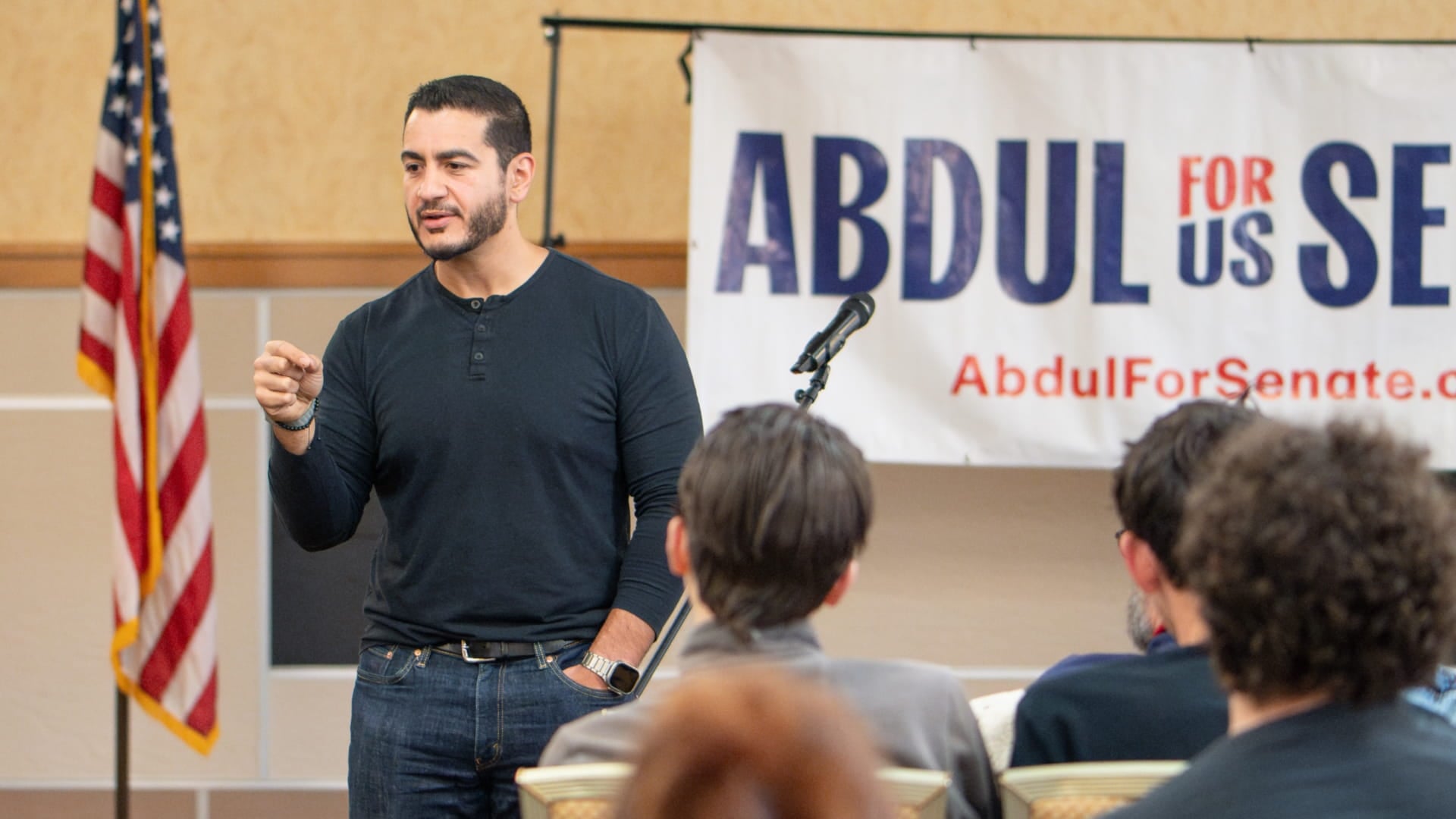
In every election in the USA, there are voters ready to support an opposition figure promising to "turn over the table." In 2024, such a figure was Trump. Today, the anti-system message is being offered by young socialists from the Democratic Party. The post The Democratic Party is being changed by a leftist wave first appeared on Krytyka Polityczna.
It is already evident today that the most important event of the American primaries was the progressive-left wave that swept through the Democratic Party this year. Party-left candidates supported by Bernie Sanders and Alexandria Ocasio-Cortez, sometimes affiliated with the organization Democratic Socialists of America (DSA), were winning across the United States – from California through Colorado and the Midwest to New York – in all possible primaries: for state legislatures, Congress, the Senate, or mayoral positions.
In November, the new mayor of Washington, D.C., is most likely to be Janeese Lewis George, who identifies as a democratic socialist, and Nithya Raman, a DSA member, will compete for a similar position in Los Angeles. If they win, the capital and the two largest cities in the country would be governed by democratic socialists.
Left-wing candidates won primaries despite opposition from the party establishment, and often also against large financial backing – in key races, their main opponents had several times larger campaign budgets. Some commentators even speak of a “populist revolution” in the Democratic Party.
Whatever term we use, something has undoubtedly changed in the party in recent months, and these changes evoke as much enthusiasm among the leftist base as fears among the more moderate faction of the party about an “enemy takeover” by the “extreme left.” Some also fear that democracy could pay a high price if too-left candidates fail in the November elections, which would be winnable if the party supported a more moderate candidate.
Mamdani from the Midwest
These hopes and fears are especially concentrated in Michigan, where two weeks ago, the supported-by-Bernie Sanders and AOC progressive candidate Abdul El-Sayed won the primary, a well-educated, forty-year-old health official, a Muslim born in the U.S. to immigrant parents from Egypt.
El-Sayed is sometimes compared to New York City Mayor Zohran Mamdani. Like Mamdani, El-Sayed ran a highly disciplined, message-focused campaign, centered on a slogan that could be translated into Polish as: “Money out of politics, money in your pocket, universal healthcare.” Just as the New York mayor, the Michigan politician strongly criticized Israel’s policies toward Palestinians and U.S. military support for Israel.
Finally, just like his New York colleague, El-Sayed was very skilled in political marketing tools. El-Sayed’s first clip began with a typical story about a young man climbing the rungs of the American dream – a high school football captain, a scholarship to a prestigious university, and so on – illustrated with archival footage from Michigan’s golden age, several post-war decades when the state’s automotive industry was a driver of material progress. “Michigan values serving Michigan,” says the narrator, “and his name is…” then the candidate appears on screen and says ironically, “Abdul El-Sayed is a name made for American politics,” and begins to explain why he is running.
El-Sayed now draws the attention of the entire country not only because of his name, faith, or resemblance to Mamdani. Michigan is one of those states where Democrats must win Senate races if they want to control the chamber – approving, for example, Supreme Court nominations. In the last ten years, the state has voted twice – in 2016 and 2024 – for Donald Trump, making it one of the swing states – states where the outcome is uncertain and which truly decide the election, capable of swinging either right or left.
Until now, left-wing candidates mainly won primaries in safe Democratic districts where Republicans had no chance from the start. Michigan – although Sanders won the presidential primary there in 2016 – is not one of those states. If El-Sayed demonstrates that a distinctly leftist, Israel-critical candidate can win in a “toss-up” state, it will be a major success for the party’s left and a sign that its politics can be electorally effective even in places where the real fight is against Republicans.
If El-Sayed loses, the left will be blamed for Michigan’s loss – and perhaps also for the Senate. The party establishment will interpret his defeat as proof that the leftist revolt must be limited at all costs to areas where Democrats have no chance of losing.
Does the left overestimate its strength?
For now, El-Sayed slightly trails in almost all polls. At the same time, his primary victory was narrow, by less than a percentage point, fewer than 15,000 votes, despite polls giving him a much larger lead. This raises the question of whether polls overestimate progressive candidates. The significance of this question is reinforced by what happened last Tuesday in another Midwest state, Wisconsin, where the favored DSA-linked Francesca Hong narrowly lost the gubernatorial primary.
According to an analysis by the “Washington Post” El-Sayed mainly mobilized a younger and better-educated electorate, winning decisively in counties with the highest percentage of residents aged 18–34 and those with college degrees. He also performed best in counties with median incomes – his opponent Haley Stevens won in the wealthiest and poorest counties of the state. Stevens also won in counties with the highest percentage of African Americans, and it’s clear that, as in many primaries over the last decade, this group, especially its older segment, remains quite resistant to the progressive Democratic message.
What conclusions can be drawn from this? As liberal journalist Fareed Zakaria argues, the Michigan results show that young, progressive left has energy that the party cannot ignore, but on the other hand, they falsify a key electoral theory of the left. Since Sanders’ sensational campaign in the 2016 primaries, the left claims that instead of chasing the mythical “moderate voter” and constantly moving toward the political center, the Democratic Party should focus on well-understood economic populism and a real fight for the interests of the working and middle classes, which the Democrats’ drift to the center either discourages from politics or pushes into the hands of right-wing populists like Trump. Zakaria says: look, El-Sayed did not attract disillusioned working-class voters, but young and educated ones. The true working class does not want socialist policies, and if Democrats want to win, they must shift not to the left on economic issues but to the right on cultural issues, because that is where the values of the working class and Democrats diverge.
Data from the primaries can also be interpreted differently. Analyst G. Eliot Morris, on his substack Strength in Numbers, points out that DSA-aligned candidates can be attractive even to more moderate voters regarding economic or cultural views, due to their anti-establishment stance. According to the analyst, the key debate in American politics today is not about control over the means of production but about whether the system works or needs a radical shake-up and change. In every election, there are voters ready to support an opposition figure promising to “turn over the table.” In 2024, when Democrats were in power, it was Trump. Today, as Trump becomes increasingly unpopular, party-left candidates are able to step into the role of anti-system opposition, appealing to moderate but anti-establishment voters.
How will the party handle the change?
This anti-establishment energy was visible in almost all primaries, where left-wing candidates won. “They defeated us organizationally. We did not mobilize traditional Democratic voters. We did not give them a reason to come and vote,” commented New York State Attorney General Letitia James on the primary results and the successes of candidates supported by Mamdani.
The voices of the party elite, warning about the “unelectability” of leftist candidates, still sometimes influence decisions. Undoubtedly, this was an important factor contributing to Hong’s defeat in Wisconsin – a candidate who had to explain her very unwise statements from a few years ago, such as about abolishing Thanksgiving.
However, similar arguments are less effective than ten years ago. Over the past decade, the party establishment itself has lost twice to Trump. It also diverges from the base on many issues: starting from too weak resistance to Trump, through economic policy, to its support for Israel, which is becoming increasingly fragile among younger Americans.
El-Sayed won in Michigan by a minimal margin, but his opponent spent 11 times (!) more on her campaign, over 60 million dollars. Of this, 30 million came from pro-Israeli lobbying group AIPAC, which now plans to deploy its financial resources to support El-Sayed’s Republican opponent. As leftist commentator Ross Barkan wrote in UnHerd: the fact that 60 million dollars couldn’t decide the outcome of Michigan’s primary shows that something has fundamentally changed.
A similar pattern was observed last Tuesday in Minnesota’s Senate primary, where despite a financial advantage, the progressive candidate Peggy Flanagan, running under the slogan “many vs. money,” won.
This raises the question of how the party will now manage the division revealed by the primaries. Will it be able to utilize both wings – the progressive and the more moderate – or will it fall into a demobilizing civil war among voters? For now, party leaders seem resigned to the fact that in November they will have to run candidates like El-Sayed. At the same time, the centrist Third Way group plans to allocate at least 15 million dollars to fight DSA candidates and their growing influence in the party – especially in the context of the 2028 presidential election, when the left is increasingly dreaming of nominating Alexandria Ocasio-Cortez.
The problem is right-wing populism
In July, the liberal magazine “The Atlantic” published an essay by Jonathan Chait titled There is nothing democratic about these socialists. The author accuses DSA of having been once a genuine, democratic left organization, but now taken over by a leftist hostile to liberal democracy, ready to support any dictatorship that is sufficiently anti-American, including Iran, Putin’s Russia, or Hamas’ rule in Gaza.
Undoubtedly, some of the statements from DSA circles regarding the Ukraine war were deeply unfortunate. One of the candidates elected in New York with Mamdani’s support, Darializa Avila Chevelier, claimed on social media that Russia attacked Ukraine because since the war’s end, the U.S. has been “bullying Russia” (bullying Russia). Also, the DSA platform, which includes proposals such as cutting Pentagon funding and closing “all foreign U.S. military bases,” may raise concerns from a strategic interest perspective for Europe.
However, the main threat to Europe today is primarily the global MAGA program and Trump’s unpredictability. It is crucial for Europe that American democracy can effectively curb the impulses of Trump and the radical Republican right centered around him. And there is much evidence that, at least on some issues, Democrats need to shift leftward to be an effective opposition to Trump.