Why do we need the Union that cannot defend our rights?
Krytyka Polityczna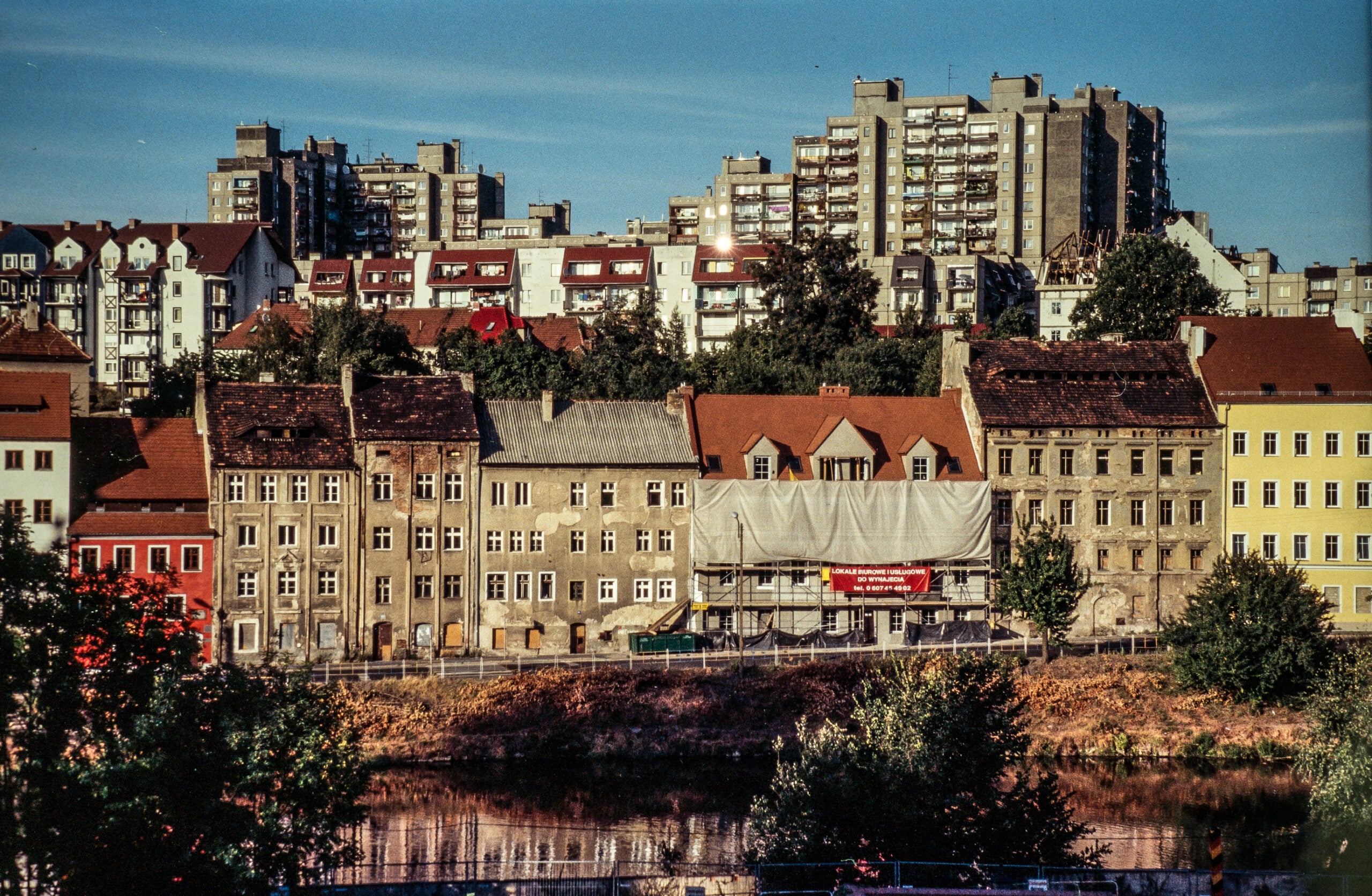
"The EU has let down the people who built their lives around the Schengen area. We will never forget this," says Jakub Wolinski, who sued the German authorities over the introduction of border controls with Poland. The post Why do we need the Union that cannot defend our rights? first appeared on Krytyka Polityczna.
Standing with Jakub Wolinski on the steep Kirchberg hill in Görlitz. We look down at the Nysa River, wide and shallow, flowing one level below, and at the pedestrian bridge in the Old Town connecting German Görlitz with Polish Zgorzelec. On the German side, no blue-white police car is visible, only large, gray poles with cameras on the bridge head revealing police surveillance.
At the end of the bridge in Zgorzelec, near the ice cream shop, Wolinski spots a Polish guard. From a distance, you have to look carefully. He shows me a photo on his phone, where you can see a soldier in a balaclava with a long gun. That’s what the Territorial Defense soldiers look like.
– As if we were dealing with terrorists here! – he exclaims. – I can't explain to my children where such a threat would come from, since people there are eating ice cream.
37-year-old Wolinski grew up in Zgorzelec. When border controls were lifted, he was 19. He remembers a celebration in the city for joining the Schengen Area on December 21, 2007. Then he moved out. In 2015, during the migration crisis, he lived in Vienna, near the main station. He says he shops at a market in the station, so he knows what a wave of refugees looks like. But the situation here – Wolinski looks down at the bridge – doesn’t remind him of that at all.
A few years ago, he returned to Görlitz with his wife and children. He works as a railway data analyst. His parents live in Zgorzelec. They often take care of the children, take them to the ice rink. Wolinski is glad that the children spend time in Poland, hear the language there, and speak Polish. We are talking while standing on Kirchberg.
Nancy Waldmann: Will you still go to the other side of the river?
Jakub Wolinski: Of course, my family’s life takes place on both sides. My parents live there, I need to take the children. But I only go there when it’s necessary. The control is very stressful for me.
Residents with local license plates are rather rarely stopped by the Federal Police (German federal police). And if they are, the matter should be quickly clarified. Why is this so stressful for you?
German officers almost always want to look into my car because I drive a minibus with tinted windows and built-in child seats. I hear from them that they need to check if these are really my children. However, there are no grounds to suggest I am transporting illegal immigrants. During the control in September 2024, my car was searched, my personal data checked – I believe illegally. That was a signal for me to go to court. And in December of the same year, it escalated.
What happened?
Late at night, I was returning home with my wife. At the city bridge, we were stopped again by the police. Officers wanted to look into the car, and we objected. A two-hour dispute ensued, and in the end, 13 police officers surrounded us. When I asked one officer to show his badge, I was ignored. They also dismissed our request to close the car doors in the freezing temperatures. They tried to intimidate us, saying: “We have time!” When the state wields power this way, it doesn’t treat citizens as equals. And the police want to show me that they have the upper hand.
How did it end?
I later received a letter. The police filed a report against me for “breach of confidentiality of conversation,” claiming that I had started recording on my phone that night. So far, this has had no consequences, but I see it as harassment.
And that’s why you went to court?
No. I care about saving the Schengen agreement because it’s a great social value. Controls are an abuse of trust. The advantage of our borderland, guaranteed by law, is being turned into its opposite. We cannot accept this. The Schengen agreement cannot apply only when there is peace worldwide!
The German controls aim to prevent illegal immigration. What do you think of the German criticism of Poland, that it has been too lenient in allowing migrants?
I find it offensive. Belarus and Russia actively support migration to harm the European Union. Poland built a fence, and last year, a Polish soldier was even killed at the border. And the Dublin system is unfair to EU countries with external borders of the Union.
In Poland, people often say something else: that Angela Merkel invited the whole world, so migration is Germany’s problem.
Yes, that’s a common view in Poland. I don’t see it that way. Migration depends on entirely different factors, mainly what’s happening in the world. People came because the situation in Syria changed.
And Ceuta? In this case, the cause was apparently not a humanitarian crisis.
A letter from 22 EU heads of state to Spain, signed also by Merz and Tusk, is unacceptable. After all, the people who arrived were not in the Schengen zone even for a moment, because Ceuta does not belong to it, and Spain conducts a second control there. Of course, the problem is when other countries use migration against the EU for political fights. Just like Russia and Belarus do. But that’s about external borders, not internal ones. It’s right-wing politics that links these two issues.
Local controls have no impact on illegal migration. At small crossings near Görlitz, controls are practically never conducted. But in the city center or on the highway, police have been stationed permanently since May 2025. It’s a political theater.
In a local Facebook group with 34,000 followers, a comment appeared regarding your lawsuit, stating that Görlitz residents “are mostly glad that the illegal influx of people from half the world has finally been stopped.” How do people from your surroundings view the controls?
I realize that these controls do not directly concern many Germans. If they feel threatened, I wouldn’t mind checkpoints deep inside the country if they increased the sense of security. There are also people in Görlitz who criticize border controls, but only a few actively oppose them. I am disappointed with the mayor of Görlitz. Because, for example, the mayor of Kehl on the Rhine protested directly to the chancellor.
Görlitz’s mayor Octavian Ursu said about the controls by the German Federal Police that they are necessary but should not be a permanent solution. Is it because he is too close to his CDU party line?
I understand that as a politician, he is limited. But I would expect someone with his background to show more emotional engagement. Ursu himself once emigrated from Romania.
But the mayor of Zgorzelec met with you to support your lawsuit. He even posted photos on Facebook.
Yes, we met several times. For example, in January 2025, after I filed the complaint.
He is the only Polish mayor to have filed a complaint against Germany to the European Commission. Because, according to law, the Commission is supposed to oversee the enforcement of the Schengen code.
In June 2025, after Germany tightened controls, the mayor announced a petition to the EU. But two weeks later, the Warsaw government decided to introduce its own controls in response to the German ones. That took the wind out of the initiative. Many Poles saw it then as “reparative justice.” Especially those who rarely cross the border. And the mayor himself is part of the ruling Civic Coalition.
By implementing these controls, the Polish government once again punished its own citizens. Now we are also stuck in traffic in the opposite direction. We are becoming suspicious to the authorities on both sides.
*
Zgorzelec’s mayor Rafał Gronicz sharply criticizes the German controls. “Smugglers are not fools. If I were one of them, I would blow up people in a shallow part of the Nysa and pick them up on the other side. For someone who has traveled thousands of kilometers from Syria or Africa, wading through this river is no obstacle,” he said in an interview with me in the summer of 2025. He advocated for mobile patrols and complained about traffic jams in his city. The petition was signed by 1,400 residents of Zgorzelec and 150 residents of Görlitz, and in August 2025, it reached Brussels.
In July 2026, I called the mayor again. – I am very upset right now – he says. To this day, no response has come from Brussels.
However, on June 2, 2026, EU Commissioner Magnus Brunner called on Germany and other countries to immediately lift temporary border controls. Brunner aimed to promote reform of the Common European Asylum System, which then came into force and was supposed to solve the problems that led to the introduction of controls at internal borders. Gronicz believes this was more of a request than an order.
The problem with traffic jams in Zgorzelec slightly decreased after the mayor raised this issue in 2025 at the Poland-Germany Intergovernmental Commission for Regional and Cross-Border Cooperation. As a result, cross-border traffic became smoother because federal police now chase vehicles for control onto the shoulder. – However, on Mondays after long weekends in Germany, it’s still an armageddon. Fire brigade and ambulance cannot get through – says Gronicz. – It’s solely our problem, and I have the impression that German authorities don’t care.
Why does his city of 30,000 residents fight alone for the Schengen agreement according to procedures provided by European law? – Other Polish municipalities also sent various letters. But gradually, everyone is running out of strength – says Gronicz and sighs: – So many millions spent on pointless controls, and on the Polish side, it’s the same.
Couldn’t Warsaw have instead filed a complaint with the EU against Germany instead of sending soldiers to the Nysa? Gronicz responds: – I think that’s a foolish move. But I also understand it because everyone expected our government to react. And it reacted very delicately, because they could have caused traffic jams on the German highway, but didn’t.
At the Ministry of Interior, I ask whether they considered filing a complaint against Germany to the EU. The answer is: “Within the framework of constructive dialogue, the parties will continue to jointly seek ways to restore the efficient functioning of the Schengen zone.” This may only mean that they are still waiting for Germany to stop the controls.
They have just extended them until March 2027, as announced by German Minister Alexander Dobrindt after the events in Ceuta. But this probably has nothing to do with Ceuta. The number of asylum applications in Germany is currently low, and voters are led to believe that we owe this to controls at German borders – and no one can prove otherwise. Poland also submitted an extension of controls to the EU until March 2027. The European Commission has not criticized this.
*
There are many companies, for example Polish carriers, who could calculate specific losses caused by these traffic jams. Why are you the only person who decided to take the matter to court?
Private individuals have far fewer resources than the state. I myself spend a four-figure sum on a lawyer. I had to wait a year and a half before the court finally scheduled a hearing for November 11, 2026. A representative of the transport union told me that presenting evidence of delays in deliveries due to controls is too costly.
In Görlitz, there is a logistics company that lost a large order. They delivered equipment from Zgorzelec to a theater in Görlitz, but deliveries were delayed because they were stuck at the border. I asked a Polish employee of the company why they don’t defend themselves. She said: “Then we’d have trouble with the tax office, they’d find something.” I think many Poles are afraid of such pressure from the German authorities. I experienced this myself when reporting to the police. It’s also an abuse of citizens’ trust.
By German authorities?
The European Union has always aimed to ensure that the law of the stronger does not apply. In Europe, where Germany is the largest country, this means that the EU ensures Germany does not dominate. However, for years, the Union has not played this role regarding border controls. How is it possible that the European Commission does not react, given that Germany has been controlling the Austria border for 11 years, four or five times longer than permitted? The European Commission has failed the people who built their lives around the Schengen zone. We will never forget that. Why do we need a Union that cannot defend our rights?
You have a chance to win. But your lawyer says that even if you win the case, the court will not be able to order the government to lift controls. So why do all this?
I want the German court to tell the German government: what you are doing is illegal. I want to prove that I am not a troublemaker, but I am defending justice for many people.
**
Nancy Waldmann – journalist of the “Märkische Oderzeitung” in Frankfurt on the Oder. Writes about Poland, the Polish-German border, and Eastern Europe.
The article was made possible by a scholarship from the Polish-German Cooperation Foundation.
The post Why do we need a Union that cannot defend our rights? first appeared on Krytyka Polityczna.