India and Israel are getting closer. They are united by state-supported nationalism and ethnic cleansing.
Kapitál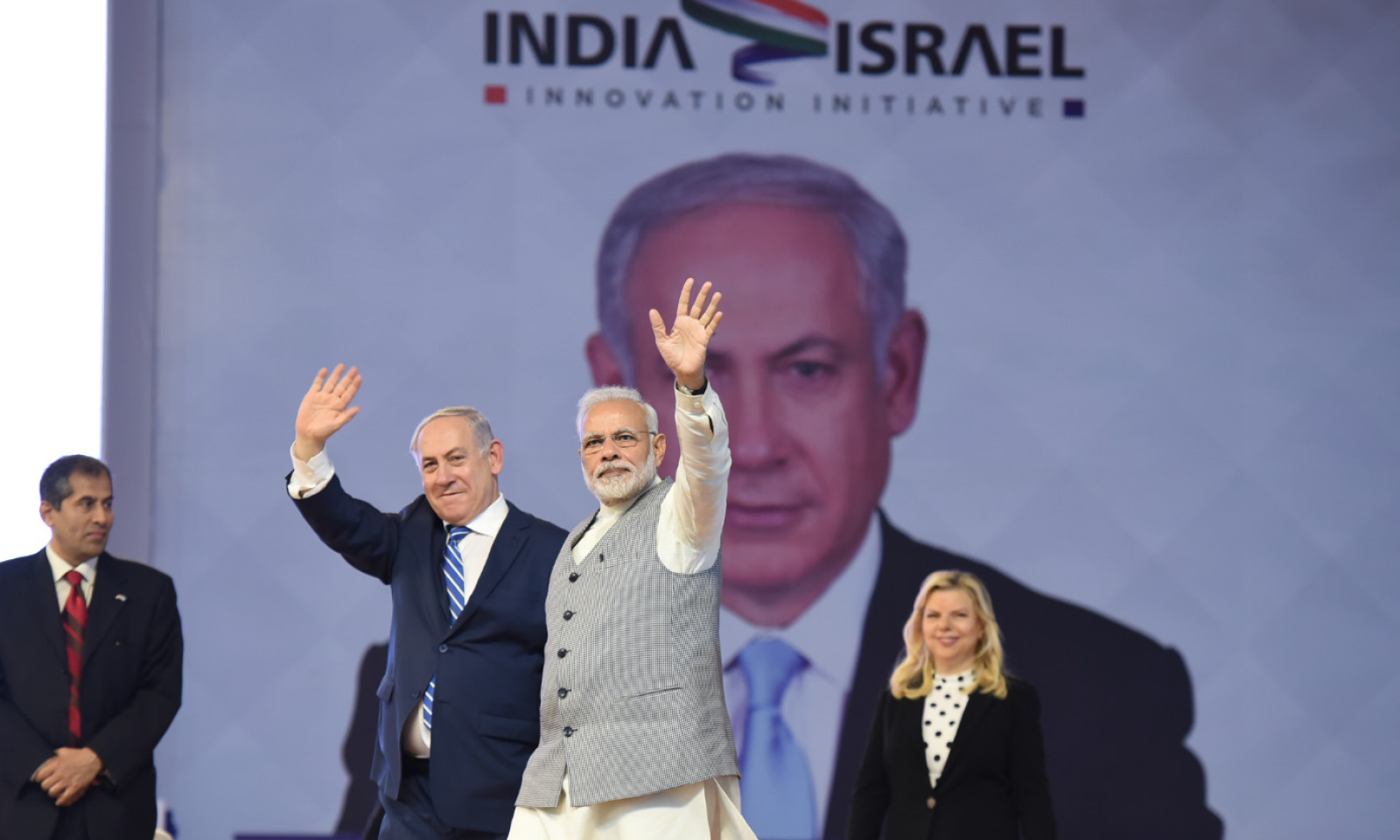
While Pakistan has managed to leverage the war in Iran to gain some diplomatic credit by advocating for an end to the fighting, despite its proximity to Tehran, India has chosen a different approach: unconditional support for its Israeli ally and the supply of weapons used in Gaza. Additionally, India and Israel are becoming closer ideologically.
While Pakistan has managed, despite its proximity to Tehran, to leverage the war in Iran to gain some diplomatic credit by advocating for an end to hostilities, India has chosen a different approach: unconditional support for its Israeli ally and supplies of weapons used in Gaza. Additionally, India and Israel are becoming ideologically closer.
In February 2026, just a few days before the United States and Israel attacked Iran, Indian Prime Minister Narendra Modi visited Tel Aviv on an official visit. Its aim was to strengthen bilateral relations through "a special strategic partnership focused on peace, innovation, and prosperity." Modi did not condemn the subsequent attack; he only expressed his "deep concern."
In the case of the attacks on October 7, 2023, the Indian Prime Minister was less reserved. At that time, he was among the first leaders to condemn Hamas's actions. He immediately labeled them as terrorism and subsequently made several gestures of support for Tel Aviv. One of these was sending thousands of construction workers to Israel to compensate for the missing workforce after the cancellation of work permits for Gaza residents on October 10. Supporters of nationalism promoted by Modi's Bharatiya Janata Party (BJP) quickly took the initiative: they organized several rallies in support of Israel, where slogans like "Long live India, long live Israel!" were heard. Most of the posts with hashtags #IsraelUnderAttack, #IStandWithIsrael, which flooded the social network X, allegedly originated from India.1
Despite the fact that New Delhi expressed support for the admission of the Palestinian State to the United Nations (UN) in May 2024, in recent years India has mostly abstained from voting on resolutions concerning Israel. Modi thus sets a strategic course that increasingly distances the South Asian giant from its original pro-Palestinian orientation.
India, a former British colony, was one of the first countries to condemn the 1917 Balfour Declaration, which supported the creation of a "national home for the Jewish people" in Palestine—then part of the Ottoman Empire. "Palestine belongs to the Arabs just as England belongs to the English or France to the French,"2 wrote Mohandas Karamchand Gandhi (also called Mahatma), the father of Indian independence, in 1938. In 1947, New Delhi voted against the partition of Palestine at the UN General Assembly. India was also the first non-Arab country to recognize the Palestine Liberation Organization and welcomed Yasser Arafat with honors reserved for heads of state. Although India recognized Israel in 1950, it only provided an immigration office in Bombay, more than a thousand kilometers away from the embassy districts in New Delhi (Tel Aviv only obtained such a headquarters in 1992).
Their common enemy is "terrorism"
Behind the scenes, however, India sought favor with Israel and showed interest in its military know-how. During the conflict with China in the Himalayan region (1962), Indian Prime Minister Jawaharlal Nehru asked his Israeli counterpart David Ben-Gurion for military assistance. Nehru, however, requested that ships transporting weapons not sail under the Israeli flag, which Israel did not comply with. Throughout the 1960s, high-ranking Israeli officers and Mossad officials (although officially denied) came to New Delhi to transfer military knowledge. An elite Mossad unit trained the Indian Army commando that attacked Sikh armed groups in Punjab in 1984.
Since the early 1990s, India has been warming up to Israel also because its army was equipped with outdated Soviet weapons, the country lacked a domestic arms industry, and its economy was opening up more. After three nuclear tests in 1998, which led to a technological embargo on India, Israel continued to supply necessary stockpiles to its partner. When, a year later, the Indian army ran out of ammunition during the conflict with Pakistan, it was again Tel Aviv that came to its aid. In subsequent years, Israeli military know-how was used against separatist movements in Kashmir as well as against Maoist insurgents. Over time, it became an established part of the state's counterinsurgency policy.
India is currently the largest importer of Israeli weapons, with annual purchases reaching nearly 2 billion dollars, accounting for over 40% of Israeli exports. Israel is overall the third-largest supplier to India—after Russia and France. India also sells military equipment to Israel, as revealed by a video showing a rocket launched from an Israeli aircraft on a refugee camp in Gaza with the inscription "Made in India" on the wreckage.3
Since Modi came to power in 2014, however, the main driving force behind the alliance between the two states has been ideology. This is related to the similarities between the policies of the Indian and Israeli leaders, namely Hindutva on one side and Zionism on the other. The former fights for India belonging to Hindus, the latter for Israel belonging to Jews. Both leaders effectively use ethnic cleansing, internal colonization, and state-supported Islamophobia to achieve their goals. Undoubtedly, this is also why Benjamin Netanyahu's wife greeted Modi at the airport in February in orange clothing: the color of the Rashtriya Swayamsevak Sangh (RSS), a century-old Hindu supremacist organization that politically shaped Modi. The ideologies of both leaders draw from related lexical fields, celebrating the prestige of their "ancient civilizations," which are "connected for over two thousand years," or praising their "great democracies" besieged by the same enemy—"terrorism."4
The high interest of Hindu nationalists in Zionism is perhaps only comparable to their interest in Nazism, which became an inspiration in addressing the "Muslim problem."5 Indian-British intellectual Pankaj Mishra, in his book The World after Gaza (Zulma, 2025), recalls his nationalist family background and also mentions a poster of former Israeli Defense Forces Chief Moshe Dayan (1915–1981), which he kept hanging in his room for a long time. In this intellectual universe, the Zionist model stands out for its ability to portray Muslims as both internal and external enemies at the same time. "Whether we call them Palestinians, Afghans, or Pakistanis, the root of the problem for Jews and Hindus is Islam,"6 writes Rohit K. Vyasmaan, leader of the American branch of the fascist organization Bajrang Dal and founder of the Hindu-Jewish Unity movement.
Moderators of several reactionary private TV stations in India repeatedly express support for Israel. "We are victims of the same radical Islamist jihadists and terrorists as Israel. Israel is leading this war for all of us," said Arnab Goswami on the Republic Media Network television channel, for example.
In a country where boycott was one of the main forms of the fight for independence, calls to end trade with Israel have paradoxically been rare. Nevertheless, in late October 2023, the Indian factory Maryan Apparel Private Limited, which had been producing uniforms for the Israeli police for eight years, refused any new orders in response to Israeli bombing of Gaza. In February 2024, the Water Transport Workers Federation, associated with the Indian Communist Party, threatened not to load ships carrying weapons destined for the Gaza war. On October 21, 2024, the Communist Party organized a demonstration in front of the Elbit factory in Hyderabad, demanding an immediate halt to weapons production for Israel.
At rallies supporting Palestine, however, hundreds of protesters were detained for disturbing public order or threatening national unity and integrity. Prayers for Gaza were also banned in mosques. Palestinian flags were repeatedly confiscated, and supporters of Hindu supremacy reported their holders to the police, who immediately investigated them for the crime of "displaying and waving a foreign country's flag on Indian territory." Such a crime does not exist in Indian law.7 Moreover, no measures were taken against those who displayed Israeli flags during demonstrations in support of Israel.