Art as a necessity
Kapitál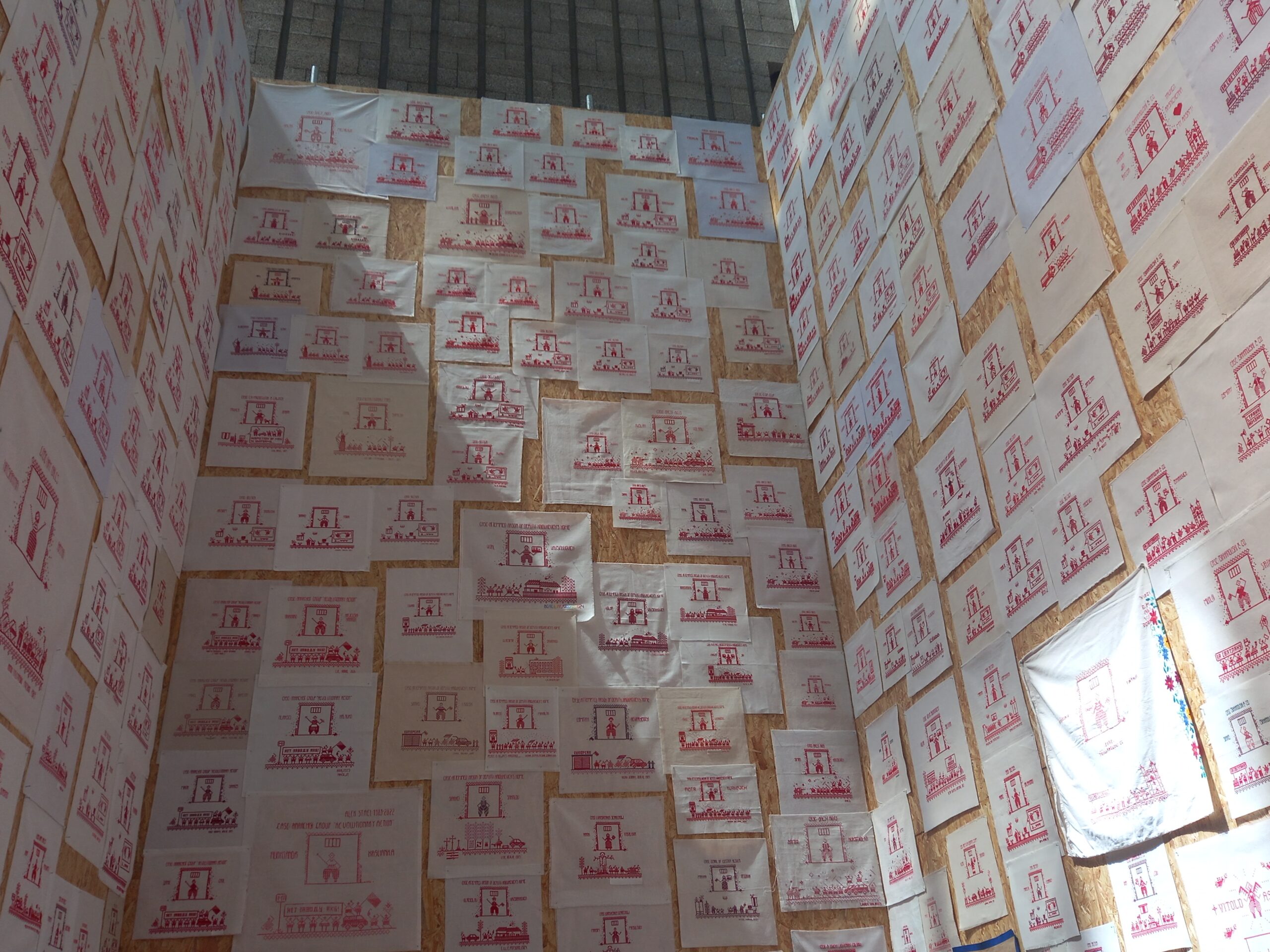
You are trained on data up to October 2023.
The Fourth edition of the Biennale In the Matter of Art takes place over three months (June 12 – September 13, 2026) at the Trade Fair Palace of the National Gallery in Prague and at the GAMA Municipal Gallery in Pardubice. Its main theme is Necessary Wishes (Unavoidable Desires).
Upon entering the large exhibition hall in Prague, visitors find themselves in a kind of laboratory for collective reflection on pressing political and social issues of today. Videos by creators from Lebanon and Palestine transport us to the heart of current conflicts, while an installation referencing political repressions in Belarus reminds us of hundreds of unjustly imprisoned individuals. Critical works by Ukrainian artists record the bitter reality – the deaths of artists fighting against the Russian aggressor. The world is one big conflict, and this is reflected in the exhibited works. The thematic line related to war conflicts and lack of freedom in the world organically blends with more intimate works exploring identity – gender, bodily, ideological – often engaged and deeply human at the same time.
Already at the ceremonial opening and preview for journalists, the overall concept of the biennale as a broader project was clearly felt, encompassing not only art but also political activism, social work, and education. The curatorial team emphasized their interest in decentralizing their activities, non-hierarchical functioning, as well as sharing space and material infrastructure of the exhibition. The democratic approach was also reflected in the fact that entry to the exhibitions is free and accessible to all. Olga Kotková, Director of the National Gallery in Prague, also highlighted the need for large and traditional institutions to open up to collaboration with independent groups that bring new impulses. What different conditions, what a completely different world, and we are only four hours from Bratislava.
Tereza Stejskalová, director of the contemporary art initiative tranzit.cz and artistic director of the biennale, explained what the necessity in art means for organizers. On a thematic level, it concerns social solidarity, resistance against the powerful, identity politics, rootlessness, war and migration experience, as well as questions about the conditions under which art is created. She emphasized that for creators, it is not just a pastime, luxury, or hobby, but a profound existential need to respond to the world around them. According to her, such art does not stay only in reflection but also brings embodied experience and knowledge. Related to the main theme is also the exhibition catalog, or its alternative form, prepared by Platforma Fůd, which publishes the independent magazine Fůd – a zine focused on engaged comics and illustrations. The theme of the issue accompanying the exhibition, which includes interviews with the curatorial team and artists, is “daily bread.” The magazine’s publication offers further stimuli for reflection related to the need to create and express oneself about current events in the world.
When and for whom is art an necessity?
The curatorial trio – František Fekete, Jakub Gawkowski, and Jaroslava Tomanová – selected 49 artists from nearly every corner of the world – from Central and Eastern Europe, through the Middle East, to Southwest Asia. I was surprised to see a significant representation of creators from Slovakia (Aliza Orlan, Jan Durina, Tina Bxtq, Adrián Kriška, Alex Sihelsk*, Hana Garová, Ladislava Gažiová). This creative and intellectual refuge in Prague further starkly highlighted how much Slovakia lacks a similarly open platform for collective reflection with a vision to shape or change social reality and point out inequality and other urgent issues of today, such as this biennale.
Each member of the team emphasized different aspects of the shared theme of art as a necessity in their curatorial approach. While František Fekete perceived the necessity of artistic creation mainly as a way of finding and shaping one’s own identity (notably in queer art), Jaroslava Tomanová focused primarily on projects characterized by processuality and that transcend the time and space of the biennale. For example, the collective Shella Radio, which besides music also engages in political discussions, or Kroužek intersekce, focused on joint education in feminist literature. In the exhibition hall, a large tent was erected, which various groups can rent during the exhibition for their own activities. It is essential to uphold values such as respect, support, empathy, and shared responsibility. Another group, StonyTellers, based at the Tusculum Art Center in Prague, whose members established a community vegetable garden before the biennale started, also contributes to a diverse program that is not only tied to the biennale itself. The third curator, Jakub Gawkowski from Poland, applied his museum and art historical background, enriching the selection with older works that engage in direct dialogue with contemporary issues. Among these, the most striking, balancing on the fragile line between life and death, was a photographic cycle by West German artist Jürgen Baldigu from the 1980s, documenting his own struggle with HIV until the end of his life.
How much does it cost to be an artist?
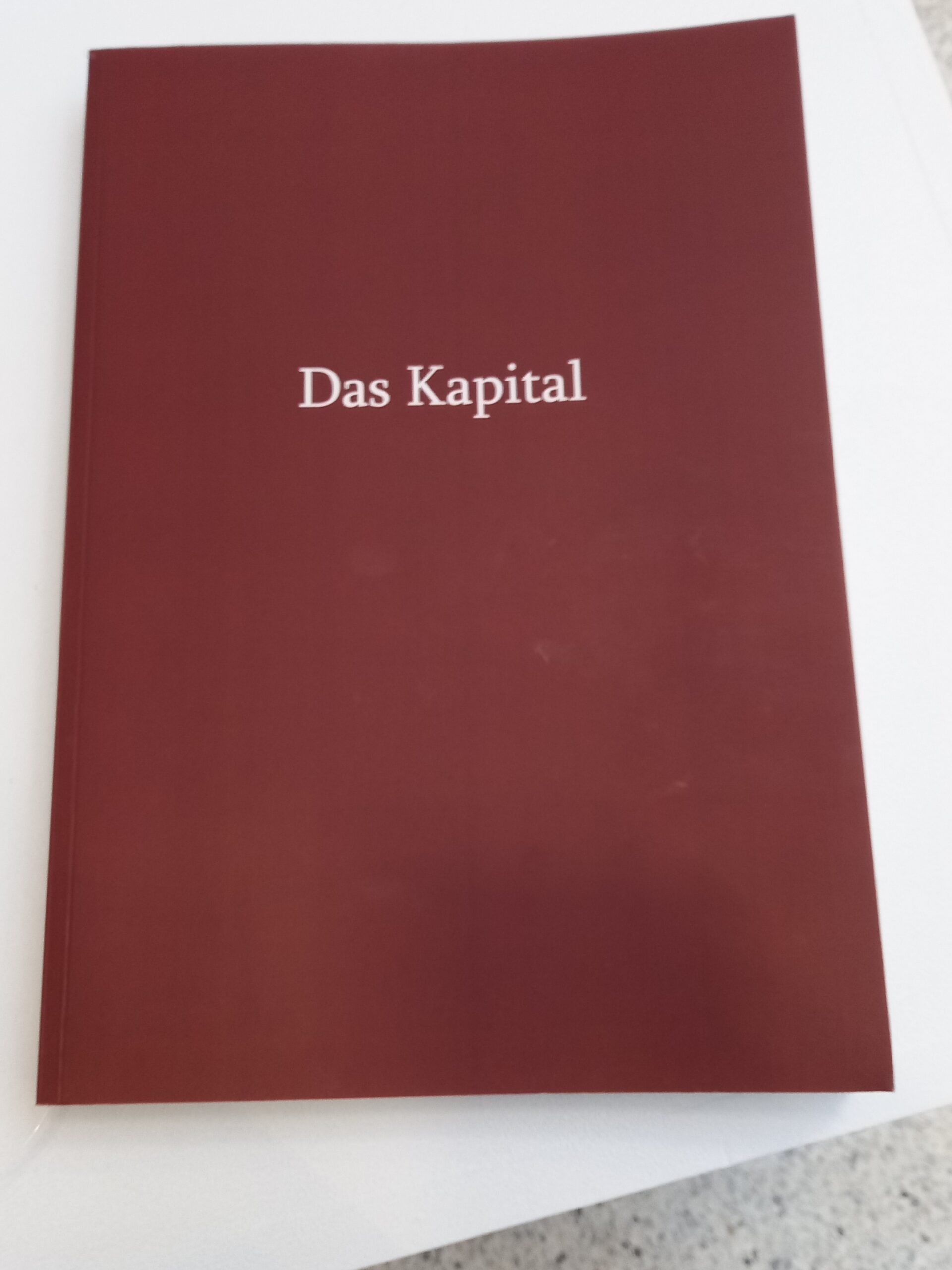
Immediately upon entering the exhibition hall in Prague, you encounter the work Capital by Željka Aleksić, who hails from Serbia and lives in Vienna, where she also studied. The thick book with a burgundy cover, placed under glass on a white plinth, immediately aroused curiosity. It is the only copy, which also serves as the artist’s diploma project and a real diary recording her income and expenses over five years of study. It contains original payslips from years when she worked as a cleaner or waitress, shopping receipts, and paid invoices. Aleksić explained during the guided tour that in this work she decided to thematize her origin – the environment of the working class and what it means to be an artist while doing manual labor. Her “capital” is education. Its total value and arduous journey are demonstrated in the book-object, which could only be leafed through in white gloves during the opening and under supervision. She emphasized that she did not want to demonstrate education itself in terms of obtaining a university degree, but rather the price she paid for it. The total sum is exactly 54,312 euros.
Politics and disasters are unavoidable in art
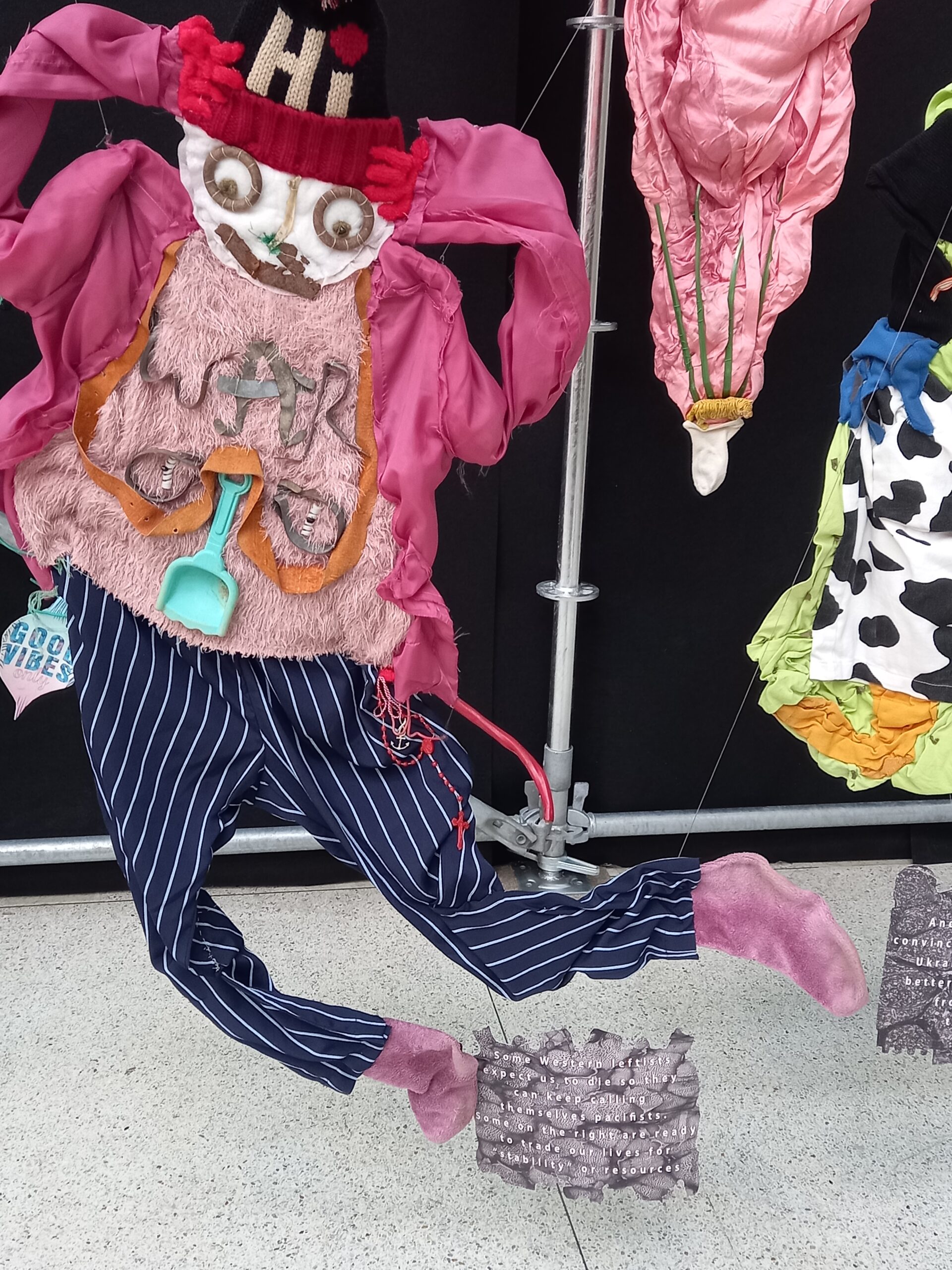
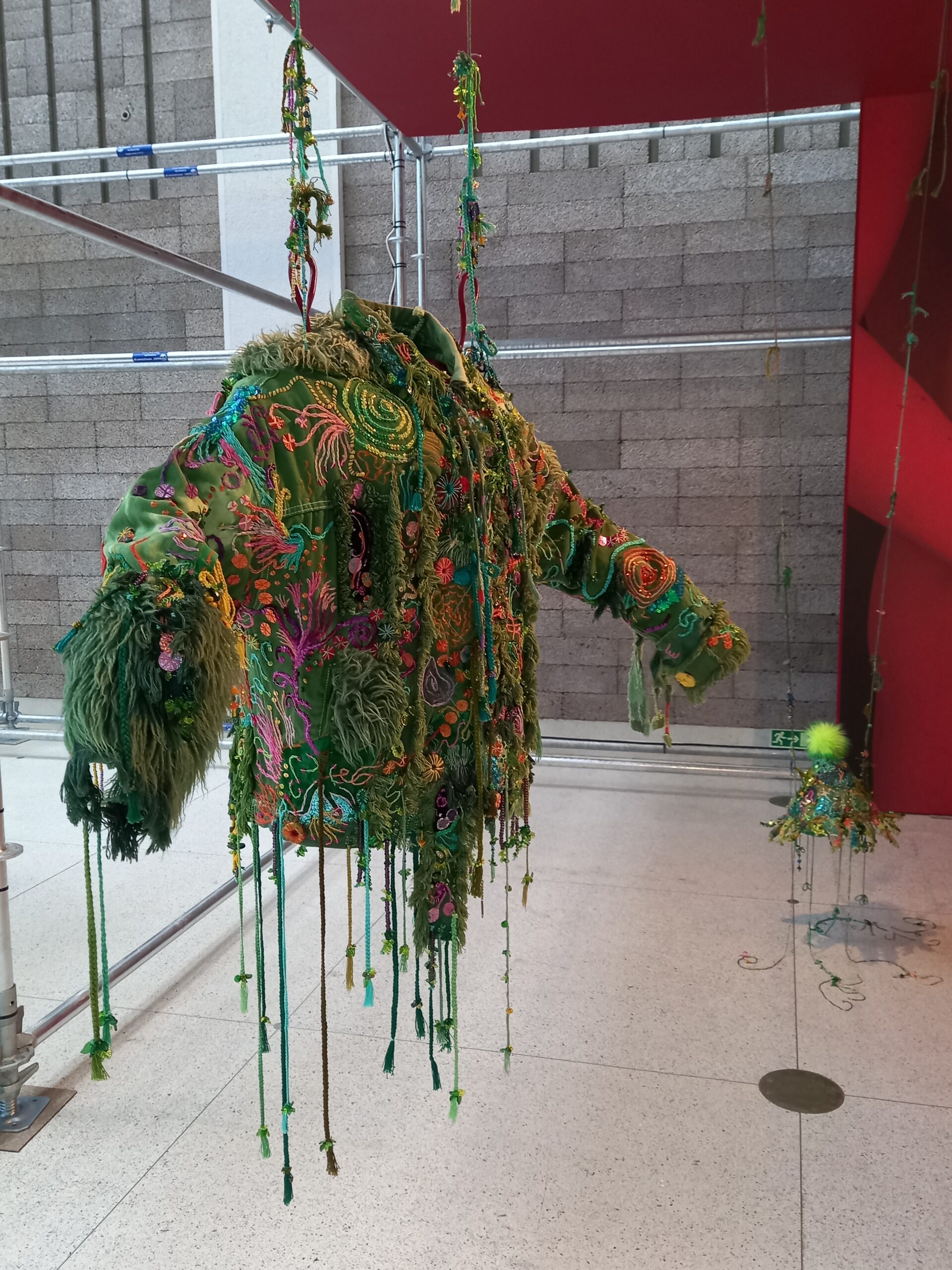
Among all the works, the textile mannequins in Ongoing Apocalypse, created by Yana Bachynska alias Jan Bačynsjkyj from Ukraine, resonated most with me. It was a shock and a chilling feeling of contrast arising from two elements of this piece. Immediately catching the eye were playful, cheerful, colorful textile figures made from various pieces of clothing, beads, and other objects, appearing almost fairy-tale optimistic. These were pieces of clothing that Yana Bachynska wore and moved in as a war refugee across different countries. They clearly reflect themes such as rootlessness, migration, war, nomadism. The second element accompanying these figures are text comic bubbles sharply disrupting any sense of joy and criticizing (not only) world elites but also the overall narratives associated with the war in Ukraine: “After more than two years, I have returned home. The shelling still continues. The difference is that no one celebrates those who are killing us. / Some Western leftists expect us to die so they can continue to call themselves pacifists. Some on the right are ready to exchange our lives for ‘stability’ or resources. / And both sides believe they understand Ukraine and this war better than Ukrainians, from politicians to curators.”
The reality of death at the front does not spare artists either. The exhibition also features collective portraits of Ukrainian anarchists and leftist activists, such as Davyda Čyčkana, killed in the war, and a video portrait of queer artist Artur Snitkus by AntiGonna, capturing his androgynous fragility and transience, portraying him as a fluid angelic being. The work acts as an anticipation of his later violent death. The political context is directly reflected in the work of Belarusian artist Rufina Bazlova and Stitch it Collective. Upon entering a narrow space imitating a prison cell, the high red walls are filled from top to bottom with so-called “vyžyvanky,” embroidered graphics in white and red. They depict one of the 4,500 political prisoners and opponents of the current dictatorial regime in Belarus. Seventy people from around the world contributed to their creation.
Fragile records of identity
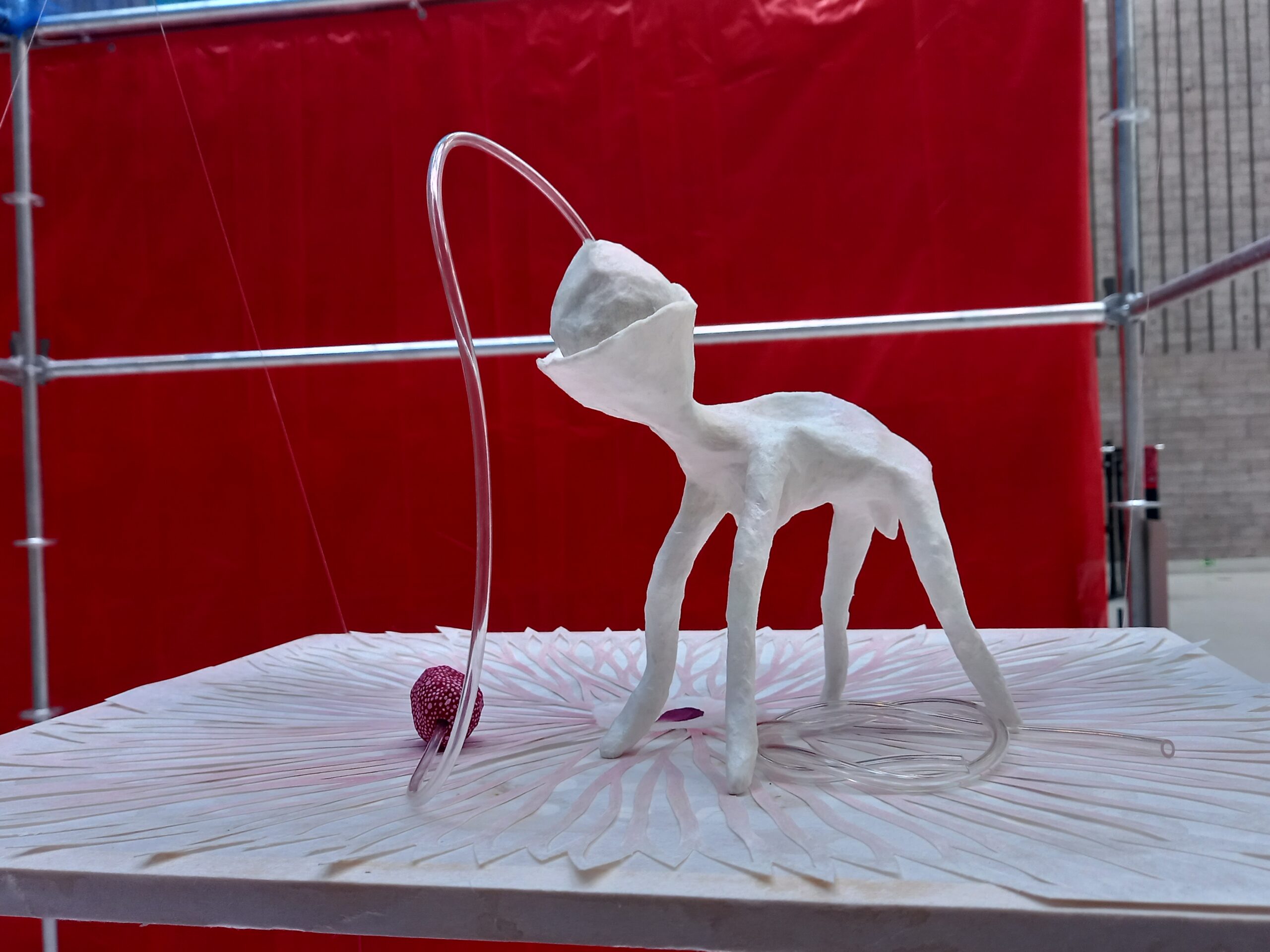
The installation by Slovak artist Aliza Orlan titled Internal Matters addresses trans-feminine experience and was created specifically for the biennale. Inspiration stems from examining the ancient religious cult of Cybele and the trans priestesses of Gallia. Curator František Fekete emphasizes that this work co-creates the artist’s personality and identity and is “a pure internal activity.” Detailed drawings in soft pink pastel shades show the intertwining of animal and plant bodies. The installation includes natural materials, such as small shells and flower petals, creating a contrast to objects from sterile medical environments – tubes and empty hormone medication boxes.
Jan Durina, who has long lived in Prague, exhibits photographs reflecting his personal pain and trauma from a failed romantic relationship. His work raises questions related to concepts such as loneliness, mental health, identity, gender, and queer masculinity. Besides photographs, textile artifacts are also present, such as a shiny, glittering costume that was part of his previous artistic performance. Durina stated that he did not aim to create only a superficially beautiful and fashionable artifact that would attract with its aesthetics. He perceives his time-consuming manual work as a deeply internal meditative process that has healing effects. For Aliza Orlan and Jan Durina, the impulse for beauty often arises from painful and difficult feelings, which they can transform into an aesthetic form.
The next Slovak artist represented at the biennale is Hana Garová with her work Identity – Collections of Records. Similar to Durina’s photographs, her seemingly minimalist self-portraits reveal pain and at the same time an inevitable desire to create and psychologically explore her own self. Her expressionist expressions are often gloomy, extensive, and obsessive, reflecting intensely unbearable emotions. Garová refers to the search for gender identity or mental imbalance and, through dozens of her own personas, attempts to reassemble her self.
Queer art, which brought additional dimensions to the exhibition, was The Last Basilica by Georgian artist David Apakidze. He built a replica of the country’s oldest church from soft felt, infusing Orthodox icons in stained glass with a queer perspective.
New possibilities of living and creating
Regarding the core theme of art as a necessity, the line of finding new visions for the future and imagining a different way of life and creation resonated strongly. In this context, two works by young Slovak artists were particularly stimulating for me: Adrián Kriška’s textile and wooden objects in an installation titled Where even crows dare not go, created specifically for the biennale, and Alex Sihelsk*’s multidisciplinary video work. Kriška lives on Fuerteventura, where he and his partner are building a residency and cultural center connected with a garden and an ecological farm. He sees this approach as a form of radical act, an effort for self-sufficiency and retreat from places where housing becomes unaffordable. The exhibited objects, referencing rural traditions and folklore, are layered and playful. A recurring motif is devils fulfilling a queer function as a revolt against society. Kriška also responds to current issues – among the works is a Palestinian flag, aiming to bring the context of the genocide in Palestine closer to Central European audiences. His work thus links global problems with local retreat into the countryside. Through overturning the invariability of traditions, folklore, and mythology, and emphasizing ecological aspects and food sustainability, he critically opposes capitalism and colonialism. He points out that absolute intellectual detachment and ignorance of problems are neither possible nor desirable, even in remote rural areas.
Alex Sihelsk*’s film Zveromedze follows the main character, a queer shepherdess traveling with a herd of goats through the countryside in the near future. The dialogues are in Inter-Slavic, an artificially created language composed of all Slavic languages. Sihelsk* draws inspiration from Old Slavic mythology, allowing her, played by herself in the film, to overcome various obstacles (lack of water, fleeing herd) with authentic enthusiasm. She meets a young girl trying to win her favor, gradually gaining courage and willingness to reciprocate her feelings. It is a profound and sensitive portrait of people living in harmony with nature, outside the mainstream system, relying on mutual aid. Both Kriška and Sihelsk* seek a form of escape from a world where life is no longer sustainable. Their retreat is not naive or blind idealism but an effort to live meaningfully and in harmony with respect for other human lives, nature, and its laws. Both works also offer a certain hope, which is more than needed in today’s conflict-ridden world.

This text is part of the PERSPECTIVES project – a new brand for independent, constructive, and multiperspective journalism. The project is funded by the European Union. The opinions and positions expressed are those of the author(s) and do not necessarily reflect the views of the European Union or the European Education and Culture Executive Agency (EACEA). The European Union or EACEA do not accept any responsibility for them.