Patodevelopment in Israeli style. This is how they build on someone else's land.
Krytyka Polityczna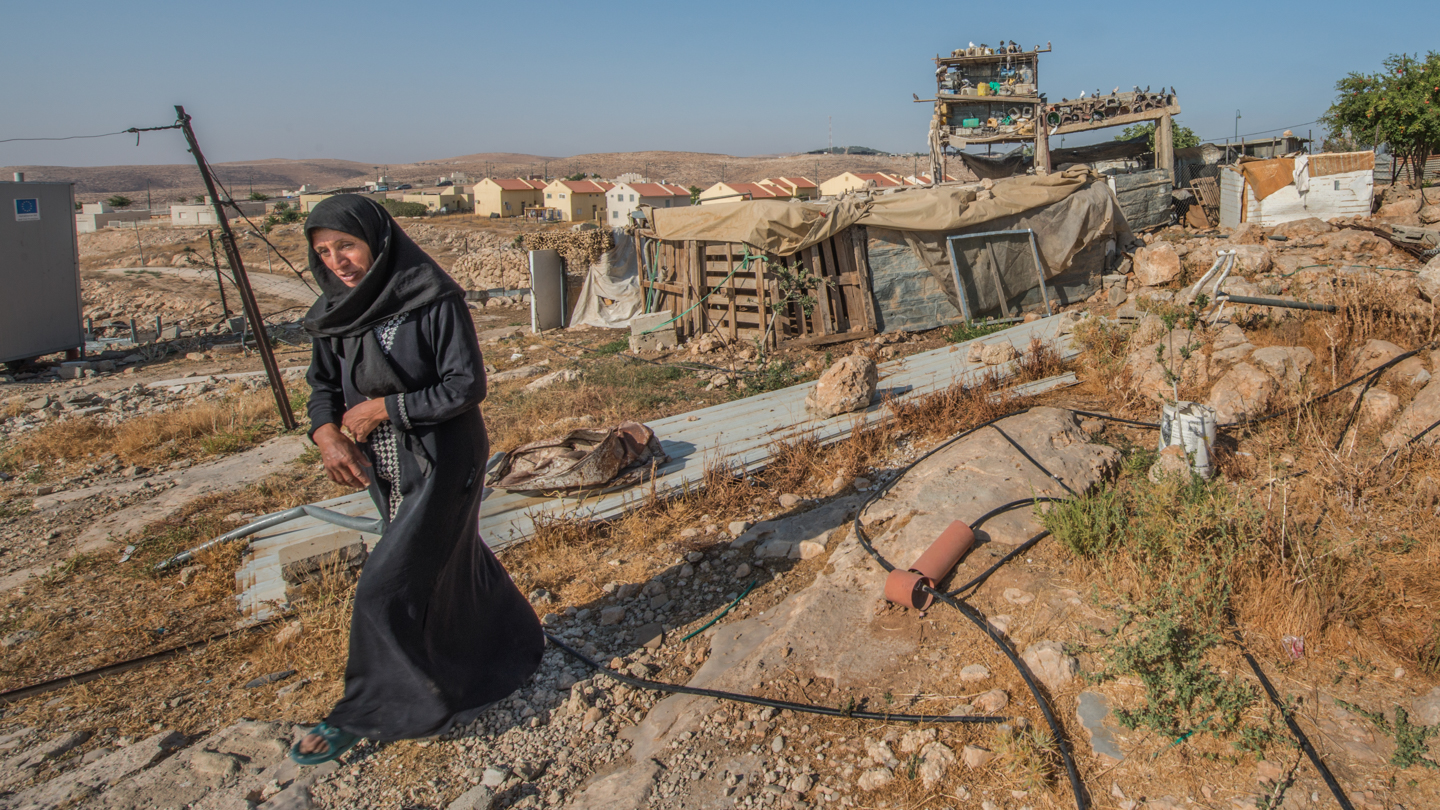
If the project goes ahead, up to 3,000 Palestinians face forced displacement. Why did Israel decide to build a new settlement on the occupied West Bank two months before the upcoming elections? The post "Patodevelopment" in Israeli style. This is how building on someone else's land is done first appeared on Krytyka Polityczna.
August 19th, three Israeli non-profit organizations – Bimkom Planning and Human Rights, Ir Amim, and Peace Now – publicized information that the Israeli Ministry of Construction and Housing has opened a tender for the construction of 1234 residential buildings on the occupied West Bank. The proposed project is to be built in an area called Mevaseret Adumim or E1, which according to Oslo Accords belongs to Zone C of the West Bank, thus under Israel's exclusive control. E1 is of strategic importance to Israel due to its location: it lies on the line between Jerusalem and the Jordan River, forming the narrowest part of the West Bank. This area is mainly inhabited by Palestinian Bedouins, who experience settler violence on a daily basis. If the project proceeds, even 3,000 local Palestinians face forced displacement.
Critics of this decision argue that building the settlement will destroy the traditional way of life of Bedouin communities and will hinder the prospects for a peace agreement between Israel and the Palestinians. The creation of a settlement corridor connecting East Jerusalem with the illegal settlement of Ma’ale Adumim, located about 10 km to the east, will further restrict Palestinian mobility in the West Bank and complicate the establishment of an independent Palestinian state.
Palestinian human rights defender Ubai al-Aboudi said in an interview with Al Jazeera that the establishment of a new settlement will be “the last nail in the coffin of the two-state solution.” According to him, creating the settlement will make the emergence of an independent Palestine next to Israel impossible.
Why did Israel decide to expand the settlement two months before the upcoming elections? How will the construction of an illegal settlement infrastructure under international law affect Palestinian lives? Let’s go back a bit in time and look at the history of the Israeli colonial project on the occupied West Bank.
Where did the occupation of the West Bank come from?
Israel’s borders were shaped by armistice agreements signed in 1949. In the case of the West Bank, the line established then was formally a temporary ceasefire line, but over time it began to function as Israel’s internationally recognized border. The Gaza Strip, which was not occupied by Israeli forces, came under Egyptian control, while Jordan unilaterally annexed the West Bank in 1950.
These borders heavily favored Israel. The country gained access to over 77% of the former British Mandate territory of Palestine. Meanwhile, on the eve of independence, Jews made up only about 30-35% of the total population. Israel also took control of a strategic corridor connecting the Gush Dan metropolitan area with Jerusalem. This step divided Palestinian territories from the west and opened the way for future Israeli expansion toward the Jordan River.
However, the shape of these borders also posed serious risks for Israel. At its narrowest point, the strip of land connecting the north and south of the country was only 15 kilometers wide. The prospect of the country being cut in half by an Arab invasion during the years became Israel’s greatest nightmare.
The situation changed in 1967 with Israel’s attack on Egypt, Jordan, Syria, and Iraq – a conflict known in Israeli historiography as the Six-Day War. As a result, Israel occupied the Gaza Strip, Sinai Peninsula, West Bank, and the Syrian Golan Heights.
Controlling all of Jerusalem was a key propaganda goal, commemorated today in the Israeli holiday Yom Yerushalayim. Until then, only its western part was under Israeli control, while the Old City and the rest of East Jerusalem remained under Jordanian occupation. In the first days after capturing the city, Israeli soldiers arbitrarily demolished the so-called Moroccan Quarter in the Old City, creating the site of the current Western Wall prayer plaza. The oldest of the buildings removed dated back to the 12th century.
One consequence of the 1967 war was a rise in anti-Semitic sentiments in many parts of the world, especially in the Eastern Bloc and countries allied with the Soviet Union. In Poland, these events served as a pretext for a so-called anti-Zionist campaign, which resulted in the expulsion of up to 13,000 Polish citizens of Jewish origin from the country.
The path of apartheid that consolidates Israeli “sovereignty”
Israel returned the Sinai Peninsula to Egypt in exchange for mutual recognition of sovereignty under the Camp David Accords, signed on September 17, 1978. Additionally, Israeli forces and settlers were evacuated from the Gaza Strip in 2005 as part of a unilateral withdrawal plan, known as the disengagement (Hebrew: hitnatkut).
In 1981, Israel unilaterally annexed the Golan Heights. Although the West Bank was never formally annexed, Israel undertakes actions there that are reserved under international law solely for sovereign state authority – including registering land and settling its own citizens on it. These actions are in clear violation of art. 49, paragraph 6, of the Fourth Geneva Convention.
A different situation applies to East Jerusalem – encompassing the area from the western walls of the Old City to the vicinity of Wadi an-Nar valley – which Israel unilaterally annexed in 1967. This step has not been officially recognized by most UN member states, although the United States and Guatemala have accepted “Israeli sovereignty” over this area. The status of East Jerusalem remains a primary reason why many countries, including Poland, maintain their embassies in Tel Aviv – despite Israel claiming the entire Jerusalem as its undivided capital. It is worth noting that the decision to expand the territory did not include granting residents of East Jerusalem Israeli citizenship – today, as many as 400,000 of them (40 percent of the city’s population) live there solely on permanent residency cards. According to the B’Tselem association, since 1967, Israel has revoked the permanent residency status of over 14,000 Palestinian Jerusalemites.
As Dr. Michal Braier, research director at Bimkom, explains, this annexation was a compromise between Israeli factions seeking to expand the country’s borders and opponents of such a move. The latter pointed out its incompatibility with international law and warned of negative consequences for Israel’s relations abroad.
“At that time, there were both more expansionist ideas and proposals limited to a smaller territory, including the Old City and the so-called Holy Basin,” says the researcher. “There were heated debates within the government, and the final decision was an attempt to reconcile extreme positions. Authorities were aware they had little time for annexation – it was only possible immediately after the end of hostilities. Everyone knew that if it was not done immediately, such an opportunity might not come again.”
Despite international and domestic pressure, the Israeli settler movement did not abandon its colonization plans for the West Bank
Subsequent Israeli governments used settlement activity as a method of political pressure. In 1975, 23 Jewish families established the illegal settlement of Ma’ale Adumim (Hebrew: Red Stork) east of Jerusalem. In 1991, during Yitzhak Shamir’s government, the entire area of today’s E1 was expropriated for the Israeli local government. Today, several Israeli settlements exist between Jerusalem and Jordan, including Micpe Jericho, Wadi Jericho, and Beit HaArawa, forming the nucleus of a settlement corridor that could, in the future, cut the West Bank in half from north to south.
“Ma’ale Adumim was expanded in the 1980s and 1990s,” says Braier. “It is a heavily urbanized area and practically functions as a suburb of Jerusalem.”
Yitzhak Shamir’s successor, Yitzhak Rabin, ordered the Minister of Construction to develop plans for an Israeli settlement in this area, but under international pressure, he did not proceed with their implementation. Subsequent governments emphasized Israel’s desire to maintain control over the E1 area: in 1996, Prime Minister Shimon Peres confirmed that his country aimed for “sovereignty” over this territory. In 2004, the Ministry of Construction prepared the land for a road connecting the planned settlement with Jerusalem.
Since 2008, the main headquarters of the Israeli border police for the Judea and Samaria district – as the West Bank is called in Israeli terminology – has been operating in the E1 area. In December 2012, in response to the UN General Assembly granting Palestine non-member observer state status, Israel announced the resumption of planning and development procedures for the E1 area the very next day. In 2019, Netanyahu’s government opened Road 4370 north of E1, called by human rights defenders “the road of apartheid”: the route has separate lanes for Israelis and Palestinians. As Ir Amim representatives argue, the construction of this road was also aimed at hindering Palestinian movement within the occupied areas.
Human rights defenders versus the bureaucratic machinery of occupation
A breakthrough occurred in August last year when Israel finally approved the project to build 3,401 new housing units in E1. Prime Minister Netanyahu and Finance Minister Smotrich publicly announced that the settlement’s construction aims to prevent the creation of a Palestinian state. To stop the development, organizations Bimkom, Ir Amim, and Peace Now filed a petition to the Jerusalem District Court, demanding the annulment of the approval of two detailed development plans for E1, which together envisage about 3,400 housing units.
“The E1 development plan was challenged in court many years ago,” explains Braier. “At that time, the court recognized that – similar to other settlements – this was a political issue, not a legal one, and therefore should not interfere. Currently, authorities argue that the procedure concerns the same arrangements and is simply a further step in their implementation. In other words: since the court did not previously question them, there is no basis to now halt their execution.”
On July 19, 2026, the Office of the State Prosecutor assured the petitioners that within the next 2-3 months, no tender for settlement construction was planned. They also committed to notify them of any change in the decision. Nevertheless, on August 18, an announcement appeared on the Israeli Land Authority’s website about the opening of the procedure. Activists were not informed in any way, and the tender was announced under a new number.
“It seems they tried to do this quietly. Interestingly, even the lawyer representing the state was unaware of the tender opening,” notes Braier.
Faced with the bureaucratic arbitrariness of Israeli authorities, activists decided to raise awareness in the media. “This is a decision with far-reaching political consequences. […] The current authorities have nevertheless decided to initiate the first stage of one of the most controversial settlement projects during ongoing court proceedings – even before they officially responded to the court and in direct violation of the clear commitment made to the petitioners. A government that claims to uphold the rule of law cannot treat its promises made to courts, parties to disputes, and the public as merely optional,” – states a joint statement by the petitioners.