Doctor Jason Arday is dead. Will there finally be a structural transformation, or are we facing another media lynching?
Kapitál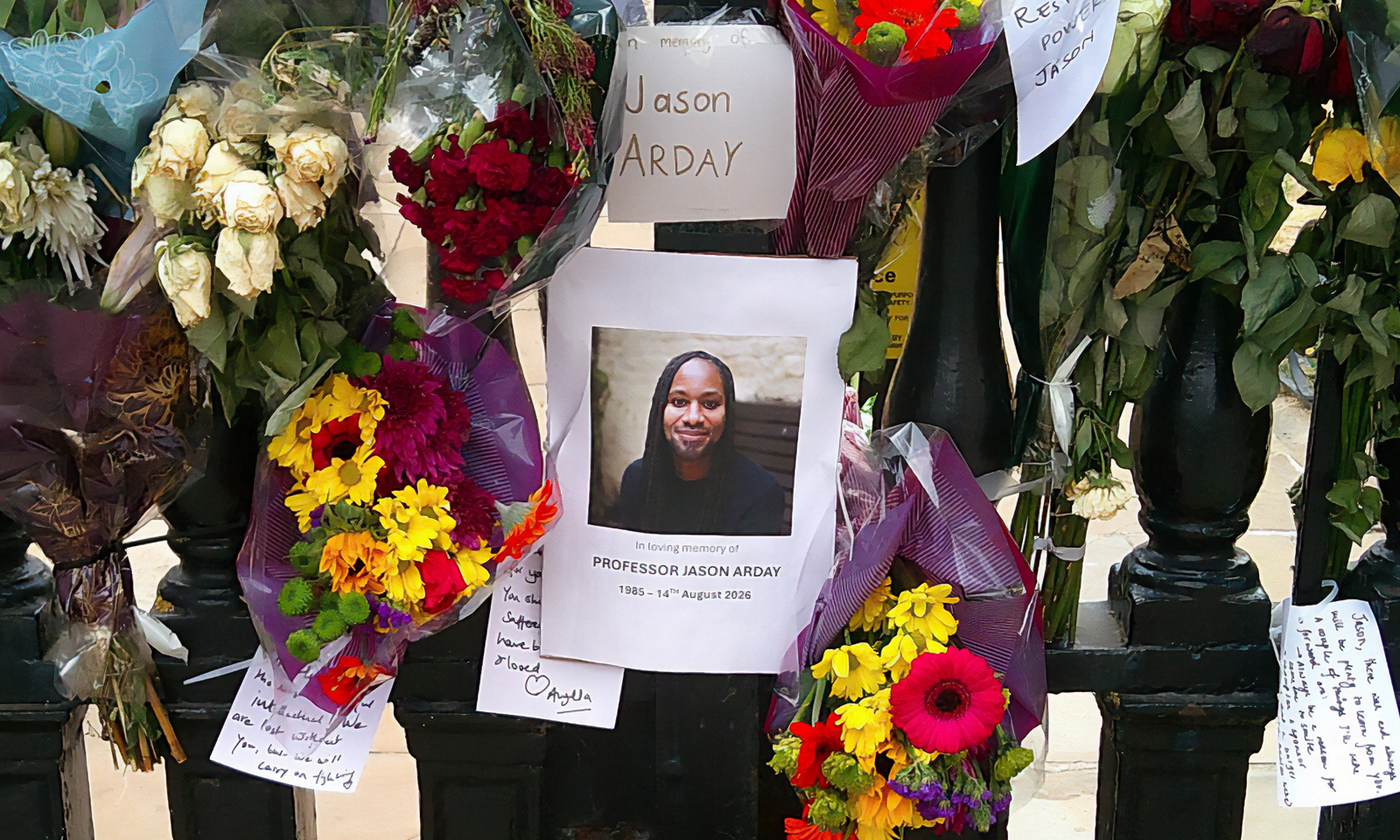
Cambridge professor Jason Arday was driven to suicide after a former colleague advocating scientific racism accused him of plagiarism and orchestrated a media lynching against him. He is now becoming a symbol of his own work. He was in Britain, and we are here. What now?
Cambridge professor Jason Arday was driven to suicide after being accused of plagiarism and faced media lynching by a former colleague advocating scientific racism. He is now becoming a symbol of his own work. He was in Britain, we are here. What now?
Three weeks after the death of Cambridge sociologist Jason Arday, my Instagram is full of videos about him. Opinions. Shock. Shared photos. Calls for justice. All posts can be summarized very simply – an almost brilliant young Black scientist took his own life after a media lynching initiated by his former racist colleague (who describes himself as a “racial realist”) accusing him of lies and plagiarism. Allegations concerning aspects of his life were not confirmed as justified, although further investigation of his academic work is still ongoing. It must be said that the allegations raised seem justified. But we must ask why now a racial realist is persecuting a Black professor and what this situation tells us about the media and academia.
On my (leftist) side of the internet, the situation is clear and the general narrative can be summarized as follows: The number of accused academics, not only of plagiarism but also of sexual harassment, is countless in Britain. They do not receive as much attention and do not have to face the consequences of their actions because they share one thing – they are white. The university environment and media sphere remain loyal to their racist foundations. They sometimes select Black representative figures to cover this reality. The true face of British academia, however, is still a white racist professor, like Nathan Cofnas. Nathan Cofnas could not bear the idea that his place – a racially predetermined position – is held by a Black professor. Even after being expelled from Cambridge following large student protests against his racist and eugenic articles and media appearances, it is him who has the power to drive a Black academic to suicide. Jason Arday is a victim, and we all share responsibility for his death through our silence.
Thanks to the London memorial organized by the initiative Stand Up to Racism, which gathered tens of thousands of people, this has become the dominant narrative. Speakers there lament inaction and reach into the conscience of all present. The mentor of the deceased professor and director of Cambridge’s Homerton College Simon Woolley instructs the crowd to repeat after him: “I am Professor Jason Arday,” to remind those present that they too could face the same fate tomorrow. A moment arises to realize feelings of regret, anger, and the scope of the problem. “Rest in Power,” the crowd from the banners sends to Arday.
When you do research, the cited articles are just names you write down in your working memory. I have no idea what 98% of the people I cite look like, and the remaining 2% I know from conferences or videos. Due to my academic focus, I had articles by Jason Arday saved for reading for several months. The media lynching did not reach me until his death. His death cannot be reduced to a symbol, yet it is precisely that. A symbol of what he himself wrote about. Through protests and petitions, perhaps a continuation of Arday’s ideas in the field of EDI (Equity, Diversity, Inclusion), which he himself criticized for tokenistic implementation in elitist institutions, and instead proposed decoloniality in education.
Media and social networks
He was there, we are here – connected through social networks and media. What are social networks and media doing right now? British media and various foreign creators bring tragic news. Based on previous behavior and moral integrity, they wash their hands, erase traces, throw dust in their eyes, criticize, accuse, spread panic, mourn, or remember. Czech and Slovak media report similarly, as if a celebrity had died of old age or a zebra in the zoo. In Lidovky they even consider his death “good media work.” Creators either do not know what to say or do not consider the event important. Arday’s death is not a significant event in the local media space, even despite the dull season.
One media lynching drove Jason Arday to suicide. Within 22 days, 249 articles were published about his case. Before his death, a friend told him that he simply could not go on anymore. It was really a lynching. Otherwise, titles like “The Cambridge fantasist is proof that stupid intellectuals are poisoning Britain” or “Cambridge’s diversity poster boy in plagiarism row” in The Telegraph can be explained.
Now a second media lynching begins – searching for and punishing the culprit. Media have still not “self-reflected” enough and the case’s attention has already significantly faded. They will at most face short-term public pressure, but at the next opportunity, they will proceed exactly the same way. Using media for what media caused makes little sense. However, there is no escape from it. The culprit must be found.
It is difficult to confront the entire structural racism and dehumanization that flows from it. That is why it is necessary to personify them, show a concrete face. That face now is Nathan Cofnas, and it is completely deserved. His eugenic statements, however, we must read as a symptom of a huge historical problem stretching from colonialism’s beginning.
Similarly as the face and past of Doctor Jason Arday appeared in the newspapers and on the internet, today the face and past of Nathan Cofnas appear. Cofnas was suspended from his current position at Ghent University, among other reasons, due to a video interview in which he explains that his motivation to persecute Arday was the very focus of his research, which “has nothing to offer,” and (perhaps in sarcasm) he says that after the revolution, he would be head of the Department of eugenics and racial science at Harvard. Now, however, he returns to some of his duties and his statements will be further investigated.
But what would be a real victory in the situation after Jason Arday’s death? Yes, it would be great if the media, the public, and other institutions remembered that when a self-proclaimed white racial realist publicly accuses a Black professor known for his fight for social justice, it is necessary to be alert and not dehumanize. But we must go much further.
Academia
He was there, we are here – connected through academia. Therefore, it is necessary to ask what academia is doing right now and here. (Spoiler: nothing.)
In Britain, perhaps, an investigation will be launched, and a few scientific societies and institutions will issue official reports about regrettable events that, unfortunately, happened, for unknown reasons. Anyway, it is very sad to lose such a promising, almost miraculous young autistic scientist. Arday’s long-term scientific work on inequalities and racism in education will become just another characteristic contributing to the overall tragedy of his death. The content of his scientific work itself will not gain much attention. Only a wave of student protests and their calls for change can give us hope. We must not forget that they already managed to drive Nathan Cofnas away once. Student body with a few allied academics is the only real force that has true power.
In Czechia and Slovakia, we cannot expect anything like that. Such statements are not written. It is also unlikely that we will find ourselves in a situation where a top non-white scientist commits suicide – there are not many of them here. Perhaps, the fact that the Czech Republic faces a fine from the European Commission for segregation of Roma in education plays a role. But even that has not attracted any attention from university staff. Have you seen any public roundtables discussing this, or has it been discussed as an agenda item in academic senates? I haven’t. Therefore, we cannot be sad that we lost the face of our progressiveness.
How long have we waited just for the formation of the Initiative for Critical Academia (IZKA), only to see it falter into oblivion? Now it’s summer holidays. It’s hot. It’s dry. I have been waiting weeks for responses to emails and not delivering the promised work. Czech and Slovak scientists who perhaps knew Arday personally have already lit a candle in their living rooms. Sharing news of his death or statements from various British scientific bodies with local academic institutions remains a dream.
Potential (unconfirmed) plagiarism is of course a serious offense in the hierarchical academic world. These hierarchies are built through individualized authorship of new knowledge. In social sciences, research is mostly based on data extraction from a certain group to advance science. Sometimes, the goal is to design appropriate interventions to help that group. Because the group does not know what would help, an academic must come with a rigorous method and analysis to offer a new perspective on their existence. But usually, they do not get involved in the actual promotion and implementation of interventions. The group must handle that itself, or if we trust the state apparatus, responsible institutions should do so. The group often gains nothing but a smaller monetary reward, and the academic advances in their career and receives money for publications.
Reflections
How in such an environment to highlight that Jason Arday’s death is a proof of institutionalized racism? Embedded structural racism of the same global academia we are part of. It is so simple. White academics do not face the same attention or consequences for their actions. We can illustrate this, for example, by noting that in 2023, a white Cambridge historian William O’Reilly was also accused of plagiarism. However, he did not receive such media attention and did not have to resign. White academics are more often those holding important positions and fueling racial hatred. In the UK, at the end of 2024, there were a total of 270 Black professors, which is only about 1%, and their existence in a mainly white institution is challenging . They are burdened with the so-called “minority tax,” which involves hours of unpaid work expected to represent the entire ethnic group. Meanwhile, white academics benefit from their privileges, and when they fear losing them, they attack potential threats as a defense mechanism called white fragility. This is meant as structural racism and white supremacy. This is the reason for the death of Doctor Jason Arday. His research was different. He strived for a real transformation of the historically oppressive university structures. He listened to the hardships of those experiencing systemic racism in academia . You can read about these mechanisms, among other sources, in the book Whiteness, Racial Trauma, and the University, in which author Harshad Keval thanks Jason Arday for great support and his work.
With criticism and the impact of media we are witnessing now, I am more aware that I am writing a media article. I considered my options and evaluated this path as the most accessible, but certainly not the most meaningful and effective. But what can I do now besides continuing my decolonial academic work? I can at most post this article on LinkedIn and the Discussion Forum in the IS and hope someone from the academic community reads it. I can urge various departments, faculties, and institutes to issue statements. But without deeper internal reflection, that would be just performative. I could even organize a discussion forum. But under whose auspices? And who would come? The problem is so big – and the willingness to see it so small.

The text was created with the support of the Rosa Luxemburg Foundation, with representation in the Czech Republic. The publisher is fully responsible for the content; the views expressed in the text do not necessarily reflect the Foundation’s position.