Old grudges in a new war. Polish sympathies for Ukraine are not unlimited.
Kapitál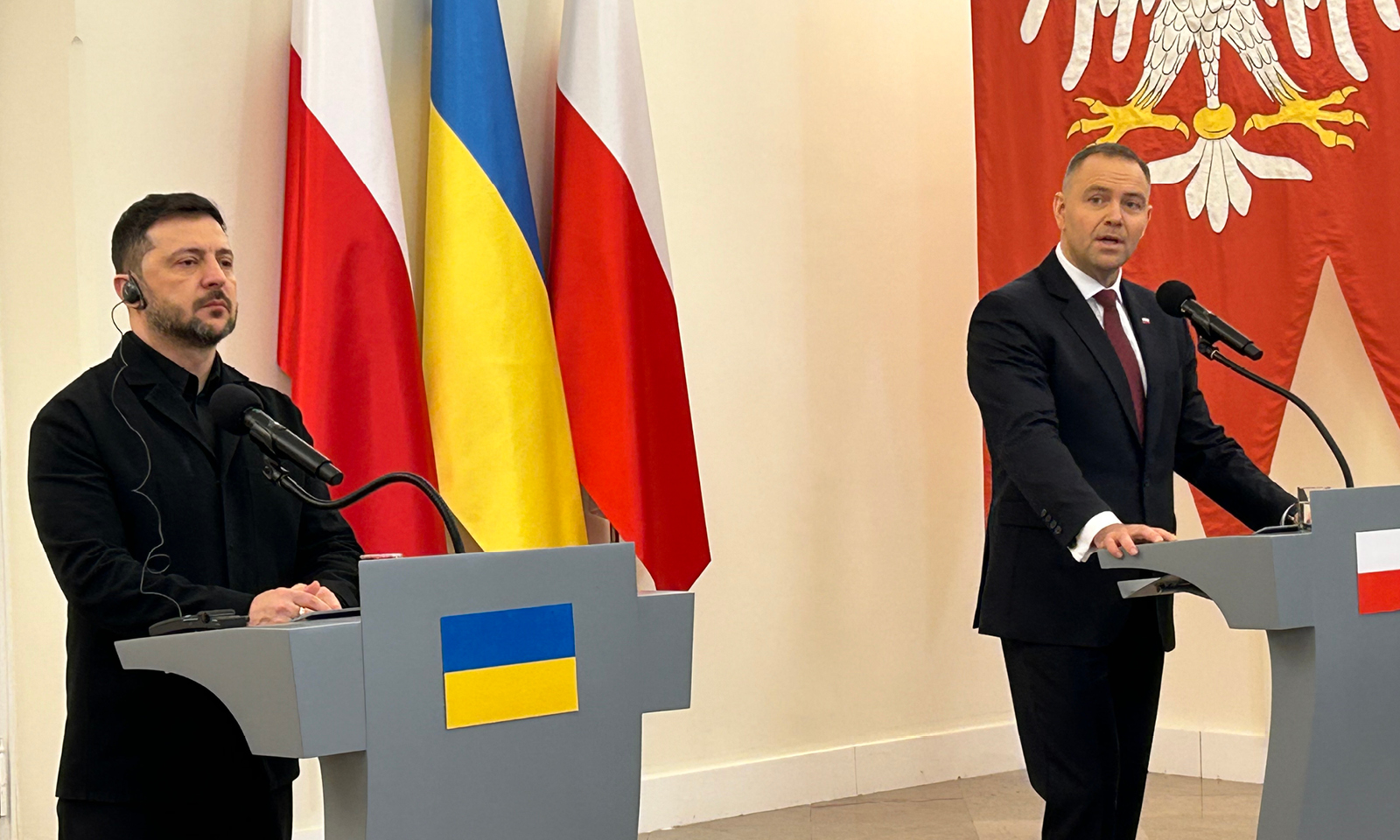
When the war in Ukraine began, it seemed that Poles and Ukrainians could not be closer. After nearly five years of relative peace, however, both countries returned to their usual bickering, which we all willingly forgot. The dispute over the Ukrainian Insurgent Army (UPA) only rekindled old unresolved conflicts.
When the war in Ukraine began, it seemed that Poles and Ukrainians could not be closer. After nearly five years of relative peace, however, both countries returned to their usual bickering, which we all willingly forgot. The dispute over the Ukrainian Insurgent Army (UPA) merely revived old unresolved conflicts.
In May, Ukrainian soldiers decided to name their unit after “heroes UPA.” President Volodymyr Zelensky approved their request, provoking a sharp reaction from Poland. The local president Karol Nawrocki decided to revoke the highest state decoration from their Ukrainian counterpart, the Order of the White Eagle.
Proposals for such a revocation, however, appeared in Poland as early as the second half of May. They were spread by Russian and Belarusian propaganda as well as anti-Ukrainian channels. Already on May 18, Małgorzata Zych, a politician who in 2023 apologized to Putin for calling him a war criminal, proposed this idea. Zych is a member of the nationwide federation of independents from local governments (Ogólnopolska Federacja „Bezpartyjni i Samorządowcy”), which is considered among political entities amplifying Russian interests.
Subsequently, politician Paweł Usiądek, vice-chairman of the far-right National Movement (Ruch Narodowy) and member of the far-right Confederation (Konfederacja), who in 2020 led the election campaign of presidential candidate Krzysztof Bosak, demanded the removal of the order.
Former Polish Prime Minister Leszek Miller, known for his anti-Ukrainian stance, also called for the withdrawal of the decoration. Politicians demanded this action in connection with the official funeral of Andriy Melnyk, one of the leaders of the Organization of Ukrainian Nationalists (OUN).
Only on May 28 was the request directly addressed to the president’s office. Member of the Confederation Grzegorz Płaczek wrote a letter urging Zelensky to have the Order of the White Eagle revoked. Then Karol Nawrocki took the initiative, but his approach resembled a clever trickster. For the decoration to be truly revoked, the decision would have to be published in the Monitor Polski newspaper, which is the responsibility of the Prime Minister, Donald Tusk, who did not do so. Another problem was that the document stripping Zelensky of the award was not signed by the prime minister. The previous practice was that the head of government always countersigned such decisions.
Therefore, the Ukrainian president rather returned the decoration than actually revoked it. He sent it to Warsaw and used the Ukrainian Post to do so, which he also used to promote publicity. A number of Ukrainian politicians followed, expressing sympathy with Zelensky’s actions. Head of the Presidential Office Kyrylo Budanov and Ukrainian ambassador to Poland Vasyl Bodnar also relinquished their awards. Foreign Minister Andriy Yermak, as well as former presidents Leonid Kuchma, Viktor Yushchenko, and Petro Poroshenko, did so as well.
The Order of the White Eagle has been revoked by Poland only once in history, in 1932, when it was stripped from the opposition politician and three-time former prime minister Wincenty Witos during a government of sanation. However, in 1939, the order was returned to him. Poland, however, never took it from Benito Mussolini, for example.
Ukraine and Poland Have Been Disputing Over History Long Before the War
In the 1990s, Ukrainians in Poland had a very bad reputation. The Polish population feared them. Perceptions were influenced by the Volhynia massacre and the rivalry between Polish and Ukrainian nationalism rooted in history.
Although Poland has been positioning itself as a strategic partner of Ukraine since the 1990s, the relations cannot be described as anything but complicated. The first dispute over history occurred in 2009, when Poland did not allow Banderite supporters into the country. The rift reopened in 2013 during the 70th anniversary of the Volhynia massacre. The third conflict flared up in 2015, when laws were passed in Ukraine banning criticism of formations that Poland perceives as criminal, after President Bronisław Komorowski’s visit. When the Polish Sejm labeled the Volhynia massacre as genocide, Ukraine almost saw it as interference in its domestic politics, whereas the previous law condemning the Ukrainian famine was not rejected.
Since Ukraine gained independence, Poland has consistently demanded permission to bury victims of ethnic cleansings. Kyiv, however, granted exhumation permits only very rarely. In 2017, it even completely halted further searches for victims on its territory through a moratorium.
The official reason was the removal of the UPA monument in Hrushevski near Przemyśl, which local authorities agreed to restore once archaeological surveys confirmed the presence of Ukrainian partisans’ remains.
However, during debates about lifting the moratorium, which finally happened in 2024, Ukrainians conditioned the end of the ban on restoring the monument on Mount Monarstyrz in Poland, which commemorates UPA fighters fallen in combat with the NKVD.
The memorial plaque was damaged twice by vandals, first in 2015 and again five years later. Poland repaired the monument but did not add the note that the partisans died for an independent Ukraine. The names of the fallen were not restored on the plaque either.
On the other hand, Polish-Ukrainian relations also have many bright moments, mostly in geopolitically crucial areas. These include long-standing deepening of military cooperation, support for visa-free travel with Ukraine, and sharp condemnations by Poland of the construction of the Nord Stream 2 gas pipeline, whose development from the beginning meant less money for Ukraine, which otherwise would have earned transit fees. Poland also unequivocally condemned the annexation of Crimea.
After 2015, the Law and Justice party (PiS) radicalized its memory politics and began promoting narratives about national heroes and the suffering of the Polish nation. Politicians took control of the Institute of National Remembrance (IPN), which served to glorify martyrdom and nationalism.
The central theme of Polish memory politics became Volhynia and Operation Vistula, the state-led forced displacement of minorities in 1947.
The authors of the 2018 law on the Institute of National Remembrance even accused Ukrainians of nationalism, criminal structure veneration, and attempts to distort 20th-century history. Despite disagreements over the past, the ties between the two countries remained strong in all critical moments. Whether it was 1991, 2004, 2014, or 2022.
After Russia’s invasion of Ukraine in 2022, disputes faded into the background. Only episodic skirmishes disrupted smooth cooperation. When in 2022, a Ukrainian anti-aircraft missile fell in the village of Przewodów, killing two Poles, Ukraine refused to accept responsibility for the incident. Disagreements related to trade followed. In an effort to help the warring Ukraine, the European Union temporarily abolished customs duties and lifted the requirement for Ukrainian drivers to obtain transport permits. Poland initially supported these changes but later, as more Ukrainian goods appeared on its market and more Ukrainian drivers joined the transport sector, local farmers and carriers protested.
Then, Warsaw, along with Hungary, Slovakia, Romania, and Bulgaria, banned the import of certain Ukrainian products but allowed their transit. Radical Polish farmers, however, resisted even this compromise. They dumped Ukrainian grain and blocked roads at the border with Ukraine. In response, Volodymyr Zelensky accused Poland at the UN in autumn 2023 of aiding Russia’s interests.
Populist Presidents
It is known that Zelensky knows little about Polish politics and its nuances. Therefore, it is likely that when deciding whether to approve the name of a unit for soldiers, he looked more at domestic affairs than at possible reactions from abroad. After all, his political future depends primarily on public opinion. And every time Zelensky pushed his agenda, his support at home increased support. A message to the Ukrainian public this time would be roughly: the president fulfilled the soldiers’ wishes, and his Polish counterpart took away his state decoration, which was also seen as an appreciation of the Ukrainian nation’s bravery in fighting against Russia. As a result, Ukrainians united around the president, similar to the previous split with Trump in the White House.
However, Karol Nawrocki also sought to stir up the domestic audience, as he has been straining relations with Ukraine since the beginning of his term. The behavior of both presidents was ultimately shaped by domestic politics, because both needed to gain popularity.
In this regard, the Polish side made an even more calculated decision. If the only problem were the veneration of controversial figures from Ukrainian history, discontent would have manifested long ago. There would be many reasons for that. For example, as early as January this year, President Zelensky named another military unit after Vasyl Kuka, the last commander of UPA. In March, Ukraine announced plans to build a national pantheon and organized the funeral of Andriy Melnyk, leader of one of the factions of the OUN, who died in Luxembourg. During the ceremony, Zelensky also pointed to the continuity between UPA and today’s Ukrainian army, which fights the same enemy – Russia. He also promised a state funeral for Yevhen Konovalets, founder and leader of the OUN since 1929, murdered in Rotterdam in 1938 by a Soviet agent. None of these events caused a stir in Warsaw; Nawrocki only woke up in May when his poll ratings dropped. The names Kuk, Melnyk, or Konovalets mean little to Poles, but UPA as a whole works perfectly. If they add the word hero, it’s literally a red horde.
Decolonization in Real Time
Impulsiveness on both sides prevents mutual understanding. Although, given the weight of historical circumstances and the layer of communist propaganda, it’s not surprising. For decades, the Soviet Union hammered into Ukrainians’ heads its imperial narrative about the Banderites as the worst of the worst. A similar narrative was used by socialist Poland, which depicted UPA members solely as criminals who killed civilians and communists. It also did not touch on one of the biggest Polish traumas, the Volhynia massacre. The socialist state did not highlight this event because the territory where it happened was already part of the USSR, and it was not convenient to remind people that it was once Polish.
The current Ukrainian hypersensitivity is a response to the long-standing burden of Soviet propaganda, which the country is trying to shed. Ukrainians also see themselves as victims of Polish colonialism of the First and Second Polish Republic, which the Polish side completely does not understand. Its national narrative has adopted patterns of 19th-century imperial discourse. In this narrative, it is crucially believed that the so-called Kresy (borderlands), including the Volhynia region, were not colonized or Polonized by Poles, but civilized.
Poland refuses to admit that its historical presence on today’s Ukrainian territory had colonial features. The only problematic point in history it recognizes is the Volhynia massacre, which can be brought up in every debate about history.
While Poland’s perception of Ukraine has somewhat frozen, Ukraine itself has begun to emancipate. The Revolution of Dignity brought about decommunization and a break from the Soviet legacy. Its symbol became the destruction of Lenin monuments. The removal of Pushkin monuments was characteristic of the decolonization process. There has also been a change in attitudes toward the OUN and UPA. Although in 2014, 66 percent of eastern Ukrainians viewed them negatively, their opinions began to change after Russia’s annexation of Crimea and during the fighting in Donbas.
The fundamental transformation of how Ukraine views its history occurred after Russia’s invasion in 2022, and the entire decolonization process accelerated rapidly. Ukrainians no longer want to be under the cultural or mental influence of their imperial neighbor.
The process, however, involves building a new national memory. Figures from Ukrainian history such as Hetman Ivan Mazepa, the political leader and fighter for Ukrainian independence Symon Petliura, or the politician and military leader Pavlo Skoropadsky, as well as the leader of Ukrainian nationalists Stepan Bandera and members of UPA, are being reintroduced into the collective consciousness. Ukrainians are creating a new space where they symbolically incorporate images and stories that unite them and allow them to craft a narrative about themselves, untainted by Russian and Soviet discourse. The story of the OUN-UPA, with its anti-Soviet charge, fits well into this narrative, especially in the context of the current war with Russian occupiers. Generally, UPA is not associated in Ukraine with the Polish-Ukrainian conflict or the Volhynia massacre, but rather with the tradition of resistance against the aggressor, which remains unchanged. The partisan formation is primarily seen here as a symbol of the fight for independence.
On its historical foundation, parallels to today can be very effectively built. While UPA fought against the USSR, today’s Ukraine defends itself against its successor state: Russia. And although this may be controversial, the legacy of UPA today helps unify society. Behind the positive myth of this formation are pro-Western Ukrainian politicians and historians who, on one hand, give Ukraine a chance to see itself anew, but on the other, shift toward an opposite extreme of idealized perception of their own history, overlooking the crimes committed by UPA on their conscience.
In summer 1943, between 40,000 and 80,000 Polish civilians living in Volhynia fell victim to UPA, refusing to leave their homes based on Ukrainian partisan ultimatums. In retaliation and preventive actions, the Polish Home Army (Armia Krajowa, AK) and local self-defense forces killed approximately 30,000 Ukrainians. Crimes committed by UPA also include murders motivated by antisemitism and collaboration with Nazi Germany at the end of the war. In the context of ongoing war, it is easier to emphasize the anti-Soviet resistance, which can be dated between 1944 and 1960, when the last partisan group was defeated.
Different Views on Volhynia Divide Poles and Ukrainians
Poles and Ukrainians disagree on how to perceive the events in Volhynia. The former see it as genocide, while the latter view it as a consequence of conflict for which both sides bear some responsibility of each other. Most Poles perceive the OUN and UPA as formations that must be unequivocally rejected.
Historian Timothy Snyder writes that the AK planned to clash with Ukrainians over ethnographically Ukrainian territory, which after World War I was assigned to Poland. The formation of extensive Polish partisan units could not let Ukrainians forget Polish territorial claims. Ukrainian nationalists, specifically the OUN and its armed branch of UPA, also prepared for an ethnically oriented war. In other words, Snyder suggests that both sides were preparing for an ethnically motivated conflict.
Ukrainian historians often argue that the Volhynia massacre was essentially a spontaneous Polish-Ukrainian conflict caused by anti-Ukrainian policies of the Polish state. They cite violent assimilation, Catholicization, burning Orthodox churches, and pacification campaigns. Although such actions did occur, they are incomparable to what happened during the war in Volhynia.
One of the problems hindering the resolution of past disputes is also the mythologization of history. Today’s Ukrainian military culture has adopted symbols like the black and red flags, nationalist slogans, and figures associated with radical movements fighting for Ukrainian independence in the past. Ukrainians are now demythologizing these symbols, associating them with the defense of Kyiv, Mariupol, Bakhmut, or Avdiivka, rather than with events from over 80 years ago. Poland often perceives this decontextualization as well. UPA today plays a mythic role in Ukraine, serving as a symbol of resistance against Russian imperialism, with less awareness of the crimes behind it. The younger generation is also less likely to relate to World War II and more to the key points of the present.
For Ukrainians today, it is crucial whether they have the right to build their own memory politics and decide about their heroes themselves, regardless of what others think about them. In Ukraine, the legend of UPA helps maintain morale in society, while in Poland, it mobilizes electorate. Both presidents, through their thoughtless behavior, have only provided arguments for Russian propaganda, which can claim that Ukraine is full of Nazis.
Anti-Ukrainian Sentiments Spread by Top Politicians
In Poland, in connection with naming the unit after UPA heroes, anti-immigrant populism has intensified. This has led to attacks on Ukrainians and attempts to vet officials with foreign surnames. Former PiS politician and now independent Janusz Kowalski, for example, sent an email to ministries requesting a list of Ukrainian-origin officials, describing the current situation as Ukrainianization of the government administration.
PiS politicians have also begun pointing out the Ukrainian origins of Polish politician Andrzej Szeptycki and demanding the cleansing of the administration from similar individuals. PiS candidate for prime minister Przemysław Czarnek even asked in the Sejm why Ukrainians insulting Poles are in the government. Later, he sought to pressure the European Union to immediately stop funding Ukraine’s armament and reconstruction, until Ukraine adopts the Polish right’s view of history. In other words, until Ukraine accepts their perspective, no support should be expected.
His words were later toned down by party leader Jarosław Kaczyński, who, thanks to Czarnek’s radicalism, could play the role of a more reasonable figure. He not only expressed support for Ukraine but also promised that the party leadership would address Czarnek’s statements. Nevertheless, this did not deter Przemysław Czarnek from calling Ukraine a Bandera-oriented state and describing it as a mortal threat. In his speech, he emphasized that Banderism poses the same danger to Poland as aggressive Russian politics.
As Polish top politicians behave more and more rudely toward Ukraine, attacks on Ukrainians and Ukrainian women are also increasing. The attitude of Poles and Polish women toward accepting refugees from Ukraine is currently the worst since 2014. People also believe that aid to Ukraine is too much. Although a war is ongoing beyond Poland’s borders, the Polish population does not directly experience it, so they do not perceive the seriousness of the situation equally. Support for Ukrainians in Poland has fallen to pre-war lows, and currently 60 percent of Poles do not want their neighbors in the EU.
It is an undeniable fact that Ukraine fights and survives thanks to Poland. At the same time, Poland paternalistically believes that through its efforts, Ukraine’s population is learning Western values. There is also a growing belief in Poland that a strong Ukraine will not take its larger, happier neighbor seriously in the future and will try to dominate it.
Currently, it also appears that Polish sympathies toward Ukraine are not unlimited and are largely influenced by Kremlin developments. Warsaw, in the words of former Prime Minister Mateusz Morawiecki, pursues a hard policy of “iron for blood,” in other words, providing Ukraine with weapons so it can fight and prevent the conflict from spreading to its own borders. Its alliance with Kyiv is thus driven mainly by the desire to keep Russia as far away as possible from its body. This pragmatism is not to be dismissed, as in the end, it benefits both sides. Today, however, rhetorically, the greatest threat to Poland seems to be Ukraine, which stubbornly expects an apology—interpreted as unconditional acceptance of its perspective of it. But from the pubescently sensitive Ukraine, that is unlikely to be received now.
Both presidents should instead be haunted in their dreams by the growing Russian propaganda influencing their societies and spreading hatred between the two nations, just as the Soviet propaganda did. Its goal was, as it is now, to alienate Poles and Ukrainians. If it succeeds, Ukraine will be deprived of decolonization, and Poland of exhumations and burying its dead.

The text is part of the PERSPECTIVES project — a new brand for independent, constructive, and multiperspective journalism. The project is funded by the European Union. The expressed opinions and positions are those of the author(s) and do not necessarily reflect the views of the European Union or the European Education and Culture Executive Agency (EACEA). The European Union and EACEA do not accept any responsibility for them.