Do student protests in France pave the way for Le Pen's presidency, or rather, do they hinder it?
Krytyka Polityczna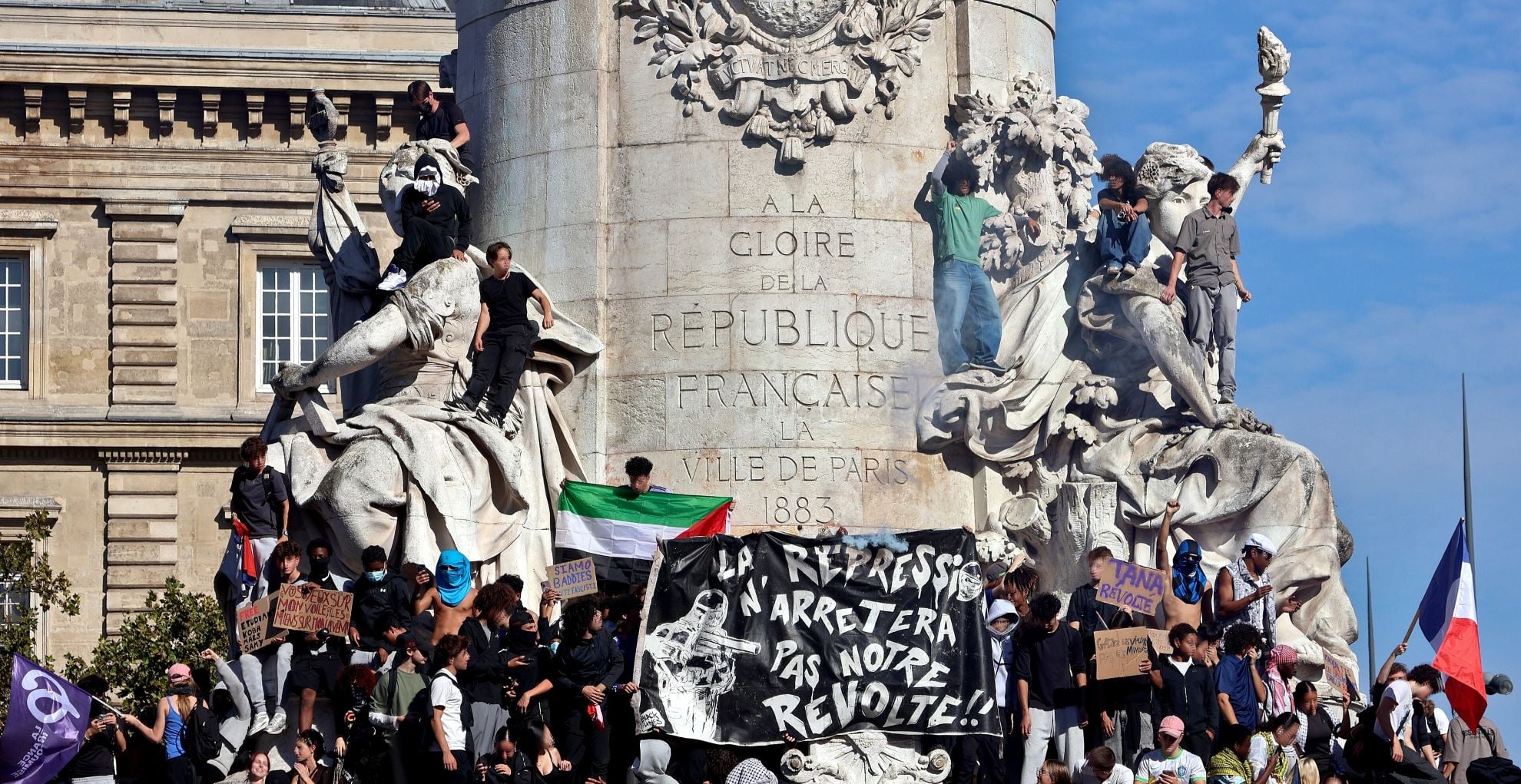
If in the second round in spring Le Pen faced Jean-Luc Mélenchon, as a candidate of the "order party," saving the country from the far left and chaos, she would have the greatest chances of victory. The post Do student protests in France open the way for Le Pen to the presidency, or the opposite? first appeared on Krytyka Polityczna.
On Tuesday, students and pupils took to the streets in France, supported by their parents, trade unionists (mainly associated with the education sector), and ordinary citizens. According to the Ministry of Internal Affairs, across the country 266 thousand people participated in demonstrations, of which 56 thousand in Paris alone. Organizers report even higher numbers: 450 thousand across France, including 100 thousand in the capital. The protests generally proceeded peacefully, despite isolated incidents in places like Paris, Lyon, and Marseille.
Tuesday's demonstrations were the culmination of high school student protests that began on September 17 in one of Paris's suburban districts, and then spread across the country, involving not only suburban neighborhoods inhabited by working-class populations but also schools in affluent, wealthy districts in city centers. The protests were accompanied by occasional acts of vandalism and violence – the entire world saw photos of burning trash bins, barricades erected in front of schools, destroyed school buildings, confrontations between young people and police, in which over 700 officers have been injured since the beginning of the protests, according to the government.
The protests are taking place a little over half a year before the scheduled presidential elections in April. Questions are arising about whom they might help and whom they might harm. The two most common answers are: “Young people have just handed Marine Le Pen the presidency” on one side, and: “The protests do not create a favorable climate for the far right” on the other. Which of these might be more accurate?
What do students want?
Certainly, the protests can be seen as an unsatisfactory grade given by the youngest generation of French people to Macron’s ten-year rule and to the state of education left by the outgoing president. The student protests do not come out of nowhere. They stem from specific problems for which the authorities are responsible.
Students protest against staff shortages in schools, the condition of school buildings, excessively long lesson hours, poorly arranged class schedules, and finally – against the electronic platform Parcosoup, operational since 2018. It handles applications for university studies and decides on the allocation of places at universities, which protesters say is done in an opaque and unfair manner.
The student movement has issued 10 demands to the authorities, including a special program for renovating school buildings; increasing the number of auxiliary staff in schools, especially school nurses and psychologists; guaranteeing students a long break in the middle of the day so everyone can eat peacefully and recharge; increasing scholarships; ending “algorithmic selection” for higher education; and creating 250,000 additional university places in the upcoming academic year.
Many of the issues raised by students are very real. In French high schools, the current student body is from the 2010 cohort, and as “Le Monde” reports – although today a quarter of a million more students are enrolled than in 2008, there are fewer teachers teaching them. This is a result of Macron’s government decisions, specifically cuts and failure to fill teaching positions in education. The staffing shortages lead to overcrowded classes and problems with creating student- and teacher-friendly schedules.
The average age of French school buildings is 60 years, and only 15 percent have been built or renovated after 2015. Most schools lack air conditioning and are unaccustomed to the realities where the school year coincides with increasingly frequent and intense summer heatwaves.
All these specific problems are compounded by broader, existential fears of young people. Historian of social movements Stéphane Sirot pointed out in an interview with “Le Monde” issues such as climate change – experienced this year in France through heatwaves and wildfires; sluggish growth of the French economy; wars in Ukraine and Iran; the development of artificial intelligence; and finally, the possibility of Marine Le Pen’s National Rally winning in next year’s elections.
The reaction of Macron’s government to the protests has also faced criticism. The right accuses the government of being unable to ensure basic order in the country and of failing to handle the violence accompanying the protests. The left claims that instead of seriously engaging in dialogue with students, the government resorts to repressive police measures, which ultimately only deepen chaos. As journalist Alexandre Schwarzbrot wrote in the left-wing newspaper “Libération”:
“The way this movement [student protests] got out of control shows how deep the rift is today between the authorities and society. The government is unable to deal with basic problems other than putting out fires, applying makeshift solutions, making empty promises, and when all else fails – resorting to violence.”
Does Le Pen have this in her pocket?
Research shows that over 60 percent of French people support the demands of the student protests. At the same time, images of clashes with police, chaos in city centers, law enforcement on the streets, and especially bold acts of vandalism and violence naturally evoke fear among a large part of the public and generate a longing for a strong government capable of “restoring order in the country.” Hence the voices that ultimately Marine Le Pen could benefit most from the protests.
British journalist Andrew Hussey, who specializes in French topics and is the author of biographies of Guy Debord and Isidore Isou, presents this thesis in the portal UnHerd. The current protests, in terms of scale and demographic profile, are often compared to 1968. However, Hussey warns to remember the political consequences of May in Paris. After May came June and the elections to the National Assembly, which resulted in a crushing victory for the right – the Union of Democrats for the Republic supporting General de Gaulle achieved an absolute majority for the first time in history.
This was also contributed to by divisions on the left and tactical mistakes made by its leadership, but the right’s campaign mobilizing the “silent majority” to defend the republic against “communist threats” proved simply effective. The left waited 13 years to regain power in France after May – until Mitterrand’s victory in the 1981 presidential elections.
Almost 60 years ago, the “party of order” united around de Gaulle and his Prime Minister Georges Pompidou. Today, the center-right in France is in a state of deep disintegration, and Marine Le Pen remains the most popular right-wing politician. She could therefore gather votes from those craving order in 2027.
Algorithms of tech oligarchs sympathetic to the far right, associated with the MAGA movement, will work in Le Pen’s favor, amplifying acts of vandalism and violence during potential further protests, especially those committed by people of non-white skin color, portraying them as “proof” that France is descending into a civil war between “true French” and migrants, implementing the “great replacement” project.
If in the second round in spring Le Pen faces Jean-Luc Mélenchon, leader of France Unbowed – which current polls suggest is a very likely scenario – as the candidate of the “party of order” saving the country from the far left and chaos, she would have the best chance of victory. Polls already give her the highest chances in the second round precisely against Mélenchon, with her potentially securing 68 percent of the votes in the runoff.
Is this really a convenient topic for the far right?
Leader of France Unbowed (LFI) is very active in supporting the protests, as are politicians from his party. The government accuses LFI politicians of inciting youth, treating students as their “electoral cannon fodder.” On Tuesday, during a debate in the National Assembly, Prime Minister Sébastian Lecornu accused LFI politicians of deliberately “sowing chaos” and pursuing a policy of “disorder in the country”.
As French journalist specializing in leftist topics Sandra Cassini pointed out in her analysis, for Mélenchon, student protests are both a political opportunity and a threat. An opportunity because they can become a mobilizing event for his voters in the upcoming elections and ensure they turn out in large numbers in 2027. Whether Mélenchon advances to the second round largely depends on how well he can mobilize the youngest voters. According to an Ipsos poll for “Le Monde,” 40 percent of voters aged 18-24 intend to vote for Mélenchon in the first round – but under normal circumstances, this youngest electorate often exhibits high abstention, so extra efforts are needed to ensure they vote.
On the other hand, the more acts of violence accompany the protests and the more LFI is associated with them in the eyes of the average voter, the lower Mélenchon’s result in the second round against Le Pen might be. If protests burden LFI’s candidate so much that he does not make it to the second round, it could be an opportunity to prevent Le Pen’s victory – because, at least today, Mélenchon seems to be her most politically convenient opponent.
Everything depends on how the protests will develop further – because they probably won’t end with Tuesday’s demonstration. And specifically, on what framework the debate around them will be based: whether around law and order, or social issues. The more the latter can be emphasized, the greater the chances of stopping the far right. That’s why sociologist Vincent Tiberj, in an interview with “Le Monde,” somewhat optimistically speaks about the political prospects of the protests for the left side:
“So far, in the presidential campaign, politicians have ignored issues of social inequality and the state of public services, focusing instead on debates about migration and security. Student protests are forcing the campaign to confront reality, encouraging candidates to take positions on issues like education and other public services. Those who now appeal to authority and meritocracy or advocate for restrictions on access to higher education will face significant political risks.”
The post Do student protests in France open the way for Le Pen to the presidency, or the opposite? first appeared on Krytyka Polityczna.