Suspiciously good novel
Kapitál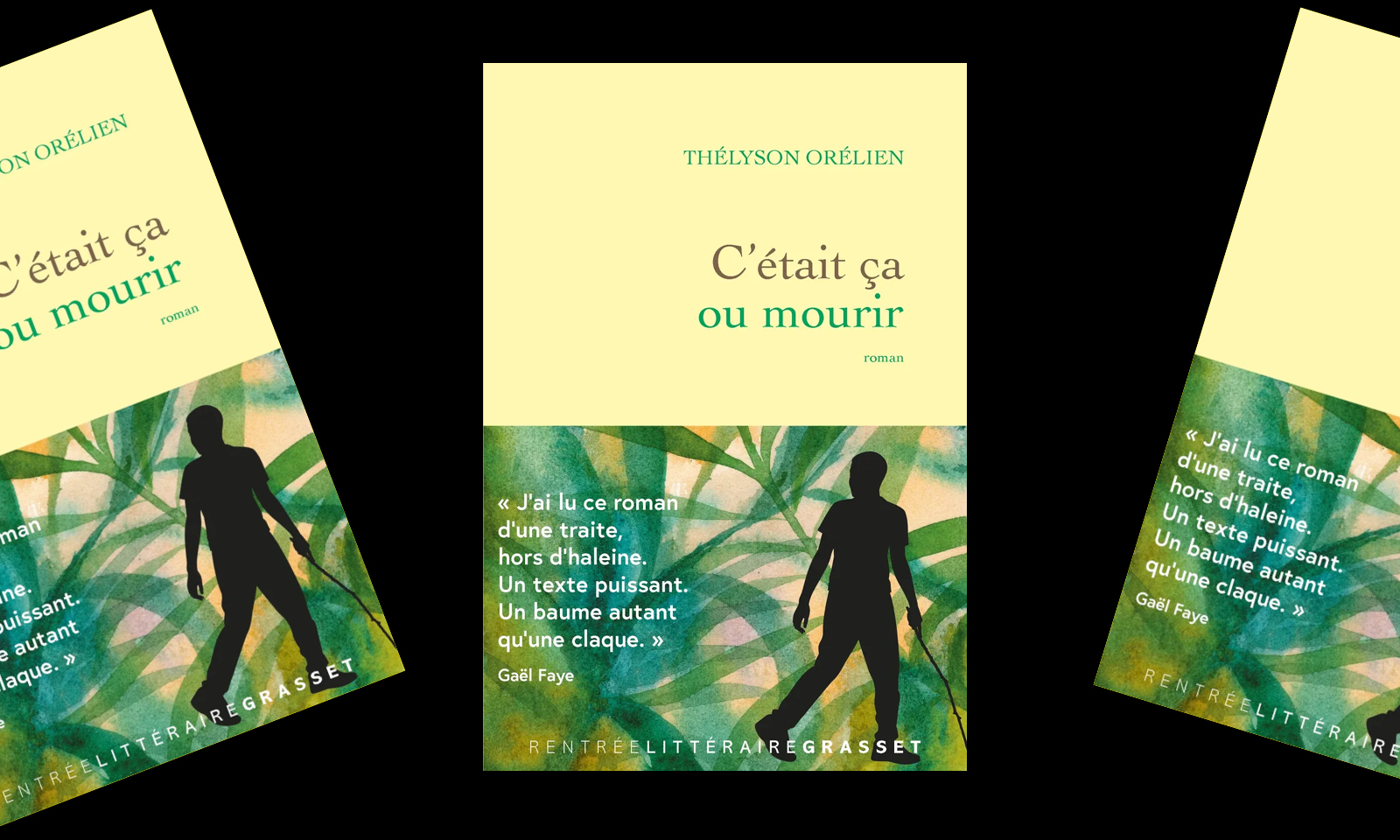
The French literary world has been shaken quite a bit in recent months. Barely recovering from the spring scandal—when nearly three hundred authors left after the dismissal of editor-in-chief Olivier Nora from the Grasset publishing house, owned by right-wing oligarch Vincent Bolloré—a new scandal has emerged.
The French literary world has been shaken quite a bit in recent months. It barely recovered from the spring scandal – when nearly three hundred authors left after the resignation of editor-in-chief Olivier Nora from the publisher Grasset, owned by right-wing oligarch Vincent Bolloré – and now another scandal has emerged.
On September 21, an anonymous X account named Balance ton Claude (Bonzi your Claude) posted a message that the novel C’était ça ou mourir (Either this or death) by Canadian writer of Haitian descent Thélyson Orélien was largely created using artificial intelligence. The post was based on an analysis by the AI detector Pangram, which ranks among the most successful in some comparative tests.
The work was first published in Canadian Quebec and has been garnering incredible success from the start – on the day the accusatory post was published, the debut novel received an award for best novel from the distribution company Fnac, was among the candidates for several French literary prizes including the Goncourt Prize, and critics showered it with praise while readers expressed their enthusiasm in reviews and social media posts. In short, Thélyson Orélien as an enfant prodige, a new young genius...
The novel, narrated in the first person, follows the escape of Haitian history teacher Jonas Dorléon from his homeland after gang members, some of whom were recently his students, set fire to the neighborhood where he lives. It tells of the violence that has brutally plagued Haiti in recent years, of the lack of a meaningful future, and of the dangers of exile. Jonas tries to reach Canada via the Dominican Republic, Brazil, Central America, and Mexico. Along the way, he meets other refugees and describes their survival strategies, violence, solidarity, and the search for a better and more dignified future. And it must be said that he does so without pomposity, with an ironic detachment that can evoke sympathy without mocking anything or instilling guilt for our better circumstances.
The very accusation immediately raised many questions – are detectors like Pangram reliable? On what basis do they decide whether a text is human or non-human? How should one handle an anonymous report from an account with only 92 followers? Despite the obvious problematic nature of the whole issue, the event took a dramatic turn and fundamentally divided the French literary world. The news was quickly seized upon by right-wing media, to which the anti-racist segment of society responded. Social media was filled with slogans like “You will never be more than literary niggers,” referring to ghostwriters writing for others. The racist dimension of the entire affair caused outrage and expressions of anger and solidarity, with authors submitting their works written before the AI era for Pangram analysis.
Supporters of Thélyson Orélien argued, among other things, that Pangram also labeled Victor Hugo’s work as non-human. An outsider would hardly decipher what such detectors are learning. With a bit of exaggeration, it’s as if one baker stole another’s apple pie recipe and then accused him of still selling the pie.
Finally, Orélien himself, who denies any guilt, initially claimed in interviews that it was an attempt to silence him. And it wouldn’t be the first time that an author of dark complexion is discredited in such a way. An example worth noting is Malian writer Yamba Ouologuem. His novel Le Devoir de violence (The Duty of Violence) was published in 1968, achieved extraordinary success, and in the same year received the Prix Renaudot – Ouologuem became the first African writer to receive this award.
However, doubts soon arose about passages resembling the texts of Guy de Maupassant or André Schwarz-Bart, and in 1972, a full scandal erupted over passages taken from Graham Greene’s novel It’s a Battlefield. Ouologuem defended himself by saying that it was a conscious work with foreign texts and that some borrowed passages were marked with quotation marks in his manuscript. The book was ultimately withdrawn from the French market for decades. Well, not everyone is Umberto Eco. Some write in the spirit of postmodernism, and in their works, we appreciate intertextuality and palimpsest; others are dragged through the mud for similar methods.
Just a few days later, on September 25, the Goncourt Academy withdrew the novel from its initial selection, adding fuel to the already blazing fire of the first phase of the cultural war. The academy removed the book even before doubts about AI usage could be convincingly refuted or confirmed. Their reasoning cited the results of several analyses and newly published cases of plagiarism in older Orélien texts.
Academics also stated that “the book [...] is probably largely a product of artificial intelligence,” without providing any analysis or arguments to support their claim. Their decision was supposedly “driven by the desire to preserve the integrity of the Goncourt Prize and the Academy itself, whose central role is to support and recognize literature written by women and men.”
The mentioned integrity of the jury, however, raises questions also in light of other recent scandals. Kamel Daoud received the Goncourt Prize in 2024 for his novel Houris, whose creation later became the subject of another ethical controversy. The woman, who was a patient of Daoud’s wife, a psychologist, accused the author of using her life story and information she was supposed to reveal during therapy in writing the book.
And then there’s at least the question of what criteria should actually be used to assess authorship. Not to mention that one of the jurors made a remarkable observation in a media interview – that the novel must have been written by artificial intelligence because its language is very rich, almost opulent, while the author’s statements in the media are more modest...
The whole affair is not yet over, but it already looks like more electronic ink has been spilled over the novel C’était ça ou mourir than we can imagine. The book’s sales certainly did not suffer: in the week from September 21 to 27, more than 18,000 copies were sold, and the novel became the best-selling fiction title in France, although Canadian and French publishers canceled their promotional tours.
The intensity with which the public and literary critics responded to the scandal indicates a concern that today, in connection with artificial intelligence, is shaking not only the literary world.
Discussions are ongoing on multiple levels. Besides the moral and political aspects, the whole issue also touches on the core of symbolic reflections about what still constitutes a creative act and what will happen to literature when we can no longer reliably determine who – or what – wrote it.
Sociologist Fabrice Raffin, in his commentary for the newspaper Le Monde, states that “the case of Thélyson Orélien shakes the privilege of some people to decide what art is, as well as the idea of the artist as an exceptional individual.” According to him, “we still largely understand an artwork as an expression of uniqueness, sensitivity, or genius, capable of shaping a certain experience of the world through words, sounds, or images. An extraordinary work should necessarily be associated with an extraordinary author. Artificial intelligence disrupts this romantic notion: if a machine can learn the codes of a certain artistic form well enough and create a text recognized as literary, it not only threatens the work of some artists but also the very understanding of the artist as an exceptional being.”
Some intellectuals, however, counter with references to the functioning of art studios, comparing “collaboration” with AI to Leonardo da Vinci probably creating main figures on his paintings while assistants painted backgrounds at home.
Johan Faerber, an expert in contemporary literature, perceives the accusation against Thélyson Orélien as a classic witch hunt motivated by the crudest racism. Ultimately, Samuel Fitoussi, a journalist for Le Figaro, who openly shares his right-wing views, claimed responsibility for the account Balance ton Claude. He could have written a regular article and supported his claim with analysis, but he chose not to.
Faerber also points out that AI brings about a fundamental democratization of creation – for those who do not write, write poorly, or simply want to improve. According to him, “everyone familiar with modern literature knows that the death of the author is inevitable.”
Alongside these profound symbolic questions, there are also other, much more pragmatic issues. The work is currently being translated into more than 20 languages, including Czech. How will foreign publishers and translators respond? And then there’s the question of criticism. The fascination that the novel has inspired since its publication until the start of the scandal may have had at least a partial political dimension from the beginning. Perhaps it was more about showing how welcome authors and authors from elsewhere, who tematize exile, are than about the genius of the work itself – although the reality of this bienvenue is often distant from public statements.
What will critics do today if they simply do not find the book good? What if they are bothered by aphoristic lines like “This is Haiti: every day is another tragic story better left unverified” or “He wanted to escape death as one escapes debt,” which in many situations seem like a particular manner allowing the author to move on to the next experiences? Or, for example, certain repetitiveness? And even the much-praised linguistic opulence is not something the reader will enjoy much...
Do we have the right to subject the book to critical reading and not be labeled racists?