How a rock trial helped create Charter 77
New Eastern Europe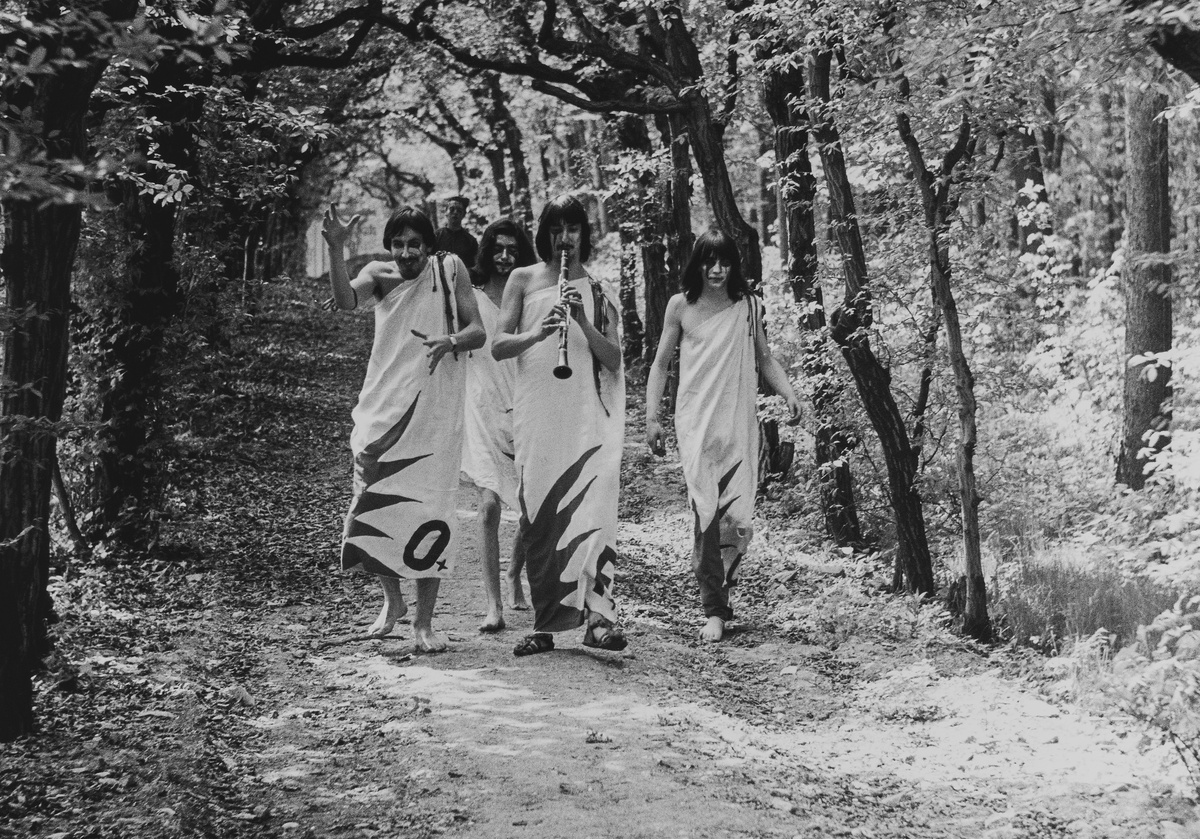
The Velvet Revolution in Czechoslovakia has extensive roots in the country’s dissident scene in the 1970s and 1980s. The arrest of the rock band “The Plastic People of the Universe” in 1976 set in motion a chain of events that encouraged individuals to question communist rule through groups such as Charter 77.
In his 1971 play The Conspirators, Václav Havel imagines the leaders of a newly liberated democracy becoming frightened of a supposed conspiracy by their exiled dictator. They create their own secret security apparatus to prevent the public from hearing of the rumours though it turns out that the conspiracy does not exist. Their attempts to defend themselves generate so much paranoia and unrest that, by the final scene, they conclude that the only way to save democracy is to restore the dictator and have him lead the country again.
Six years after the play was written and banned in its country of origin, the communist Czechoslovak state supplied its own real-life adaptation of it. In 1976, the authorities arrested a rock band on the grounds of "organized disturbance of the peace". In trying to suppress an apolitical subculture, which they viewed as a nuisance, the regime inadvertently created the first substantial, organized resistance movement of the 1970s and 1980s. They had provided its opponents with a common cause and a common language they had previously lacked: human rights.
In protest of the arrest, members of disparate groups of Czechoslovak society such as priests, writers, academics, workers and musicians came together to create the human rights organization “Charter 77”. The group would later play a big role in laying the groundwork for the Velvet Revolution in 1989, which saw the country freed from communism.
The government had decided that the rock band’s refusal to conform, wearing their hair long and playing rock music, was a form of dissent. The more harshly the authorities treated the band, the more legendary and important they became in the eyes of the wider public.
The rock band, named “The Plastic People of the Universe”, formed shortly after the 1968 Warsaw Pact invasion brought the Prague Spring to an end. Founded by the seventeen-year-old bassist Milan Hlavsa, the group took its name and musical inspiration from American rock acts including Frank Zappa, the Doors and the Velvet Underground. They mostly played English-language covers, while sometimes translating their own Czech songs into English because they regarded English as the lingua franca of rock music.
After 1968, Gustáv Husák's regime reversed the liberalization of the previous years, purged reformers, tightened censorship and attempted to restore political and social conformity. The authorities did all of this to determine and tightly control what constituted acceptable culture and it was in this context that they revoked and reinstated the PPU’s licence to perform. The authorities ultimately decided that their music was too morbid and had a "negative social impact".
Under the rules of the “normalization” era, rock music, English lyrics and wearing long hair were seen as subversive acts and essentially banned. The band was not allowed to rent rooms or halls to play or rehearse in and often had to build or borrow their instruments. Even with mounting state supervision in their way, the musicians continued playing illegally in basements or at friends' homes and parties.
Even though the members maintained that they did not have any political aspirations and did not see themselves as activists, the police continued to target them. At one of their illicit concerts, policemen moved in on the fans before the band had even gone on stage, noting down the attendance of hundreds. As a result, some of the attendees were expelled from school without getting to sit final exams and some others were tried and jailed. The band’s founder Hlavsa said in an interview in the 1980s that with this treatment “We felt more like a guerrilla group than a rock-and-roll band. We didn't play this role intentionally – it was forced upon us from outside.”
Ultimately, in March 1976 the police broke up another one of their concerts and this time arrested some of the students who were in attendance alongside the band members themselves. One ex-member, Paul Wilson, was deported back to Canada, while the others received sentences ranging from eight to eighteen months in prison. They had been convicted of "organized disturbance of the peace".
Václav Havel, by then a well-known dissident, heard of the arrests the next day and quickly came to the arrestees’ help. In her biography of Havel named Acts of Courage, the academic Carol Rocamora notes: “With the same passion for plotting the structure of his plays, he plotted the strategy to protest the arrest.”
Havel arranged radio interviews to inform the public of what had happened, which garnered international attention. He sent messages about the incident to several embassies and addressed an open letter to the German writer Heinrich Böll that resulted in a petition signed by seventy people, amongst them prominent writers and intellectuals.
Public protests were organized and later Havel himself remembered “the government thought they could hurt them without anyone caring. But to their surprise, the worst thing happened — the fate of the musicians made a unity among different kinds of people. It was at this time, October to December, that the first 240 names were signed to Charter 77.”
Indeed, the trial united a coalition that would have seemed unthinkable a year earlier. Priests and professors, Marxist revisionists and factory workers, and writers and rock musicians suddenly came together.
While the authors of Charter 77 made sure to clarify in their document that their aim was not revolution or political opposition, it was undeniable that the government of Gustáv Husák felt nervous about this initiative.
People's outrage turned into action when the group’s three official spokesmen – Havel, the philosopher Jan Patočka and former member of the communist party Jiří Hájek – decided to create a manifesto. Drawing on the human rights commitments the Czechoslovak government had signed in the Helsinki Accords the year before, the initiative called attention to the gap between the regime’s promises to honour human rights and the reality of censorship, surveillance, harassment, and the suppression of basic civic freedoms inside the country.
The Chartists insisted that their aim was not revolution or political opposition, but simply that they wanted citizens to be allowed to “work and live as free human beings”.
The Helsinki Declaration of August 1st 1975 marked a turning point for Cold War relations. The Warsaw Pact countries, including the Soviet Union, had their national boundaries acknowledged by the rest of Europe while at the same time adopting ten points of international diplomacy. Part of this was an agreement to uphold human rights for every citizen in the country.
Under Section 7 (“Respect for human rights and fundamental freedoms, including the freedom of thought, conscience, religion or belief”) the document states: “(The participating states) will promote and encourage the effective exercise of civil, political, economic, social, cultural and other rights and freedoms all of which derive from the inherent dignity of the human person and are essential for his free and full development.”
Describing Charter 77’s purpose, the ostracized philosopher Ladislav Hejdanek, one of the earliest signatories of the Charter, said in an interview with the playwright Tom Stoppart that “The important thing is to throw light, to find out what sort of society we live in. If the government cannot keep its declarations it must not make them. The Charter is a legalistic action based on morality. It is not a political action for me. It is not even a technically political action structured [i.e., presented] as a nonpolitical action. It is a moral action.”
The authorities responded to Charter 77 with predictable hostility. Signatories were harassed, interrogated, dismissed from their jobs, and subjected to constant surveillance. The regime's repression took less dramatic forms as well and saw the authorities confiscating signatories’ writing equipment, cutting telephone lines, and revoking driving licences. In some cases the authorities also deprived Charter signatories of their livelihoods or passports. These measures were designed to isolate them and make participation in the Charter as personally costly as possible.
Havel himself was repeatedly detained and questioned. However, rather than retreating, he became increasingly involved in dissident activity and in 1978, as a direct result of Charter 77, helped establish the Committee for the Defence of the Unjustly Prosecuted (VONS), which documented cases of political repression in Czechoslovakia.
Eventually the regime decided to make an example of its most visible critics and arrested Havel alongside several other VONS members in May 1979. They were charged with “subversion of the republic”. Havel was sentenced to four and a half years in prison at his subsequent trial. However, he would be released after three years and nine months due to his critical health condition.
Jan Patočka, a prominent Czech philosopher and spokesperson for Charter 77, suffered a heart attack just three months after the Charter had been published. He had already been weakened by influenza, and the prolonged police interrogations he was subjected to further contributed to his deteriorating health.
A few days before his death, Patočka wrote in his "Political Testament" that “Many people ask whether Charter 77 will not lead to increased “vigilance” which in turn will have an adverse effect on all citizens.” He responds to this issue by saying “Let us be frank about this: In the past, no conformity has yet led to any improvement in the situation, only a worsening. The greater the fear and servility, the more brazen have the authorities become. There is no way to make them relax the pressure other than by showing them that injustices and discrimination are not ignored.” This, to him, was the purpose of Charter 77 – for the citizens of Czechoslovakia to speak the truth.
His funeral drew around a thousand attendees, but the authorities used the occasion to demonstrate their continued hostility towards the Charter. Police arrested more than a dozen mourners, while helicopters and vehicles surrounding the funeral created so much noise that attendees reportedly struggled to hear the priest's speech.
The Charters document itself was circulated widely and within six months it had collected 750 signatures. The government made efforts to characterize the group as a small group of degenerates, criminals and bourgeois revisionists to try and communicate to the rest of society that these complainers were not to be taken seriously. Workers were actively encouraged to denounce the Chartists but still, within six months, the document had collected 750 signatures.
One Chartist said in the summer of 1977 that “A few years ago when we made a protest, people were against us because they thought we would only make things worse for everybody. Now I’ve found that no one thinks this way any more. I know of one factory where the workers were asked to condemn Charter 77, and the result was that they realized that a protest was actually a possibility in this country. So they made their own protest against certain work conditions, and they won.”
Ultimately, by the time of the Velvet Revolution in 1989, Charter 77 had collected 1,882 known signatures despite the regime's harsh and public punishment of its members. Although the government succeeded in suppressing the Charter's wider distribution, and many Czechoslovak citizens did not read the document itself until after 1989, its significance extended far beyond the number of people who signed it.
The Charter created a new network that brought together people who might otherwise never have had reason to collaborate. The years of repression that followed saw them organizing, communicating and supporting one another outside the structures of the communist state. Furthermore, the public outside of Czechoslovakia became aware for the first time of the breaches of human rights through the organized collection of cases by Charter 77 signatories as part of the VONS group.
When the regime finally began to crumble in 1989, this network provided an existing community of dissidents who were able to respond quickly. Many of the figures who became central to the Velvet Revolution had already spent years organizing through Charter 77 and other dissident initiatives. The Civic Forum, the broad opposition movement established during the revolution, brought together many of these existing networks and quickly became the principal vehicle for negotiating the end of communist rule.
The political language and culture created by Charter 77 made possible a rapid mobilization when the opportunity finally arose. Its significance was demonstrated after the revolution. Numerous Charter 77 signatories went on to enter government or be elected to parliament, with people engaged in the dissident networks of the 1970s and 1980s directly working within the institutions of the new democracy.
Shelly Foreshaw Brookes is a German writer and independent researcher based in London.