Elif Eralp is changing Berlin. The daughter of Turkish refugees on the verge of historic power.
Krytyka Polityczna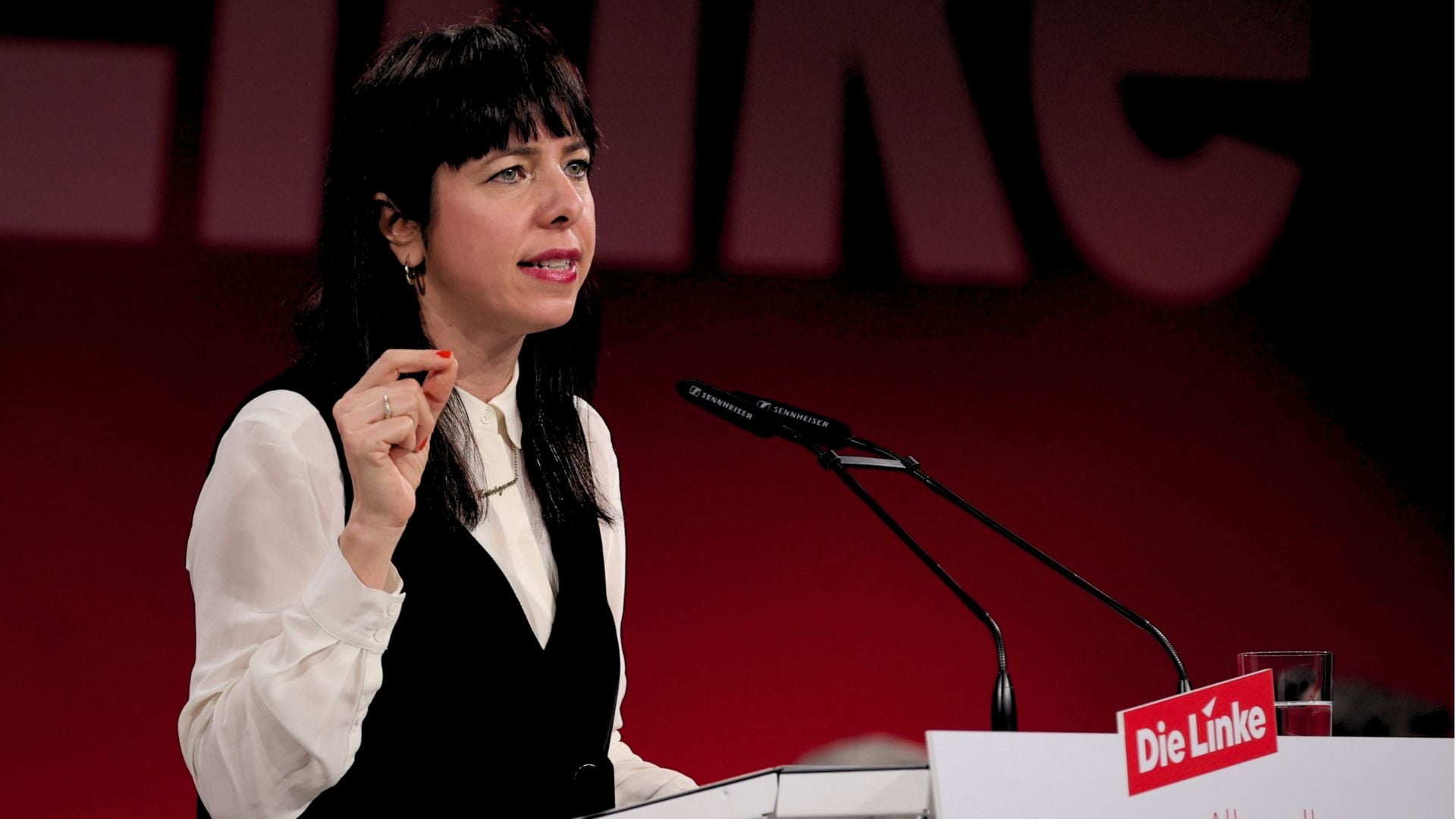
Elif Eralp led the Left to a historic victory in Berlin and may become the city's first female mayor of Turkish descent. However, her success says more about Germany: voters disappointed with the establishment do not have to turn to the right. The post Elif Eralp is changing Berlin. The daughter of Turkish refugees on the verge of historic power first appeared on Krytyka Polityczna.
When Elif Eralp went out to her supporters in Berlin on Sunday evening, she spoke briefly in Turkish. In the political ritual of the German election night, it was a small gesture of symbolic significance. Here in the regional elections in the capital of Germany, a woman whose parents fled Turkey to escape repression after the military coup of 1980 celebrated her victory. A woman who just a few years ago was a relatively unknown lawyer and parliamentary expert, now has a real chance to become the first female mayor of Berlin of Turkish descent. And above all: a candidate from a party that just a short time ago many commentators wrote off, has just won the elections in the German capital.
The scale of this victory is greater than suggested by the first place itself. The Left (Die Linke) received 25.7% of the votes. In 2023, it had 12.2% – more than doubling its result in three years. CDU, which previously governed Berlin, fell to 18.8%. AfD gained 16.3%, Greens 14.3%, and SPD – the party that for decades almost identified with political Berlin – only 12.1% (its worst result in the city’s history). Even more telling is Eralp’s personal result. In her Friedrichshain-Kreuzberg 1 district, she received over half of the votes – 50.4%. The Green candidate, a party that for years was almost hegemonic in this part of the city, received 17.2%. Three years earlier, Eralp herself lost here to the Greens. This is not an ordinary change of guard. It’s a kind of small political earthquake.
Eralp wants to negotiate with Greens and SPD. The Green leadership already announced on election night that they prefer a coalition of The Left, Greens, and Social Democrats. A coalition of CDU, Greens, and SPD is also mathematically possible, and there are serious reservations within SPD regarding parts of The Left’s program, especially regarding the socialization of large housing corporations. Nothing is decided yet. But the scenario in which Berlin is governed for the first time by The Left, leading a red-green-red coalition, and the mayor is the daughter of political refugees from Turkey, is no longer a political fantasy. Today, it is one of two realistic options for city governance.
The girl from a refugee family
Eralp was born in 1981 in Munich. Her parents were socialists and unionists. After the military coup in Turkey in 1980, they fled repression to West Germany. Her mother was pregnant at the time. The family later moved between Munich, Dortmund, and Hamburg. Elif studied law, passed both German state exams, worked in asylum law, and later worked as an expert for the Left faction in the Bundestag. She entered the Berlin House of Deputies in 2021. So she is not a product of identity politics in its most superficial sense. She is a German lawyer, parliamentarian, and politician rooted in the classic leftist tradition: trade unions, labor law, tenants, social state. At the same time, her biography already belongs to a different Federal Republic than the one some German political circles still imagine. Berlin is a city where the concept of “migration minority” begins to be statistically misleading.
By mid-2025, 41.7% of Berlin’s residents had the so-called Migrationshintergrund, a migration background. In Friedrichshain-Kreuzberg, it was 50.1%, in Neukölln 52.2%, in Mitte 59%. More importantly for the elections: about 658,000 residents of Berlin were simultaneously German citizens and people with migration experience. They made up 16.9% of the city’s total population. Of course, not all are of voting age, and not all vote. They do not form a single electorate. A Turkish worker, a Polish nurse, a Syrian lawyer, and a Vietnamese kiosk owner do not become a political community just because German statistics categorize them together. But that’s precisely why Eralp’s result is interesting. It shows that the migrant society in Berlin has ceased to be an addition to the “main” society, whose support can be gained with a few sentences about integration before elections. It is a huge reservoir of experiences, interests, and – in the case of German citizens – votes. The Left apparently understood this earlier than some of its competitors.
The Left opens the door
The strategy was surprisingly old-fashioned. Instead of seeking a magic topic on social media, the Left ran a large door-to-door campaign. They asked people about rents, prices, public transport, housing. Eralp wore a gold necklace with the inscription “Mietendeckel” – rent freeze – almost as an ostentatious symbol that politics should once again concern material life. And she hit a nerve of the city. Only 20% of Berliners declared satisfaction with the CDU-SPD government before the elections; 77% were dissatisfied. Since Infratest dimap has been measuring satisfaction with government before regional elections, it has not recorded such a low result.
Over the years, successive parties promised Berliners that the city would finally start functioning properly. That new apartments would be built, administration would speed up, schools would improve, public transport would be more efficient, and everyday life would become more predictable. Meanwhile, for many residents, the experience was the opposite: Berlin was becoming more expensive, and the sense of material security was diminishing. At some point, the voter stops asking whether another system correction is “realistic.” They start asking why, for thirty years, only steps that do not solve the main problem are considered “realistic.” This is where the political space for the Left begins.
So did Eralp win thanks to migrants, small entrepreneurs, or Berlin Muslims outraged by German policy toward Israel, as some claim? We do not yet have such data. But it is worth asking a question that German politics has long avoided: what happens when a group does not see these communities as an integration problem, but as normal participants in political conflict? The Left has just done that. It has opened the door wide.
Palestine, anti-Semitism, and the boundaries of the broad tent
This also concerned the most sensitive topic in contemporary Berlin – the war in Gaza and Germany’s stance toward Israel. In a city with a large Arab, Turkish, and Muslim population, anger at Tel Aviv’s policies is not a marginal phenomenon. Over the past years, some of these communities felt that the German public debate did not sufficiently distinguish anti-Semitism from sharp criticism of the Israeli government. On the other hand, Berlin is a city where, after October 7, there was a real decline in Jewish security. These two things can be true at the same time.
Eralp tries to walk this thin line. She speaks about discrimination against Muslims and women wearing headscarves, but also presented a plan to protect the Jewish minority. She does not want to accept the logic that one must choose which discrimination is more condemnable and to be fought. It is politically intelligent but not without risks. The most problematic for Eralp remains the party’s relationship in Neukölln, especially strongly involved in the Palestinian issue. Controversy arose from rapper Dahabflex’s performance at the Left’s election event, during which words like “death to the IDF” and “yalla yalla intifada” were spoken. Eralp distanced herself from the performance, called it crossing a line, and demanded consequences. The Greens have already announced that the issue of anti-Semitism in the Left will be a subject of discussions about a possible coalition. Their federal leader Felix Banaszak also expressed support for an alliance with the Left and SPD and called for a clear stance against anti-Semitism from the Left. If Eralp becomes mayor, it will be one of her first tests. The broad tent is electorally effective only as long as politicians can define its boundaries.
Migrant and Ossi
There is one more story hidden behind the Berlin Left’s result. Naika Foroutan and Jana Hensel wrote a few years ago the book Die Gesellschaft der Anderen (The Society of Others). One is a migration researcher of Iranian roots, the other a writer raised in East Germany. They contrasted two experiences that the German debate usually separates: the experience of migrants and the experience of East Germans. They did not claim they are identical. They are not. The history of East Germany, the transformation after 1989, and migration to Germany are entirely different stories. But they are connected by a certain mechanism: the experience of being described by others.
“Ossi,” like “migrant,” for years was more an object of diagnosis in the German debate than its author. People talked about their frustration, deficits, problems with democracy, insufficient integration into the Federal Republic. A similar paternalistic language – though in a completely different context – is familiar to migrants. Perhaps this is one of the most interesting lessons from these elections.
In Mecklenburg-Vorpommern, anger at the political center helped AfD win the elections. In Berlin, the rebellion against the status quo took a different form: the Left won. The programs of these parties regarding democracy, migration, minorities, or Europe are fundamentally different. The common factor, however, is a political fact: in both places, the existing power arrangements have lost their majority. This is an important difference. Because it shows that economic frustration does not have a natural ideological direction. A person who cannot afford an apartment is not born a voter of the right. An East German resident is not born a supporter of AfD. A migrant is not born a supporter of the Left. Only politics explains to a person who shares their interests and who is to blame for their situation.
Right-wing populism says: the problem is someone foreign – migrant, refugee, liberal elite. The Left Eralp proposes a different construction of the conflict: the problem is that work no longer guarantees security, housing becomes a financial asset, and the city you co-create ceases to be accessible to you. That’s why the eastern Berlin in the coming months will be particularly interesting. Not because some great “Ossis and migrants” alliance has already formed. It has not. But because the success of the Left shows the possibility of a different political language for people whom the German center has come to call periphery. And peripheries have a certain irritating property: sometimes it turns out that half the society lives there.
Maria Bigos and the new German biography
This story also includes Maria Bigos. Born in Ustrzyki Dolne in the Polish Carpathians, as a child she came to Germany, grew up in Bremerhaven and Bavaria, and later moved to Berlin. Now she has secured a direct mandate for The Left in Pankow. Here too, more interesting than simple triumphalism is her biography itself. A Polish migrant woman wins a mandate in part of the former East Berlin for a party whose historical roots are in East Germany (GDR). Such biographies will become more common in Germany. And it will be increasingly difficult to describe German politics using old categories: Germans and migrants, East and West, center and margin. The margin is moving to the center.
Perhaps Eralp’s most important innovation is actually much less exotic than her biography. She is simply a very good campaign politician. She speaks in everyday language, can be both programmatically radical and balanced in her manner. She does not look like someone who came to give a lecture on false consciousness of voters. Rather, like someone who wants to talk to them about their rents.
The European left has often seemed over the years to have more patience for theories about society than for society itself. The Berlin Left has reversed this order. Instead of explaining to people why they should be left-wing, it asked what hurts them – and tried to give it a leftist interpretation. Data on voter flows are fascinating in this regard. The Left took tens of thousands of votes from Greens and SPD, but also managed to mobilize many previous non-voters.
Elif Eralp has already made her mark in Berlin’s history. Now the more difficult part begins: in a city with an empty treasury, she will have to prove that leftist politics can not only mobilize those who have lost trust in politics but also noticeably improve their daily lives. Because you can make history by winning elections. It is much harder to ensure that political change reaches the wallet, the apartment, and the daily life of those who voted for it.
The post Elif Eralp is changing Berlin. The daughter of Turkish refugees on the brink of historic power first appeared on Krytyka Polityczna.