Don't kick for the team, but for the values
Kapitál
At the very top of the Prague Slavia stand, we watch with a group mostly of young boys from low-threshold clubs aged 8 to 13 years on an empty playing field. Although there is no real grass there in the summer, the view continues to captivate us. One of the boys remarks: "This is the best experience of my life." Filled with admiration and unspoken expectations, each of us dreams in our own way about what it must be like to play on the field during a match with so many people in such a large stadium.
At the very top of the Prague Slavia stand the bleachers, where we observe with a group mostly young boys from low-threshold clubs aged 8 to 13 years, an empty playing field. Despite the fact that there is no real grass there during the summer, the view continues to captivate us. One of the boys remarks: “This is the best experience of my life.” Filled with admiration and unspoken expectations, each of us dreams about what it might be like to play on a field during a match with so many people in such a large stadium.
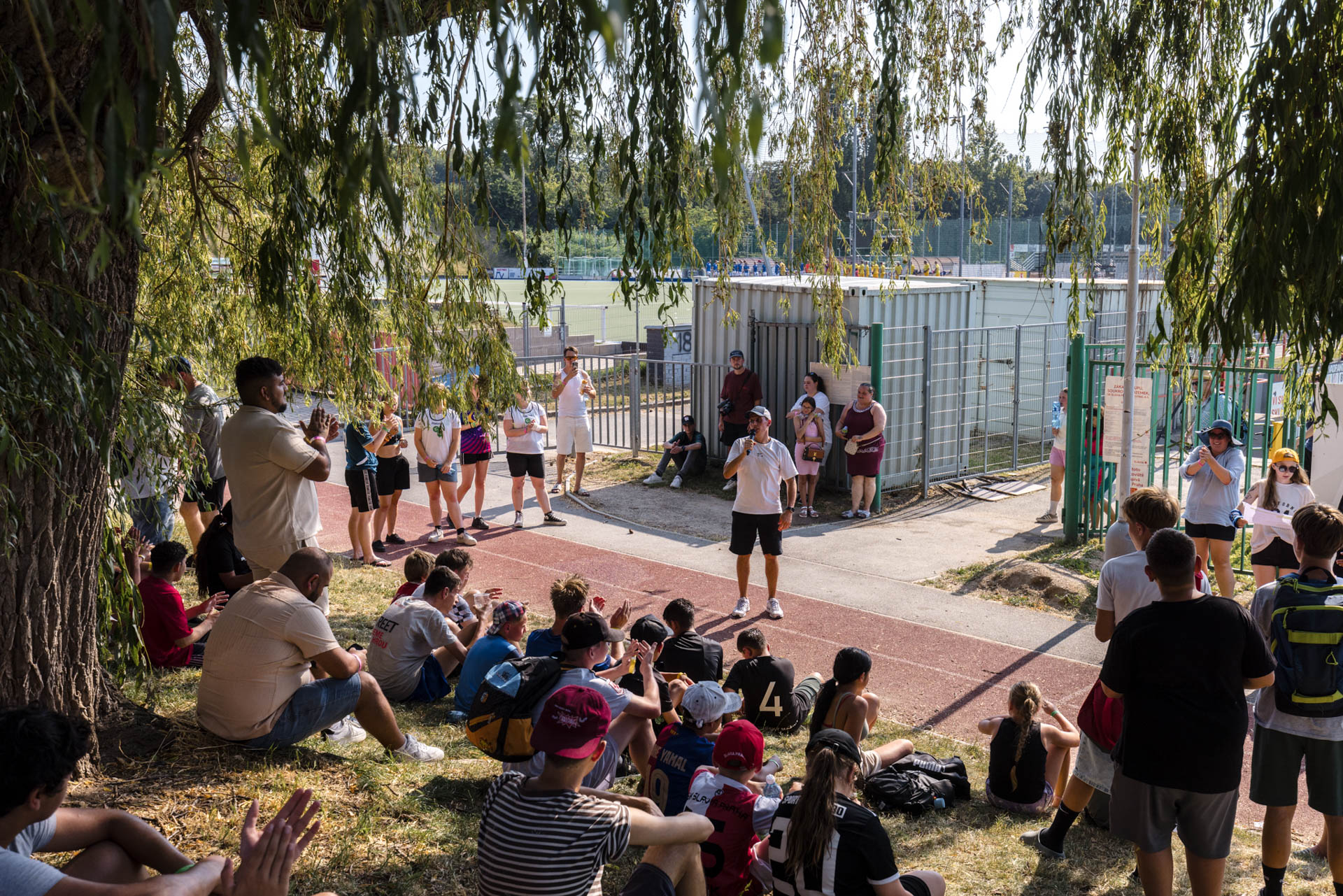
While on one side of the world the best countries are competing against each other, on the first holiday Saturday, a slightly different football tournament takes place on the training grounds of Prague Slavia. Following the host’s call to the playing field, the coaches and trainers of the individual teams – those who were not discouraged by extreme heatwaves – step onto the field. A large part of the teams had canceled their participation at the last minute because of them. “Plzeň, Karlovy Vary, Kladno, Prague 1, Prague 2, Haná,” the announcer lists the teams entering the field. Despite the setbacks, the determination of everyone remains high. After initial words from the head of the organization Fair Play Point, Ansley Hofmann, the teams begin preparing for the first kick-off.
The nationwide fair play football tournament marks the end of the regional league season. Fair Play Point is an organization that uses football as a tool for education and development. It works with football rules in a way that participation not only benefits one’s team but also “for their values, future, and standing in society”, whether on the field or off it. Almost all teams consist of children from low-threshold clubs, social activation services, or similar socially engaged and non-profit organizations.
The roots of this specifically fair football date back to an event from 1994. A few days after Colombia’s elimination from the World Cup, the Colombian defender Andrés Escobar was found dead in his car. He was murdered by three men who allegedly shouted “Goal!” during the shooting. Their act is still perceived as revenge for Escobar’s own goal in the match against the USA, which contributed to Colombia not advancing further. In response to this tragic event, social innovator Jürgen Griesbeck launched the initiative Fútbol por la Paz (Football for Peace) in the then record-crime Colombia, where football offered an opportunity to promote peaceful conflict resolution. Since then, similar initiatives have emerged in other countries around the world.
Do you think it will be so evenly matched?
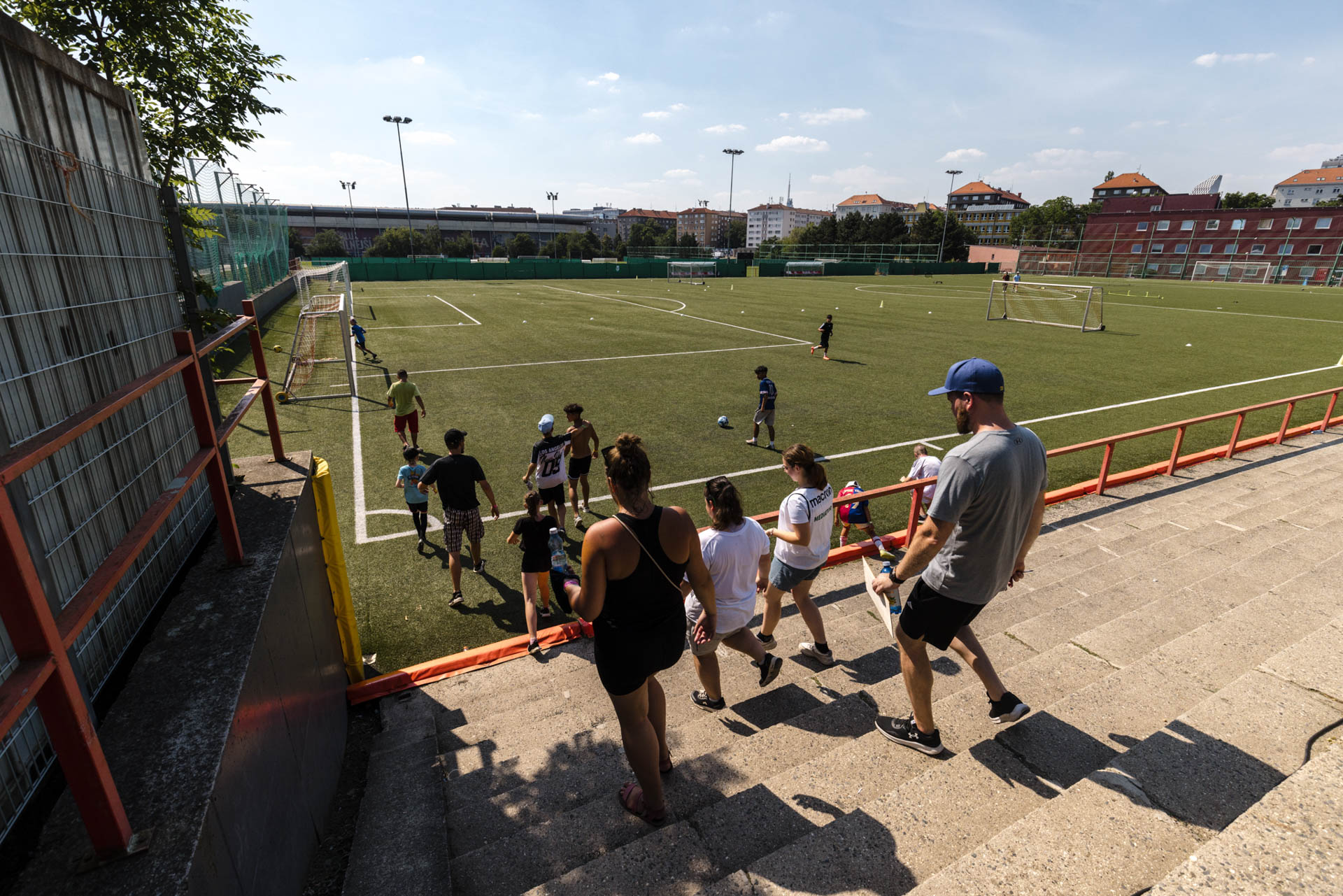
On the field, a match between Karlovy Vary and Prague 2 is about to start at any moment. But before that, several boys pour buckets of cold water over each other. Some even dip their sneakers in water because of the heat. Meanwhile, we, a few spectators, try to hide from the sun under folding canopies or in the shade of an adjacent tree.
The match begins with both teams and their coach and coachess gathering in the middle of the field. Also present is a pair of mediators. The methodology of fair football, called Football 3 (orig. Football3), differs from traditional competitive football in several aspects. It consists of three halves – initial agreement on rules, the actual game, and then a final reflection with point evaluation. The rules change from match to match, and there is no referee involved. Players must agree on everything together. That’s why the match starts with a discussion involving both teams. The mediators guide it and record the agreed rules on match forms.
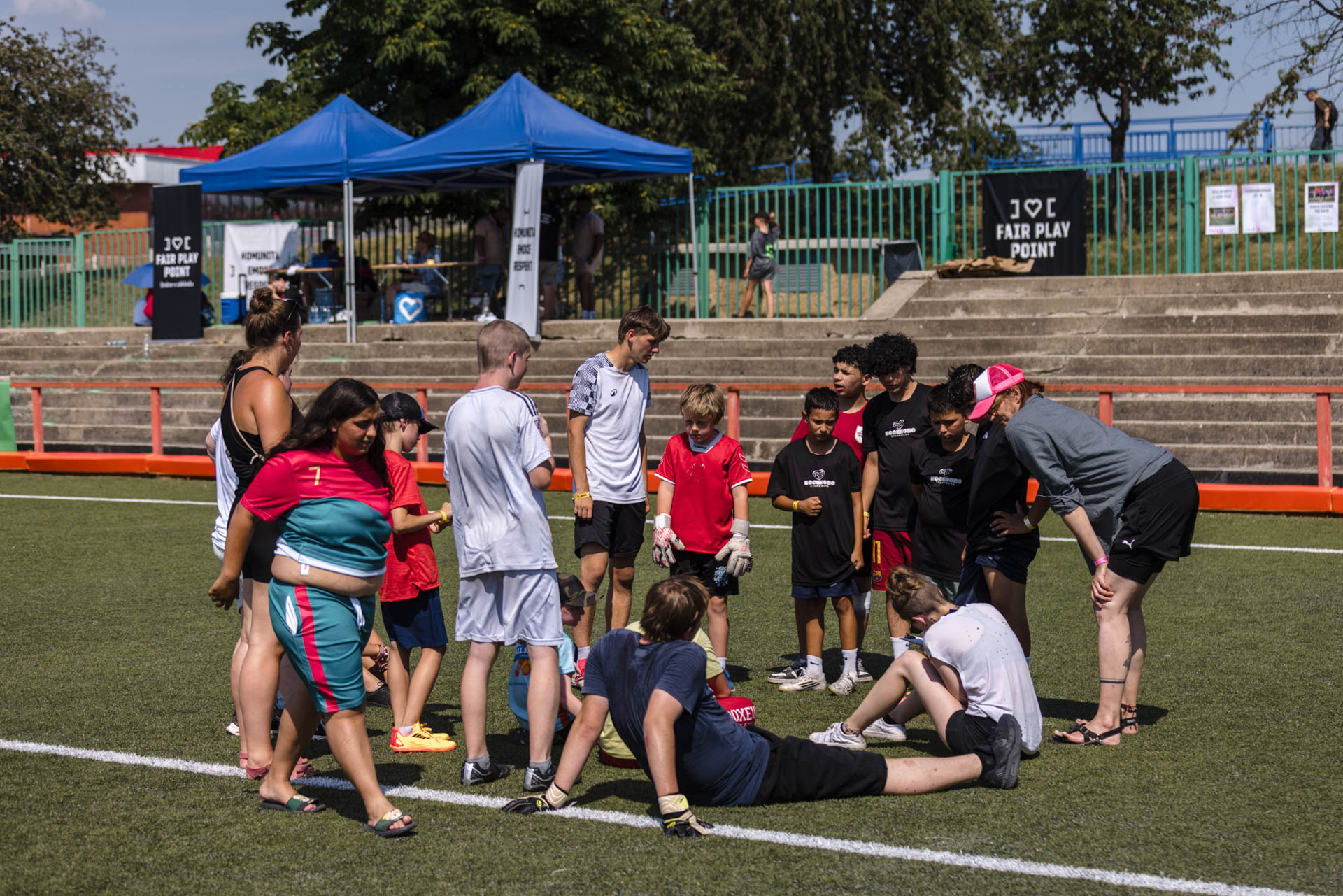
“We won’t give perdy (power shot, note by author)” says one of the boys in response to the fact that their team is older and stronger. There is also discussion about corners, out-of-bounds, and offsides. The conversation proceeds quickly, with some players interrupting each other or speaking simultaneously multiple times. Teams internally agree on substitutions, and one girl suggests they switch after a sign they agree upon.
“Are we playing 3 + 1 or 4 + 1?” asks one of the boys, referring to the advantage of the number of players in the Prague team. Another boy immediately follows: “Give us his, he’s good,” pointing to a smaller boy in a Barcelona jersey. Although the boy wants to run quickly to them, the Prague team’s coach’s question briefly halts everything: “Do you think it will be so evenly matched?” After a moment of discussion, the boys respond generously: “You’re smaller, you can have an extra player.”
The variation and diversity of rules in Football 3 create space for practicing key aspects of conflict resolution and reaching consensus: mutual listening, expressing one’s needs or desires, the ability to reflect and plan changes that can be tested immediately in the next match. Social workers, who become trainers in this environment, gain a tool for their work through Football 3. Thanks to a very simple and inexpensive sport, they can work with their clients on developing consideration and communication skills. Although at first glance the rules—such as playing with one extra player or the condition that the first goal of the match is scored by the youngest player—may seem strange, their significance is key to larger goals and values beyond football itself. Moreover, the overall victory in the match is not determined solely by the number of goals scored. During post-match discussions, teams award each other points for fair play and must reflect on their own behavior and performance. Based on the total points for wins, goals, fair play, and mediator’s points, the winning team is finally determined at the very end of the discussion.
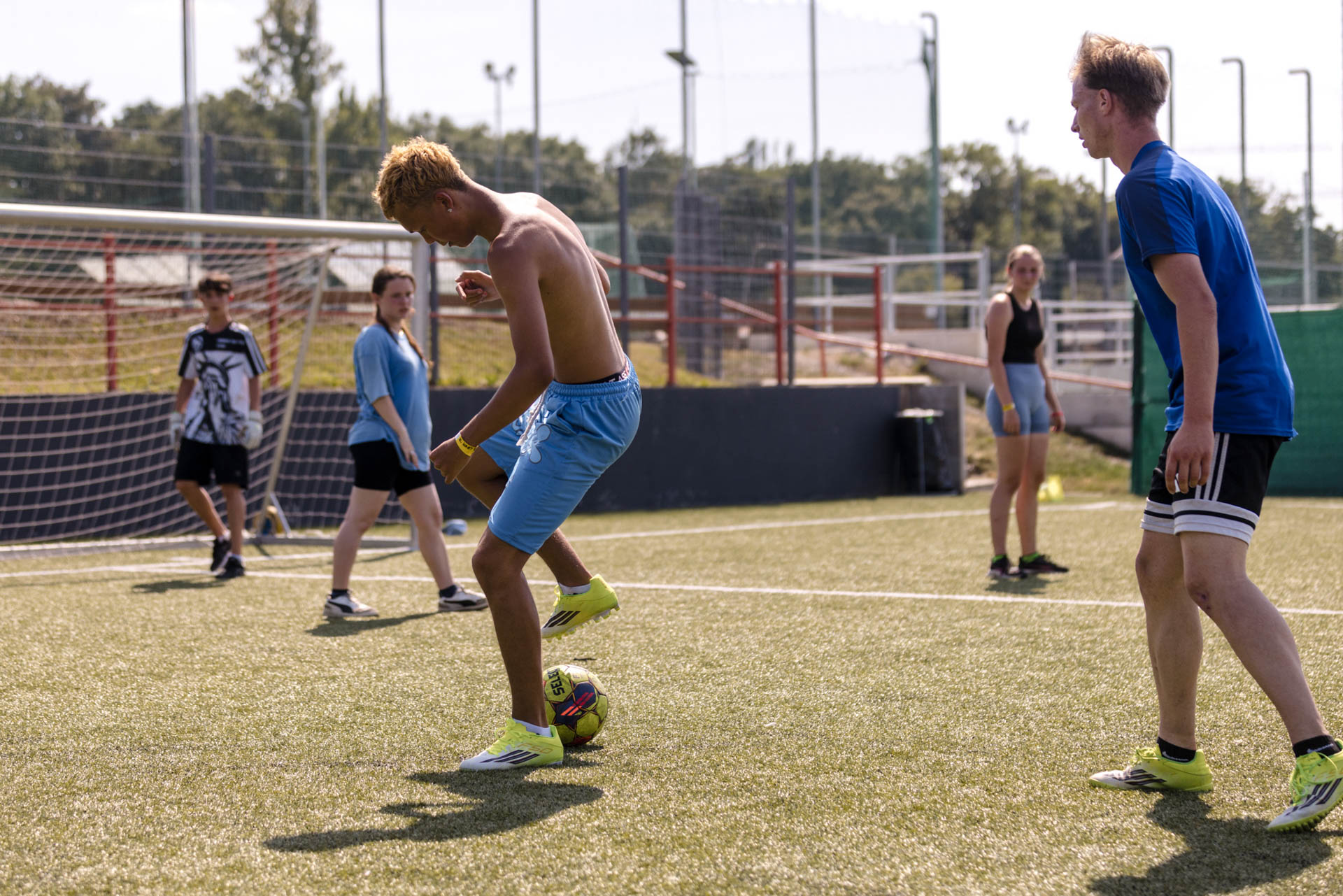
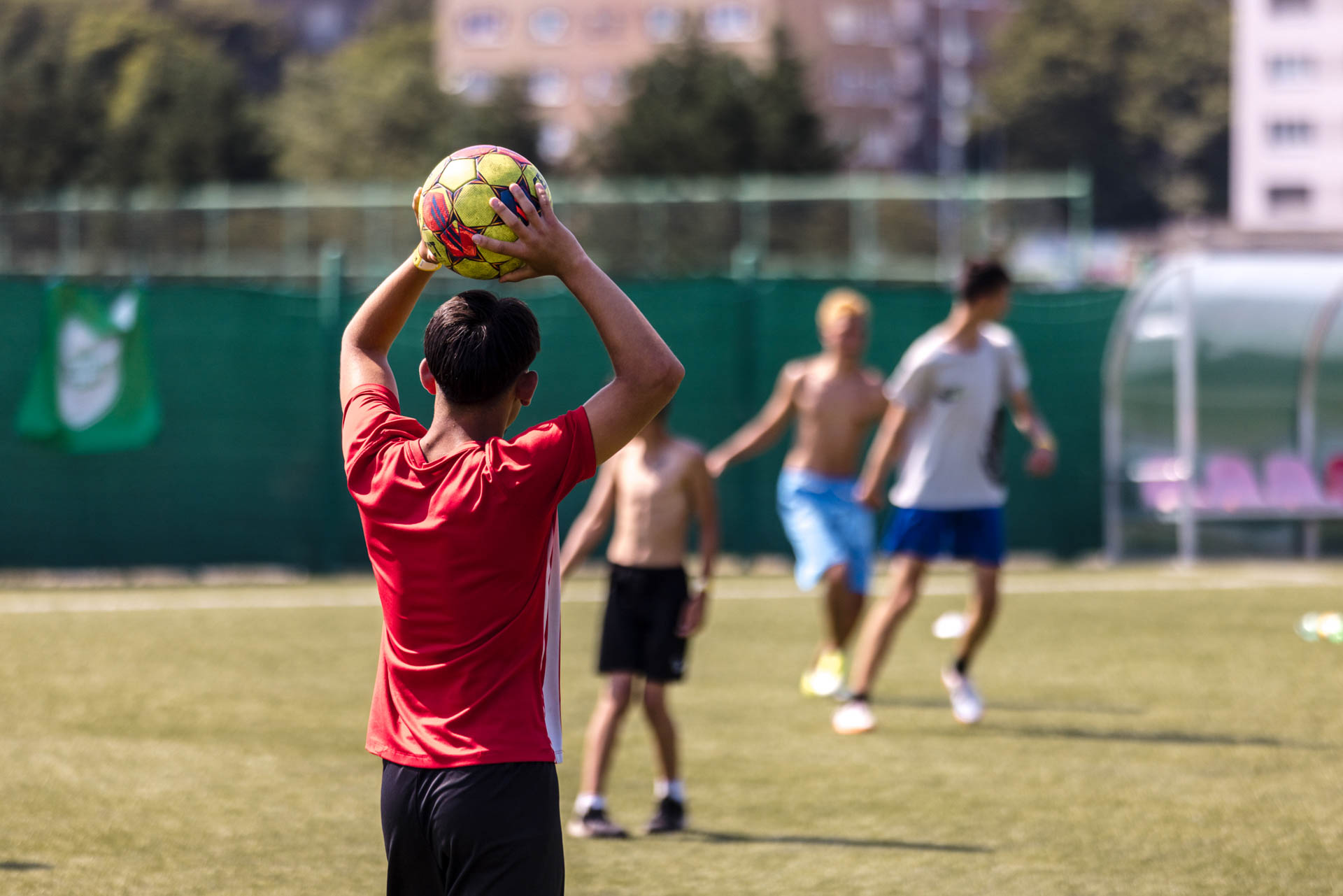
Under normal conditions or rules, the result of the match between Karlovy Vary and Prague 2 would probably be obvious in advance. But with the advantage of one player in the Prague team, it is no longer so clear-cut. Despite the age advantage, Karlovy Vary initially struggled to score a goal. Although they tried to bypass the smaller and younger opponents with passes or solo attempts, the goalkeeper was always ready.
On the stands, several parents cheered for the players. One of them, in a fierce “Run, Peťo, run!” shout, added some vulgar cheers. The coaches immediately reprimanded him with a reminder of one of the basic rules of fair football: “Please, no swearing.” After the first three minutes, the significant advantage of the Prague team proved truly helpful. On about the third attempt, a boy in a Barcelona jersey turned a shot on the goalkeeper into a goal after the Karlovy Vary team forgot about him far behind their defense. The game then gained tension, and Karlovy Vary intensified their pressure even more. They trailed by goals until the last minute, but eventually managed to break through the goalkeeper three times in a row after a long siege. After the final whistle, both teams moved from the field to the shade of a tree for post-match reflection.
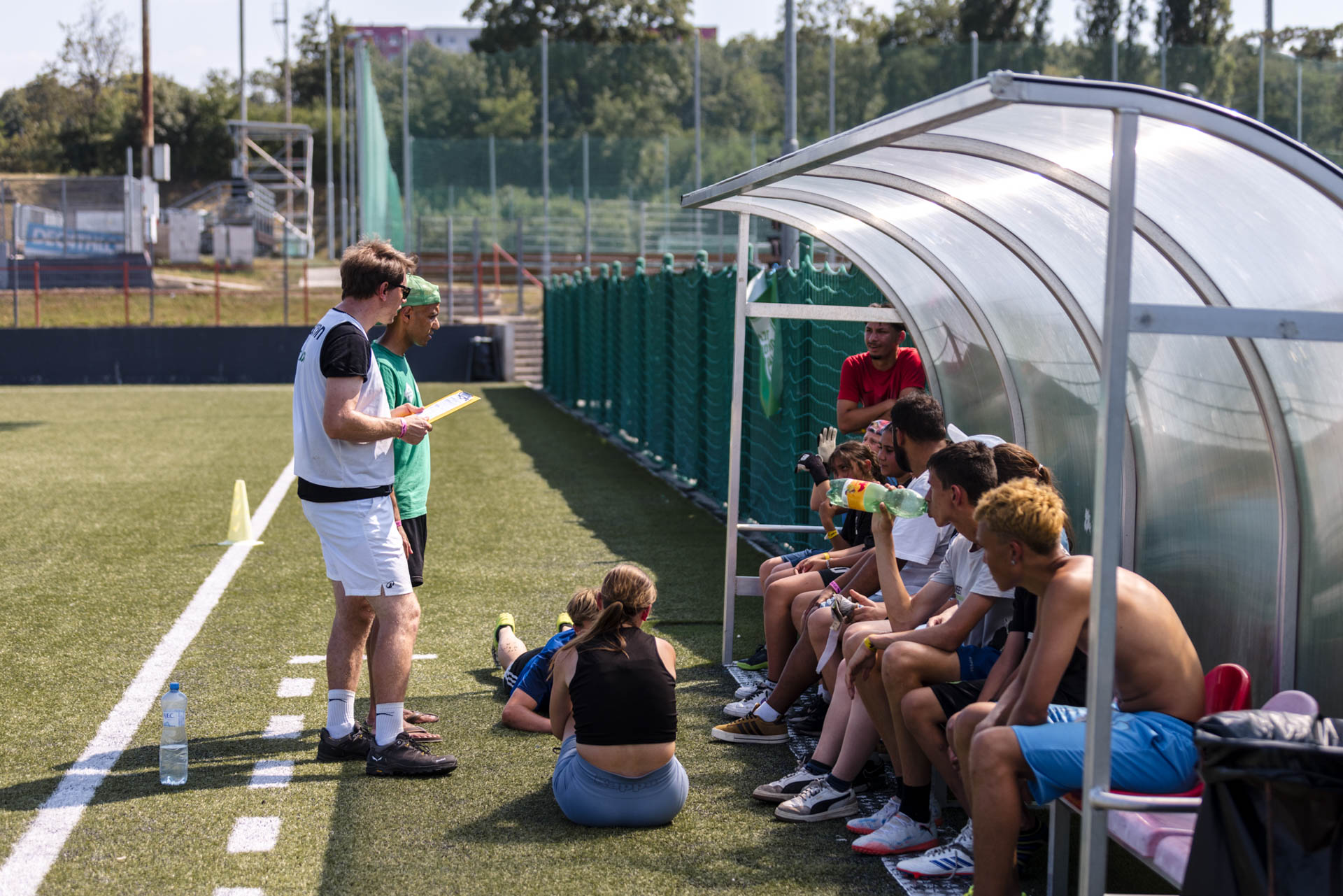
The mediators opened the discussion with questions about how the players evaluate the agreed rules. How did they feel about playing under them? Did they follow them? Did they make sense? Would they change anything for the next match? Some children immediately responded, reflecting positively on the rules, while others said nothing during the entire discussion. The mediators tried to work with this. Teams also earn points for active participation in the post-match reflection – to get a full score, everyone must participate. After another match of Karlovy Vary, a debate broke out in the team, during which two girls shared their frustration that boys from their team refused to switch during the game. Their team lost points, and the boys promised to switch in the next match.
Monitoring and motivating teams to work on similar conflicts is mainly in the hands of coaches and trainers, besides the players themselves. Instead of performance pressure, they aim to encourage youth to fair play, reminding them of its principles (substitutions, no swearing, etc.). Their role also includes leading and preparing training sessions. A pair of coaches from Plzeň, from the social activation service Tady a Teď, arrived at the tournament with one of the youngest teams. Both coaches are named Dávid. During the matches, it was a joy to watch not only their protégés but also how much they enjoyed the game themselves, sometimes experiencing it more intensely than the players. Even after conceding a goal, the children kept encouraging and motivating each other to continue playing.
Dávid came to Fair Play Point during university. He liked the concept so much that when he started working at Tady a Teď, he helped integrate fair football into their services. They train once every two weeks and meet with other teams in the regional fair league once a month. The age range of their protégés is from 7 to 17 years. Some older ones help prepare and run the training sessions. Dávid sees the benefit of fair football in social work mainly in activating children who were previously mostly passive and did not participate in any clubs or leisure activities. Over three years, during which Tady a Teď has been part of Fair Play Point, he has observed improvements not only in football skills but also in reflection abilities and in the courage to participate in group discussions with strangers.
Even that girl plays better than you
During the day, I had the opportunity to talk also with Terka, one of the young leaders. They can participate in training preparation and collaborate during training sessions. At events, they serve as mediators and help in other ways to run the entire tournament. They know almost everyone involved, creating a friendly, sometimes even family-like atmosphere. During our conversation, Terka was hugged several times by friends saying goodbye or by a few friends with whom she exchanged verbal provocations. Terka got involved with Fair Play Point at the age of eight. It was at a time when she started attending a low-threshold club in her hometown. There, she began playing fair football and participating in matches with other low-threshold clubs. When she started playing football, far fewer girls were involved in the Fair Play Point initiative in the Czech Republic than today. Fortunately, the team she played for was quite gender-balanced. However, at matches and tournaments, she repeatedly encountered opinions that girls shouldn’t play football or that they are worse at it than boys. In this context, a phrase she once heard from an opponent is significant. It was directed at her own team: “Look, even that girl plays better than you.” Although Terka could have taken this comment as a compliment, she recalls feeling very mixed. Mainly, she found it unfair to compare her to a player with almost no experience in the league. Moreover, she objects to gender-based comparisons. Even if she wanted to be pleased by an indirect compliment, the phrase for her mainly embodies a stereotype she still often struggles against today.
Today, she has the opportunity to stand against this stereotype as a mediator. As she told me, even at today’s tournament, she had to deal with several situations where boys denied girls time on the field, with the ball, or accused them of losing the match. She gained experience in this topic also during foreign trips, for example at a youth leadership workshop in Montenegro, at a tournament in Austria, or recently in Barcelona at an event focused on “women’s leadership.” She shared her experiences with footballers from Denmark, the Netherlands, and Spain.
At the beginning of July, during the FIFA World Cup, she traveled to a fair tournament in Boston, USA. Thanks to playing in mixed teams, she had the chance to play with various nationalities: “Boston was a great space for conversations on many topics. It was interesting to hear how things work differently in different countries. I met many amazing people, experienced something completely different, and also learned new things about different cultures.” The Fair Play Point initiative represented Europe at the tournament as one of seven organizations.
International scope is a key aspect of the initiative. Under the umbrella of Common-Goal, a total of 201 organizations are connected across 117 countries worldwide. Together, they create opportunities (not only) for youth to play fair football beyond their home or otherwise affiliated countries. For boys and girls attending low-threshold clubs, these trips are a unique chance to experience the world and other cultures beyond their borders. Each country’s organizations or initiatives operate somewhat differently. Hofmann described these differences using their closest partners from Hungary, Poland, and Austria as examples. In Hungary, the target group is very similar to that in the Czech Republic, but the organization and programs operate only in one city. In Poland, the organization is linked to the education system, and Football 3 is implemented within schools. In Austria, football is mainly used for integration and cultural rapprochement of youth with migration experience.
This year, Fair Play Point will also travel to Belgium, where a week-long (not only) football program for youth focused on the theme of peace will take place. It pays homage to the football matches of soldiers during World War I, when they laid down their arms at Christmas to play friendly matches.
Despite the dominant and deafening coverage of the World Cup, led by performative displays of power by Trump or Infantino’s flattery, football can also tell very different stories. It doesn’t have to be just a platform for billionaires to sportwash or promote themselves. It can also be a space for our dreams of a more inclusive and equal future. And as the Fair Play Point organization shows, football can be a game that teaches us how to make those dreams come true.

The text is part of the PERSPECTIVES project – a new brand for independent, constructive, and multiperspective journalism. The project is funded by the European Union. The expressed opinions and positions are those of the author(s) and do not necessarily reflect the views of the European Union or the European Education and Culture Executive Agency (EACEA). The European Union or EACEA do not accept any responsibility for them.