Another win for the far right in Germany
Voxeurop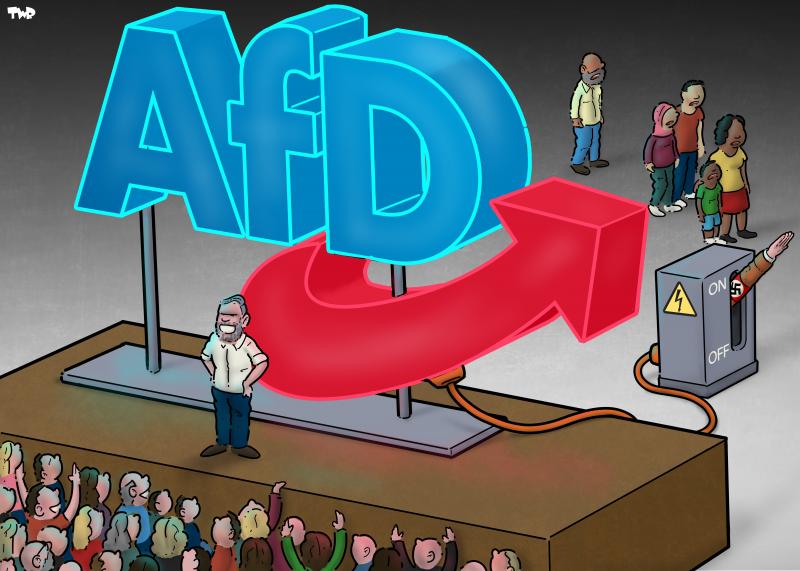
In Germany’s regional election, the far right achieved its strongest result since WWII, raising questions about its influence on national politics and the potential impact of coalition-building amid promises of drastic policy changes. How will this shift shape Germany’s future?
It’s the best election result for the German far right since the Second World War. On 6 September, Alternative für Deutschland (AfD) won a landslide victory in the regional election in Saxony-Anhalt, eastern Germany. With 48.4% of the vote, the party finished far ahead of the Christian Democratic Union (CDU, 17.3%, down 20.4 percentage points compared to 2021), the Social Democratic Party (SPD, centre-left, 7.5%) and Die Linke (left, 7.4%).
Despite doubling its share of the vote since the last election, the local AfD branch led by Ulrich Siegmund – dubbed “Germany’s most dangerous man” by the German weekly Der Spiegel – fell just short of securing an absolute majority. The AfD will therefore have to form a coalition to be able to govern. However, this hardly mitigates the inexorable rise of the far right in Germany, nor its consequences.
More :Cas Mudde: ‘Until the mainstream inspires, far right’s defeats are just temporary interruptions’
Germany’s federal system grants its Länder (or states) a high degree of autonomy, and it is for precisely this reason that the far right’s victory in Saxony-Anhalt is significant: the AfD has promised drastic measures regarding migration, education, security and media funding if they manage to gain power. At the national level, the AfD’s success puts further pressure on the ruling coalition led by Chancellor Friedrich Merz (CDU), particularly in the run-up to the federal elections in 2029.