Whose forest, whose future?
Kapitál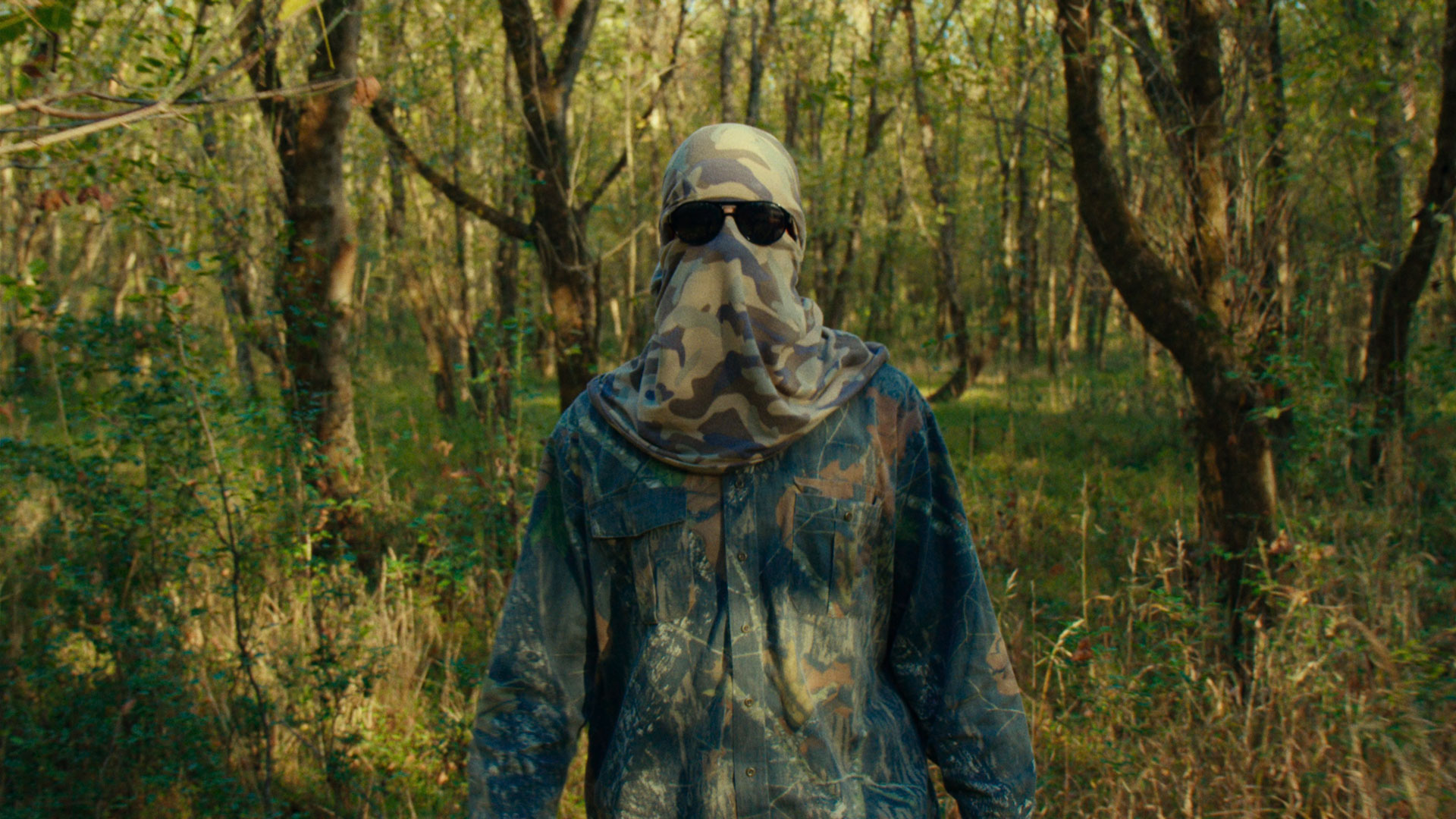
A documentary film reveals the fight for the Weelaunee forest in Atlanta, which connects environmental, racial, and indigenous rights. How have protests become part of the international resistance against domination, and what are the consequences of state repression?
Could you briefly tell us about the Stop Cop City movement and what led you to document its development?
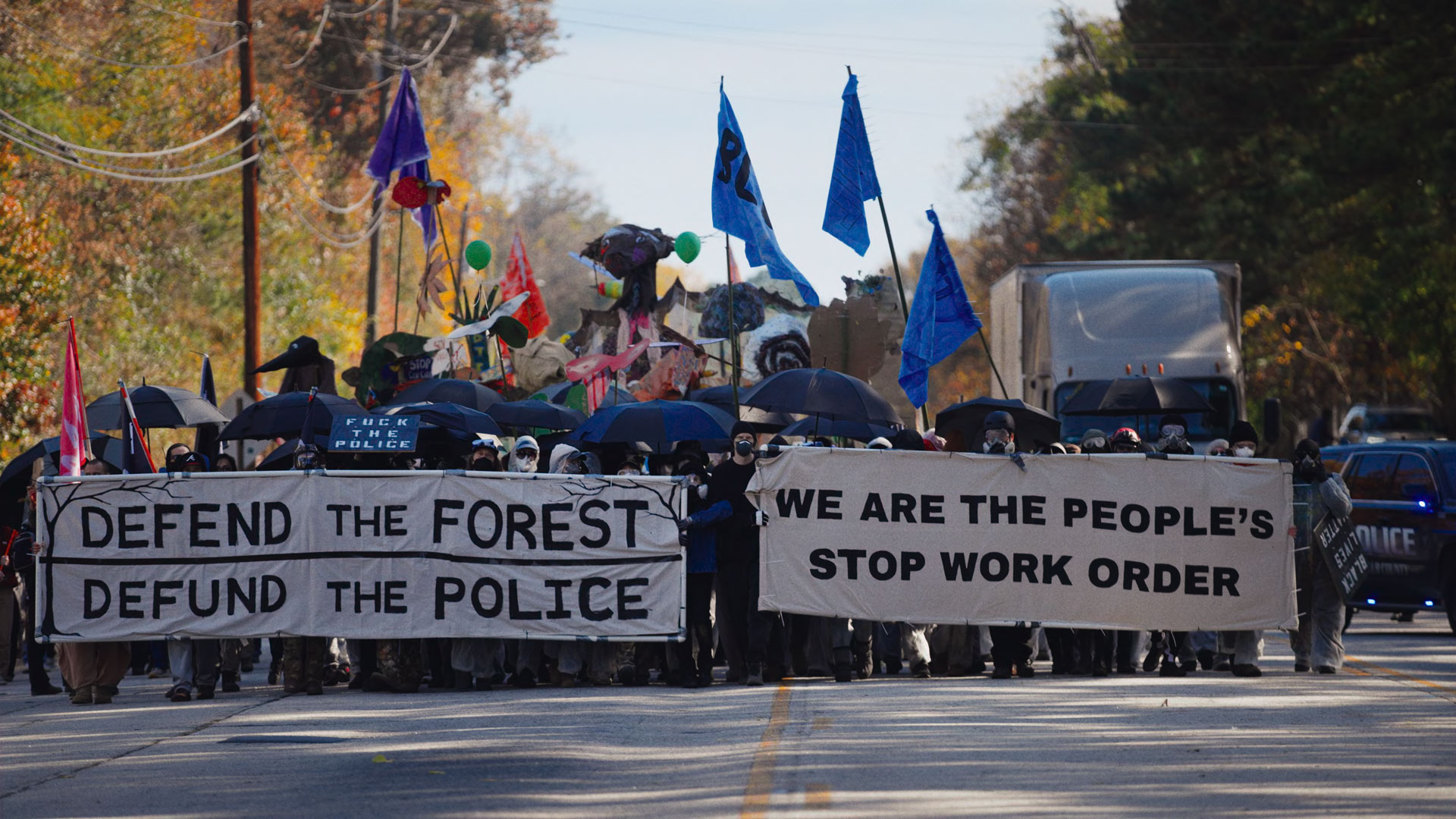
The movement emerged in response to protests in 2020, which were probably one of the largest mass movements against the police in the United States and perhaps in the world, focused on demands to reduce funding and abolish the police. This movement was a reaction to the murder of George Floyd, but specifically in Atlanta also to the killing of Rayshard Brooks. However, the authorities did not fulfill these demands. After Biden's election, there was a certain return to normalcy, without addressing any of the key issues people protested against. Most police agencies received increased funding, and their militarization was further reinforced. The Stop Cop City movement was created precisely because Atlanta became a city where local politicians, in collaboration with corporate lobbyists and the Atlanta Police Foundation (the largest police foundation in the United States – a "non-profit organization" that allocates private funds to police activities), announced that they would build the largest police training center in the country. They try to present it as a place for training in social justice and police reform, but from the first information people managed to obtain, it was clear they wanted to build a city model used for urban combat training. I think people saw it as a way to ensure that the uprisings of 2020 would never happen again.
This fight was also intensified by the fact that the site chosen for the training center was not some abandoned parking lot or old warehouse; it was supposed to be located on four or five hundred acres of forest, which once belonged to the Muscogee tribe before they were ethnically cleansed. The area was used in the 18th and 19th centuries as a slave plantation and then throughout the 20th century as a prison farm, where mostly Black men worked in the fields to produce food for the prison system in Georgia. It is a territory with a very dark and brutal history, where trees that are three hundred and even thirty years old grow, having sprouted during periods when it was abandoned.
The combination of defending the territory, rooted in environmental and Indigenous struggles, along with the urban anti-police fight that emerged in 2020, attracted me. It created a really interesting connection of different political directions and ideologies, as well as tactics on how such a fight could be conducted in an urban environment. I felt that while the rest of the country might be "returning to normal" under the new Democratic government, Atlanta had become a center of resistance, carrying the torch from 2020 forward. During the climate crisis, it was a combination of environmental violence and extreme police militarization, especially in the Black neighborhood. Since attempts to persuade city council members to abandon this project were met with no response, people decided to defend this land directly.
I was only fifteen minutes by car from this forest. Its construction would have affected my home, my community. I was inspired when I saw how people united and how much solidarity there was with those willing to use more radical tactics. They did not divide or point fingers at each other. There was a real sense that this was a collective fight – as long as we committed to principles of anti-colonialism, anti-imperialism, and anti-capitalism, and supported, protected, and helped each other for as long as possible.
Could you tell me more about your position during filming, which you have already outlined, and how you built trust within the community?
At that time, I had been living in Atlanta for about five or six years and was helping run a DIY art center called Bakery Atlanta. I was involved in organizing and coordinating, very active, so when the Stop Cop City movement emerged, I felt these were people I knew. Initially, I didn't plan to necessarily make a film, I was just curious about what was happening. I always carry a camera with me; I enjoy documenting things I find valuable or important from time to time. So, when in September 2021 they first voted on approving Cop City, I came to a protest and decided to film it. It was a small protest of ten people in front of a city council member’s house, organized during COVID when people couldn’t gather at the city hall.
The day I started filming this film, I was arrested along with everyone else there. That somehow motivated me to continue because it was clear from the start that there was a large-scale repression happening. I kept documenting, and as the fight intensified, I began building a team around the project, including my co-director Nolan Huber, Ike Roof, Annie Woods, and Jamie Chu, who are part of the production team. The protests outside city council members’ homes evolved into a full occupation, which was a truly tumultuous experience. Essentially, within Atlanta’s city limits, we lived in the forest – dozens of people organized parties, cooked, held events, shared skills, gave lectures on the history of this country… I felt like I had entered an alternative reality. But of course, it wasn’t. It was rooted in the reality of those who deeply care about the planet, each other, and their neighbors.
Gradually, I started filming more and more. People trusted me with the camera because they knew me; I was with them when I was arrested, I spent time with them even without the camera. Initially, there was some pressure, especially in places like the forest, where cameras are generally unwelcome. But the more I stayed there, the more I could film, and eventually, as repression increased and raids became more frequent, people actually wanted the camera. They saw it as a form of safety in the presence of an impartial journalist or documentarian. I didn’t want to be labeled as an “activist journalist,” which is a term the city of Atlanta started using, and which questions my ability to work with sources. But I wanted to ensure my loved ones and sources were safe, so it was in my interest not to get arrested on the ground. Maintaining a certain level of impartiality allowed the police to see me as someone documenting events for news.
Over time, the camera gave me a certain sense of security, but I didn’t want to tell a story that truth is somewhere in the middle – between the movement and the police. I don’t think it’s necessary for someone to understand what’s happening in depth, and so I mostly filmed different factions within the movement, which, although interconnected, may not have communicated perfectly with each other. Nolan and I had an interesting insight into its different parts, which I believe many others did not have.
How does your film connect the fight over this forest with the history of racially motivated police violence in Georgia?
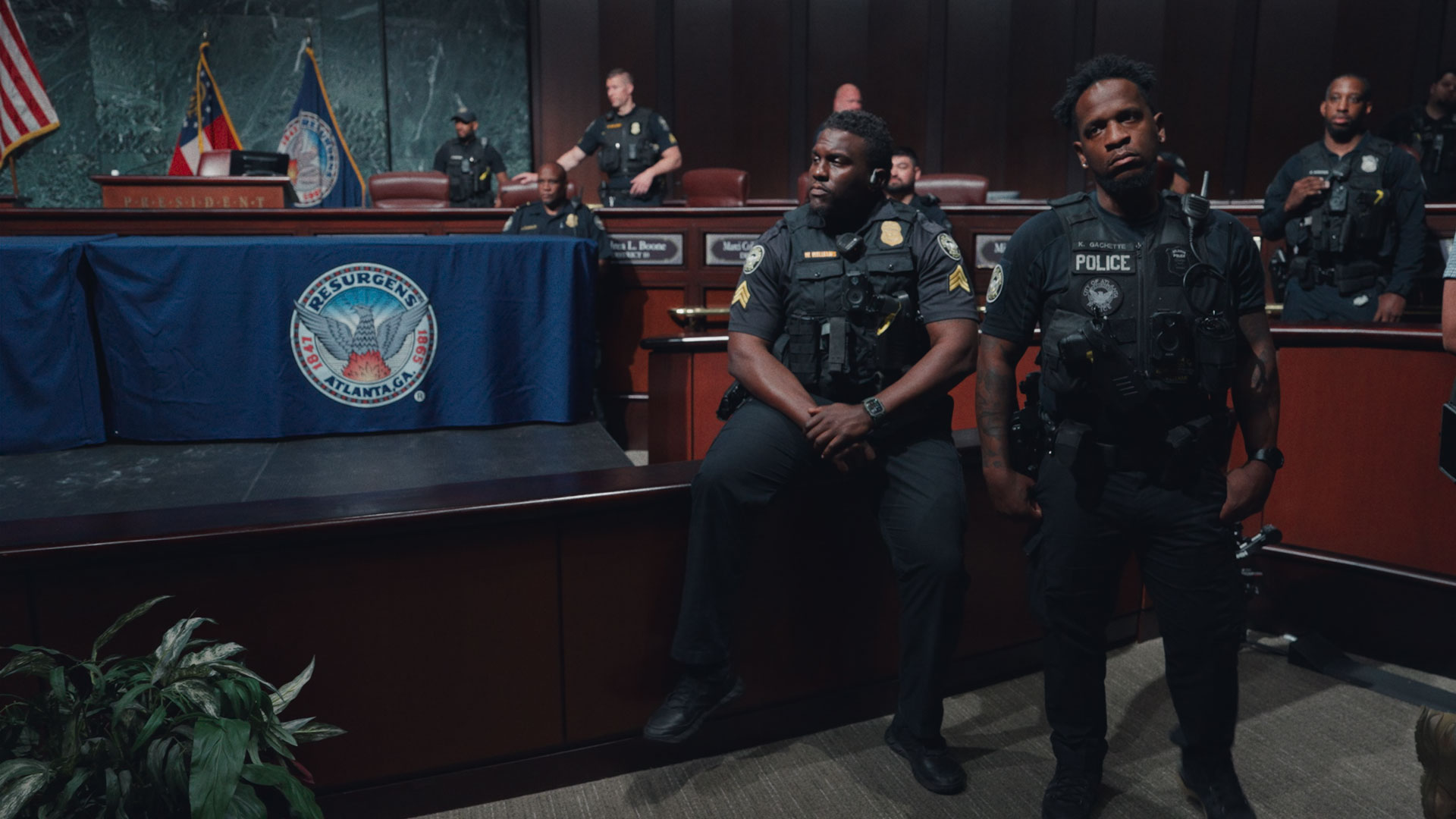
I think through this film, you will understand that Atlanta is a complex city. It’s a city with fifty years of Black mayors; our police force has many Black officers. Many people told me that what surprises them most is how many Black people hold positions of power in Atlanta and how, despite that, the city remains undemocratic and how violent its police actions are. One argument the Atlanta mayor used against the movement was labeling people as external agitators, a tactic known from the 1960s used by white supremacists against Martin Luther King Jr. and his movement... And although we have a Black ruling class, it still uses language and tools of white supremacists to protect the capitalist class in Atlanta. This is well expressed by one of the activists in the film, a Black man who says to a Black police officer: “All of you, Black cops, who bear all this criticism about the police training center, are protecting white money. You know it, Hill, just as I do.” Atlanta is in a complicated situation, as it is, in a sense, the capital of the South, and most of the wealth in this city is in the hands of white families. Ninety-six percent of people born in poverty in Atlanta remain in poverty. If you visit any prison in this state, sixty percent of the incarcerated are Black. It’s a city under incredible police oversight. Although our film doesn’t list these statistics or try to be overly didactic about the city’s entire history, I think it’s perceptible through the complexity of who holds power, who can use violence against whom, and how people in the movement analyze and criticize what’s happening around them.
Do you feel that your film serves as a cultural counter-narrative, and if so, how?
Do people outside Atlanta know about Cop City? If you are involved in engaged underground environmental and anti-police circles, you’ve probably heard of it, though not necessarily, especially in Europe. If you are involved in mainstream circles, it’s likely you’ve never heard of it. Although, you know, Tortuguita was a person who was murdered (Manuel Paez Téran (they/them) was an activist against Cop City and their shooting during a police intervention was covered in the media and eventually led to protests in Atlanta and elsewhere, ed. note). One reason why this story wasn’t widely discussed is that the largest newspaper in Atlanta, AJC (Atlanta Journal-Constitution), is owned by one of the wealthiest families in the US. This family donated ten million dollars for the construction of Cop City. The narrative shaped by the mainstream media was either openly propagandistic against the movement or simply didn’t know how to approach it.
The result is that Cop City was ultimately built – albeit on a smaller scale and with a significantly exceeded budget, but they managed to build it despite everything. So Mayor Dickens and the governor can craft narratives around the history of protests because they achieved their goal – they built Cop City. Without our film, there was a real risk that this history would remain unknown and no one would address it. And that’s very dangerous because the fight against Cop City and the state repression of the movement are closely linked to what we are witnessing now in connection with Trump, ICE, and the repression of the movement to stop the data centers’ construction. We can trace how we got to where we are now through the story of the Stop Cop City movement.
Would you tell me more about how you gained access to police camera footage featured in the film and how you obtained permission to use it?
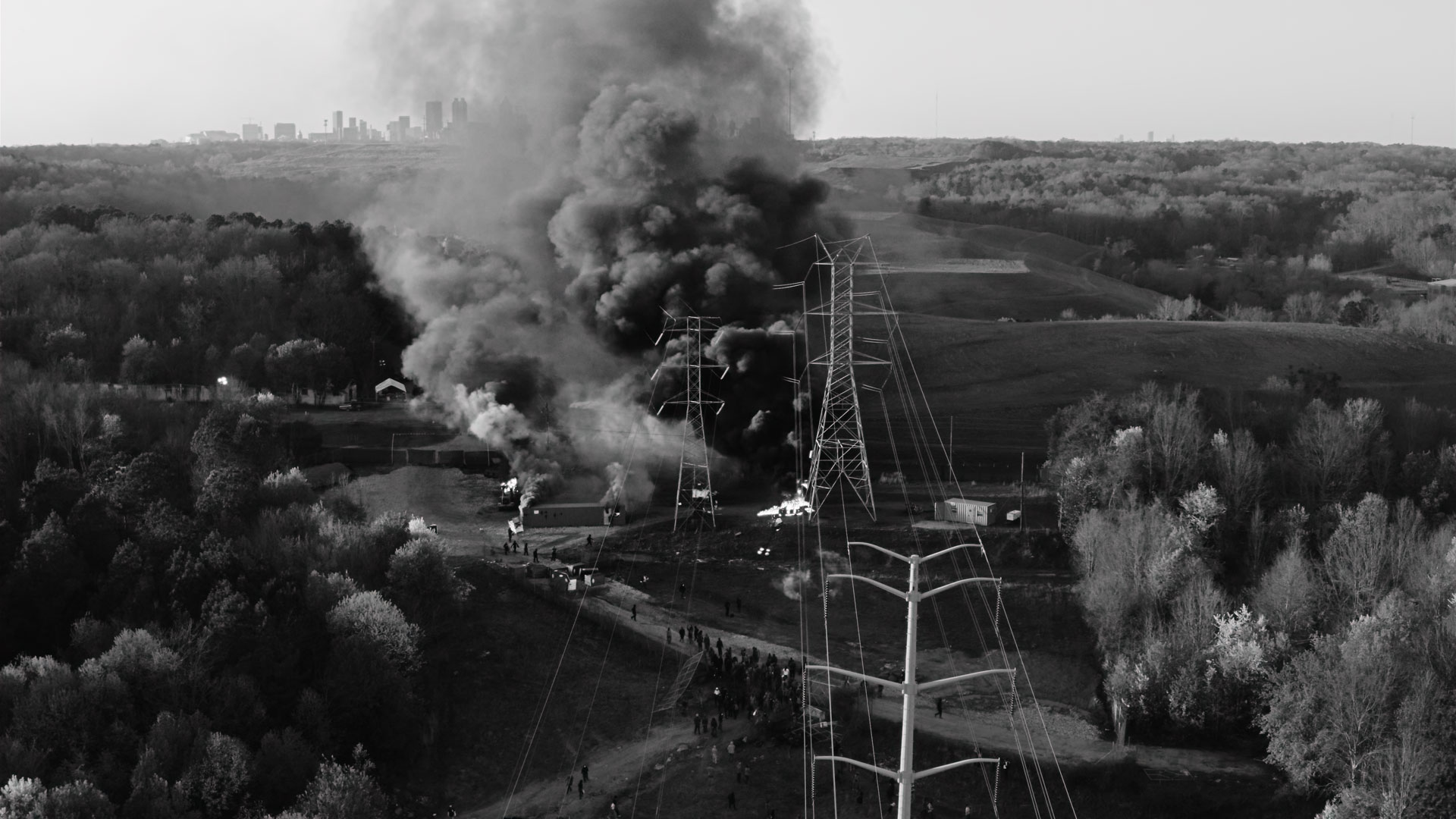
All the footage from cameras that we used and that came from the police were those they published themselves. Theoretically, you can request access to public records and try to obtain footage from body cameras and similar sources. We tried to do that, but it was a complicated and costly process. They told us many things couldn’t be released because a court process was ongoing, so we mainly relied on what they had already published. Why did they do that, when it casts them in such a bad light? I don’t have a clear answer. I feel they released those videos as a tool of their own propaganda. They thought they could prove that Tortuguita had a weapon and that you could hear gunfire, or to show all those people gathering at the construction site and portray them as terrorists and hordes of zombies. They used these videos to create their own narrative in the media, and we, in turn, used them to build a counter-narrative.
The Trump administration officially labeled Antifa as a “domestic terrorist organization” and also uses counter-terrorism initiatives to prosecute protesters against Cop City. How does this federal intervention change environmental protection and civil rights protest rules?
The official use of the word “terrorism” in the US Congress has its roots in the designation of material support to Palestine as terrorism in 1969. During the War on Terror, it eventually expanded across the Middle East. And, of course, the language we use to demonize “the others” on the “front lines of America’s fight” also comes home, because it’s a very useful tool. If you can label someone as a domestic terrorist or a terrorist in general, you can deny them many rights, and at the same time, instill fear in those who might associate with them. Accusations of domestic terrorism in Atlanta threatened prison sentences of five to thirty-five years. Charges under the RICO law (Racketeer Influenced and Corrupt Organizations Act), used in the 1990s in New York to dismantle the mafia, have been applied against people in the Stop Cop City movement to argue that they are not individual activists but part of an organized criminal conspiracy. The expansion of these legal tools, which we saw in connection with the Stop Cop City movement, is now used by Donald Trump and the far right to persecute a much broader target group, including people from Prairieland, organizers in Texas, or protesters against ICE in Minnesota. They are “a threat to our national security,” and therefore, we must go after them, again, not as individuals but as organized “terrorist cells.” They use tactics previously employed against people in Vietnam and in the Middle East. I see many similarities between these events: first fighting against insurgents in Vietnam, then against “insurgents” in the US, such as the Black Power movement or Black Panthers.
What is the current situation of the sixty-one activists from the movement, who face charges under RICO and domestic terrorism?
The judge has currently dismissed the RICO charge because he found that the Georgia attorney general did not follow proper procedures during prosecution. The state is, of course, trying to appeal this decision, so the lives of these sixty-one people remain uncertain. They are waiting to see whether they will have to defend themselves against these charges in court or not. Although none have been convicted, many have had their travel options restricted, lost jobs, faced housing difficulties, and been expelled from university. When someone is accused of something like RICO or terrorism, it doesn’t necessarily mean they believe they will win, but the very accusation changes the lives of the accused and their ability to survive. It also drains the movement’s resources because people need millions of dollars to get the accused out of jail and help them through this difficult period.
I must say that no one from the Stop Cop City movement ultimately turned informant or became a state witness. One of its strengths is that it created a culture where people knew that the collective would take care of everyone and that no one would be thrown under the bus. There is a collective effort to keep people safe and prevent them from ending up in prison. Of the sixty-one, forty-two or forty-three face specific charges of domestic terrorism; some of these charges were dropped, others not. But again, these charges were filed in 2023, and we are now in 2026, so they have been living under the threat for three years, with the possibility of long prison sentences. This has a serious impact on their mental and physical health.
The movement emphasizes that the forest is Muscogee territory and uses the original name Weelaunee. What is the significance of Indigenous perspectives for your film and for the movement itself?
Solidarity with the Muscogee people was an integral part of the movement. It was not accidental or easy. The Muscogee people were ethnically displaced from Georgia during President Andrew Jackson’s term through the Trail of Tears. While in other parts of the country, especially in the West and Northwest of the Pacific, Indigenous peoples still live either in reservations or in areas connected to their ancestral lands, on the East Coast it is different. The Muscogee, who once inhabited Georgia, now live in Oklahoma, quite far from Atlanta. Mike Shabban, the chief of the Muscogee tribe, who also appears in our film, talks about how members of the movement approached him and invited the Muscogee tribe to protests. When, at the end of November 2021, they decided to march – about 100 of them – to Atlanta during the occupation to defend the land, it was almost like a blessing. It showed the connection between different struggles the movement was involved in and collaborated with. The movement demanded not only the cancellation of Cop City but also that the land be returned to its original custodians, the Muscogee people, which would transform our relationship to this space. Our relationship to water, trees, and air is fundamentally different from what the American capitalist and imperialist project seeks to impose on this land. The involvement and support of the Muscogee people was very important.
In November, they performed the Sun Dance, which is a sacred act for their people and must not be filmed. But we have footage of it; people trusted me and agreed that I would be the only person to document it. They felt it was an important event. Within the movement, certain knowledge and wisdom of the Muscogee tribe were truly significant. Tortuguita took their name from an Indigenous leader from Miami who fought against the colonial state. After Tortuguita was murdered, many people in the forest strongly felt that a small turtle was killed on Turtle Island – the name for North America used by many Indigenous nations, including Muscogee – and the turtle is a sacred animal for them. So, there was a certain level of cosmic harmony and synchronicity in the whole situation. The Muscogee continued to come to Atlanta, perform dances, and hold other ceremonies. Mikos Shabban continued to show solidarity with protesters, especially children in Atlanta, and gave a speech at City Hall supporting the movement. Stop Cop City drew much of its knowledge and tactics from Indigenous resistance across the US, such as the protests against the oil pipeline at Standing Rock.
Does your film depict a very unified front, with only minor hints of internal disagreements? Was the movement truly cohesive, or were there splits beyond what is shown?
Our film did not focus on detailed exploration of all minor tensions and disagreements, mainly because if they had been more prominent, we would have included them. What was truly interesting and inspiring was seeing how the movement managed – sometimes through conversations, sometimes through arguments – to overcome internal disagreements and maintain a united stance. We saw this as very important and worth documenting because the prevailing narrative is that the left cannot be united, that its supporters are constantly fighting among themselves and incapable of organizing any unified resistance. Our film shows that this is not true, that we are actually capable of unity.
One moment in the film usually elicits quite a lot of applause or cheers: when a journalist at a press conference asks whether the movement condemns arson and destruction of construction equipment, and Mary Hooks, a highly respected organizer who does not wear masks or anything similar, responds: “Hell no.” I think it was really important to include this moment because it was another attempt by the city and the media to create divisions within the movement. These questions were not just out of curiosity; the media and the state constantly tried to generate tension. However, the movement was disciplined enough to avoid these traps and publicly reaffirm internal solidarity whenever possible. We wanted people to see that because this kind of unity within the left sometimes seems unattainable.
Does one person in the film point to a natural symbiosis between guerrilla movements and forested areas? Do you see similar connections in other guerrilla movements elsewhere?
I believe that Stop Cop City was in many ways a guerrilla movement. The people involved drew a lot of inspiration from other land defense struggles, such as Standing Rock, but also from Chiapas, the Zapatista movement, the Rojava struggle... Many saw themselves as part of the land defenders tradition – people willing to use asymmetrical tactics because state power is so enormous that you have to strike when they are weakest. In this sense, the movement took a lot from these struggles but was also solidaristically connected to them. I am very glad that those involved in other fights will see this film and realize that what’s happening is also happening in the United States. Stop Cop City is not just an American fight; it’s part of an international struggle against the forces of domination and violence that have existed for thousands of years.
Are you in contact with Tortuguita’s family, who are involved in a legal case against the police, and how are they coping with their death after more than three years?
I can mainly speak about Tortuguita’s mother, Belis, because she played a very important role in the film. I don’t have much insight into the rest of the family. She was at our premiere in England at Sheffield DocFest. I asked her how she felt about it and what it was like for her to see Tortuguita, her Manuel. It was important for her to see how her child was part of this struggle’s history. When we received the award in Sheffield, we invited her on stage for a discussion with the audience, where she said very beautiful things. In September, she will speak at a socialist conference in Chicago; she feels the need to be present in such spaces and events.
Currently, she is building a health center in Panama in honor of Tortuguita, and this project, like our film, is one way she can keep her child’s legacy alive. She has often said that anyone who sees themselves as a protector of the land or forests can consider her their mother. It’s truly beautiful that she takes on this role and wants to be that person for others. It’s a way she copes with the tragedy. Regarding the legal process, unfortunately, the judge dismissed the lawsuit against the police. The family could appeal the ruling, but they decided not to, mainly because we are in the South, and with the South, there’s always the same problem – if you appeal, you might end up before an even more conservative court. So they chose not to pursue further legal action and instead focus on honoring Tortuguita. And that is also at the heart of our film.


The text was created with the support of the Rosa Luxemburg Foundation, with a representation in the Czech Republic. The publisher is fully responsible for the content; the views expressed in the text do not necessarily reflect the Foundation’s position.