State of the Union: the words Brussels stopped using
Voxeurop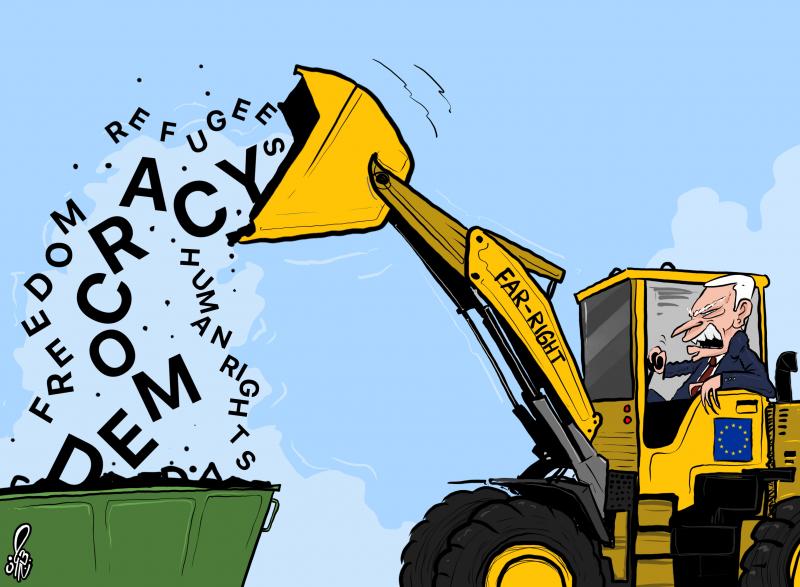
An analysis of eight EU State of the Union speeches finds Urusla von der Leyen's rhetoric on migration, climate and values converging with far-right frames – without adopting far-right words.
In late July, an estimated 72,000 people crossed into the Spanish exclave of Ceuta from Morocco in under 48 hours – the largest such crossing in the territory's history. At least 80 people died, according to Spanish authorities. Italy's Giorgia Meloni imposed checks on travel from Spain, calling the arrivals "uncontrolled immigration" and a threat to national security; France's interior minister ordered extra checks along the French-Spanish border.
On 1 August, 22 EU governments signed a letter accusing Spain's migrant regularisation programme of acting as a "pull factor" for the crossing – a claim an International Rescue Committee fact-check later found unsupported, since the programme's application deadline had passed before the relevant arrivals began. Spain's prime minister, Pedro Sánchez, called the EU response "selfish, polarising and unlawful"; within days, Spain imposed its own retaliatory checks on Italy. On 10 August, Manfred Weber – chairman of the centre-right European People’s Party (EPP) Group, the largest in the European Parliament – published an op-ed demanding the EU build "return hubs" in Africa and give the Commission power to act "without waiting for the slowest member state."
More :Fewer arrivals, less protection: Von der Leyen outlines the EU’s new border emergency
Five weeks later, Ursula von der Leyen stood in Strasbourg with her own answer. Ceuta's border, she said, "is a European border. Because Ceuta is Spain. Ceuta is Europe." She proposed a new emergency framework for border crises, to be triggered only under "a strictly defined set of criteria" and allowing "time-limited and strictly defined flexibility in standard procedures." She promised to strengthen Frontex, the EU border agency, "especially to speed up returns." And she said: "It is we, Europeans, who decide who comes to our Union and under what circumstances. And not the smugglers and the traffickers."
Return hubs, the proposal at the heart of Weber's op-ed, do not appear in her speech. A senior EU official told Osservatorio Balcani e Caucaso Transeuropa (OBCT) beforehand that she would not raise them: hubs are on a separate legislative track, on which Council and Parliament negotiators reached a provisional agreement on 1 June.
The framework itself was expected, wrote Mihai Sebastian Chihaia, policy analyst at the European Policy Centre (EPC), and it arrives when "trust in common solutions is weaker." What its terms mean, he adds, "will determine whether the EU can effectively and responsibly deal with Ceuta-like emergencies."
It was von der Leyen's sixth State of the Union address (SOTEU in Brussels' jargon; none was given in 2024, an election year). We read all six, plus two by her predecessor Jean-Claude Juncker as a baseline, tracking how the vocabulary shifted on migration, climate and values.
Migration: first in German, then in English
The Ceuta line was not new. In 2025, the migration section of von der Leyen's speech was delivered in German – and it contained the same sentence: "we in Europe must be the ones to decide who comes to us and in what circumstances, not the people-smugglers and traffickers". A year later, after Ceuta, it returned in English, almost word for word.
That passage also announced a tripling of EU funding for migration and border management, said Europeans will help people fleeing war but grow frustrated when rules are ignored, and called the Migration Pact "strict, but fair."
The vocabulary moved too. Juncker in 2017 and 2018, and von der Leyen in 2021 and 2023, spoke of "irregular" migration. The word is absent from her 2025 and 2026 speeches. In 2025 she said, in German, that too many people still try to cross borders "illegally"; in 2026 she cited a 55% reduction in "illegal arrivals" over two years and a further 35% drop this year – "real progress" – and spoke of how to "reduce illegal migration." "Illegal migrants," applied to people, appears in none of the eight speeches.
More :‘Climate action is too costly’: how the far right and big business are weaponising social instability to block progress
In their analysis for OBCT within the PULSE network, György Folk and Daniela Ioniță set the claim against International Organisation for Migration (IOM) data: by 15 September, around 59,500 people had reached Europe by sea and more than 2,400 had died or gone missing. "Deterrence and protection are not the same thing," they write. The initiatives meant to offer alternatives – a Mediterranean Youth Skills and Jobs programme, and "gateway offices" for legal migration – came, they note, with no earmarked budget or timeline.
Alberto-Horst Neidhardt, head of the EPC's European Migration and Diversity programme, notes that "Europe's migration debate cannot ignore its labour and demographic needs." Alberto Alemanno, who heads the NGO The Good Lobby, points to another omission: von der Leyen "celebrated [Schengen's] freedoms without mentioning the systematic return of internal border checks," while Austria "now even invokes events in distant Ceuta to prolong its own checks without establishing a convincing connection."
Climate: the label fades, the subject stays
Von der Leyen mentioned the "Green Deal" three times in 2020 and seven times in 2023, when it had a section of its own. She called it "the centrepiece of our economy" and added: "We stay the course." In 2025 it appears once, and this year not at all.
Climate itself has not left the speeches. In 2026 she called climate change and artificial intelligence "the tipping points of our time," described a "summer of truth" – 660,000 hectares burnt, more than 35,000 additional deaths in heatwaves – and said Europe "will stay the course on its climate targets." The vocabulary is different. "Emissions," "net zero" and "climate neutrality" do not appear this year. "Adaptation" does, four times, with a new resilience framework, a heatwave plan and the aim of making Europe "the champion in adaptation technologies – a huge emerging market."
The economic case runs alongside. In 2025 the speech named the Commission's Clean Industrial Deal once and said Europe is "catching up with US venture capital for clean tech – and way ahead of China." This year nuclear stands with renewables as "clean energy" that is "technologically neutral," so long as it brings "independence" and lower prices. The economic agenda, she said, follows "the logic of the Draghi and Letta reports", referring to the recommendations by the former ECB president Mario Draghi on competitiveness and the ones on the single market by Italy's former PM Enrico Letta.
Alemanno finds that the economic passages "too often echoed the lobbying points of industries fighting decline rather than defining which capabilities must remain in Europe, and why." Von der Leyen chastised member states over "gold-plating" (adding requirements to EU rules), he notes, "without properly explaining the practice or how another pact would stop it."
Values: a word that went quiet, then returned
Von der Leyen used "values", in the sense of shared principles, 10 times in 2020, 14 in 2021 and 8 in 2022. In 2023 and again in 2025 it appears once per speech. In 2026 it is back, 10 times.
The early register was civic: a "community of values" in 2020, the "great European values" of Václav Havel in 2021 – though in 2022 she spoke of "a war on our values" and warned that "foreign autocrats are targeting our own countries. Foreign entities are funding institutes that undermine our values."
In 2026 the word sits beside border enforcement. "Respect for our values is non-negotiable," she said, and of Europe's adversaries: "They despise our values." In the Ceuta passage: "we will always comply with our values and fundamental rights. But we will never compromise on protecting our borders."
What doesn’t fit
Not every word moved in the same direction. "Sovereignty" appears most often in Juncker's 2018 speech, which has a section titled "The hour of European sovereignty" and argues for pooling it at EU level. Under von der Leyen it appears at most three times a speech, often as "tech sovereignty."
Alemanno's overall assessment: the speech offered "incremental progress where the moment demands a quantum leap." Europe's problem, he concludes, "has never been a shortage of diagnoses, roadmaps or frameworks. It is the widening gap between the clarity of its diagnoses and its willingness to project the political power needed to act on them."
🤝 This article was produced within the PULSE collaborative network . György Folk from (EUrologus, Hungary) and Daniela Ioniță (Osservatorio Balcani e Caucaso Transeuropa, Italy) contributed to it.
🗣️ Have a question, comment or suggestion? Share it with us through the PULSE reader form – we read and reply to every message. Be part of Europe’s conversation. Your experiences and ideas can inspire the next stories we tell. Join the PULSE readers’ community by filling in this short form.