Is Slovakia still a country of the willing?
Kapitál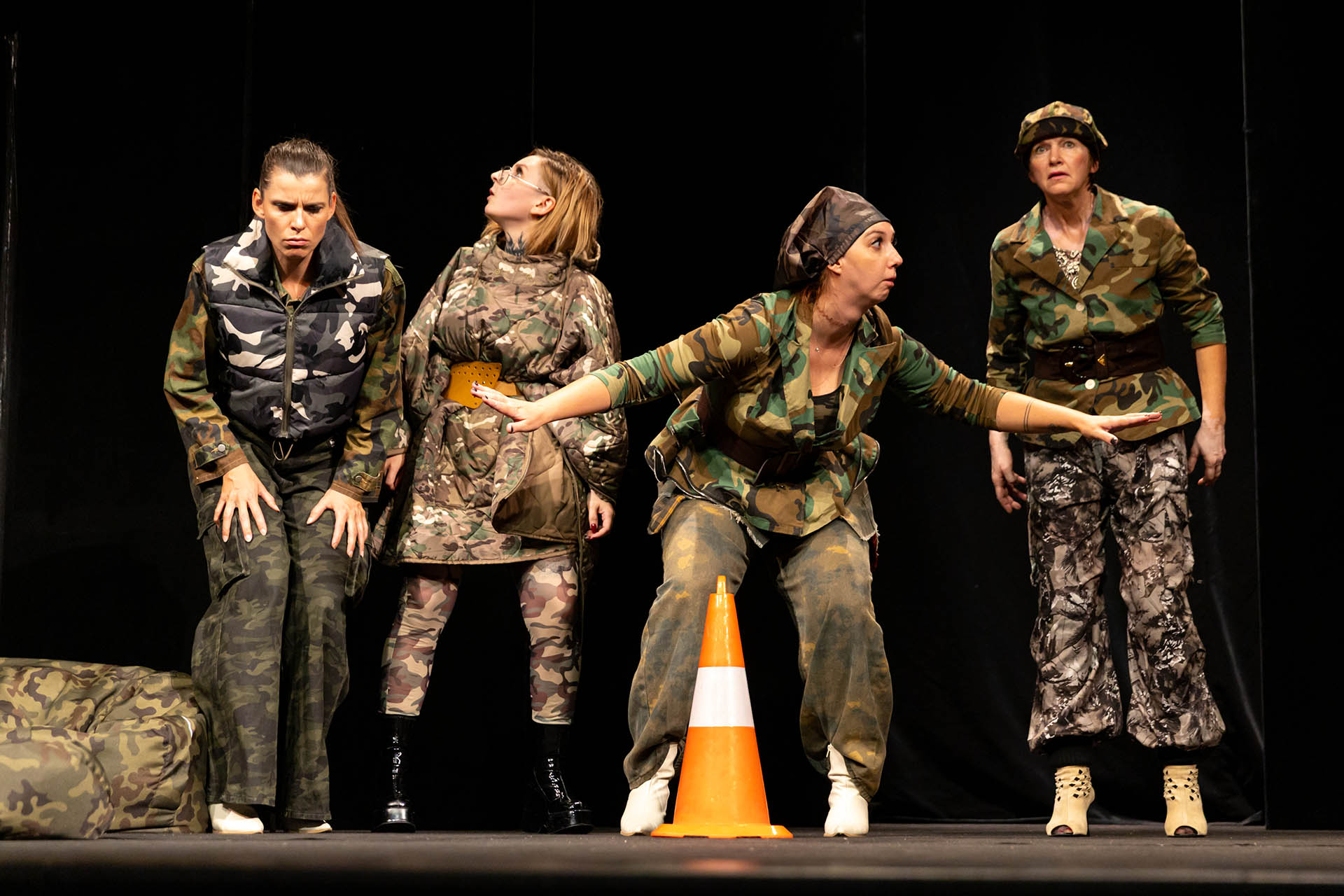
Forty years ago, it was the most popular leisure activity, surpassing even folk ensembles and art clubs in the number of participants. Today, only a handful of seniors, a few fire brigades, dozens of civic associations, and a few passionate teachers at elementary art schools are involved. Slovak amateur theater is considered a global rarity, but its decline is happening before our eyes. Those who still engage in amateur creation face many obstacles – financial, personnel, spatial, and now ideological.
Just forty years ago, it was the most widespread leisure activity, surpassing even folklore ensembles or art clubs in the number of participants. Today, only a handful of seniors, a few fire brigades, dozens of civic associations, and a small number of passionate teachers at elementary art schools dedicate themselves to it. Slovak amateur theatre is among the world’s unique phenomena, but its decline is being observed in real time. Those who still engage in amateur creation face many obstacles – financial, personnel, spatial, and now ideological.
When I talk about amateur theatre with people outside its immediate circle, the same reaction often comes: “Does it still exist?” It does. And it’s not few. It’s just becoming increasingly difficult to see exactly where it is. Amateurism is a niche and nerdy activity of the last Mohicans. Moreover, we cannot precisely say how many groups are currently functioning in Slovakia, how many people perform in them, where they meet, how many performances they put on annually, or how many spectators watch them. Statistics simply do not exist. We only know that a neighbor’s son lasted a few months in a drama club until football caught his interest more. We suspect that a grandmother in a nursing home, besides knitting workshops, also rehearses biblical scenes. We guess that some village men enjoyed acting in a Passion play so much that they will stage Statky-zmätky in the summer. Slovak cultural workers in the past knew more about the state of amateur theatre than we do in the digital age.
Counting Them All
When in 1830 Gašpar Fejérpataky-Belopotocký founded the very first theatre performed in Slovak in Liptovský Mikuláš, it was not yet a mass phenomenon. Amateur theatre spread slowly, unevenly, and often under conditions far from today’s understanding of cultural infrastructure. It was performed in schools, inns, hotel courtyards, barns, or empty granaries. After Belopotocký, only “samizdat” plays or student clubs appeared, mainly in inconspicuous corners of the country, often with illegal support from local priests or wealthier patrons. In the “better” case, they performed a one-time allegory for Christmas or Easter, attracting no attention from local authorities; in the “worse,” they had national-educational ambitions, and police reprimanded them after a few seasons. However, amateurs were stubborn and did not stop. Some were enchanted by theatre because they encountered it on their way home from a tavern or church; others saw it as a tool of enlightenment and patriotism.
Between 1830 and 1919, according to theatre scholar Ladislav Čavojský, at least occasional theatre appeared in 220 Slovak towns and villages. In 1830, he recorded three groups; in 1870, sixteen; and by 1910, forty-five. After the founding of Czechoslovakia, the growth accelerated: Čavojský documented 234 amateur theatre groups in 1920.
These numbers were obtained retrospectively by theatre history. Although Hungarian authorities in the 19th and early 20th centuries tried to record every activity of cultural associations and organizations, most Slovak amateur theatres, seen as “counter-state elements,” kept their existence secret. Only after the establishment of Czechoslovakia did someone systematically start counting amateurs and amateur groups. In 1922, the Central Office of Slovak Amateur Theatres (ÚSOD) was established. Its officials Pavol Socháň and V. K. Barvínek were tasked with finding out who actually performed theatre in Slovakia. Since no central database existed, they sat in the building of the Slovak Matica in Martin and went through old issues of Národné noviny one by one. They then classified groups according to whether they belonged to Slovak Matica, Živena, Sokol, Orol, workers’ units, sports clubs, craft or peasant associations, Catholic or Evangelical organizations. ÚSOD was not just a counting body. It united, educated, organized competitions, and helped with props, masks, or decorations. By 1928, it registered about 800 groups; by 1932, 1,100. The total number of people involved in amateur theatre then was around 21,000.
Where Are They Playing Today?
The greatest boom came after World War II. Socialism ideologically dominated amateur theatre, dissolving or transforming many old associations, but also creating infrastructure that enabled its mass spread. Theatre moved into factory clubs, cultural centers, and community houses. This is one of the more unpleasant historical paradoxes of Slovak cultural life. The authoritarian regime also controlled culture and heavily financed it.
Between 1952 and 1968, Slovakia experienced its largest construction of cultural facilities in history. By 1968, 2,537 villages had their own cultural and social spaces. They were five times more than in 1945. Amateur groups grew alongside them. In 1950, there were 1,800 registered groups; in 1956, 2,671; and in 1962, nearly 3,000. The total number of members of amateur theatres was around 45,000 in 1962.
Of course, these figures should be taken with caution. Some groups existed only on paper; others performed sporadically; a single collective could be registered as a fire brigade, a trade union, and a youth organization simultaneously. Cultural workers sometimes exaggerated these numbers or did not fill out the tables at all. Nevertheless, one thing remains clear: every amateur theatre had its “home.” And that home was literally a cultural center.
The latest comprehensive data come from 2003. At that time, 720 groups and 9,666 members were registered. Later data are fragmentary and difficult to compare. After the dissolution of the Cultural Education Institute and the creation of the National Cultural Center, more systematic records of organizations disappeared. The Union of Theatre Amateurs in Slovakia (indirect successor to ÚSOD) also ceased to exist, and no organization has replaced it in this role.
Currently, we can only estimate that about 500 amateur theatres exist, from children’s groups to seniors. In 2021, I managed to gather 352 current contacts and email addresses. The current core of the system consists mainly of collectives at kindergartens and elementary art schools, and to a lesser extent, adult civic associations. In 2025, 199 competing groups participated in competitions organized by the National Cultural Center, and the total active membership is estimated at 4,000 to 4,500. That’s roughly one-sixth of the number from 1962. This comparison reflects two different political and social systems, and it would be easy to misuse it as a cheap statement about “decline.” But the problem is not only in numbers. The real issue is that today we don’t actually know what is disappearing.
Cultural Center After Closure
If we want to understand the state of amateur theatre, it’s not enough to look at the number of groups. We need to look at what’s around them. At the cultural house that needs a roof repair. At a hall where heating is impossible. At a stage without lights. At a school that lacks funds for transportation. At a teacher who, after work, rehearses a play with students. At firefighters who, besides firefighting equipment, also maintain local theatre life. At a civic association whose chairperson handles production, directing, dramaturgy, driving, and ticket sales. Amateur theatre is one of those cultural phenomena that very easily survive despite the system and very hard because of it. And that’s precisely why it vividly shows what cultural infrastructure really means.
In 2025, according to the Summary Report on Culture Consumption (published by the National Cultural Center), the Slovak population does not believe that money is the main barrier to cultural participation. The biggest barriers are disinterest, cited by 22 percent of respondents, and lack of time, cited by 17 percent. Lack of finances accounted for 12.4 percent, and travel needs for 12.1 percent.
However, the situation with amateur theatre is paradoxical. The performances themselves are usually inexpensive, and according to surveys, attending them does not constitute a significant financial barrier for most people. But a cheap ticket does not mean accessible culture. If one has to travel 20 kilometers to see a show, if the bus doesn’t run in the evening, if a parent doesn’t have a car, if a child cannot go to a weekend competition, or if the rehearsal takes place in a building with leaks, then the problem is no longer the ticket price.
More than two-thirds of Slovaks and Slovak women attend cultural events outside their town or village. And 14.7 percent do so precisely because of limited local access to culture. This is most common in municipalities with fewer than 5,000 inhabitants. It is exactly in such environments that amateur theatre historically emerged and persisted.
We Want a Medal, But Not on the Weekend
However, the most interesting finding of the survey comes from elsewhere. When asked which areas of culture they lack information about, the top answers were literary events, amateur theatre, and cultural-educational activities. Thus, amateur theatre is not just a culture that people do not visit. It is a culture they often do not even know about.
More than half of Slovaks and Slovak women today get information about cultural events from social media. But what if a group does not have someone managing its Instagram? What if its town’s website was last updated three years ago? What if a poster is only on the door of the cultural house, unnoticed due to visual clutter? Amateurism has a property that could make it an exceptional tool for cultural policy: it can produce culture where professional infrastructure will never be economically sustainable.
Especially in children’s and youth theatre, it is evident how easily the entire system can hinge on one person—and how easily it can be broken by one person.
Alena Váradyová is a teacher at the elementary art school in Poprad on Letná Street, where she has led the literary-dramatic department since 2003. Since then, hundreds of talented young people have passed through her hands, shining at top recitation or amateur theatre competitions. However, Alena now describes a situation where schools compete for students through success in competitions. A diploma, medal, or award becomes proof of the school’s quality, which can be displayed on the website and social media. But then comes the national qualifying festival. Two-thirds of the program takes place on weekends. Suddenly, there is a problem. “Weekend events are a waste of resources and unnecessarily spent funds,” describes Alena the school director’s stance. Teachers would receive statutory pay for weekend work. Similarly problematic are weekend camps, non-competitive festivals, and showcases. “The demotivation of teachers is enormous, and the motivation of young actors to work in elementary art schools and pursue the challenging paths of theatre and pedagogy is almost nil.” It is a very contemporary story. The school wants results but not costs. It wants medals but not weekends. It wants representation but not the process that leads to it.
Competition Instead of Community
Amateur theatre also faces another problem. Over decades, we have measured its quality mainly through competitions. This is historically understandable. ÚSOD already organized contests and qualifying festivals. They created a network of contacts, motivated, and provided professional feedback. However, competition can only be infrastructure if it is part of a broader system. If it becomes the sole reason for a group’s existence, something else begins to happen. A group rehearses a production for a qualifying festival, does not qualify, and then falls silent. We know this mechanism from historical records of ÚSOD as well. Groups registered mainly for competitions, and after failure, they neglected or discontinued their activity.
Generally, if something cannot be measured, it seems to not exist. To request grants for events, underfunded cultural centers must gather all competition applications, count attendance, keep administrative records, etc. Many workers lack the capacity for this and cannot even record all premieres of amateur theatres in their region. Moreover, amateur theatre is not just a performance. It is a group of people who meet once a week. A child performing for the first time in front of an audience. A retiree acting as a neighbor in a comedy after forty years of work. A firefighter coming to rehearsal after training. A parent driving six children to a show. A teacher staying at school until seven in the evening. All of this is cultural participation.
The summary survey of culture consumption in 2025 also shows that significant parts of the population actively participate in various collectives and associations. Choirs or dance groups have been or are part of the lives of nearly one-fifth of Slovaks. But amateur theatre is almost invisible in this picture. Not because it does not exist, but because we cannot properly count it.
Relying on Good Luck
In Slovakia, culture is often discussed as a set of professional institutions: the national theatre, philharmonic, galleries, museums, cultural centers. However, amateur theatre shows culture from the opposite side. Not from the building to the person, but from the person to the building. If you have a community that wants to perform, you do not need a large theatre first. A room. Light. Chairs. Heating. Someone to unlock it. Someone to advise on obtaining a grant. Someone to find scenery. Someone to attend the premiere.
All this was gradually built around amateurism in the past. Associations, cultural centers, ÚSOD, later factory clubs and cultural houses. The system was often ideological, paternalistic, and bureaucratic, but it was a system.
Today, we have more freedom and less system. And that’s why we increasingly rely on individuals like “our teacher” Alena or “one person from the cultural center who still knows his way around, even though he could retire.” This is not infrastructure. It is good luck.
Perhaps the right question is not whether Slovakia is still a country of amateurs. Maybe the question is how much work we are willing to leave to amateurs: Does the state maintain a database? Let them count themselves. Does the municipality lack funds for equipment? Someone will bring their own. No money for transport? Children will be driven by parents. No budget for a producer? A director can fill that role. Budget for promotion? Just set up an Instagram. In this sense, amateurism is almost a perfect reflection of the Slovak cultural model: a lot of work, a lot of enthusiasm, a lot of DIY improvisation, and very little certainty. But enthusiasm is not an inexhaustible resource.
When someone today says “amateur theatre,” many imagine older people in a comedy performed twice a year in a cultural house. Such theatre exists. But there is also a completely different kind: young people in elementary art schools, experimental collectives, author projects, community groups, seniors’ groups, civic associations, village theatres where professional theatre will never be.
And that is precisely why amateurism is a political issue. Not because every amateur production must be political, but because the decision whether a theatre will be performed in a village or not is a decision about whether people will have space to meet, create, and organize outside work, school, and family. Culture is not a consumer product here. It is social infrastructure. And if we let it fall apart, emptiness will not appear. Something else will emerge: a culture accessible only to those who can afford to travel, pay for it, or have enough time and contacts to reach it.
Starting Over
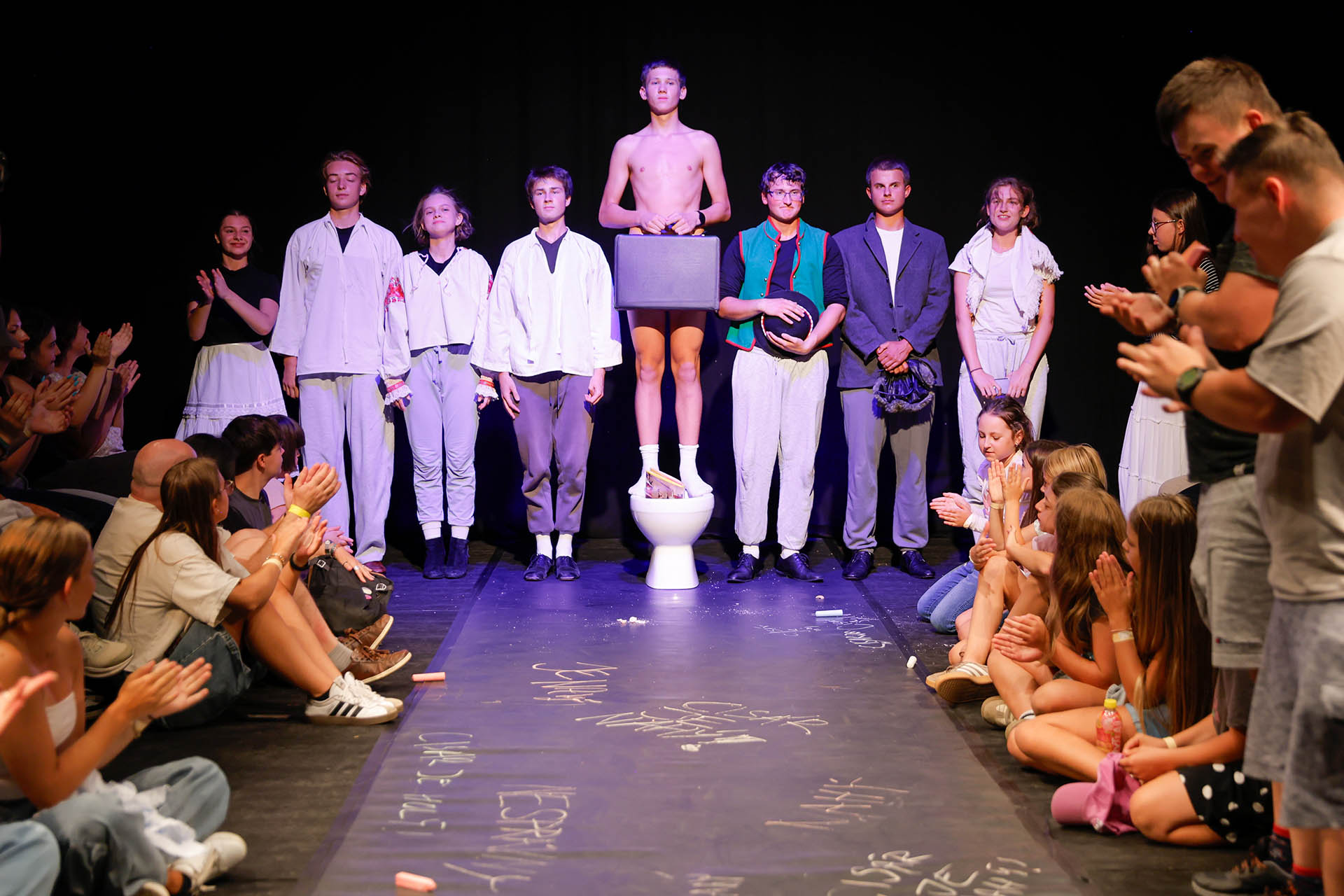
I am writing this two weeks after the 104th edition of the Scene Harvest, the most important national festival of Slovak amateur theatre. Here, in Martin, amateur performers from all over Slovakia gather annually at the end of August. As always, it’s a colorful palette of contestants from various regions, from children to youth to adult groups. Yet, despite an artistically successful year, I feel a certain bitterness. Apart from a few exceptions, the same faces and the same leaders of collectives repeatedly appear at the Harvest. Where are those who have stopped performing? Or those who lost their venues? Those whose school principal did not let them participate in the festival over the weekend? Those whose director has passed away forever? Those whose group of children, who went abroad to study, has disbanded? Those without money for travel? Those who exist only out of inertia, with their last performance in 2019?
Almost a hundred years ago, Socháň and Barvínek sat in Martin over old newspapers, trying to count everyone involved in theatre. Today, we have the internet, databases, social networks, electronic forms, and sophisticated data collection tools. Yet, we still do not know how many there are.
Inspiration can come from, for example, the Czech amateur theatre database maintained by the National Institute for Culture (NIK, formerly NIPOS), which in 2025 underwent a radical redesign. The database contains detailed information about 3,500 active theatre associations, personalities, event organizers, instructors, photos, attachments, etc. Similarly, the Brontosaurus Information System (BIS) of the non-profit ecological movement Brontosaurus, which unites over 1,500 members and can coordinate hundreds of smaller and larger events across the country, maintaining communication and detailed records. The National Cultural Center could implement a similar system to map not only groups registering for competitions but also those organizing their own festivals or performing for their own enjoyment.
Perhaps it is time to start again. Not to produce another spreadsheet for the ministry, but to finally know whom we actually (do not) support. Because if amateur theatre is one of the most widespread forms of active cultural participation in our modern history, then the question of how many we still have is not a statistical one. It is a question for cultural policy. And perhaps for all of us: Is Slovakia still a country of amateurs?


The text is part of the PERSPECTIVES project – a new brand for independent, constructive, and multiperspective journalism. The project is funded by the European Union. The opinions and statements expressed are those of the author(s) and do not necessarily reflect the views of the European Union or the European Education and Culture Executive Agency (EACEA). The European Union and EACEA do not accept any responsibility for them.