“Do you know what the Oleshki morgue is?” - What a humanitarian disaster looks like
New Eastern Europe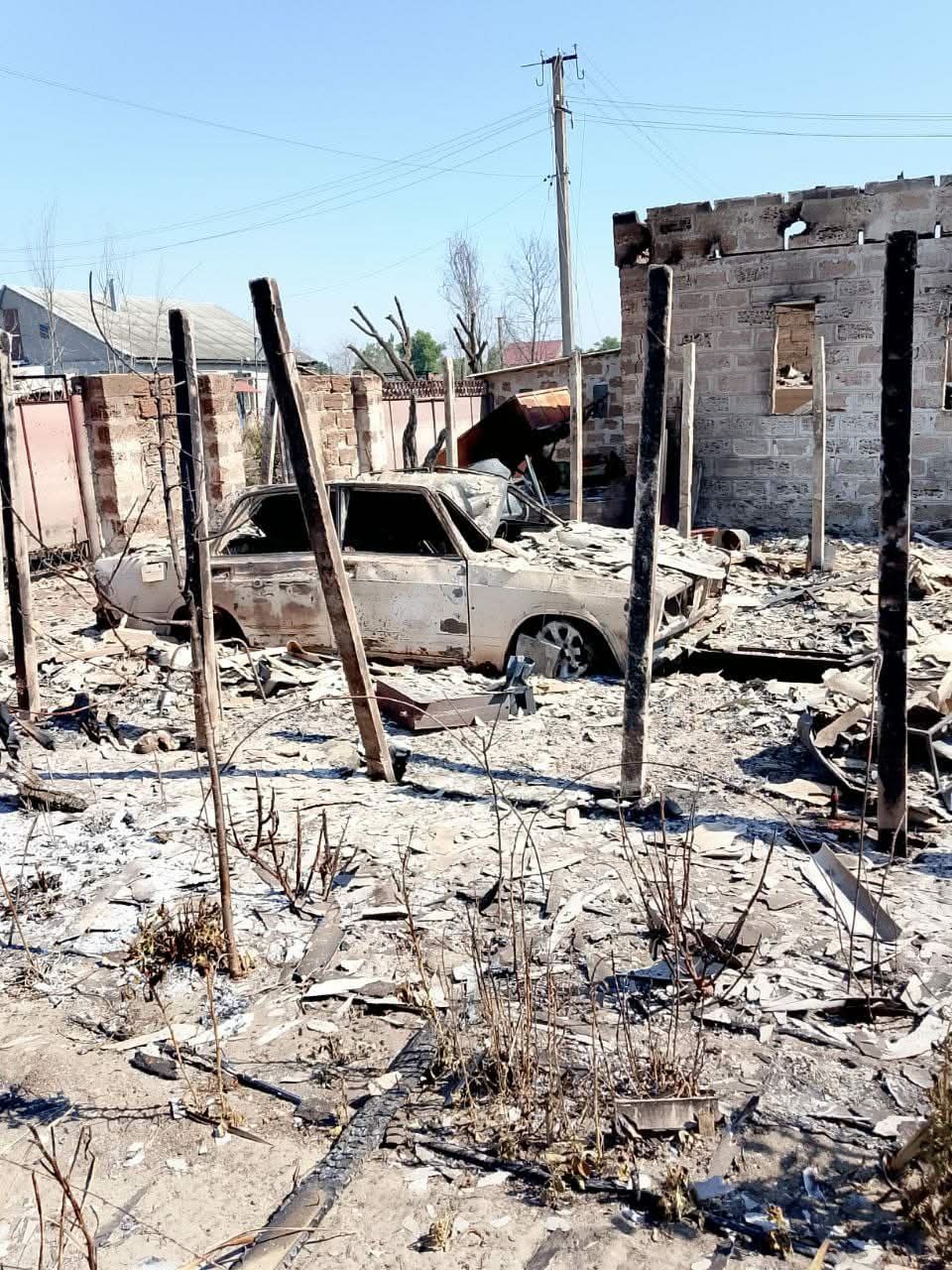
Only a few kilometres separate Russian-occupied Oleshky from the Ukrainian-held bank of the Dnipro, where food and medicine are available. In Oleshky itself, finding either can cost a life. Residents and their relatives describe mined streets, drones overhead and people surviving on what they can grow in their gardens. Some of the dead cannot even be retrieved from the roads.
Before Russia’s full-scale invasion, Oleshky was home to nearly 24,000 people. Russian forces seized the town in the opening days of the war, and much of it was flooded after the Kakhovka dam was destroyed in June 2023. The Kherson regional administration estimates that about 4,000 people remain, including children. Regular food deliveries by road largely ceased after late May. For many residents, the approach of another winter means facing severe shortages of food and medicine without a safe route out.
On 27 September, the Kherson regional administration said Ukrainian forces had delivered about 4,000 kilograms of food by drone to 100 designated locations in Oleshky, in one of their largest such operations. But the delivery does not establish how many households have received supplies, and the people we interviewed describe families still struggling to find enough to eat.
The administration also says Russian troops shoot down drones carrying provisions, seize or resell food intended for children and older people, and detain or beat residents for accepting aid. Other reports from the town describe soldiers going door to door to take some of the drone-delivered food and threatening residents with interrogation. Bodies of the dead have reportedly remained unburied for weeks, while aid vehicles have been blown up by mines or struck by drones before reaching the town. Kyiv is demanding a humanitarian corridor and Ukrainian officials claim Russia is refusing one and using the population as a human shield, while Moscow-installed authorities deny the crisis and blame Ukraine.
The world is not hearing the people trapped in Oleshky. Until now, all the information available to us had come from official representatives of the Oleshky City Military Administration, which is currently based in Ukrainian-controlled territory. To learn the truth, we found a way to contact people in Oleshky, who told us what is happening there.
Our first interviewee is Vladimir Kostyan, 49, former beekeeper. He remained in Oleshky until March 2026, when he miraculously managed to escape the occupied territory.
This interview was first published by Radio Free Europe/Radio Liberty’s Georgian service here: https://www.radiotavisupleba.ge/a/33839094.html
RADIO LIBERTY: How did you manage to leave Oleshky?
VLADIMIR KOSTYAN: We left in a convoy of three vehicles on March 5th. The word “PEOPLE” was written in large letters across the bonnet of my car. We knew of a section of road that had been cleared of mines in advance. Women and pets were travelling with me.
What were you doing in the occupied territory? We understand that the Russians also held you captive for some time. Why?
They took me away on November 15th 2022. On November 23rd 2023, they released me after making me sign an undertaking not to leave the area.
I was delivering food to people. I went through four vehicles in all. One was hit by a drone, while the others struck mines. I passed the coordinates of Russian military equipment to the Ukrainian Defence Forces and helped civilians escape from the occupied territory. I helped to destroy two Russian S-300 launchers.
Were you tortured while in detention?
Yes. The Russians tortured me with electric shocks using a “tapik”, a Soviet TA-57 field telephone. They attached wires to my genitals and mocked me, saying they were about to call Putin.
I spent only a year in that torture facility. People who were held captive for longer endured far worse things.
I know of approximately nine torture sites in the Oleshky and Hola Prystan municipalities. Those are located inside police-station buildings that were seized when the occupation began.
People are constantly being abducted. Some are taken because of their pro-Ukrainian views, while others are targeted because they have money.
Do you remain in contact with people in Oleshky?
Yes, I manage to speak to people in Oleshky about once a week. Sometimes they can pick up a signal from Ukrainian mobile operators.
But Russian soldiers confiscate Ukrainian SIM cards from residents. They literally go from house to house taking people’s SIM cards.
They do this partly to leave people without communications. They also do it because they have no reliable communications of their own and are forced to use Ukrainian networks.
What is the situation in Oleshky now? What do you know about people’s living conditions?
Life is extremely difficult. There is water because almost every yard has its own water pump. But there is no electricity or gas.
Some people managed to find solar panels, but they are already damaged and barely work. They may also have old lead-acid batteries. That is the only way they can charge anything.
Heating is a disaster in Oleshky. I do not know how people will survive the winter. Inside the five-storey and nine-storey apartment blocks, room temperatures can fall to minus 5C.
There are no regular food deliveries. A kilogram of flour in Oleshky now costs 5,000 roubles, almost 2,500 hryvnias. Some traders manage to cycle around the mined sections, but how much can they possibly deliver that way?
Are there any possible evacuation routes?
No. Everything has been mined and re-mined again. There is so much unexploded ordnance lying around, as well as shrapnel, and everything is covered with “Petal” (PFM-1 anti-personnel blast mines used by the Russian Armed Forces) mines. The entire riverbank is covered with mines. The Russians arrive and mine it. Then there is a rotation, and the Russians who replace them step on those mines so the en up mining the entire area all over again. I fear that Oleshky will never recover or return to life.
Is it true that the bodies of civilians can remain lying in the streets?
I was informed that, right now, the body of a civilian is lying on the road out of Oleshky. I do not know the circumstances in which the man died. They have been unable to retrieve his body for three days.
In March, while I was still in the town, I saw the bodies of Russian servicemen blown up on the mines. They were not removed because the Russians have no proper logistics in that area. They still somehow manage to carry their wounded out through the tree lines and forests. But they leave the dead behind, and their bodies rot and are torn apart by dogs.
We used to remove the bodies of civilians ourselves, risking our own lives. But do you know what the morgue in Oleshky is? It is a basement containing around 90 bodies that are decomposing there. It has already been hit a couple of times. The stench is unbearable. The bodies simply lie there and decompose, and there is no way to give those people a proper burial.
Our second interviewee is O. M., a middle-aged man living in occupied territory, 8 kilometres from the cut-off city of Oleshky, where his family and other relatives remain. Risking imprisonment or even death, he answered our questions.
RADIO LIBERTY: According to various estimates, between 1,500 and 4,000 civilians remain in Oleshky. They cannot leave because the area is mined and drones are constantly in the air, hunting them. Is that true?
O.M: Yes. People are trapped in their homes and cannot leave. Everything around them is mined. My family has neighbours who live in a house 300 metres away, but they cannot reach them because everything is mined.
What kinds of mines have been laid across Oleshky?
Everything there has been mined with whatever they could use. But most of them are “Petal” mines.
Who is laying them?
Both sides are doing it. I understand why. The Russians do not want the Ukrainians to land on the riverbank, while the Ukrainians do not want the Russians to maintain a fortified position on the bank in Oleshky.
What is the situation now for the Ukrainian civilians trapped in Oleshky?
It is extremely difficult. Leaving the house to obtain even a little food means risking death. Other relatives of mine live on the outskirts of Oleshky and happened to learn of a path that allows them to avoid the mines. They arranged for some kind people from a village near Oleshky to come and meet them, and those people managed to give them a little food.
Reports have circulated online that the bodies of civilians killed in Oleshky are lying in the roads. Is that true?
It is true. When everything around you is mined and drones are flying overhead hunting people, nobody can retrieve the bodies from the streets and give them a proper burial. The bodies can therefore remain in the street and decompose, or stray dogs can tear them apart. I have witnessed this myself. It happened last winter where I am living now.
Do you think there is any way to evacuate people?
If evacuation corridors were to be opened through Russian territory, Ukrainian civilians would face a brutal filtration process. Most of those subjected to it would either be forcibly mobilised into the Russian Armed Forces or sent to Russian prisons.
Therefore, if an evacuation route across the Dnipro were opened, I would be prepared to cross this huge river on an inflatable mattress. I just want to live.
Our second interviewee is P. R., a teenage boy who is now in Poland. His grandmother and grandfather remain in Oleshky. On rare occasions, they manage to pick up a signal from Ukrainian mobile operators, allowing them to maintain contact with their grandson.
RADIO LIBERTY: Tell us how they manage to survive under these conditions.
P.R: Previously, volunteers helped them with food and medicine, or one of their close relatives would find a route around the mined areas once a week or every two weeks and bring them whatever they needed. That is no longer possible. The volunteers cannot reach them, and my grandparents have forbidden our relatives from coming. It has become far too dangerous.
Previously, it was possible to order essential medicines from the rear areas of the occupied towns and somehow deliver them to my relatives. That is now completely impossible.
What conditions are they living in?
My grandmother and grandfather are trapped in a private house. It is their own home. They have had no gas or electricity for approximately a year and a half to two years.
When the Kakhovka dam was destroyed, their house was flooded, but my grandmother and grandfather later managed to put it back into some kind of order. They still have a little gas left in a cylinder and a gas burner, allowing them to cook something. Sometimes they manage to catch fish so that they have something to eat. But every time they leave the house, they are risking their lives.
They have poultry and a vegetable garden, and they somehow try to grow things there.
Do you think they will be able to survive the winter under these conditions?
They rely on firewood. They collect brushwood and chop it up for fuel. Last winter, relatives gathered dead trees and cut them into firewood in their yard.
Previously, everything depended on help from volunteers and relatives. Now everything depends entirely on my grandmother and grandfather’s own labour. They no longer expect help from anyone because it is impossible to buy coal or firewood anywhere. They have to do everything themselves.
How do the Russian soldiers treat your grandmother and grandfather?
Russian soldiers constantly go from house to house. They know that my grandmother and grandfather live in that house. But they appear to have taken everything they considered valuable from the other abandoned homes. Looting is rampant there.
Our third interviewee is S. M., a 36-year-old woman living in Ukrainian-controlled territory. Her father, grandmother and uncle remain on the outskirts of Oleshky.
RADIO LIBERTY: How do you manage to maintain contact with them?
S.M: Very rarely, only when they manage to pick up a signal from Ukrainian mobile operators. We exchange information very cautiously because it feels as though our calls are being monitored. We hear an echo, including our own voices. During conversations, there is interference and some kind of mechanical noise.
What conditions are your relatives living in?
They have neither electricity nor gas. They survive solely on what they can grow in their garden. No food, bread or fuel that would allow them to run a generator is being delivered now. Leaving the house is extremely dangerous.
Will they be able to survive the winter under these conditions?
It will be extremely difficult. It will be a terrible winter.
What is the situation with medicine? Does your grandmother need it?
My grandmother is very old and can barely move. She desperately needs medicine, but there is nowhere to obtain it. It is impossible to leave, and equally impossible to find medicine there.
What would be the best evacuation route?
Anywhere but through Russia. For many residents of Oleshky and the surrounding district, that could end with them being forcibly mobilised or imprisoned.
Have your relatives witnessed Oleshky residents being killed? Is it true that the bodies of civilians are currently lying in the roads?
My relatives have had to bury children who were killed, as well as girls and women who had been raped and murdered. Their bodies were found in the street.
Copyright (c) 2026 RFE/RL, Inc. Used with the permission of Radio Free Europe/Radio Liberty.
Dr Olga Matveieva is a Research Fellow at the University of Paderborn in Germany
Vazha Tavberidze is a journalist with Radio Free Europe/Radio Liberty Georgian service.
Viktor Shkurko