Scenarios for the future of the Russian Federation
New Eastern Europe
Current thinking on Russia’s future trajectory remains focused on a Moscow-centric approach to future events. Despite this, a broader understanding of the country’s various regions provides essential nuance at a time in which Moscow is facing growing pressures.
The issue of ending the Russian-Ukrainian war is inseparable from the issue of scenarios for the further political development of the Russian Federation. A careful consideration of these scenarios and the corresponding challenges for European, American, and global security will allow us to understand the path to ending the war and establishing a sustainable peace.
For a long time after the start of the Russian-Ukrainian war, the dream of a large part of western elites was a return to the status quo, to business as usual. Changes in the global balance of power make that impossible. The question is what will happen instead of this much hoped for scenario.
In a previous article, we examined the three biggest illusions about Russia's future: that democracy is one good election away, that a ceasefire equals peace, and that the existing toolkit can manage the problem. There is no reason to believe that the Russian Federation as we have known it for the past 25 years will remain that way indefinitely. There is every reason to believe it will change substantially. The open question is how.
Russia's assault on Ukraine is not a conventional land grab. Russia has vast territories of its own that are neglected and underdeveloped. The existential question of this war is not only whether a neighbouring nation can live outside Moscow's control, but whether the Russian state can endure as an empire without permanent external expansion. In that sense the war is existential for both sides. Treating Russian statehood as eternal and unchangeable makes it impossible to heal Russia itself or the wider region.
Two baseline scenarios
Once the hopes of a near‑term democratic transition and a durable short‑term peace are set aside, as we suggested in the previous article, most western discussion still defaults to two broad futures.
The first is consolidation in Moscow. In practice this means tighter repression, a deeper shift into the war economy, heavier mobilization, and a political system that becomes more openly coercive. This is an observable current trajectory. Citizens are being moved onto a state-controlled messenger platform integrated with government services, VPN services are being blocked in the hundreds, foreign platforms are throttled or shut down, and the administrative groundwork for a further mobilization wave is being laid without being announced. Each step is presented domestically as a technical or security measure. Together they describe a state closing its information perimeter and preparing to draw more deeply on its population. In this scenario escalation is not an accident. It is the regime's operating model. The longer the system survives, the more likely that the conflict expands in form or geography. This is a bad outcome for Europe and the United States and a highly convenient one for China. A more isolated, militarized Russia becomes more dependent on Beijing for markets, technology, finance, and diplomatic cover. It becomes a junior partner, finally even a satellite.
The second is collapse in Moscow. This is the scenario that haunts western capitals: disorder across a vast nuclear-armed space, humanitarian shocks, refugee flows, competition among armed structures, and the risk of nuclear insecurity or proliferation. It is easy to see why policymakers want to avoid this at almost any price. It is also a scenario in which China could gain extraordinary leverage, including access to resources, logistics corridors, and political influence in a vacuum.
There is an underappreciated link between the two scenarios. Russia has no functioning mechanism of legal succession at the top. Even on a path to consolidation, any abrupt leadership change creates a dangerous transition period. Control weakens, expectations rise, elite factions compete, and the probability of sliding from consolidation into collapse rises with it. The two scenarios look like alternatives, but they could be sequential states.
So the standard debate leaves the West with two scenarios that are both bad for Europe and the US and both broadly favourable to Beijing. That should prompt a basic question: why has the menu been reduced to outcomes that punish the West and reward China?
The Moscow-centrism trap
When every available option looks disastrous, the frame is usually wrong. In this case the frame is a long-standing habit in western analysis: treating Russia as if the only meaningful political reality is Moscow.
Moscow-centrism did not begin in 2022. It has shaped western policy for decades, reinforced by institutions, expertise, and career incentives that focus too much on the capital and disregard understanding of the regions. A telling example came at the end of the Soviet period. On August 1st 1991, US President George H. W. Bush addressed Ukraine's parliament and warned against "suicidal nationalism", urging a reform path that would hold the Soviet Union together. The speech became known as the "Chicken Kyiv" speech. Within three weeks Ukraine proclaimed independence under the threat of revenge by Soviet hardliners due to the attempted coup in Moscow. Within five months the Soviet Union was gone. The point is not to relitigate 1991 but to name a recurring instinct: stabilize the centre, even when the centre is the source of the instability.
The analytical cost is straightforward. Moscow is not a typical region. It is an imperial capital, structurally unlike everything it governs, and it is the one place in the country insulated by design from the consequences of the wars it starts. Using it as the single lens distorts the entire system. Understanding Russia's trajectory requires treating the regions as political actors rather than background geography.
What holds the empire together
If the regions matter, the useful question becomes mechanical rather than speculative. What are the load-bearing walls of the Russian state, and what condition is each one in?
Resource redistribution. Moscow extracts revenue from the regions and redistributes it. This is the primary instrument of control, and it is under strain. As the economy degrades, donor regions surrender more and retain less, while recipient regions receive steadily less than before. Only Moscow is protected from feeling the effects of the war. Shrinking transfers produce quiet resentment among regional elites, which is a stronger and more durable factor than popular discontent.
Fear of the security services. This is eroding as the siloviki experience visible failures. A second dynamic works faster: the personal insecurity of local clan leaders. The Kremlin maintains programmes to replace them with more loyal figures, and in Russia losing a post means losing property, often freedom, sometimes health or life. An abstract fear of disloyalty to the centre is displaced by a concrete fear of what the centre intends to do to you specifically.
A common identity, that is, a common story about the past. Despite all the efforts of Moscow propaganda, it is not possible to unite Russians, Tatars, Chechens, Bashkirs, Sakha, Buryats and over a hundred other ethnicities into a single Russified “people of Russia”, just as the communists failed to create a “Soviet people” that unites such different nations as Estonians, Georgians and Uzbeks. The traditional racism of the “Great Russians”, which is also fuelled by the official mass media, also hinders propaganda efforts.
A shared story about the future. There is not one. Russian propaganda is oriented entirely backwards. Even science fiction, a genre defined by the future, has largely turned into descriptions of an alternative past in which Russia wins the (numerous) wars it historically lost. A state can survive without prosperity for a long time. Surviving without any account of where it is going is harder.
Elite career mobility. This is a subtle factor with a strong historical record — it contributed materially to the breakup of the large Latin American state of Gran Colombia. Elite loyalty to a large state holds as long as the centre guarantees career rewards. When the lifts stop and a ceiling becomes visible, a large post in a small country starts to look better than a small post in a large one. Moscow was a powerful career magnet for over a century. Today there is no mechanism giving major regional and national clans automatic representation at the centre, nothing equivalent to the Politburo arrangement where ethnic and regional clans placed their own people at every level.
Inertia. Everything holds until it does not, and then very little works at all. This is the factor that makes prediction unreliable and makes historical pattern-matching necessary.
When the empire was fragile
Russian imperial crises follow a recognizable sequence. External military failure exposes fiscal and institutional weakness, and the centre's legitimacy erodes slowly and then all at once. What differs across cases is not the trigger but the outcome. The outcome is dependent on two variables: whether an organized alternative elite exists to take or replace the centre, and whether the centre retains enough coercive resource to reconquer what is slipping away.
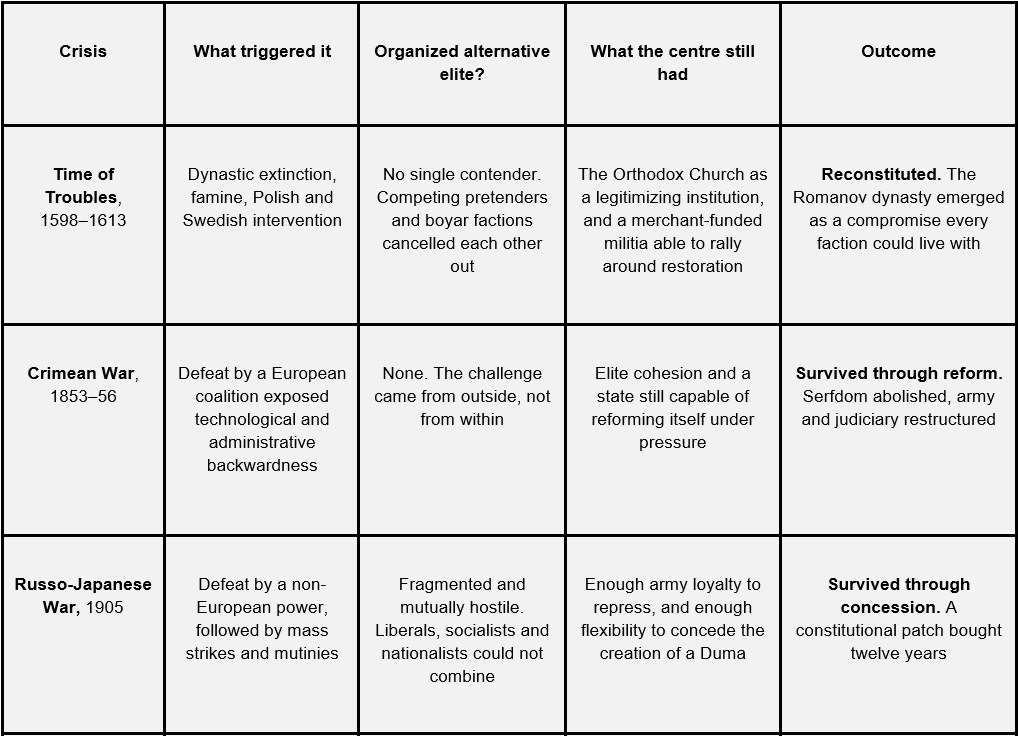
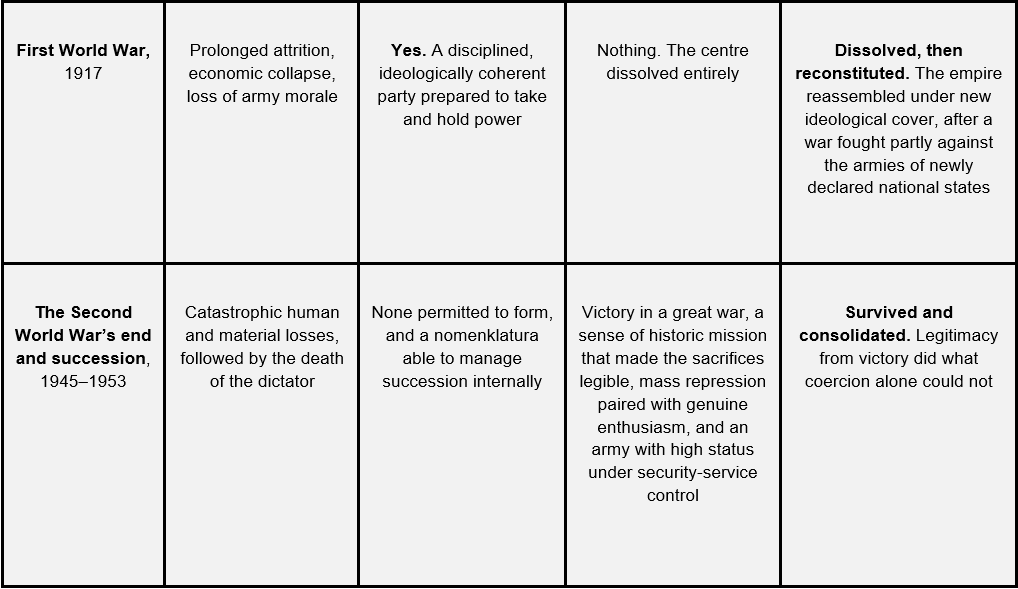
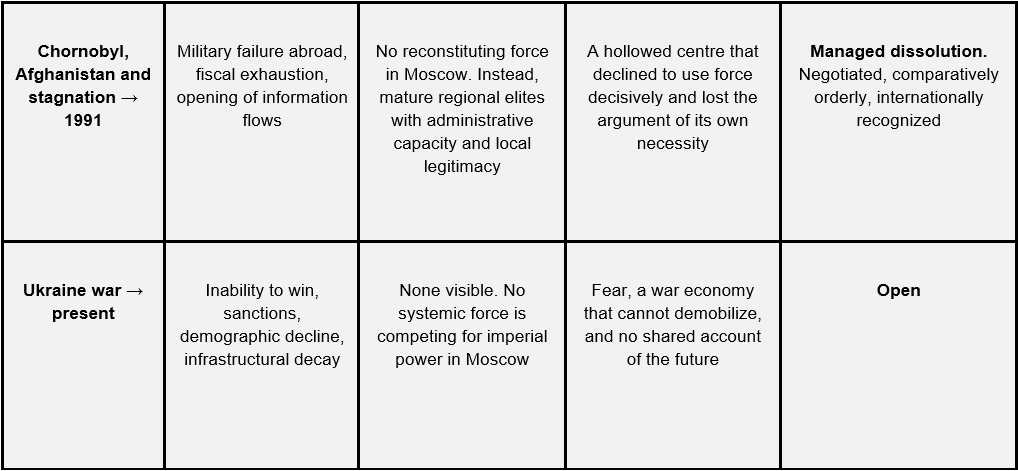
Three outcome families emerge in these circumstances.
Reconstitution, in 1613 and 1917, required an organized alternative elite capable of taking the centre and reimposing unity. Nothing comparable exists today. There is no mass disciplined ideological movement, no religious legitimation of a restoration, and no faction competing for imperial power rather than merely for succession. Moscow's elites remain ideologically, culturally and often religiously foreign to the regions they govern.
Survival through reform, concession or victory, in 1856, 1905 and 1945–1953, required the centre to have something to offer: a reform to grant, a constitution to concede, a war won that made the losses meaningful. Today's system has repression without ideology and cannot achieve the war aims it set for itself. The gap between elites and society is widening rather than closing. Society is demoralized, atomized and apathetic. The army is exhausted and resentful. What remains is fear.
Dissolution, in 1991, required a weakening centre, regional elites with real administrative capacity, and the absence of a reconstituting force. Those three conditions are present now. Several additional factors are present that were absent in 1991: potential military defeat rather than peaceful exhaustion, sanctions rather than western economic rescue, demographic decline concentrated in the ethnic Russian population, information access that persists despite censorship, working examples of successful post-1991 independence, and external powers with their own regional interests and the capacity to act on them. Nothing new has appeared on the other side of the ledger. No new factor supporting imperial cohesion has emerged since 1991.
Two lessons deserve to be carried forward. Legitimacy outlasts coercion, and repression without a narrative story does not stabilize a state. A system with no functioning succession mechanism is structurally fragile at precisely the moment it appears most consolidated.
A wider scenario space
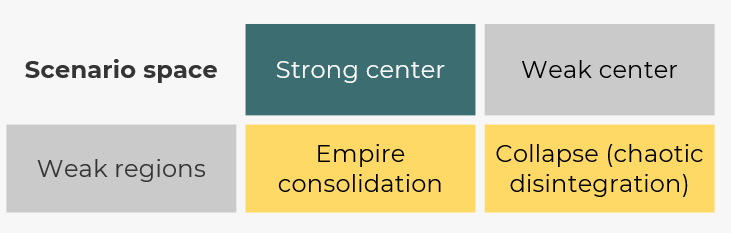
A one-dimensional model produces two outcomes: a strong centre or a weak one. Adding a second variable — the capacity and agency of the regions — expands the map from two futures to four.
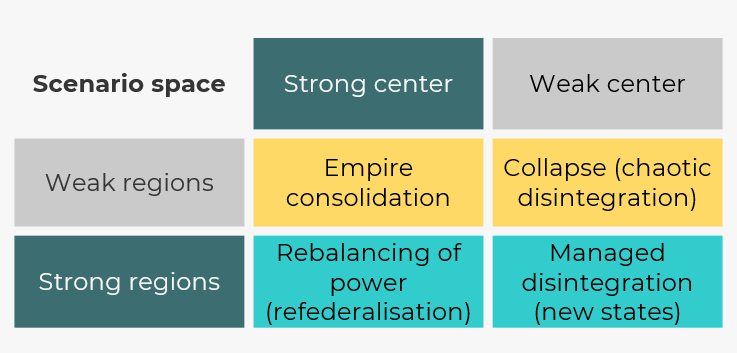
The upper row is the familiar one. Both consolidation and collapse are Moscow-centric outcomes, and both are the ones currently on the western menu.
The lower row is where there is little current analysis. A strong centre with strong regions creates genuine federalization: a rebalancing of power rather than its concentration. In a real federation, the centre cannot unilaterally launch a war of aggression, because it does not control the resources to do so without consent.
A weak centre with strong regions gives managed disintegration: a controlled process in which new states emerge from the imperial structure with external support, security guarantees, and a rules-based pathway to recognition. This is not a fantasy scenario. The Russian imperial system broke apart twice in the 20th century, chaotically in 1917 and in a managed way in 1991. What has happened before can happen again, and the historical record shows it can happen in more than one way.
These two lower-row outcomes can be described in practical terms as decolonization scenarios. They shift the governing question from "how do we preserve Moscow's control?" to "how do we reduce major risks?"
Challenges for European and global security
As we have already noted above, the scenario of consolidation of power means an escalation of the war and its expansion in geography, as well as a significant change in the geopolitical balance due to Russia's increasing dependence on China. At the same time, the scenario of chaotic collapse carries unacceptable global risks, which makes it even more feared.
Are these risks relevant in the case of managed disintegration along the model of 1991?
Nuclear weapons. Russia's strategic nuclear infrastructure is geographically concentrated and expensive to maintain, and it gives the Kremlin leverage over the regions that host key sites. The lesson of the 1990s is not that nuclear risk makes political change impossible. It is that custody arrangements and security guarantees have to be designed properly and honoured afterwards. Mariana Budjeryn's work on post-Soviet denuclearization shows how contested and consequential those choices were, and how much depended on decisions taken quickly under pressure. A credible approach would trade strong security guarantees, economic support and international recognition for a verified transfer of strategic systems under international mechanisms, rather than assuming by default that everything must revert to Moscow. That assumption is a policy choice, not a law of physics, and it was made once before with results Ukraine is still living through.
Armed conflict. The relevant historical analogy is not a war of all against all. It is the consistent tendency of imperial militaries to use force to prevent secession. Deterrence is the governing variable. If the centre retains the resources to reconquer the periphery, violence becomes considerably more likely. If it does not, negotiated outcomes become plausible. As for the newly independent states, they will strive to become centres of order and security for the sake of international recognition and economic assistance.
Radicalization. The standard fear is Islamist extremism in the Muslim-majority republics. Radicalization grows where lawful political paths are blocked and repression is permanent, which describes current conditions rather than a post-imperial situation. Where self-government becomes available, political energy tends to shift from insurgency toward state-building, because state-building offers what insurgency cannot: budgets, offices and international recognition. These are the arguments that current supporters of independence are engaged in with radicals.
China. Two points are usually conflated here. The first is that many groups and regions seeking to escape Moscow have no interest in becoming clients of another empire. Among all Turkic, Mongolic and Finno-Ugric peoples there is a well-founded fear of Chinese domination, shaped by what has happened to the Uyghurs and Tibetans. The second point is more uncomfortable. The trajectory that most reliably converts Russia into a Chinese satellite is the one western policymakers sometimes describe as stability. An isolated, militarized Moscow surviving on Chinese markets, technology and finance is not a check on Beijing. It is a supply line.
The Arctic. This deserves separate treatment because it is where the China question becomes concrete and near-term in nature. The next contested theatre is most likely the Arctic, and Beijing is preparing for it methodically. The instinctive western response, a larger American military footprint in Greenland, brings great-power confrontation closer rather than pushing it away. There is a less escalatory option. Chinese access to the Arctic runs through territory that is not ethnically Russian and does not identify with Moscow. The Sakha Republic, better known in the West as Yakutia, sits astride that access and is potentially one of the most resource-rich territories on earth. Supporting Sakha's self-determination denies Beijing an Arctic corridor without placing a single additional western soldier anywhere. This is the kind of option that only becomes visible once the analytical frame stops treating Russia as a single actor based in Moscow.
What has to be true for the wider scenarios to become real, who the necessary actors are, which risks require planning rather than avoidance, and who stands to gain from each outcome — these are the subject of our next article.
Sviat Hnizdovskyi is the Founder & CEO of OpenMinds, a strategic intelligence tech company.
Valerii Pekar is a chairman of the board of the Decolonization NGO, the author of four books, an adjunct professor at the Kyiv-Mohyla Business School and Business School of the Ukrainian Catholic University, and a former member of the National Reform Council.