Report from Cuba: Will capitalism save the revolution?
Kapitál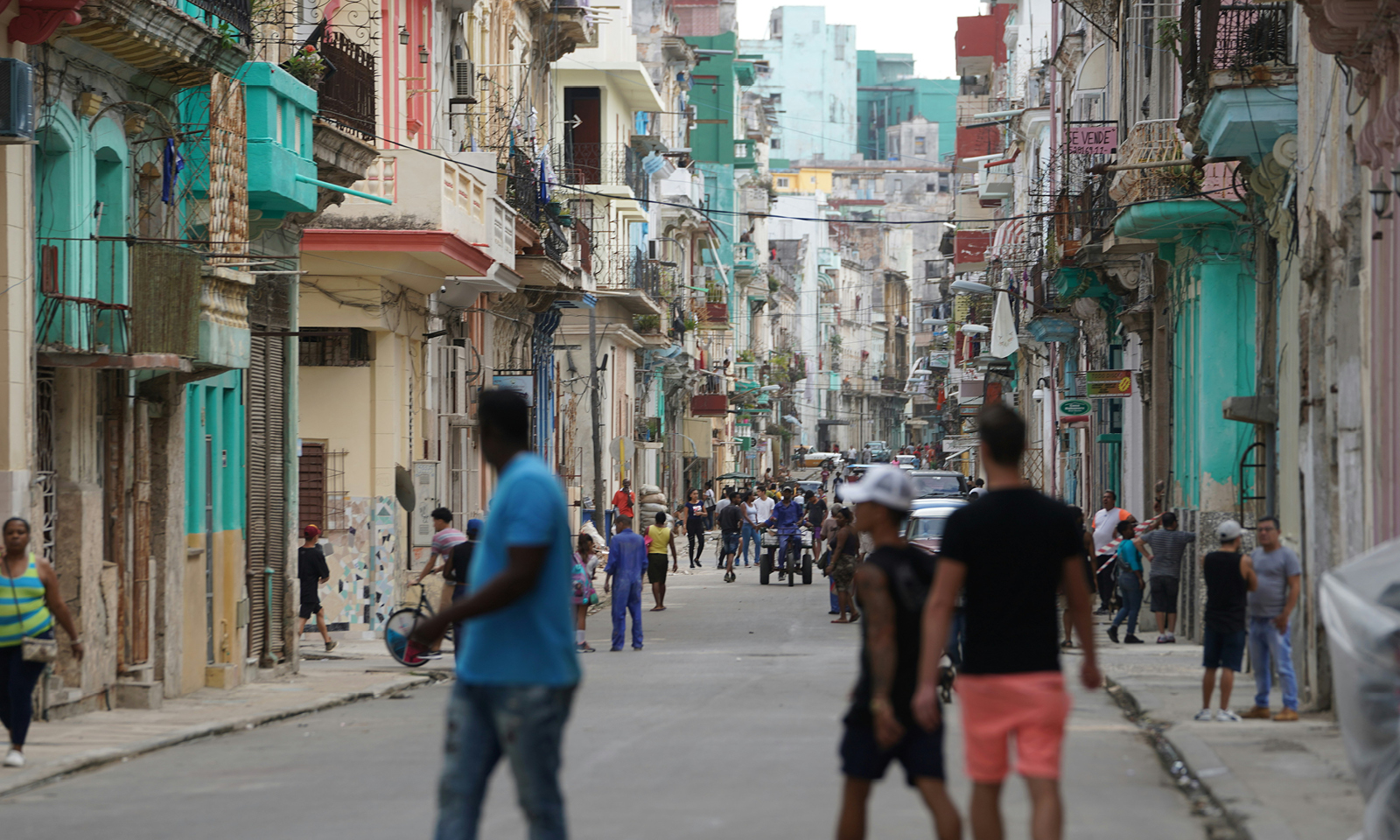
The U.S. Department of State imposed sanctions on July 13th on ten additional Cuban companies and government entities, including the Ministry of Tourism. Washington continues its strategy of economic strangulation of the island. Authorities in Havana are cornered and trying to prevent collapse. What are they betting on? Extensive liberalization of the economy and support for the emerging entrepreneurial bourgeoisie.
The US Department of State imposed sanctions on July 13th on a further ten Cuban companies and government entities, including the Ministry of Tourism. Washington continues its strategy of economic strangulation of the island. Authorities in Havana are cornered and trying to prevent collapse. What are they betting on? Extensive liberalization of the economy and support for the emerging entrepreneurial bourgeoisie.
In the tired Havana neighborhood of Vedado, a freshly renovated turquoise house stands out. Two fruit trees cast shade over its terrace. An artificial lawn decorates the area with a swing. Tinted windows provide a certain degree of privacy. An elderly woman sits in a wheelchair, looking towards the front door, talking to herself. She is one of the residents of TaTamanía – the first private senior care home in Cuba, opened this spring. Until now, the revolution had prohibited such facilities. Public care homes, however, have been in a critical state for several years due to resource shortages.
This mipyme (an acronym for micro, small, or medium-sized enterprises authorized by the state in 2021, with thousands having emerged since) was founded by former pediatrician Yadira Álvarez and her husband, an IT specialist. After the COVID-19 pandemic, Havana decided to liberalize its economy. The aim is to prevent collapse caused by a combination of factors: the US embargo in place since 1962, the "maximum pressure" policy applied by Donald Trump during his first term (including 243 coercive measures against the island), the healthcare crisis, and also a currency reform that caused a sharp rise in inflation.1 This first turning point came at a time when the largest anti-government movement since 1959 shook the regime, which harshly represses opponents.
Since the return of the Republican president to the White House (2025), Washington has Havana under more scrutiny than ever before. Trump even repeated several times that he would "take" the island.2 On January 29, 2026 – three weeks after requesting Venezuelan officials, who remained in power after the kidnapping of President Nicolás Maduro, to halt all oil supplies to Cuba (which was granted) – he declared that this country posed an "unusual and extraordinary threat (...) to the national security and foreign policy of the United States." 3 No country may sell or supply hydrocarbons to Cuba without risking US tariffs. The economic, trade, and financial strangulation intensifies as Washington expands its sanctions: from May 1, they also target Cuban officials accused of "serious human rights violations," as well as any government, individual, or entity maintaining trade relations with Havana or its businesses.4 A few days later (May 20), the US Department of Justice filed charges against Raúl Castro for "conspiracy to kill US citizens." This relates to the Hermanos al Rescate affair from 1996, when Cuban fighter jets shot down two civilian humanitarian aircraft, killing three Americans – note for translation.5
Trump's strategy involves weakening the state monopoly and applying pressure on the Cuban government to stop hindering the development of the private sector motivated by profit. The process of liberalization marks a fundamental shift for one of the most state-controlled economies in the world. Land reforms (1959), extensive nationalizations in the 1960s, and the "revolutionary offensive" of 1968, during which Havana authorities initiated the expropriation of all small businesses – the last private firms on the island – all led to extreme centralization and the creation of a bureaucracy that became more paralyzing as it grew. The effects of the embargo, tightening sanctions since the late 2010s, and centralization weigh heavily on the population. While disputes between the Cuban government and the dominant global superpower continue, Cubans themselves are struggling for survival amid the greatest economic and social crisis since the revolution. Daily water and electricity outages persist, transportation problems worsen, the healthcare system is collapsing, and prices are rising sharply. Foreign companies under US pressure are leaving the country. As for tourism (a key sector of the national economy), it is completely paralyzed. The number of visitors plummeted from 4.2 million in 2019 to less than 360,000 in the first half of 2026.6 Economic liberalization thus appears as the last hope to ensure the country's supplies. For Cuba, this also marks the beginning of a new era.
With business development, inequalities also grow
The holding company Grupo de Administración Empresarial SA (Gaesa), which epitomizes the centralized system, is among the entities targeted by Washington sanctions. Raúl Castro and the Revolutionary Armed Forces (FAR) founded it in the early 1990s, during the "extraordinary period in peacetime" following the Soviet Union's collapse and the end of the Cold War. Luis Alberto Rodríguez López-Calleja, Raúl Castro's former son-in-law, led it until his death in 2022. It encompasses dozens of other companies in tourism (Gaviota), finance (Rafin, Banco Financiero Internacional), retail (Cimex), as well as import-export, money transfer, construction, fishing, and more.
A large part of the public perceives this conglomerate as a financial arm of the army and the ruling regime. It is currently criticized mainly for the construction and full financing of numerous luxury hotels. Since 2016, about fifty have been built, almost all currently empty due to the economic crisis and US sanctions. One such luxury hotel is Iberostar Selection, also called Torre K (Tower K). A massive building rising amid dilapidated structures, officially opened in 2025, sparks outrage. Many Havana residents wonder how, despite the embargo, the materials needed to build this five-star hotel were brought in. They also do not understand the state's reasons for such expenditure. "It's appalling," complains a local. "A symbol of contempt from our leaders, right here in the middle of the city. And we have to look at it because it can be seen from many parts of Havana!" Authorities decided in March to close the hotel. Although tourists did not use it, it was lit every day while the city suffered power outages.
The government responded to criticism in the June 2 issue of Granma, defending the holding company: "Nothing is secret about Gaesa; it was not created by elite initiative, nor as a tool for enriching a select group of people." The same statement also claims that profits were reinvested "into the Lidio Ramón Pérez thermal power plant" in Holguín province or "into the renovation of polyclinics, health centers, and schools."
US President and Secretary of State Marco Rubio perhaps rely on the idea that "food riots" will corner the regime or even bring about its fall. Havana has adopted 176 measures under pressure from the current situation and escalating threats of intervention from Washington for "economic and social transformation."7 This plan represents a true Copernican shift. Capitalism is being revived in sectors such as trade, services, agriculture, manufacturing, and energy. Measures announced by Prime Minister Manuel Marrero Cruz include foreign capital participation in the trade sector, establishing private banks and credit institutions, and introducing foreign currency accounts for individuals. The government also plans to set a goal for partial "dollarization" of the economy and prepare the ground for transforming state enterprises into commercial companies.
The state is reconsidering its scope of influence and is relinquishing its monopoly over the energy sector in favor of private investors. In foreign trade and agricultural product pricing, liberalization is also underway. The Libreta, the rationing system that long provided Cubans access to food at very low prices, is gradually being phased out in its current form. The aim is to redirect national solidarity towards "vulnerable persons," as President Miguel Díaz-Canel announced on June 18 before the Central Committee of the Communist Party of Cuba.
Cuba faces ongoing pressure from Washington, which considers its reforms "superficial," despite the thriving of mipymes. From now on, they will be able to employ more than a hundred people and expand their activities without obstacles, with owners able to own multiple such enterprises simultaneously. Good news for the founders of TaTamanía, which provides clients with permanent accommodation and daily care. Families must pay between $1,000 and $1,200 monthly for care, while the average monthly wage in Cuba is around $15. Yadira Álvarez admits: "Our market is not aimed at Cubans living on the island but rather at those who emigrated and left their relatives here." Álvarez also shares her future ambitions: "We opened a branch in the Dominican Republic, and our goal is to establish ourselves throughout Latin America, develop the market, and become leaders in the field of care services on the continent."
Just a few years ago, no one in Cuba would have spoken like this. Measures aimed at liberalizing the economy introduced in 2021 allowed a new class of entrepreneurs to emerge. The trend of entrepreneurship is gradually spreading mainly in large cities – along with sharply increasing inequalities, which are visible in everyday life. The driving force behind this development is precisely mipymes. About ten thousand active small businesses employ approximately 900,000 people out of a total labor force of 4 million.8 Thousands of homes and yards across the country have been transformed into shops. "I used to rent rooms to tourists. The years were empty, so I set up this small grocery store on the ground floor of my apartment," explains a resident of Vedado. Small businesses such as restaurants, phone repair shops, furniture manufacturing, construction, cleaning supplies, or tech stores are multiplying. Several food delivery apps have appeared. La Nave, Cuba's equivalent of Uber, operates on the same principle.
First signs of financial companies (mainly in online payment services) are also emerging, with the ambition to "provide Cubans with financial freedom," as one founder of such a company explains. Another entrepreneur plans to create a "Cuban Amazon," a platform that would centralize mipymes sales.
Economy liberalizes, politics do not
The development of entrepreneurship was significantly aided by the import law introduced in 2021. Until then, only the state had the right to import. Mario9, head of a mipyme specializing in importing agricultural machinery, visits a client in Artemisa province west of Havana. On a three-hectare farm, several farmers gather around a small, recently purchased red tractor with a trailer.
“How's it going?” Mario asks. “It's really practical. I can do in thirty minutes what I used to do with oxen all morning,” replies one of the farmers. The tractor is used for plowing, digging, planting, spraying crops, and transporting harvests. “We use it at all stages of our work. It's amazing. The only problem is that we don't always have diesel,” he adds ironically and somewhat disappointed.
Mario founded his company in 2024. “We import everything from China. The agricultural sector has great potential in our country. Cuba must shift towards agro-industrial production. That is the goal of our company.” On his phone, he scrolls through photos and videos of massive Chinese hangars filled with agricultural machinery soon arriving in Cuba. This prospect could positively impact the domestic food industry, which has been in decline for decades: in 2024, only nine thousand tons of pork were produced, a negligible amount for a country of eleven million people, and rice production reached only 30% of the 2018 volume.10
From now on, farmers, cooperatives, and mipymes can sell their products directly. Previously, everything had to be sold to the state, which managed distribution through Acopio. Only a small part of surpluses could be sold directly to local consumers.
On this farm, beans, squash, corn, cassava, bananas, and mangoes are grown in long black greenhouses. After feeding about twenty pigs and checking water levels in tanks, farmers can relax in the shade. "From now on, we will sell at markets and to hotels. If we had done this earlier, hunger in this country wouldn't be so widespread," cautiously notes Rolando, one of the farmers.
When his colleagues walk away, he continues: "The previous system hindered production. The company Acopio used to come pick up the harvest. Many products spoiled in the halls. The state lacked fuels due to the embargo, but the problem was also the disinterest and lack of will among officials. A lot of money was invested in tourism, but very little in agriculture. Private firms pay better, and bureaucracy has also decreased."
Production capacity remains limited, but new rules give farmers more room for production and investment. For private entrepreneurs, it is now crucial to turn this opportunity into long-term profits and prove they can ensure food security in the country.
Among small entrepreneurs (mipymeros), there are various types. Pablo parks his Toyota SUV, recently imported from Panama. We sit on the terrace of the Roc Presidente hotel in the capital. In 2021, this young man opened an auto repair shop employing about twenty people. Filters, oils, tires, and similar items were once scarce before mipymes emerged. Pablo earns quite decent income from his business.
While we sit having coffee, a beggar with a child in her arms passes by. She extends her hand and asks us for money. The entrepreneur pulls out a 1000 peso bill (about €1.70 at the time) and gives it to her. He sighs: "You see, I’m looking for someone to take care of my sick mother. I would pay her without issue 1200 pesos a day. But I can't find anyone. Someone like this beggar woman could do that job!" He continues: "There are things that shock me about low-income people. Too many young and strong people refuse to work, even if they could. For example, in construction. If you haven't studied, you have to take such work," thinks Pablo. "In society, instead of complaining, everyone should work. It doesn't matter how." Pablo has fully adopted the new entrepreneurial culture: "When all my employees go home, I still answer messages. We entrepreneurs sleep five or six hours a day. Last year, I only had two days off all year."
What does Pablo envision for the future? "I was in China. There, Uber arrives a minute after you order it! Shops are open all night. Here, you see people loafing around at two or three in the afternoon. In China, I saw what I dream of in Cuba!"
Private initiative was long forbidden in Cuba to prevent individuals from getting rich and creating inequalities. The recent liberalization of this sector has indeed led to a visible deepening of social disparities. Inequalities are immediately noticeable: children begging (a phenomenon that has appeared only recently), mountains of garbage accumulating in the streets of the capital, drug use spreading, and prostitution.
Sunset over Havana. Across Linea Street in Vedado, a white Tesla passes, and a parked Porsche Panamera stands at the corner. Nearby, several restaurants offer meat imported from the US, fish, wine, or ice cream. Compared to state-run restaurants, which lack practically everything, this is a huge contrast. A full menu costs between €10 and €20. Some new shops sell jam for €9.50, bottles of olive oil for €13, wine bottles for €30, pasta packs for €3, or Parmesan cheese at €40 per kilogram.
Many entrepreneurs who opened the most lucrative shops have obtained (or still obtain) money from abroad. Although they still hold company accounts in Spain, Mexico, or elsewhere, many who lived abroad have returned to Cuba to seize new opportunities. And also to enjoy life. On the outskirts of Havana, there is a path leading to a several-hectare estate on the shore of a peaceful lake. Waitresses welcome guests in a luxury bar connected to a restaurant under palm trees. The price of a meal reaches €40, and a night in a bungalow with a private pool costs around €400. Visitors can also enjoy activities like kayaking, horseback riding, or massages... The El Patrón business, founded by Robert Carlos Chamizo González, has a mixed reputation nearby. "This place is... immoral," complain several farmers we met along the way. One of Fidel Castro's grandsons also visits here. Sandro Castro presents himself on social media as one of the mipymes entrepreneurs. In 2019, he opened a bar called EFE in Vedado. At the Patrón resort, you can also meet Dionisio Arranza, a well-known entrepreneur in Havana's luxury sector, son of a former senior official of the Ministry of Foreign Trade. Chamizo González himself posts personal photos on Instagram of private jets, luxury restaurants, Dubai, and vacations in Italy. Everyone knows about his close ties to the government. He also owns a restaurant called Mia Culpa in the Iberostar Packard hotel (owned by Gaesa).
Other "mipymeros" from the power circles also present themselves on social media. An example is Ángel David Fernández del Valle, grandson of General Sergio del Valle Jiménez, a close collaborator of Fidel Castro. His company Sil26 distributes products from Supermercado 23, one of the large online sales platforms (registered in Florida). Its products are purchased in the US and then transported to the island. Of course, only those who can afford it buy them. Lisa Titolo Castro, Raúl Castro's granddaughter, is on the board of Gaïa, another player in distribution.
The expansion of the market economy in Cuba is not accompanied by any political liberalization. Criticism of the Communist Party's decisions remains unwelcome, and repeated arrests maintain an atmosphere of fear. The emerging leftist opposition is also subject to repression. Historian Alexander Hall Lujardo (who considers himself a Marxist) explains why he opposes recent reforms: "The emergence of mipymes has its pros and cons. Without them, there would be nothing to eat in Cuba. However, the emerging entrepreneurial bourgeoisie will ultimately prioritize its own interests." He himself favors alternative solutions based on cooperatives, which he considers compatible with a socialist perspective. This academic has been banned from leaving the country. The state security service demanded he record a confession video admitting to alleged facts and publicly committing not to cooperate with the media. It was a condition for his travel. He refused. "Is it perhaps easier to sit down and negotiate with the historical enemy of the revolution than with your own citizens?"
Raymar Aguado is part of the new generation of leftist dissidents in Cuba.11 These intellectuals studied at the local university, consider themselves Marxists and anti-imperialists, but are critical of the ruling regime and want the Castro era to end. Aguado is a prolific author, publishing his texts under supervision in several online media. "Most owners here want to get rich. Opening the economy to private entities is not accompanied by any policy that would strengthen the position of unions or organized popular movements in the country," he analyzes. "We lack freedom to associate, protest, or express ourselves."
Is the Cuban model born from the revolution coming to an end?
General uncertainty causes anxiety among Cubans. In the Centro Habana neighborhood, two friends discuss on a café terrace. They wonder whether to stay on the island. "What will happen to this country?" asks the first. "I don't know where we're heading, my brother. But I think, 'those above' will find a way to turn it to their advantage." Many residents have long awaited the legalization of private enterprise. But, like in other countries that transitioned from state-controlled economies to capitalism, a local oligarchy composed of current power representatives is beginning to form in Cuba as well.
Every day, the same questions are repeated in conversations: What will happen tomorrow? Will social unrest break out? Will the US intervene? Will the liberalization measures really be implemented, or will bureaucracy block them? Is it already too late? Shouldn't it have happened thirty years ago? Will the social system based on free healthcare and education survive, or will the Cuban model born from the revolution finally disappear?