Feeling ashamed with Derrida
Kapitál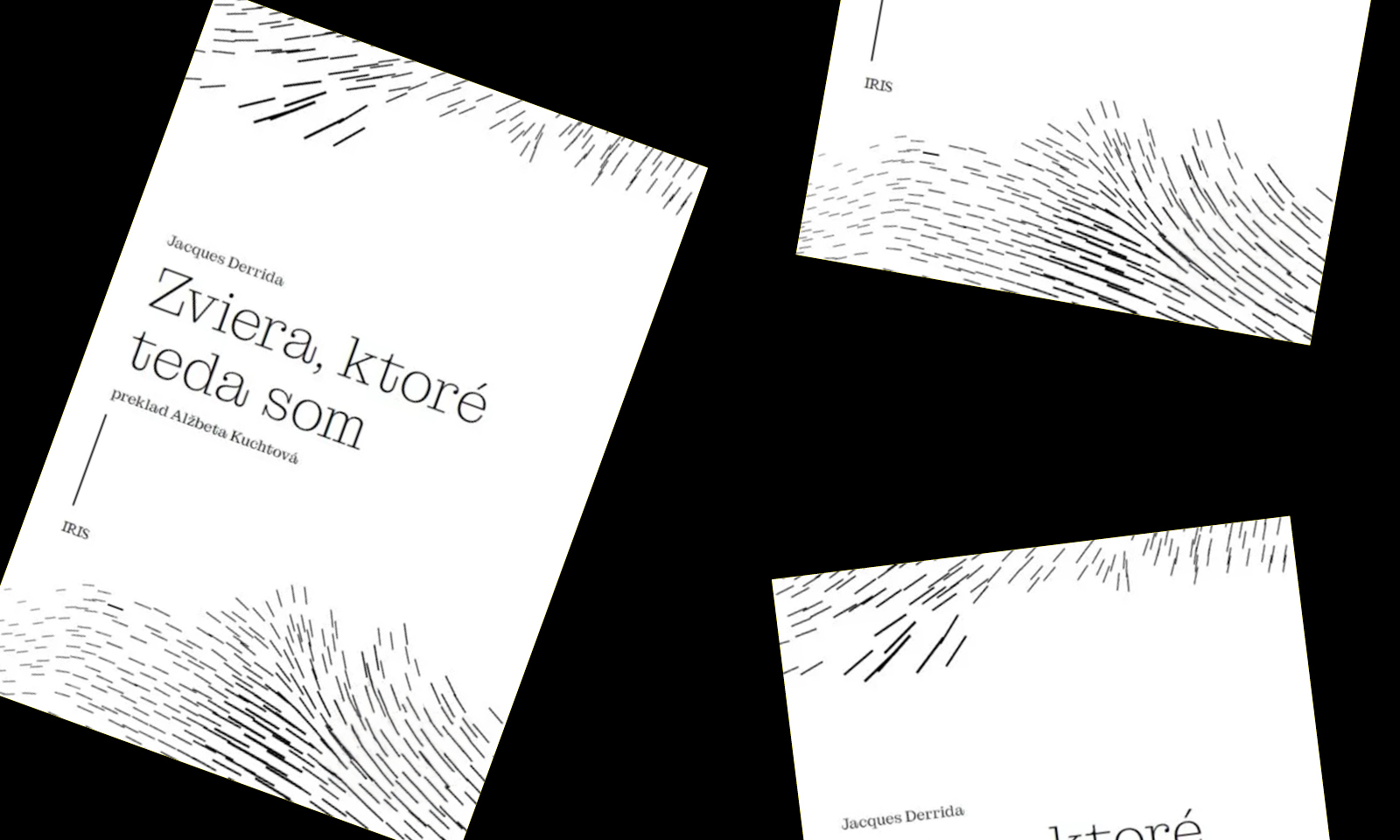
On bookstore shelves, the first Slovak translation of Jacques Derrida's L’animal que donc je suis recently appeared under the title The Animal That I Am Therefore . Derrida in the book examines how the dominant Western philosophical tradition has created a hierarchical boundary between human and non-human animals.
The first Slovak translation of Jacques Derrida's L’animal que donc je suis has recently appeared on bookstore shelves under the title Animal, That Is What I Am. In the book, Derrida examines how the dominant Western philosophical tradition has created a hierarchical boundary between human and non-human animals.
From Aristotle to Lacan, he traces a recurring pattern in which "Man" reserves speech, reason, thought, and many other abilities, while "Animal" is defined by their supposed lack. Derrida deconstructs this opposition. He does not deny differences among various forms of life; rather, he questions the idea of a single, impermeable boundary between the abstract categories of "Man" and "Animal." Instead of a universal category of "Animal," he emphasizes the plurality of creatures and the differences among them. The neologisms "l’animot" and "limitrofia" simultaneously demonstrate how inherited language not only describes but also creates and sustains the boundary between humans and other animals.
In the bathroom with a cat
The starting point of the text is Derrida's early encounters with a cat, during which he finds himself naked. At that moment, he realizes he is not the only one watching. Just as he sees the cat, the cat also sees him. For him, the cat is not merely an object of human observation but a being with its own perspective. Traditional philosophy, according to Derrida, considered non-human animals as beings that humans observe, describe, and judge. However, it did not acknowledge that some of them can also look at humans and have their own perspective. The cat's gaze thus disrupts the traditional division of roles, which makes the "Animal" a passive object and the "Human" a sovereign subject.
Derrida emphasizes the uniqueness of the cat standing before him. It is not an abstract symbol nor a representative of the feline species. The designations "cat," "species," and "animal" categorize it somewhere, but never fully capture it as a specific being. But who is this cat, when its uniqueness escapes the usual "boxes"? And who am I in front of its gaze? On what basis do I attribute abilities that I refuse to grant to other animals?
These questions remain open for Derrida, who returns to his own discomforts. Under the cat's gaze, he feels uneasy, ashamed of his nudity. At the same time, he is ashamed of feeling ashamed. Why should he be ashamed when the philosophical tradition denies non-human animals consciousness of nudity? He is ashamed because he stands naked like any other "animal," like the cat opposite him. Or is it because, as a "human," he is aware of his nudity? Derrida does not decide whether cats can experience shame. However, he questions the certainty with which the philosophical tradition has reserved shame for humans, as well as clothing and awareness of nudity, transforming them into another boundary between "Human" and "Animal."
"Human" and "Animal" in opposition
Looking at history, Derrida examines how influential philosophers have created the boundary between humans and other animals. He finds this logic in the book Genesis and later in Aristotle, Descartes, Kant, Heidegger, Levinas, and Lacan. Philosophers declare as decisive those abilities they consider exclusively human. They attribute to humans reason, speech, thought, the ability to respond or think symbolically. The absence of these abilities is regarded as a deficiency, thus establishing a boundary between human and non-human animals.
Derrida does not believe that all animal species possess the same abilities nor that there are no differences among them. However, he emphasizes that the difference from humans need not be a deficiency. He criticizes philosophical concepts that lump all non-human animals into a homogeneous category of "Animal," deny them certain abilities, and use this supposed deficiency to create a hierarchical boundary. To challenge the general category of "Animal," he introduces the neologism "l’animot."
This term is a wordplay. "Animaux" in French means "animals," the plural of "animal." "Animot" is pronounced the same as "animaux" because the final "t" is silent. In written form, however, "mot" means "word." Derrida thus reminds us that the general category of "Animal" is a result of human naming. Summarizing all non-human animals under such a broad category is not only a conceptual mistake but also a crime against them. Non-human animals represent a multiplicity of ways of life, relationships, and differences; their "plurality cannot be simply grouped into one animal figure in opposition to humans." Or, in other words, "there is no such thing as an Animal in the singular, general form."
By using the term "animal" as a general designation for all non-human animals, we place ourselves outside this category, as if we have nothing in common with them. This creates a chasm between "human" and "animal." According to Derrida, such oppositional terms are usually in a power imbalance. The side that names has the advantage, while the named side is denied the possibility of speaking. "Human" thus appropriates the right to control the lives of other beings. At the same time, it denies them the ability to name or respond.
Derrida continues with the wordplay. The article "l’" indicates singular, even though "animot" sounds like the plural "animaux." This tension shows that a single, general word cannot encompass the "multiplicity" of beings it names: differences among a lizard, a dog, an elephant, or a cat can be significant. But the goal is not to eliminate all distinctions that set "humans" apart from other "animals." Instead, he proposes another approach, limitrofia: to multiply and complicate the forms of boundaries and to examine their origins, histories, and transformations.
Compassion as a possible starting point for ethics
The philosophers Derrida criticizes seek active abilities that would distinguish humans from other animals. Something that can be possessed and used. He aims to disrupt the logic that derives the status of a being from what it can do. Instead, he focuses on something passive that can happen to humans and other beings—something over which a living creature has no complete control. He revisits Bentham's question of whether non-human animals can suffer.
Derrida assigns extraordinary importance to the capacity to suffer. He points to undeniable suffering of certain non-human animals and our responsibility towards them, despite their supposed lack of abilities considered exclusively human. He clearly condemns industrial farming, killing, and experimenting on non-human animals, as well as organized cover-ups of such violence. He considers compassion a possible basis for rethinking ethics, law, and politics. Moreover, he emphasizes vulnerability and mortality, which humans share with other animals.
The animal rights movement has long pointed out the suffering of non-human animals before Derrida's work. He regards the political and ethical impulse of this movement as significant. However, he sees a problem in the very concept of rights. The dominant legal and philosophical tradition associates rights with an autonomous subject capable of bearing obligations, and thus does not consider non-human animals as beings that can have rights. Extending rights to non-human animals may still preserve the opposition between humans and other animals. Humans remain the norm by which other beings are judged. Is it even possible to extend the concept of rights to non-human animals without reevaluating the very notion of rights? Derrida deeply develops the critique of anthropocentrism but does not specify what a new understanding of rights and duties should look like.
The cat's perspective reveals more
Although the call for compassion is desirable, how can it be fulfilled when humans can very effectively suppress compassion and ignore the suffering of their own and other species? Derrida's approach also has limitations. When considering the cat's gaze, he insufficiently attends to its own feelings or desires. Not that he is entirely uninterested in it; most of his attention is absorbed by his own feelings of shame and criticism of other philosophers. The cat's perspective, despite acknowledging its uniqueness, becomes primarily a mirror of Derrida's own reflections. Its feelings, desires, and interests remain aside. According to Donna Haraway, Derrida does not take the opportunity to learn something new from the mutual contact with the cat, about it, and with it.
The very presence of the cat in Derrida's apartment also points to something important. Cats, as well as other domesticated non-human animals, do not appear in human dwellings without reason. Derrida suggests that domestication has a long history linked to human violence. Taming, training, cloning, or acculturation into the human environment produce new animal figures that can seem "monstrous." However, Derrida does not further systematically develop this theme, which is a pity. It would be interesting to explore how he would confront domestication as a power-imbalanced relationship, through which many people encounter "their animals" every morning and, in the name of care, continue to reproduce their obedience, dependence, "monstrosity" created by humans, and reinforce their own power. In domestication, humans decide on breeding, reproduction, movement, and living conditions without prior consent from non-human animals. This trait is characteristic of other practices of human dominance, which Derrida also distances himself from in the text.
Transforming boundaries
Derrida rejects the idea of a simple boundary between humans and other animals. Instead, he wants to observe the shifting differences among various forms of life and examine how boundaries are divided and take on different forms. It sounds complicated, but it is not difficult. Consider the philosopher Jacques Lacan's idea that humans can respond, while non-human animals only react to stimuli. Derrida objects that even human responses contain elements of reaction, such as repetition, habit, unconscious processes, and automatism. The difference between reaction and response does not disappear. However, he questions the notion that there is a pure and indivisible boundary between them that also separates all humans from all non-human animals.
Although Derrida complicates this boundary, the difference between humans and non-human animals remains central to his attention. But why start from there? Philosopher Matthew Calarco proposes postponing the search for a difference between humans and other animals. Individual beings and their relationships can be examined without a pre-established boundary between the human and the non-human. Instead, one can investigate how a particular being in a specific situation responds, reacts, learns, or changes its behavior. The differences that emerge in this process need not mirror the boundary between humans and other animals. From this idea, it can also be inferred that we may not need to categorize or even study non-human animals at all; we can step back from the need to interfere in their lives and simply let them live.
Humans, however, did not create the boundary only between themselves and other animals. They also enter into relationships with other non-human entities, such as plants, fungi, microorganisms, species, ecosystems, rivers, or mountains. It may seem that Derrida shows little interest in them because his work primarily focuses on animals. But this is not entirely true. In an interview with philosopher Jean-Luc Nancym from 1989, he states that "nothing should be excluded." He used the term "animal" for practical reasons as a "reference point that is as classic as it is dogmatic." The book also touches on the boundaries between humans and nature, animal and plant, living and dead, or organic and inorganic. While he only briefly addresses these boundaries, his way of thinking can be used to question them. Derrida's approach in this regard is continued by the contemporary philosophical movement called eco-deconstruction.
It’s not just about language
Animal, That Is What I Am is not a leisurely read. A continuous line in the book is hard to find. Derrida's reasoning resembles a tree that unpredictably branches into many intertwined twigs. During my first reading, I often paused and wondered whether the branches had grown differently just moments before or if I was still looking at the same tree. The branching of the book is partly due to it originating from a long conference speech, and its last chapter is a transcript of an improvised lecture. For readers unaccustomed to Derrida's texts, I recommend patience, curiosity, and especially secondary literature. Today, many quality texts clarify Derrida's ideas and show that they are often less complicated than their presentation.
It is worth asking why one should bother reading this book at all. Perhaps because the practices it criticizes still persist, and every perspective that can challenge them is meaningful. Derrida, however, does not start with the question of how we should behave toward other animals. He first examines the assumptions from which this question arises. How did we even come to the idea that, on one side, there is the ruling "Human" and, on the other, the controlled "Animal"? Derrida investigates the linguistic and philosophical assumptions of the hierarchy that justifies such behavior. His insights can inspire changes in everyday behavior and social structures. This way of thinking has also influenced contemporary philosophy, where Derrida's critique is echoed by several posthumanist and new materialist approaches. His ideas are further developed or criticized by some ecofeminist currents and the field of critical animal studies.
Derrida acknowledges the uniqueness of the cat but pays more attention to his own feeling of shame about nudity. Usually, we feel shame and blush when something about us may not be acceptable to others. In certain situations in Western society, this feeling is triggered precisely by the naked body. The cat probably does not judge his nudity according to human norms, yet he observes it. Derrida's shame, therefore, is not only a reaction to a breach of human dress codes but also expresses the uncertainty of a person who, under the gaze of another being, becomes the observed himself.
We can also perceive shame more broadly. This emotion becomes entirely appropriate when we consider our behavior toward non-human animals and other entities. Along with Derrida's critique of anthropocentrism, shame can lead to a change in how we think and speak about other beings, thereby disrupting relationships based on dominance. Feelings and thoughts alone are not enough unless they lead to a change in our actions. Ultimately, Derrida himself recognized that it is not only about emotions and language.
Author's note:
To emphasize that humans biologically belong to the animal kingdom, the text uses expressions like "human/humans and other/other animals" and "human and non-human animals." Common terms "humans," "man," and "animals" are placed in quotation marks where they appear as opposing categories. These indicate a critical distance and warn that such usage is not neutral naming but reflects historically rooted, generalized, and hierarchically arranged categories. "Human" and "Animal" with capital letters denote abstract categories of traditional philosophy, not specific beings. Quotation marks again express critical distance, while capital letters emphasize the generality and abstractness of these categories.