"Pitch Your Single Friend," or dates for Tinder skeptics
Krytyka Polityczna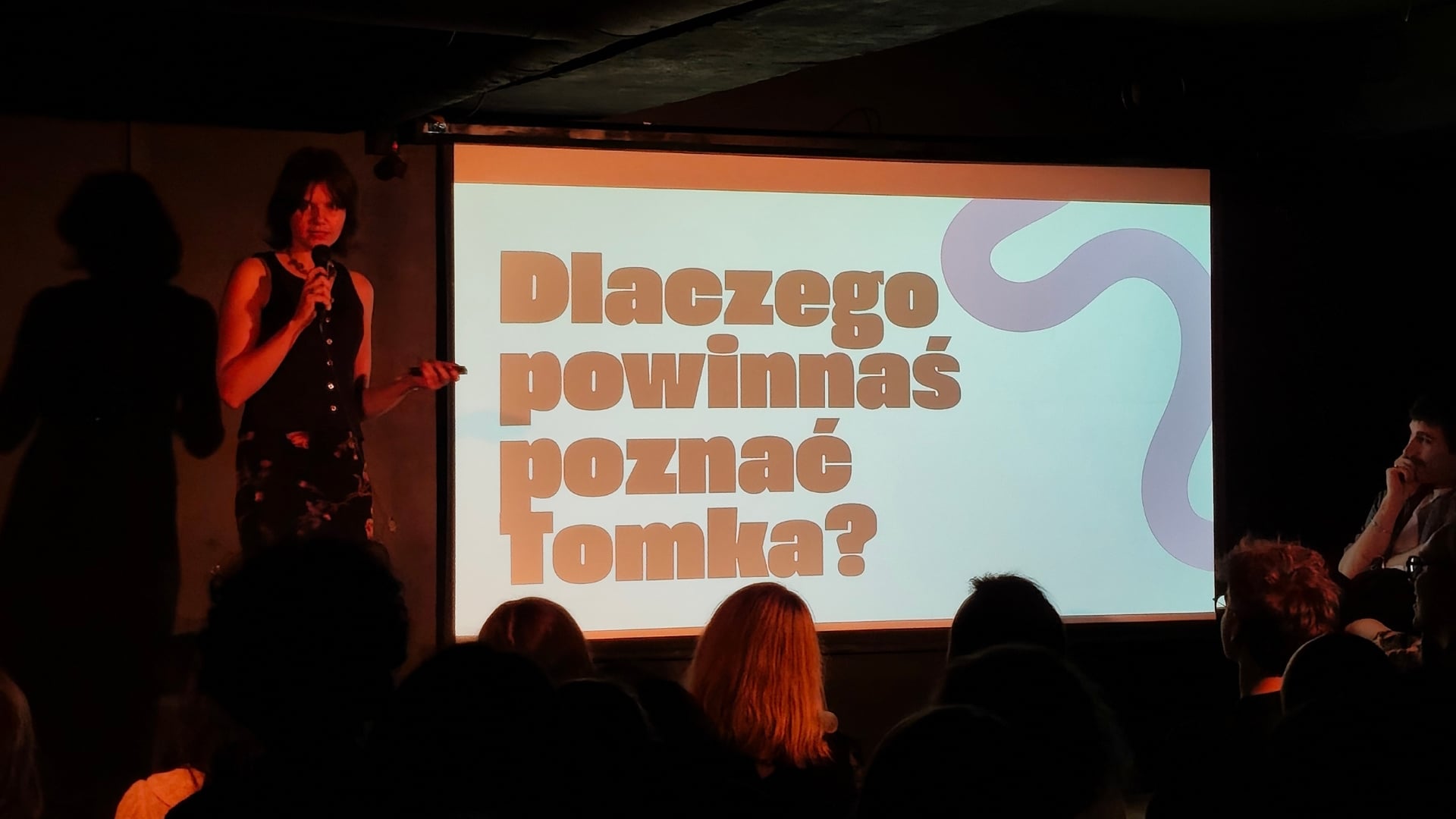
We avoid words like "matchmaking" or "speed dating." I would call it a platform for meeting and chatting without matching – say the organizers who adapted the American dating format to the Polish context. The post "Pitch Your Single Friend," that is, dates for Tinder skeptics, first appeared on Krytyka Polityczna.
Kamila knows that dating apps are hell, so she steps onto the stage at the Comedy Resort, grabs the microphone, and presents the first slide:
– Why should you meet Tomek? I'll explain – she begins, and for the next five minutes, tries to answer this question.
– Even though he has a mustache, he won't manipulate you – she reassures. – If you make a choice and set up a date with Tomek right now, you'll get a free Pępuszek cat. Tomek is participating in a draw for a marathon in Paris. He cares about other people. He is a vegan.
The man described sits on the stage a few meters from Kamila and, together with a hundred audience members, looks at the screen where his photos and description are flashing. Maybe he'll find a partner today. Or at least arrange a few dates.
That evening, Kamila will also get her pitch.
– This is Kamila – Tomek introduces her as a free friend. This is the only duet of the evening where the pitch recipient and the pitcher switch roles.
From Tomek's presentation about Kamila, we learn that she is 24 years old, 178 cm tall, has higher education, two cats. She is easy to impress, doesn't eat meat, and her type of man is a mustached guy.
The slide with a list of green flags is very long. Tomek claims that Kamila is: caring, sensitive, cooks well, likes dancing, is unconvicted, loyal, funny, creative, and vaccinated.
Only one red flag: she still contacts her ex.
– That's me, her ex – Tomek admits, and the room stirs with laughter and movement.
– Because you don't know her cats' names? – someone from the audience teases, pointing out that Tomek hesitated on the slide about pets.
– She adopted the cats after breaking up.
– Why did you break up? – another person from the audience asks.
Tomek explains briefly: she wanted children, he didn't. Everything matches, so they can move on to the next presentation.
Polish "Pitch Your Single Friend"
The event is based on the American dating format – friends prepare presentations about their single friends. During one event, there are eight presentations.
So far, four such events have taken place in Poland. The last one – at the end of September at the Warsaw Comedy Resort. Although the pitch format sounds dignified and corporate, you can hear:
– My friend and I know each other longer than we don't. She's looking for a red-haired man.
– My friend is looking for a girl who will agree to go to Sopot for waffles at night and come back in the morning to work.
– My friend was the face of a dairy cooperative.
Presentations vary – some focus on the "specifications" of the friend (height, interest in physical exercises, ability to build a four-meter snowman), others on the strength of friendship (memories of joint trips, beautiful moments playing jazz for cows). Some presenters do so well that they captivate the crowd with charisma and humor. Others are noticeably tense, confused, and stumble over words, lowering their gaze. Almost a hundred strangers watch them from the audience.
Compared to the American version, the Polish one resembles more a big house party. In Los Angeles, similar events gather even two thousand people. They are held in large halls, like professional conferences. Coordinating such large initiatives requires a special system, a newsletter, sending reminders. When the organizers of the Polish pitch contact Americans, they offer to share tools for $200 a month.
– That's what we earn from the whole event. It doesn't fit Polish realities, considering our finances and the need for an intimate atmosphere. We'll do it our way – they comment and refuse.
The Powerpuff Girls invite you to a market
The Polish edition is created by three women, endowed with a need to help others like social hybrids of Eros and the Powerpuff Girls: Maria, Misia, and Kasia.
Kasia is 35, a project manager at DKMS and a theatrical improviser.
Misia is 39, creates communication for non-governmental organizations and small Polish brands. During work hours and after – she is a mother. She is annoyed by dating apps and the commercialization of social needs.
Maria is 40, and she came up with the idea to organize the whole venture. She manages IT projects daily. She has long felt the need to do something more, to go beyond professional interests.
In October, she broke her arm, gained free time. She came across a mention of "Pitch Your Single Friend" from the USA, started following the topic. She sent the mention to Misia and Kasia. Both reacted enthusiastically.
– Shall we do it? – she asked.
Misia and Kasia didn't know each other before, but the dating project united them into a trio.
First, they had to gather applications, check if anyone was interested.
– We made a short form where you write who you are and why you want to invite a friend to the pitch. We consider the order of applications because that's the fairest way – Maria explains. – Of course, if someone wrote in the application that their friend is a Hitler fan, we might think about it, but apart from that, we give everyone a chance. We want people from different circles to come.
Maria stays in contact with the first eight applicants. Sometimes they drop out – by the event, they might meet someone, change their mind. Then, people from the reserve list step in.
There are many applications, as well as interest in filling the audience. Tickets for events in Warsaw sell out two weeks before, and people keep asking if they can squeeze someone in despite no available spots.
The idea is partly businesslike, like a corporate project meeting, and partly retro, like being set up by an aunt who talks about your assets at a wedding. Many people have such associations. The organizers are aware of this but emphasize they prefer to avoid capitalist terminology:
– We avoid words like "matchmaking" or "speed dating." I would call it a platform for meeting and chatting without matching. Some call it "selling a friend," and see the presentations as pitch decks in a corporation. We think of it more like organizing a market where you can rummage through different clothes – Misia and Maria explain.
Is this the end of dating apps?
During the break between presentations, I catch Tomek and Kamila.
– We came here because how much can you sit on dating apps? – Tomek comments. – Of course, we both have them, it's hard to give them up, especially if you work remotely and have only a handful of friends.
Tomek tests Hinge with hope. According to its creators, this app is supposed to be different from other dating apps – without ads and "designed to be deleted." Hinge boasts that it exists to connect people, not to addict them to the platform. For this reason, it has added tools like comment options or answering specific questions on profiles, which are meant to facilitate starting a conversation. Is this just a prelude to transforming into Tinder for alt-people? We'll see.
Saying that dating apps have become boring is an understatement. A whole horde of heterosexual friends tells me about frustration and the senselessness of endless swiping. They hate not only using Tinder but the very idea of finding someone there – the internet is full of sketches about people met through apps, and on Facebook, a popular group called "Tinder Bastards" warns women about "bastards" (scammers, losers, you name it). Screenshots of embarrassing conversations could easily overload a toxicology ward, and almost every Tinder user has a strange anecdote to tell in the waiting room between relationships.
According to research, using dating apps is frustrating. Of course, the researchers didn't phrase it that way, but they probably would have if not constrained by academic decorum, so I allow myself to state it for them. They do show that quick, instinctive swiping correlates with lower self-esteem, and the problem lies in the app's mechanism itself.
In 2024, they observed dating app users for three months. It quickly became clear that burnout and frustration are constant elements of swiping, while older matrimonial portals did not evoke such negative feelings.
This emotion fuels the wings of Hinge – an app positioning itself as a remedy for dating burnout (dating app burnout) and swipe fatigue (swipe fatigue). Although it was founded in 2012, it is only now gaining popularity in Poland.
Beyond beating the drum that Generation Z spends less time meeting people than those 20 years older, the app creators see user frustration. After all, if more and more people switch to offline dating, it will reduce the platform's relevance. Bumble has abandoned the swipe feature, Tinder organizes live dating events, and Hinge emphasizes that it wants to save lonely people and persuade them to delete the app. Of course, Hinge isn't exactly a noble hero. It belongs to Match Group, owner of Tinder, and besides the free version, it offers subscriptions Hinge+ and HingeX, which give users premium features like seeing upcoming likes.
After the pitch
Meeting strangers live, a funny presentation, audience enthusiasm – all together are supposed to act as an antidote. After eight singles' presentations, it's time for interactions and fun: flirt cards, chats, leaving messages, chips. The organizers also devised a visual system to facilitate conversation: wristbands signaling that you're open to contact.
– You can tie a wristband to the person next to you, that's always the beginning of intimacy – they tease from the stage.
Two weeks after the pitch, I ask Tomek whether he or his ex found someone at the market full of singles.
– No – he replies.
So, the story doesn't have a happy ending, but for the sake of this text, Tomek didn't go back to his ex either.
– During the pitch, someone introduced our friend. He hadn't gone on dates for many years, couldn't bring himself to – say Maria, Kasia, and Misia. – The pitch helped him open up, he went on a few dates.
People participating in the pitch approach them on the street, say they succeeded – they liked someone from the stage or the audience.
The organizers have many ideas for developing the format: spin-offs with previous participants, queer pitches, maybe even friendly ones.
– After the last pitch, a guy approached me who was presenting a friend and said that his girlfriend is very shy, has no female friends. If a friendly pitch event were created, not just romantic, he would gladly send her. There are probably more such people – Maria believes.
The post "Pitch Your Single Friend," or dates for Tinder-skeptics first appeared on Krytyka Polityczna.