Marco Rubio at the Acropolis. What kind of West does MAGA actually defend?
Krytyka Polityczna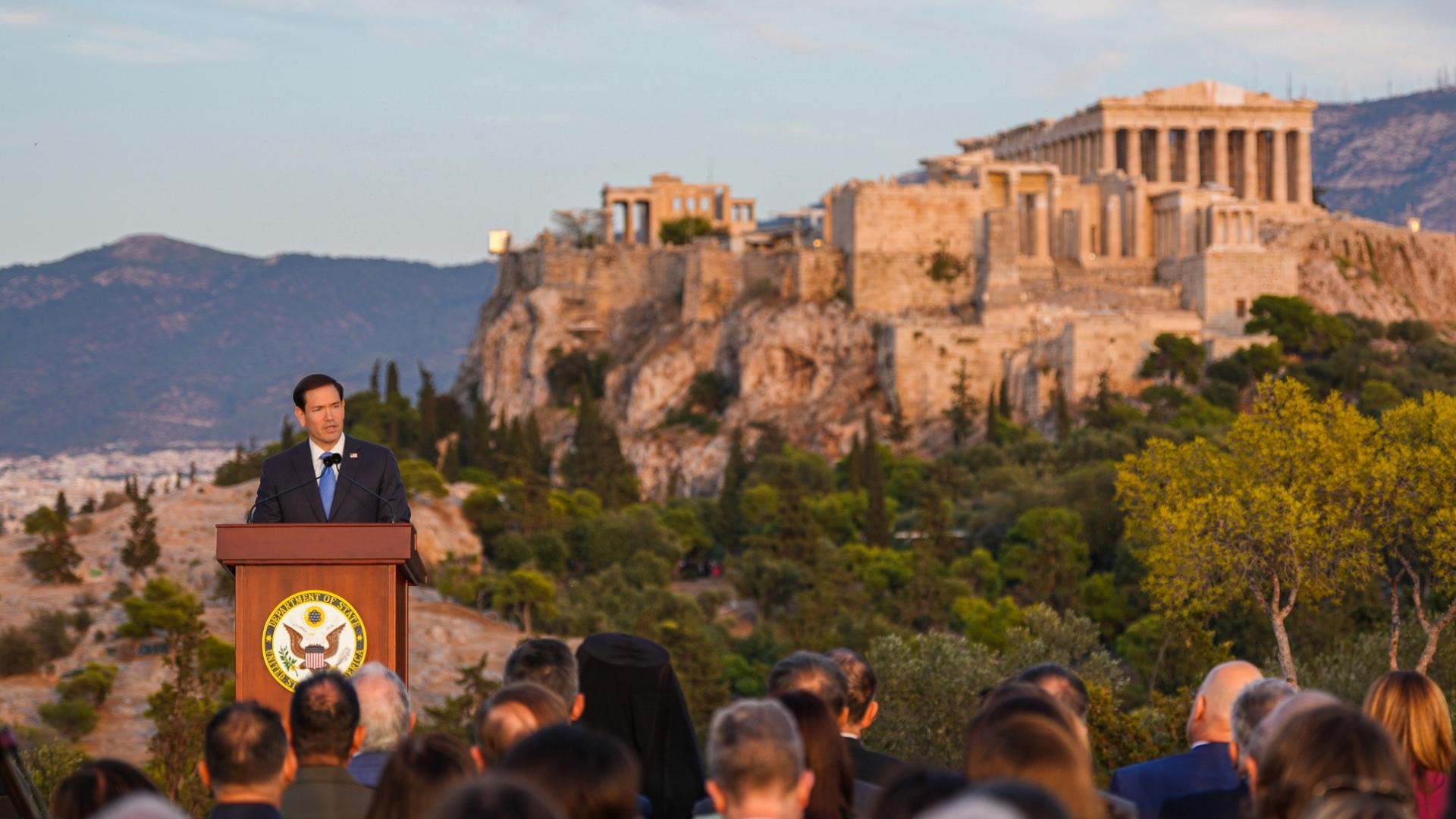
The West has many problems and faces a multitude of challenges, but MAGA’s reactionary Prometheanism is yet another threat to its survival, not a solution. The post Marco Rubio on the Acropolis. What kind of West does MAGA actually defend? first appeared on Krytyka Polityczna.
During his visit to Greece, U.S. Secretary of State Marco Rubio delivered a speech with the Acropolis as its backdrop. It was a very carefully produced event, as if the Republican's team were already preparing footage for a possible presidential campaign in 2028. Rubio used the moment to pay tribute to ancient Greece as one of the most important sources of Western civilization.
That was the main subject of his speech. More specifically, its crisis. Like almost the entire radical right, Rubio painted a vision in Athens of the decline of the West, caused by Western societies' rejection of its foundational values. “We tore down our own monuments, condemned our own history. And in too many places we began to teach our children to be ashamed of the countries they will inherit. At the same time, we opened our borders, moved our industries beyond them, and allowed our armed forces to grow weak,” the politician said.
This crisis, Rubio argued, is not the West's inevitable destiny, but the result of bad political choices. The choice made by Americans in November 2024 offers hope that – he continued – under President Trump's leadership, the West will be reborn, return to its roots, and once again win for itself its rightful place in a world where powers hostile to Europe are growing stronger.
There are, however, two major problems with Rubio's civilizational narrative.
The Greece of Achilles, not Pericles
The first is philosophical in nature and relates to how we actually understand the West and what truly makes it worth defending. Because unfortunately, MAGA wants to defend the West for the wrong reasons and not in the name of those values and traditions that constitute the greatest treasure of the Western heritage.
As Harvard philosopher Mathias Risse pointed out in his analysis of Rubio's speech, although the U.S. secretary of state initially invoked the construction of the Parthenon in the time of Pericles, he went on to celebrate not the democratic Greece of Pericles, but the aristocratic Greece of Achilles.
Praising the ancients, Rubio said: “They believed – and very strongly – in the ideal of the great man: an exceptional individual capable of achieving immortality through his deeds. They also believed in glory and fame, in values that can be achieved only through effort and sacrifice for something greater than ourselves. The history of ancient Greece is full of heroes ready to pay any price for a cause worthy of their loyalty.”
This is more the world of the Iliad than of the democratic agora. The latter was undoubtedly also a place of disputes and competition for fame and glory, but at the same time Athenian democracy created a system for restraining and controlling the ambitions and excesses of “great men” through the democratic community. This part of the Greek heritage was absent from Rubio's speech, both in the section devoted to Greece and in the one devoted to the contemporary West.
For Rubio, the history of the West is above all the history of “great men” performing great deeds: explorers arriving on the shores of new continents, missionaries bringing Western faith there, conquerors expanding the borders of their empires, inventors and engineers capable of harnessing the forces of nature and radically transforming reality with the help of machines.
Such an understanding of the West loses sight of what is truly distinctive about it and genuinely worth protecting. It is not conquerors and explorers – they could also be Mongols, Chinese, or Polynesians. What constitutes the true treasure of the West is the idea of citizenship, the universalism of human rights, and the ability to critically question its own assumptions (for example, to recognize that some heroes of the past no longer deserve monuments today).
The West is not conquistadors on ships or horses, but a city-state whose inhabitants meet as fellow citizens. It is a medieval urban corporation or an autonomous university. Finally, it is a parliament, where the interests, values, and demands of citizens are translated into government policy. It is the idea that, as a rule, all people are, at a certain basic level, anthropologically equal and should enjoy the same rights, which cannot be taken away from them under any circumstances.
This is the heritage worth defending in the face of a possible “Chinese century.”
Reactionary Prometheanism
This perspective was entirely absent from Rubio's speech. The secretary of state mentioned democracy and citizenship in a single sentence, clearly attaching little importance to these ideas. The perspective of human rights did not appear in his speech at all. This is hardly surprising, given the way the administration he represents approaches them. Much of its support base – although Rubio himself does not necessarily come from the mainstream of American politics – considers human rights to be an expression and cause of the West's degeneration, an expression of “woke ideology,” a straitjacket constraining Western governments and preventing them from securing national interests, such as protecting the country from an “invasion of migrants.”
If I were to define the philosophical vision of the West presented by Rubio and often recurring in the MAGA narrative, I would say that it represents “reactionary Prometheanism.” It celebrates the Promethean spirit of the West, especially where it leads to discoveries and inventions that make it possible to harness nature and other, non-Western communities. It is, however, Prometheanism without any promise of social emancipation, serving conservative or even reactionary social and political goals.
This is best seen in the “technological” right allied with MAGA, which on the one hand adopts radically Promethean language, defending itself against any regulation of AI, imagining a world of widespread abundance that the development of artificial intelligence will provide, or an interplanetary civilization. It combines all this with overt hostility toward democracy and redistribution, with eugenic fantasies, and with hostility toward the emancipation of women and toward all the values and institutions that make contemporary Western democracies still the best place in the world to live.
Who in their right mind would entrust the future of the West to Trump and his people?
The West has many problems and faces a multitude of challenges, but MAGA's reactionary Prometheanism is another threat to its survival, not a solution. Besides – and this is the second fundamental problem with Rubio's speech – who in their right mind would place the future of the West in Trump's hands? A man whose aesthetic of governing as president resembles the satraps of Central Asia more than the republican traditions of the United States? Whose administration, in terms of corruption and incompetence, calls to mind late-Yeltsin Russia?
Since Trump returned to the White House, his administration has done much to divide and weaken the West. Conflicts with Canada and Denmark over Greenland, constant tensions in relations with the European Union, the attack on Iran hitting European economies, and finally the fuel deal with Putin, financing the Russian war machine whose repercussions are hitting NATO's eastern flank – has any of this made the West stronger or weaker? Has it strengthened or weakened American leadership?
Under the Parthenon, Marco Rubio invoked many Greek heroes and words of Greek origin. But the only Greek concept that fits Trump 2.0 is kakistocracy – rule by the worst.
The post Marco Rubio at the Acropolis. What kind of West does MAGA actually defend? first appeared on Krytyka Polityczna.