I’m interested in decay and run-down neighborhoods.
Kapitál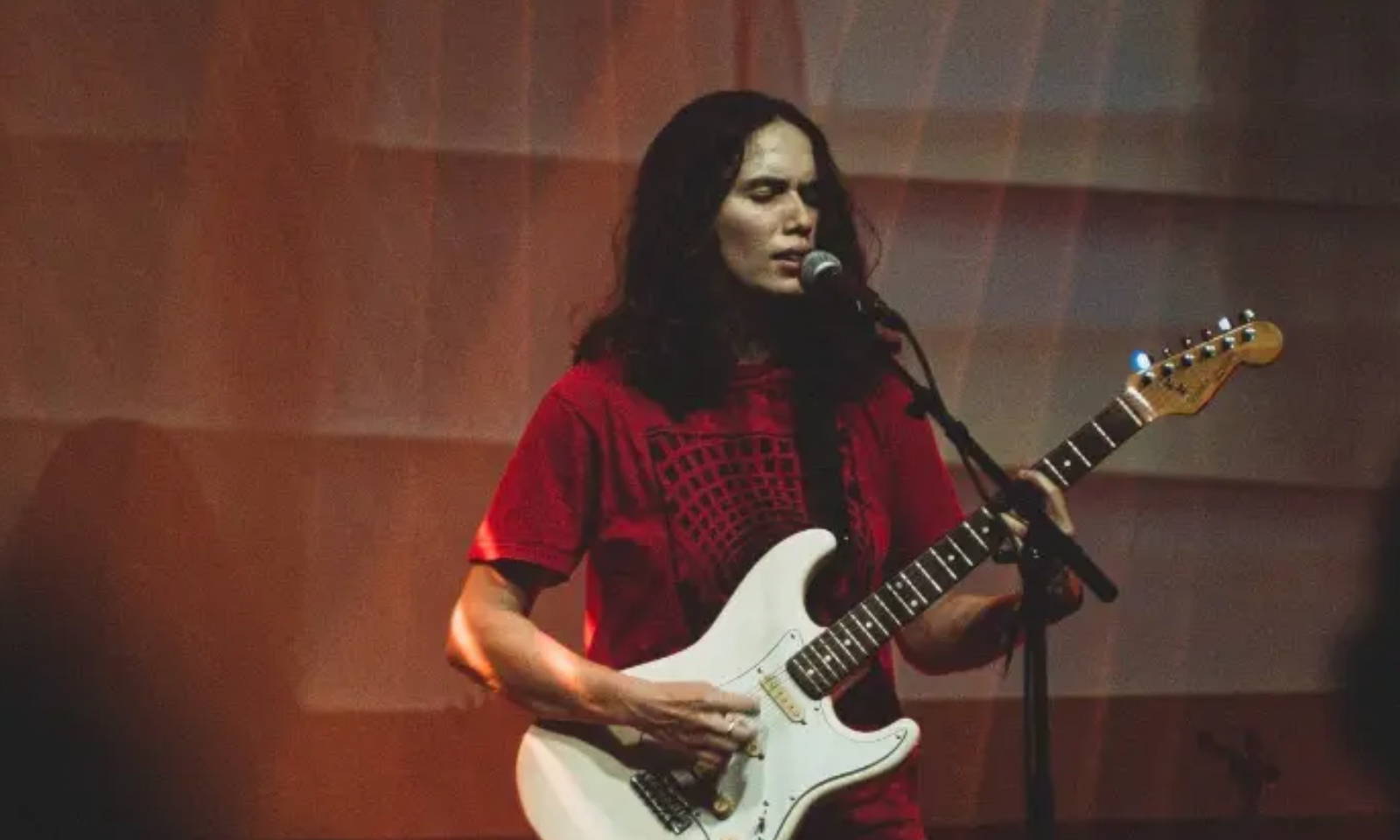
Some of Kathryn Mohr’s songs sound as though they were the result of staring into a defunct mine shaft for several hours. Her morbid track Elevator , for example, evokes precisely that. During a residency at a factory in Iceland, the California native apparently kept herself psychologically balanced in all sorts of ways. Her confrontations with the natural and industrial environments resulted in the accomplished 2025 album Waiting Room . The musician follows it up with this year’s recording Carve , which also leaves room for abstract interludes, though raw grunge takes center stage. At Kathryn Mohr’s Brno stop at Kabinet múz, we talked about more than just music. Among other things, she told me how difficult yet liberating it was for her to start talking about her injuries in front of others.
Some of Kathryn Mohr’s songs sound as if they were the result of staring into a malfunctioning shaft for several hours. Her morbid track Elevator, for instance, evokes precisely that. The California native presumably kept herself psychologically well during her residency at a factory in Iceland in all sorts of ways. Her confrontations with the natural and industrial environment resulted in the excellent 2025 album Waiting Room. The musician follows it up with this year’s recording Carve, which also makes room for abstract interludes, though raw grunge takes centre stage. At Kathryn Mohr’s Brno stop at Kabinet múz, we talked not only about music. Among other things, she told me how difficult yet liberating it was for her to start talking about her wounds in front of others.
In several interviews, you mention your positive attitude towards intensity. The fact that you drove yourself from Dresden to Brno fits in with that quite well. I assume you didn’t have time to take in the views?
No, not at all. What’s more, it was my first time driving on European roads, so it was pretty chaotic. Everyone was surprised that I had rented a car and was moving between the individual stops on my tour by myself. That’s exactly why I did it, though. After Berlin, Siem Reap will join me, and from then on we’ll travel in his van.
Apparently you like driving.
Yes, in California you really can’t get by without a driving licence. So I found a certain source of peace in driving out of necessity. European trains and other forms of public transport are great, but I wouldn’t get very far on my own with that huge box of merch, equipment and guitars.
Your debut album Waiting Room (2025) was created during a longer stay at Icelandic Sköpunarmiðstöðin – today also known as The Factory. Herring used to be processed there; today it is a cultural space. Did the building’s working class history influence you while creating the album?
American working people across the lower and middle classes definitely interest me thematically. In Iceland, though, it was different, since I went there as a tourist. That’s also why I feel it prevented me from experiencing the genius loci of the place more deeply. Nevertheless, it was a fascinating story for me. When the factory stopped production, the local population had to travel long hours every day for work.
What did your daily routine during the residency look like?
I didn’t have one. I didn’t follow a calendar, only the sun. Which was strange, because in my opinion it set late and rose very early. So I made a lot of music in the morning. When I’d had enough of it – most often in the afternoon –, I simply went for a walk in the mountains and recorded some field recordings. And that’s what every day looked like. There were no marked trails in the Icelandic landscape – I just followed them through the tall grass up over the rocks. Iceland has beautiful nature.
I have to say that on the record, you managed to capture the transitions from the factory to the Icelandic landscape through sound.
Thank you. By the way, do you have Radiohead tattooed on your arm?
Yes, and it’s great that you noticed, because I’d completely forgotten about them. Do you think some of Yorke’s style has also left its mark on your work?
A few people have already told me that my sound reminds them of Thom Yorke. He has amazing lyrics, and above all, he knows how to connect them with melodies. Radiohead were a formative band for me in my teenage years.
When did you realise that methodical work focused on a single place was right for you?
Not really until the residency. For me personally, it was a major experiment – travelling abroad alone. I had no idea whether anything would come of it at all. I function quite intuitively. I also prepared my second album during an artistic residency, but it was somewhat shorter than the stay in Iceland. When thinking about a third album, I tell myself that I’d like to go somewhere for a longer period. But I also have to think about many things – for example, taking time off from my regular job or a budget that I simply can’t expand.
Our world as an ordinary cell
What does Flenser mean to you – the independent record label that is also home to bands such as Have a Nice Life, Agriculture and Chat Pile?
I’ve always considered it a path that allows me to meet people with similar values within music. Everything revolves around our dark music as if around the sun. A large portion of the work by others in the label’s catalogue resonates very strongly with me. The America they describe is the one I grew up in, exactly as I remember it. I’m interested in decay and people from the peripheries, who are often forgotten. So much life and honesty is hidden in neglected neighbourhoods. I’m trying to find a precise word that captures that feeling, but it’s really something cleansed of romanticisation and artificial beauty.
On Bandcamp, I found quite a funny comment about your new album Carve (2026), comparing you and another label project – Midwife – to a pair of characters from a famous video game: the good Super Mario and his antagonist Wario. Did Madeline Johnston, who hides behind the aforementioned pseudonym, help you find your creative identity?
OK, I hadn’t seen that (laughs). But I don’t know how I could be her evil counterpart, since Midwife is quite dark in itself. Working with Madeline was very important to me; without her, I probably wouldn’t have released anything.
I did record one thing, but I was sure I’d done it wrong. She taught me, however, that there is nothing “wrong” in making music. At the beginning, many things can hold you back when creating music. You tell yourself, “I can’t afford to record in a studio like this, I can’t possibly do this or that,” but that’s not how it is. You can do the whole thing in GarageBand. Madeline taught me all of that, and my first recordings were made in co-production with her.
While working on the album Carve, you drove somewhere into the middle of the Mojave Desert and booked a prison cell through AirBnB. Why?
There was no symbolism behind it. I went there because it was the cheapest accommodation in California. It had a concrete floor and no running water. It’s quite funny that they converted the building into a prison; originally it was supposed to be a family friendly Western town. Someone at Flenser must have liked the story about the bars so much that they built the album’s annotation around it.
Good to know, because I was already going to explore the prison mentality...
At that time, I was going through an emotionally intense period. A long tour had ended, and the exhaustion from it collided with personal distress. A lot was changing around me. It was very unpleasant for me to move from a period of total isolation into a state where I had to open up to people. I’m a great loner even when I’m surrounded by people. But I sensed that I should finally confront the whole thing. It’s very difficult for me to open up in a way that doesn’t hurt too much. I’m grateful, though, that I didn’t completely isolate myself.
Can you compare the work on the two albums?
They were different projects. I do feel, though, that they are two sides of the same coin. While I focused on every detail with the album Waiting Room, the album Carve is more about explosive anger. It sounds as if all the emotions that had built up suddenly burst out of me.
Grunge is feminine
Forgive me for such a superficial comparison, but your riffing and energy reminded me quite a lot of PJ Harvey. When creating your own music, do you also listen to other musicians?
I usually get terribly annoyed when I listen to what I’m working on over and over again. My ears actually hurt from endlessly obsessively reworking little things. So when I want to stop torturing myself, I play other people’s music while driving. I listened to the aforementioned Polly Jean a lot this way, as well as Nirvana and Jason Molina’s work. I also like returning to my compatriot Cat Power.
Is it difficult for you to find femininity in grunge?
That’s interesting, because when I think about grunge, I mainly think of Courtney Love and her band Hole. Or Sonic Youth, which isn’t exactly this genre, but doesn’t stray too far from it. Of course, I love Kurt Cobain and Alice in Chains, although their charisma completely overshadowed the grunge women. I definitely think, however, that feminism can be felt behind their manliness. The most important recordings of the nineties seem powerful to me mainly because of the emotional charge and expressiveness of sensitive, self-aware men.
In the song Angle of Repose, you sing the refrain “Who cares?”. This apathy also seems more like a male than a female domain to me.
Well, the truth is, I care. Otherwise, I probably can’t judge whether that’s the case. But I won’t argue, gender really does play an important role in my life. Through it, I reflect on everything terrible that is happening in the world.
What place would you be unable to record your next album in?
At my workplace, because I work with children. It wouldn’t be possible because someone else would have to look after them instead of me. I also don’t consider the building of a special-needs kindergarten itself suitable for recording... If it had been abandoned for several years and I were returning to it, okay, maybe it could work.


The text is part of the PERSPECTIVES project - a new brand for independent, constructive and multiperspective journalism. The project is funded by the European Union. The views and opinions expressed are those of the author(s) and do not necessarily reflect the views and positions of the European Union or the European Education and Culture Executive Agency (EACEA). Neither the European Union nor EACEA can be held responsible for them.