October in Paris
Kapitál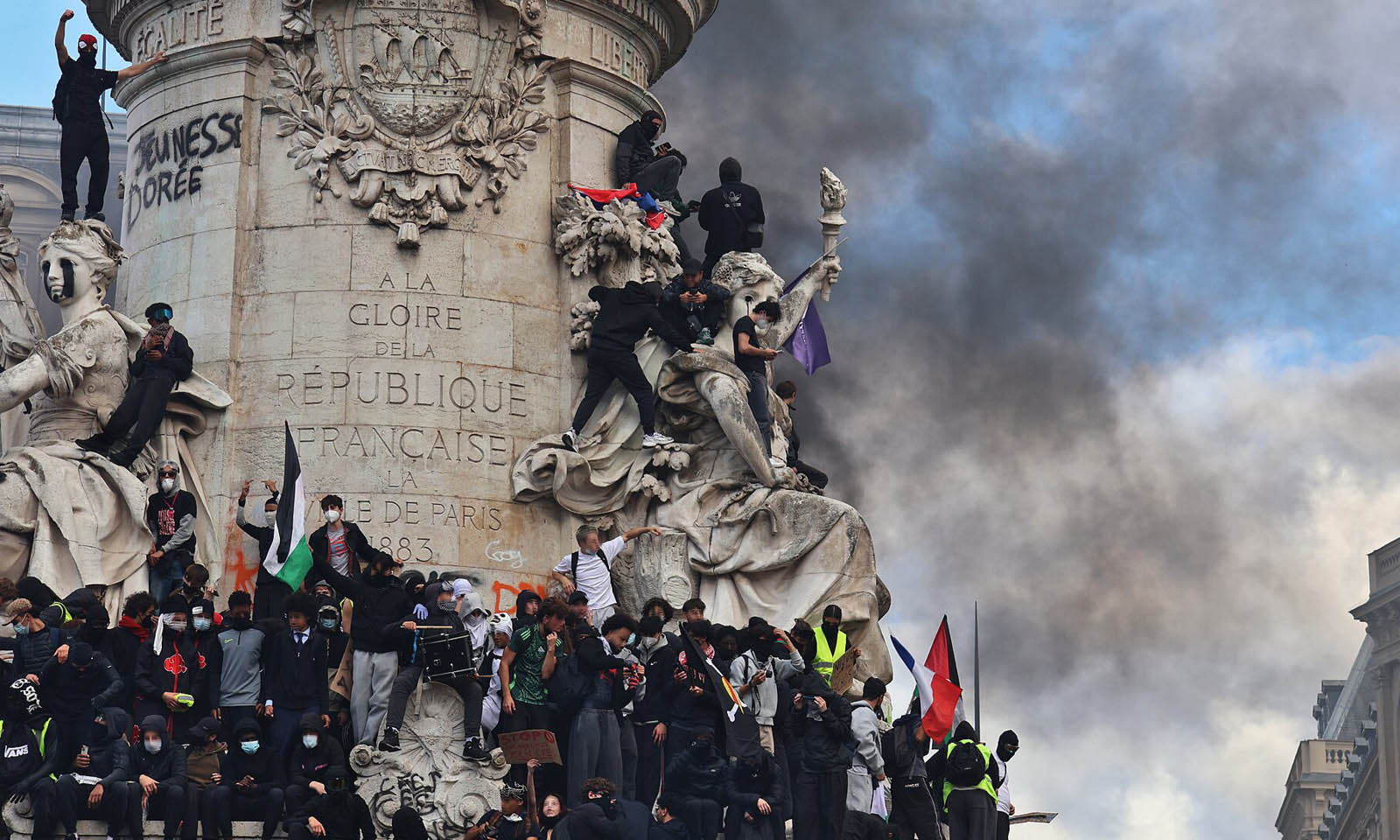
“One day we must write the history of our own insignificance—to reveal the density of our narcissism.” Roland Barthes, Empire of Signs If one wants to understand the essence of history, it is enough to compare Herod with the early press, writes Walter Benjamin in his essay Paris, Capital of the Nineteenth Century. Opinions about everything behind the mass protests in France usually arise largely from which part of the modern world their author comes from. If you are from those European countries in which, after 1989, a huge number of people could gradually be carried away by the normalized idea of the civilizational universality of the Euro-Atlantic world, identified with unlimited capitalism, you will very probably speak of a conspiracy by China, Iran, Islamists or Russia attacking “the garden of Europe” from the world’s “jungle”. If you are from France, or simply do not regard Western metropolises as a heavenly café where people like Baudelaire’s lizards bask directly at the entrance to paradise, and if you are additionally lucky enough not to be “afraid” to join the protesters, you will say that people “only” want to be able to afford food, receive a good education and not fear losing the roof over their heads. And if only there! Protests across Europe and throughout the modern world show that people are fed up with social inequality, double standards regarding the right to “humanity”, and maintaining the cultivated idea that colonialism ended with the declaration of independent states. And that they refuse to regard a society hijacked by billionaires, with the generous assistance of the manufactured consent of the Eastern European semiperiphery, as an imagined free world for all the “clever” ones. Paris Is Not a Dream Even when I first came to Paris, it was October. A beautiful warm autumn, and from the Gare du Nord I walked straight to Montmartre, where I slept for a while on a bench. One of the first Parisian images in my mind is of a Black woman who entered Sacré-Cœur just behind me. She crossed herself urgently, bowed to the ground, and I saw that it was not only her whole soul that was praying, but also, in the trembling of her body, all the desires of the people whose fates had brought her there. From the crown of blazing flames the Virgin at Chartres gazed upon me The blood of your Sacred Heart flooded me at Montmartre I am sick from it when I hear those blessed words The love I suffer is my secret illness And the image that possesses you will help you survive anxiety and wakefulness That image always dwells with you, fleeing never to return... With a gaze full of fire she went outside and disappeared into a sea of selfie sticks. On one of the walls, a spray-painted inscription shone: “Paris is not a dream.” When I emerged from the metro on 17 October this year, about two stops from the Place de la République, where another major announced demonstration was to begin at two o’clock, I smoothly joined the crowd of young people walking in the same direction as me. I was flooded by the pleasant feeling of realizing why I had ultimately fallen in love with Paris years ago. A city that is almost mythological in the imagination of people throughout the world had never been a “dream” for me, nor had it particularly attracted me. Too modern, too familiar, predatory and ruthless, too idealized, too contrived, chic. Yet I had underestimated the irresistible charm of the reverse side of this cauldron of modernity, this laboratory of European history and contrasts, this promise of hope for all the world’s outcasts. ... Tearful, you see the poor emigrants departing They believe in God, women pray and nurse their children Their smell fills the hall of the Saint-Lazare station Like the Three Kings they believe in their star, in future success They think that in Argentina their fate will change And that they will return home once they have made their fortune One family carries a little red banner like your heart That banner and our dreams are equally ghostly Some of the emigrants stay and linger here In the dens of rue des Rosiers or rue des Écouffes I often saw them in the evening go outside for some air Rarely moving from their place like chess pieces Most of them are Jews, and their women wear wigs Bloodless, they sit and watch over the dark shops... Except that today the Algerians, Tunisians, Senegalese, Congolese and people from the declining French countryside, who cannot find a place for themselves in the merciless machine of the metropolis, have replaced the Jews mentioned above in those dens. There is no poem about modernity like Apollinaire’s Zone ( Zone ). You are in Paris, questioned by the judge, arrested like a criminal and sent to prison... There is something uplifting in the fact that, despite the historical injustices and differences that separate people of all social classes and origins, precisely the universalism of which Immanuel Wallerstein wrote prevailed at the Paris demonstrations. This was at a time when, after the killing in Iraq and the effective leveling of Raqqa and Mosul, it was becoming clear that the previous universalist idea of exclusively European origin could never be just—it would always be racist and, as such, potentially generate fascism. Free trade , imposed by gunboats and computer-guided bombs, will direct its profits almost exclusively to the financial elites of Western Europe and the white settler-colonial states of North America and Australia. And freedom of labor will become a euphemism for slave labor. The People United Will Never Be Defeated The people around me are demanding on their banners exactly what has been the main cause of the protests for a month: better education, better housing conditions, less racially determined access to quality living conditions, rejection of oligarchic rule and opposition to support for armaments. Students dominate, along with clearly visible trade unionists and the yellow vests. People from Latin America express support for their compatriots at home, who at roughly the same time are facing violent police repression in Argentina, especially in Buenos Aires. And, as I later learn from sources bringing information from the Americas, participants in gatherings and marches in Ecuador, Colombia, Brazil and the USA are also facing repression. On a Paris boulevard, people lower canvases from balconies bearing the words “Artists are with you” and create improvised chamber orchestras playing Aznavour, Quilapayún and the Internationale . Society here is precisely that—international. Paris is still, in a certain way, the capital of the world, as Walter Benjamin called it on the eve of the Second World War. When I run up the stairs to the raised part of the boulevard, the view is uplifting. The marching crowd has no end. On one side the statue of Marianne on the Place de la République is already emerging; on the other, a river of singing people rolls forward. Those watching from the windows provide the melodies, and the mass below joins in. While the world’s newsrooms are already preparing their first formulations about violent demonstrators and Islamists, people in Paris are singing Aznavour’s Emmenez-moi (Take Me Away) and allowing themselves to be carried toward the Place de la République, where the Orquesta del Nuevo Mundo is already playing the song. Everyone knows its words : “Take me to the edge of the world, take me to the land of wonders…” French flags wave above the heads, occasionally flags of other states, and here and there a Palestinian flag or banner. I will soon read that Benjamin Netanyahu reprimanded Emmanuel Macron for his friendly reminder that he should restrain himself in the extermination of Gaza—if you do not, they will crawl into Paris, is that what you want?! But now I see that, like the other flags, the Palestinian flag is a manifesto that the modern society the protesters desire must be different from the one that exists. That society is defined by the military relationship of a higher race and class toward the “jungle”, at which it aims from a garden gazebo. It has not yet managed to “civilize” it through deforestation, privatization of resources, genetically modified food, genocide and artificial intelligence. At the beginning of the twentieth century, the then US president Theodore Roosevelt put it clearly: “We will continue killing them until they learn to obey our weapons.” Here We Drown Algerians In the middle of the Place de la République, the din gradually begins to overpower the orchestra’s melody. I cannot see them from the crowd, but it is clear that the musicians have suffered an outcome similar to ours below. The stinging in my eyes is becoming unbearable; shots thunder in the background. People try to leave the square, but it is no longer possible: it turns out that the exits to all the boulevards have been blocked by police cordons. If you want to leave, you get hit over the head. Everyone is pushing; the crowd grows denser. I notice that the statue of Marianne is wearing a yellow vest. On one side is the inscription “October 2026, police mutilate students”, on the other “October 1961, police drown Algerians”. A grenade lands in the crowd, panic breaks out, and if we give in to it, we will trample one another. I am suffocating, can hardly see anything, and cannot breathe. A man in a black balaclava and swimming goggles takes me by the arm: “Madam, are you all right?” He leads me to the nearest wall. He shows me how to hold my head and, when I inhale, puts drops into my eyes. One might exclaim—look, one of the masked vandals! But soon I look similar myself: my face wrapped in a scarf and, instead of swimming goggles, at least sunglasses if I want to endure it. Soon I notice that handing out drops and warnings about which way to run are commonplace—people cooperate and help one another. As I retreat with the others, only the last small groups of suffocating people and groups of young men throwing stones at the police remain at the scene. I cannot quite understand why a young woman in a headscarf, rising from the ground, is struck with a baton, nor why the police cordons suddenly press into our crowd, while those trying to return the blows leave the police unmoved. What I do see is the police’s obvious targeting of French people with different skin colors. Whether in portraying them as the main groups of vagrants, or in the fact that “colored” women are hit far more often than the rest of us. It is a long story of deeply entrenched racism that allows Macron’s government and the police to apply brachial violence against demonstrators while simultaneously turning them against one another. In France, after many years of silence, attention has focused on the film October in Paris , secretly shot in 1961 by an amateur, the immunologist by profession Jacques Panijel. The documentary about direct police brutality against the revolt of Algerians in Paris during the Algerian War was censored until 2011. Paris prefect Maurice Papon launched the so-called Paris massacre when he declared a strict nighttime curfew applying only to Algerian immigrants. The police shot at the demonstrators—roughly 40,000 unarmed men, women and children—beat them with batons and threw those still alive into the Seine. Responsibility for these acts was acknowledged only in 2012 by President François Mitterrand. Dior Is Burning! Police rush along the deserted boulevard; the crowd from the Place de la République is practically dispersed, with burning barricades of tires and bicycles in front of me and behind me. Now I calmly weave among them toward my favorite bar on Rue Saint Denis. I like that beautiful street of industry and toil lying in Paris between avenue des Ternes and rue Aumont-Thiéville... The street battles have moved precisely there. From the smoke in front of the smashed Monoprix emerge the silhouettes of homeless people sitting, drinking milk and chewing food that the vagabonds brought them after their raid. My bar appears closed, but when I knock, they let me in and pour me wine without asking. I feel as though I am in the living room of acquaintances. And once again Apollinaire flashes through my mind: You stand above the zinc counter in a dive bar Drinking coffee for two sous among the unfortunate... The Portuguese owners of the bar are not unfortunate. They came to Paris as part of the great Portuguese wave of refugees in the 1960s and 1970s and do not feel comfortable when they are spoken of as immigrants. While smoke thickens behind the bar windows, firecrackers bang, a car burns and chases break out, news teams from around the world broadcast reports on the protest, so to speak, from our street. They mention almost nothing about the hundreds of thousands of peaceful demonstrators, nothing of what I saw myself. Nor do they mention that Macronism has been plundering the country for almost ten years for the benefit of billionaires. According to Attac France, the wealth of some of the five hundred richest French families has more than doubled since 2017. During the COVID-19 pandemic it rose by approximately 170 billion euros and is half again as high as the total wealth of the poorest, eight times more than in 1980. France also still has considerable influence over the economies of several of its former African colonies through its own monetary policy. And it is among the world’s largest arms exporters. None of this, however, is called looting. I remember how, some time ago, Vlado Godár asked me, in connection with the destruction of holy places in the Middle East, whether I could imagine how Europe would react to the destruction of a Vatican temple. Now Dior is burning on the Champs-Élysées, and it seems as though the world has never witnessed a greater apocalypse. There is, of course, nothing uplifting about looting or about how the police respond to it. Those whose six-figure diamonds disappeared from display cases in luxury districts probably have them insured for six figures as well. And before the next unrest, the police have already built barricades around them. But what can one say to those whose small family businesses ended with shattered glass and years of hard work suddenly turned to ash? Incidentally, they are very often precisely the second or third generations of immigrants from North Africa or Portugal, or from other European countries. My Portuguese barmaid comes to the counter and announces: “They have already started on the optician’s next door.” I go out into the street and watch a heated group of about ten people trying to break through the metal shutter of a small shop with an iron bar. My “sermon” on the harmfulness of violence, especially with wine in my hand, would probably be in vain. And so I merely wonder why the planned theft does not motivate the advancing groups of police to stop and prevent the looting. Instead, they rush toward a fire engine into which, as an older woman standing beside me explains, the aggressor is supposedly throwing grenades. When the firefighter finally sprays the supposed aggressor with water from a hose, it turns out that he was an agent provocateur from the police ranks. Who Benefits from Concealing the Causes of the Protests? There is no more effective weapon with which the establishment and the far right, against which it allegedly stands, can keep control of propaganda and power than inciting individual segments of the “plebs” against one another. Especially when spring presidential elections are approaching and it is already clear above the barricades that the centrists and Marine Le Pen’s far right are closer to each other than ever before—in the need to protect the capital of several groups against the so-called radical left of Jean-Luc Mélenchon and La France insoumise. This is evidently also why the idea is being “sold” in our frightened semiperiphery of the (white) protesters as insane Bolsheviks eager to steal the honestly earned capital of multimillion-dollar corporations, and of the (Black) barbarians ready to devour white people alive. The result is that even the average (Czech-)Slovak demonstrator against the “Fico government” behind a computer, and the viewer in front of the television, sees in the marching crowds something I cannot see: nothing but “Black people and Arabs”, no angry (white) students or pensioners! Don’t you see? They are Arabs!!! The colonized mind will always try excessively hard to preserve the face of its master rather than attempt to gather its own dignity—these words of Frantz Fanon belong to Black and white people alike. These Protests Are About Human Dignity Today you walk through Paris, women marked with blood It was at the end of beauty; I remember it only reluctantly... Yes, it is as I began this text. Opinions about everything behind the mass protests in France usually arise largely from which part of the modern world their authors come from. And also from how honestly they can face the fully exposed fact that the modern world, in its obsession with consumption, individualism, arrogance and technocratic power, has revealed the density of its narcissism. While billionaires play with flying cars and artificial intelligence begins to resemble a modern equivalent of extermination camps, people from Portugal through Spain, France, Germany, Albania, Greece and Italy to South and North America want us to be able to live a dignified life. That is why they protest. The generations have changed. Today people understand that modernity must no longer be based on competition and the deepening of chasms, because that leads to frustration and inequality. And their result is always violence. And ultimately war. One should not be disappointed when one happens to come to a Paris museum to look at paintings of its famous revolutions and a real revolution catches one in the street. In a world where the possibility of democracy has been stolen by billionaire corporations and their robots, it is not wise to be surprised that people eventually begin demanding simple humanity. “It is very important to understand who actually commits violence: those who cause suffering, or those who resist it?” Cortázar’s question is not merely philosophical. At present there is no more suitable place to ask it than in Paris, in front of the world’s oldest shopping arcades, which arose as symbols of a “universe of phantasmagoria” that is now shaking at its foundations. And you drink that burning alcohol like the pain of life Of your life, which you drink like alcohol You want to walk home and head toward Auteuil To sleep among your idols from Oceania and Guinea They are Christs of another faith and other forms of worship Lesser Christs of dark hopes and desires Farewell, farewell, you are sleepy The sun, a severed head Rolls along like a cuckoo Excerpts from Guillaume Apollinaire’s poem Zone are given in Karel Čapek’s Czech translation. The author is a translator, journalist and essayist The text was produced with the support of the Rosa Luxemburg Stiftung foundation, represented in the Czech Republic. The publisher is fully responsible for the content; the positions presented in the text do not necessarily represent the foundation’s position.
“One day we must write the history of our own insignificance—to reveal the density of our narcissism.”
Roland Barthes, Empire of Signs
If one wants to understand the essence of history, it is enough to compare Herod with the early press, writes Walter Benjamin in his essay Paris, Capital of the Nineteenth Century.
Opinions about everything behind the mass protests in France usually arise largely from which part of the modern world their author comes from. If you are from those European countries in which, after 1989, a huge number of people could gradually be carried away by the normalized idea of the civilizational universality of the Euro-Atlantic world, identified with unlimited capitalism, you will very probably speak of a conspiracy by China, Iran, Islamists or Russia attacking “the garden of Europe” from the world’s “jungle”.
If you are from France, or simply do not regard Western metropolises as a heavenly café where people like Baudelaire’s lizards bask directly at the entrance to paradise, and if you are additionally lucky enough not to be “afraid” to join the protesters, you will say that people “only” want to be able to afford food, receive a good education and not fear losing the roof over their heads. And if only there!
Protests across Europe and throughout the modern world show that people are fed up with social inequality, double standards regarding the right to “humanity”, and maintaining the cultivated idea that colonialism ended with the declaration of independent states. And that they refuse to regard a society hijacked by billionaires, with the generous assistance of the manufactured consent of the Eastern European semiperiphery, as an imagined free world for all the “clever” ones.
Paris Is Not a Dream
Even when I first came to Paris, it was October. A beautiful warm autumn, and from the Gare du Nord I walked straight to Montmartre, where I slept for a while on a bench. One of the first Parisian images in my mind is of a Black woman who entered Sacré-Cœur just behind me. She crossed herself urgently, bowed to the ground, and I saw that it was not only her whole soul that was praying, but also, in the trembling of her body, all the desires of the people whose fates had brought her there.
From the crown of blazing flames the Virgin at Chartres gazed upon me
The blood of your Sacred Heart flooded me at Montmartre
I am sick from it when I hear those blessed words
The love I suffer is my secret illness
And the image that possesses you will help you survive anxiety and wakefulness
That image always dwells with you, fleeing never to return...
With a gaze full of fire she went outside and disappeared into a sea of selfie sticks. On one of the walls, a spray-painted inscription shone: “Paris is not a dream.”
When I emerged from the metro on 17 October this year, about two stops from the Place de la République, where another major announced demonstration was to begin at two o’clock, I smoothly joined the crowd of young people walking in the same direction as me. I was flooded by the pleasant feeling of realizing why I had ultimately fallen in love with Paris years ago. A city that is almost mythological in the imagination of people throughout the world had never been a “dream” for me, nor had it particularly attracted me. Too modern, too familiar, predatory and ruthless, too idealized, too contrived, chic. Yet I had underestimated the irresistible charm of the reverse side of this cauldron of modernity, this laboratory of European history and contrasts, this promise of hope for all the world’s outcasts.
... Tearful, you see the poor emigrants departing
They believe in God, women pray and nurse their children
Their smell fills the hall of the Saint-Lazare station
Like the Three Kings they believe in their star, in future success
They think that in Argentina their fate will change
And that they will return home once they have made their fortune
One family carries a little red banner like your heart
That banner and our dreams are equally ghostly
Some of the emigrants stay and linger here
In the dens of rue des Rosiers or rue des Écouffes
I often saw them in the evening go outside for some air
Rarely moving from their place like chess pieces
Most of them are Jews, and their women wear wigs
Bloodless, they sit and watch over the dark shops...
Except that today the Algerians, Tunisians, Senegalese, Congolese and people from the declining French countryside, who cannot find a place for themselves in the merciless machine of the metropolis, have replaced the Jews mentioned above in those dens. There is no poem about modernity like Apollinaire’s Zone (Zone).
You are in Paris, questioned by the judge,
arrested like a criminal and sent to prison...
There is something uplifting in the fact that, despite the historical injustices and differences that separate people of all social classes and origins, precisely the universalism of which Immanuel Wallerstein wrote prevailed at the Paris demonstrations. This was at a time when, after the killing in Iraq and the effective leveling of Raqqa and Mosul, it was becoming clear that the previous universalist idea of exclusively European origin could never be just—it would always be racist and, as such, potentially generate fascism. Free trade, imposed by gunboats and computer-guided bombs, will direct its profits almost exclusively to the financial elites of Western Europe and the white settler-colonial states of North America and Australia. And freedom of labor will become a euphemism for slave labor.
The People United Will Never Be Defeated
The people around me are demanding on their banners exactly what has been the main cause of the protests for a month: better education, better housing conditions, less racially determined access to quality living conditions, rejection of oligarchic rule and opposition to support for armaments. Students dominate, along with clearly visible trade unionists and the yellow vests. People from Latin America express support for their compatriots at home, who at roughly the same time are facing violent police repression in Argentina, especially in Buenos Aires. And, as I later learn from sources bringing information from the Americas, participants in gatherings and marches in Ecuador, Colombia, Brazil and the USA are also facing repression.
On a Paris boulevard, people lower canvases from balconies bearing the words “Artists are with you” and create improvised chamber orchestras playing Aznavour, Quilapayún and the Internationale. Society here is precisely that—international. Paris is still, in a certain way, the capital of the world, as Walter Benjamin called it on the eve of the Second World War.
When I run up the stairs to the raised part of the boulevard, the view is uplifting. The marching crowd has no end. On one side the statue of Marianne on the Place de la République is already emerging; on the other, a river of singing people rolls forward. Those watching from the windows provide the melodies, and the mass below joins in. While the world’s newsrooms are already preparing their first formulations about violent demonstrators and Islamists, people in Paris are singing Aznavour’s Emmenez-moi (Take Me Away) and allowing themselves to be carried toward the Place de la République, where the Orquesta del Nuevo Mundo is already playing the song. Everyone knows its words: “Take me to the edge of the world, take me to the land of wonders…”
French flags wave above the heads, occasionally flags of other states, and here and there a Palestinian flag or banner. I will soon read that Benjamin Netanyahu reprimanded Emmanuel Macron for his friendly reminder that he should restrain himself in the extermination of Gaza—if you do not, they will crawl into Paris, is that what you want?! But now I see that, like the other flags, the Palestinian flag is a manifesto that the modern society the protesters desire must be different from the one that exists. That society is defined by the military relationship of a higher race and class toward the “jungle”, at which it aims from a garden gazebo. It has not yet managed to “civilize” it through deforestation, privatization of resources, genetically modified food, genocide and artificial intelligence. At the beginning of the twentieth century, the then US president Theodore Roosevelt put it clearly: “We will continue killing them until they learn to obey our weapons.”
Here We Drown Algerians
In the middle of the Place de la République, the din gradually begins to overpower the orchestra’s melody. I cannot see them from the crowd, but it is clear that the musicians have suffered an outcome similar to ours below. The stinging in my eyes is becoming unbearable; shots thunder in the background. People try to leave the square, but it is no longer possible: it turns out that the exits to all the boulevards have been blocked by police cordons. If you want to leave, you get hit over the head. Everyone is pushing; the crowd grows denser. I notice that the statue of Marianne is wearing a yellow vest. On one side is the inscription “October 2026, police mutilate students”, on the other “October 1961, police drown Algerians”.
A grenade lands in the crowd, panic breaks out, and if we give in to it, we will trample one another. I am suffocating, can hardly see anything, and cannot breathe. A man in a black balaclava and swimming goggles takes me by the arm: “Madam, are you all right?” He leads me to the nearest wall. He shows me how to hold my head and, when I inhale, puts drops into my eyes. One might exclaim—look, one of the masked vandals! But soon I look similar myself: my face wrapped in a scarf and, instead of swimming goggles, at least sunglasses if I want to endure it. Soon I notice that handing out drops and warnings about which way to run are commonplace—people cooperate and help one another.
As I retreat with the others, only the last small groups of suffocating people and groups of young men throwing stones at the police remain at the scene. I cannot quite understand why a young woman in a headscarf, rising from the ground, is struck with a baton, nor why the police cordons suddenly press into our crowd, while those trying to return the blows leave the police unmoved. What I do see is the police’s obvious targeting of French people with different skin colors. Whether in portraying them as the main groups of vagrants, or in the fact that “colored” women are hit far more often than the rest of us.
It is a long story of deeply entrenched racism that allows Macron’s government and the police to apply brachial violence against demonstrators while simultaneously turning them against one another. In France, after many years of silence, attention has focused on the film October in Paris, secretly shot in 1961 by an amateur, the immunologist by profession Jacques Panijel. The documentary about direct police brutality against the revolt of Algerians in Paris during the Algerian War was censored until 2011. Paris prefect Maurice Papon launched the so-called Paris massacre when he declared a strict nighttime curfew applying only to Algerian immigrants. The police shot at the demonstrators—roughly 40,000 unarmed men, women and children—beat them with batons and threw those still alive into the Seine. Responsibility for these acts was acknowledged only in 2012 by President François Mitterrand.
Dior Is Burning!
Police rush along the deserted boulevard; the crowd from the Place de la République is practically dispersed, with burning barricades of tires and bicycles in front of me and behind me. Now I calmly weave among them toward my favorite bar on Rue Saint Denis.
I like that beautiful street of industry and toil
lying in Paris between avenue des Ternes and rue Aumont-Thiéville...
The street battles have moved precisely there. From the smoke in front of the smashed Monoprix emerge the silhouettes of homeless people sitting, drinking milk and chewing food that the vagabonds brought them after their raid. My bar appears closed, but when I knock, they let me in and pour me wine without asking. I feel as though I am in the living room of acquaintances. And once again Apollinaire flashes through my mind:
You stand above the zinc counter in a dive bar
Drinking coffee for two sous among the unfortunate...
The Portuguese owners of the bar are not unfortunate. They came to Paris as part of the great Portuguese wave of refugees in the 1960s and 1970s and do not feel comfortable when they are spoken of as immigrants. While smoke thickens behind the bar windows, firecrackers bang, a car burns and chases break out, news teams from around the world broadcast reports on the protest, so to speak, from our street. They mention almost nothing about the hundreds of thousands of peaceful demonstrators, nothing of what I saw myself. Nor do they mention that Macronism has been plundering the country for almost ten years for the benefit of billionaires. According to Attac France, the wealth of some of the five hundred richest French families has more than doubled since 2017. During the COVID-19 pandemic it rose by approximately 170 billion euros and is half again as high as the total wealth of the poorest, eight times more than in 1980. France also still has considerable influence over the economies of several of its former African colonies through its own monetary policy. And it is among the world’s largest arms exporters. None of this, however, is called looting.
I remember how, some time ago, Vlado Godár asked me, in connection with the destruction of holy places in the Middle East, whether I could imagine how Europe would react to the destruction of a Vatican temple. Now Dior is burning on the Champs-Élysées, and it seems as though the world has never witnessed a greater apocalypse.
There is, of course, nothing uplifting about looting or about how the police respond to it. Those whose six-figure diamonds disappeared from display cases in luxury districts probably have them insured for six figures as well. And before the next unrest, the police have already built barricades around them. But what can one say to those whose small family businesses ended with shattered glass and years of hard work suddenly turned to ash? Incidentally, they are very often precisely the second or third generations of immigrants from North Africa or Portugal, or from other European countries.
My Portuguese barmaid comes to the counter and announces: “They have already started on the optician’s next door.” I go out into the street and watch a heated group of about ten people trying to break through the metal shutter of a small shop with an iron bar. My “sermon” on the harmfulness of violence, especially with wine in my hand, would probably be in vain. And so I merely wonder why the planned theft does not motivate the advancing groups of police to stop and prevent the looting. Instead, they rush toward a fire engine into which, as an older woman standing beside me explains, the aggressor is supposedly throwing grenades. When the firefighter finally sprays the supposed aggressor with water from a hose, it turns out that he was an agent provocateur from the police ranks.
Who Benefits from Concealing the Causes of the Protests?
There is no more effective weapon with which the establishment and the far right, against which it allegedly stands, can keep control of propaganda and power than inciting individual segments of the “plebs” against one another. Especially when spring presidential elections are approaching and it is already clear above the barricades that the centrists and Marine Le Pen’s far right are closer to each other than ever before—in the need to protect the capital of several groups against the so-called radical left of Jean-Luc Mélenchon and La France insoumise. This is evidently also why the idea is being “sold” in our frightened semiperiphery of the (white) protesters as insane Bolsheviks eager to steal the honestly earned capital of multimillion-dollar corporations, and of the (Black) barbarians ready to devour white people alive.
The result is that even the average (Czech-)Slovak demonstrator against the “Fico government” behind a computer, and the viewer in front of the television, sees in the marching crowds something I cannot see: nothing but “Black people and Arabs”, no angry (white) students or pensioners! Don’t you see? They are Arabs!!! The colonized mind will always try excessively hard to preserve the face of its master rather than attempt to gather its own dignity—these words of Frantz Fanon belong to Black and white people alike.
These Protests Are About Human Dignity
Today you walk through Paris, women marked with blood
It was at the end of beauty; I remember it only reluctantly...
Yes, it is as I began this text. Opinions about everything behind the mass protests in France usually arise largely from which part of the modern world their authors come from. And also from how honestly they can face the fully exposed fact that the modern world, in its obsession with consumption, individualism, arrogance and technocratic power, has revealed the density of its narcissism. While billionaires play with flying cars and artificial intelligence begins to resemble a modern equivalent of extermination camps, people from Portugal through Spain, France, Germany, Albania, Greece and Italy to South and North America want us to be able to live a dignified life. That is why they protest. The generations have changed. Today people understand that modernity must no longer be based on competition and the deepening of chasms, because that leads to frustration and inequality. And their result is always violence. And ultimately war.
One should not be disappointed when one happens to come to a Paris museum to look at paintings of its famous revolutions and a real revolution catches one in the street. In a world where the possibility of democracy has been stolen by billionaire corporations and their robots, it is not wise to be surprised that people eventually begin demanding simple humanity.
“It is very important to understand who actually commits violence: those who cause suffering, or those who resist it?” Cortázar’s question is not merely philosophical. At present there is no more suitable place to ask it than in Paris, in front of the world’s oldest shopping arcades, which arose as symbols of a “universe of phantasmagoria” that is now shaking at its foundations.
And you drink that burning alcohol like the pain of life
Of your life, which you drink like alcohol
You want to walk home and head toward Auteuil
To sleep among your idols from Oceania and Guinea
They are Christs of another faith and other forms of worship
Lesser Christs of dark hopes and desiresFarewell, farewell, you are sleepy
The sun, a severed head
Rolls along like a cuckoo
Excerpts from Guillaume Apollinaire’s poem Zone are given in Karel Čapek’s Czech translation.

The text was produced with the support of the Rosa Luxemburg Stiftung foundation, represented in the Czech Republic. The publisher is fully responsible for the content; the positions presented in the text do not necessarily represent the foundation’s position.