Hunt for the Culprit: French Protests and the Politics of Delegitimizing Resistance
Kapitál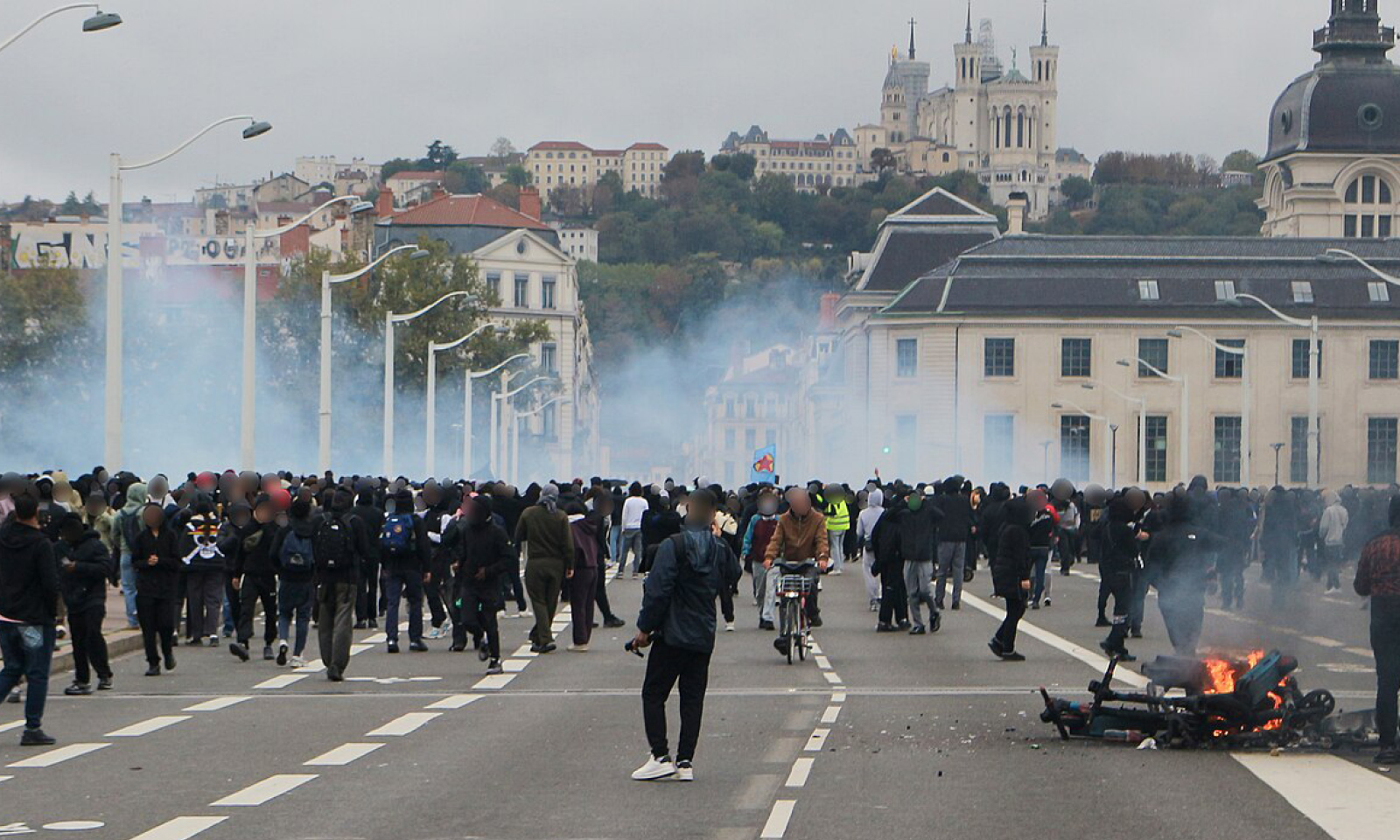
Outrage over violence is turning into a competition over which violence is still acceptable, who deserves compassion, and who now deserves only a truncheon.
Every society that finds itself in crisis needs a culprit. Someone to point a finger at and condemn before we have time to ask what actually exploded and who had been feeding the proverbial boiler for years. Today, this mechanism is repeating itself in the streets of France: outrage over violence is turning into a competition over which violence is still acceptable, who deserves compassion and who now deserves only a truncheon.
The culprit must be obvious, cunning and at the same time irrational – with a face that can easily be turned into a symbol of disorder. It is much harder to point a finger at a system that can call its own violence order. And considers foreign violence proof that order needs to be strengthened even further. Images of burning Parisian streets or shattered shop windows can say much more without words than political commentaries. Across the political spectrum, laments can be heard: What can looting possibly have to do with education? It is time to apprehend the culprits. It is time to restore order.
Paris as a European nightmare
France, and Paris in particular, represents an exceptionally suitable stage for the right-wing thesis about the threats of multiculturalism. In Western notions of civilisation, it features as an old cultural symbol of Europe, torn from its own social and political context. Foreign audiences, fed information about protests by algorithms designed to generate profit, remain perplexed. Romantic Paris, full of baguettes and bearded white men in berets, is turning before their eyes into a smoke-filled battlefield. Come on, how can these be protests by French students, if they are wearing black tracksuits and keffiyehs?
When, however, we abandon these childish notions about foreign countries, we find ourselves in an environment that has driven hundreds of thousands of demonstrators into the streets. Schools lack teachers, classrooms are overcrowded and buildings are falling into disrepair. In disadvantaged areas, pupils also encounter broken toilets, a lack of basic equipment or unbearable temperatures in classrooms. Inequality is thus reproduced from the very school desks: young people are expected to fight for their future, even though the state does not provide them with the conditions to achieve it. Police brutality and disproportionate interventions by security forces represent another layer of French reality, in which social discontent meets the repressive response of the state.
The contradiction between these two images of France is sharpened by its political culture and fondness for protests, which subsequently summon moralisers from around the world. The revolutionary ethos, however weakened by the limits of liberal democracy, drives French citizens into the streets to protest against poor conditions and untrustworthy politicians. Alongside this, ideas about the unsuccessful assimilation of migrants into a peaceful, civilised nation persist stubbornly in the discourse. Violence supposedly comes with them. Beaten young people end up in police cells, trade unions mobilise, tear gas floods the streets and images of shattered shop windows or burning bins gradually fill the headlines of prestigious newspapers around the world. Marchons, marchons...
The hunt for the culprit
It is time to intervene. The language of state rationality and right-wing fantasies about an ethnic invasion jointly fabricate an image of the culprit – the barbarian. Newspapers publish at a furious pace. Public opinion is, after all, crucial in establishing the legitimacy of resistance. In the name of order, after intense state repression, two unruly elements are portrayed, displaying admirable organisation and, at the same time, irrational instinctiveness. The latter invokes the moral category of uncivilisedness. In short, it is an expression made famous by the French far right: “Islamo-leftist barbarism”. The internal enemy is in league with the enemy from outside. The technocratic state apparatus headed by President Emmanuel Macron sets the record straight: this is an attack of the highest calibre, namely “political and inflammatory actions by far-left groups aimed at overthrowing the republic”. The protest is officially illegitimate; please, if you need to express your opinion politely, take a number and we will serve you shortly. It is logical, after all – common sense dictates obeying rational rules. Only groups with legitimate authority may protest. And only the state can decide who has that authority. Wait a minute, where have the students gone?
In official narratives, the younger generation has meanwhile acquired a divided, Janus-faced form. On the one hand, it is a morally pure (read: white) group of students with good intentions and childlike smiles, whose noble aim has been exploited by a mythical group of vandals. The more cynical right sees it differently. Young people simply lack patriotism and war. Palestinian flags clearly indicate the political orientation of the students. They are, after all, the same cunning neo-Marxists led to the slaughterhouse by “suicidal empathy” and an absence of a rational instinct for self-preservation. And rightly so. In both interpretations, their agency and its demands remain sidelined. The space for the students to define their own position has been considerably narrowed. In viral videos of violence in the streets, supposedly respectable students are nowhere to be seen; attention focuses on alleged middle-aged migrants. So where is the youth? In light of the testimonies, it is quite possible that they are sitting in a cell or in the emergency department.
Violence and order
There is perhaps nothing easier than publicly condemning looting. Nor does it require complicated thought experiments to understand how optics, the inviolability of property and the disruption of everyday life influence perceptions of the legitimacy of protests. Despite the actual damage caused, our reaction to looted shops and torched buildings – such as the town hall in Limoges –, tells us more about the symbolism of the collapse of certainties and values allegedly caused by the “invasion of barbarians”. Whether we side with the position of author Vicky Osterweil, whose book frames looting during mass protests as a political act of resistance against the unequal distribution of wealth and the sanctity of private property, or whether we consider looting an ugly but predictable accompanying phenomenon of mass protests and speculate about whether the police themselves might have been behind it, is ultimately irrelevant. This distinction does not matter in the end, because the official narrative of the collapse of Western civilisation arose long before images of violent attacks on elderly people generated by artificial intelligence or videos of wrecked streets and shop windows began appearing in headlines.
The categorical imperative to punish guilt and disobedience accompanies us constantly. It would be naïve to seek kind-hearted pacifism behind calls to oppose mob violence. The social mood of anxious anticipation of the fall of civilisation or “hybrid threats” is fed by elites’ talk of securitisation, as well as by the algorithmic or media emphasis on violence. What generates more profit than the transgression of “the others”, which prompts a person to publicly express their moral superiority? After a while, mediated suffering ceases to outrage, shock or entertain the audience. It becomes normalised. Yet the moral ethos and calls for justice build a sense of security. Increasingly intense technological surveillance is likewise hidden behind the guise of averting an ever-present threat. Society is ready to punish, and the state cannot wait. Is it really a coincidence that the death penalty is being invoked (outside the USA) now also in the context of a “radicalising Europe”? It is time to set things straight, after all.
Who with whom – and against whom?
In contemporary political language, solidarity is increasingly viewed with suspicion – especially when it crosses the boundaries of nation, ethnicity or cultural identity. By contrast, solidarity with those who can be presented as members of one’s own group may become a moral obligation. Social cohesion is then understood primarily as the cohesion of those who supposedly naturally belong together. The French protests highlighted the cohesion of society as well as its atomisation. While protesters from various backgrounds and strata demonstrate in the streets of Paris, united by the conviction that collective resistance is meaningful, public discussion is filled with laments over the loss of the homogeneity of the French nation and irreconcilable antagonism within the protests themselves. Images of guilt and punishment accompany the debate in the form of a stern executioner ready to intervene. After all, it is the state that decides guilt. And the state does not tolerate the desecration of authority.

The text was produced with the support of the Friedrich Ebert Stiftung, representation in the Slovak Republic