Artificial intelligence is creating a nationalist dream of reality.
Kapitál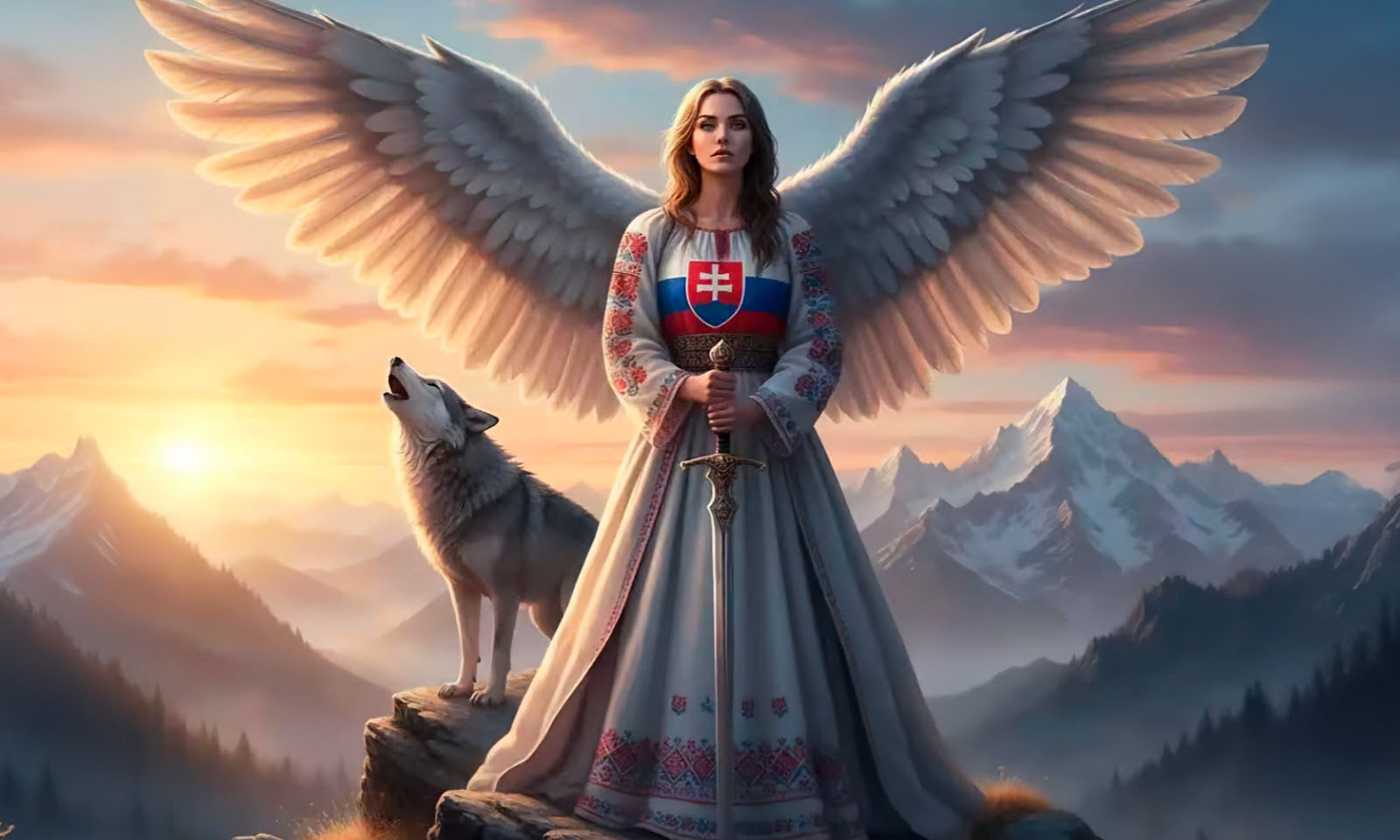
Fast, cheap, repetitive, and effective: far-right posts generated by artificial intelligence are flooding the internet and social media. Behind the kitschy façade lie parallels with Nazi propaganda. The difference is that creating images in various formats is now accessible to everyone and more insidious, as demonstrated by the Slovak movement Brat za Brata.
Fast, cheap, repetitive and effective: far-right posts generated by artificial intelligence are flooding the internet and social networks. Parallels with Nazi propaganda lurk behind the kitschy facade. The difference is that creating images in various formats is now available to everyone and is more insidious, as demonstrated by the Slovak movement Brat za Brata.
Why develop the ideology of your political movement when you can instantly generate it using artificial intelligence? People’s attention spans are short anyway. Complex narratives are unnecessary. Surely it is enough to rely on stereotypical visual references to the ideological past, isn’t it?
AI-generated aesthetics are becoming inseparable from the globalized form of contemporary extremist narratives used by far-right political parties. The formulations in prompts for large language models (LLMs), which create idealized digital images, change the perceived identity of the nationalist “in-group” and also influence reality. The scale of far-right election campaigns flooded with AI bots in Romania and Moldova in 2025 set an alarming precedent. Artificial intelligence is also strengthening the rhetoric of Germany’s far-right AfD party, currently enjoying considerable success.
Grassroots Slovak nationalism
Even small nationalist groups are active in constructing their idealized identity. They contribute to the flood of AI-generated images in order to strengthen their supporters’ sense of belonging. On the one hand, their images are also very generic, but they also draw on local historical references.
The pro-Russian Slovak motorcycle club Brat za Brata, for example, regularly shares AI-generated images on Facebook. They show young white blond men and women in traditional folk costumes, muscular “medieval” Slavic brotherhoods, and anthropomorphized wild animals representing Russia, Slovakia and Czechia, standing side by side. The images are often set in various forms of wilderness and dramatically lit for a heroic effect. Contemporary propaganda aesthetics are a mixture of elements with several layers: generic depictions of nature and stylized people meet nationalist symbolism in fantasy settings reminiscent of CGI films for the whole family. Historical stereotypes have not disappeared. New content draws heavily on them, and AI merely makes it easier to create them quickly and repeatedly.
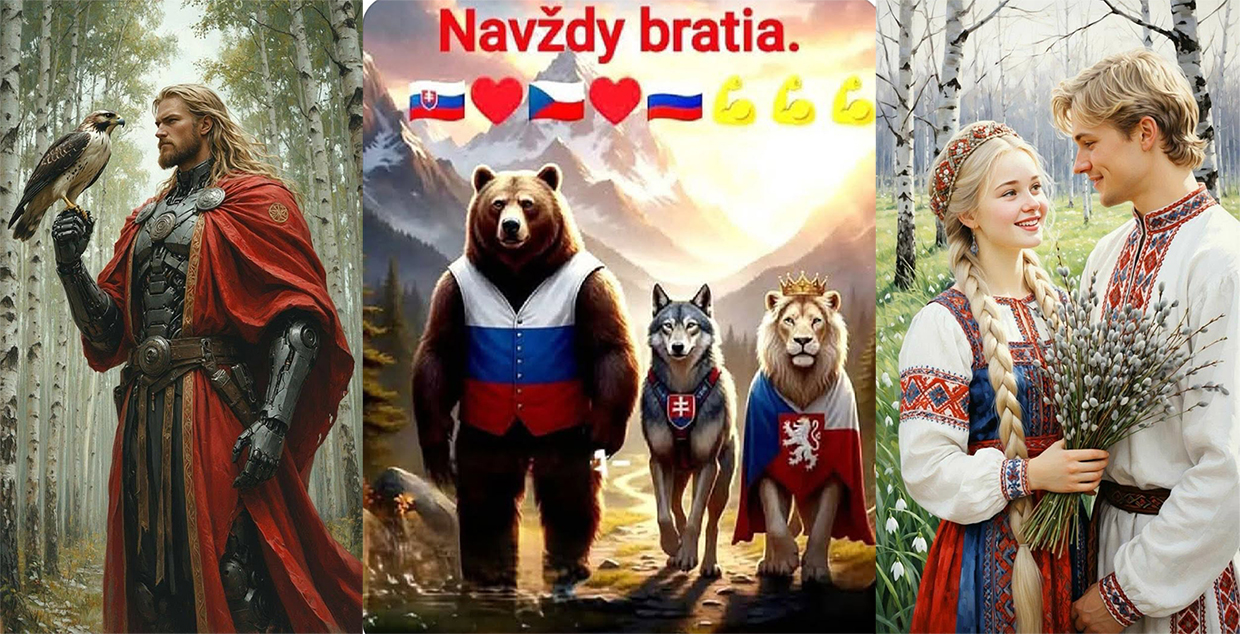
By contrast, actual photographs of Brat za Brata show groups of middle-aged men posing together in urban settings, wearing black bomber jackets with inscriptions in Cyrillic. The only thing the two sets of images have in common is the Russian flag in the motorcyclists’ hands.
Brat za Brata claims to be an apolitical group and organizes commemorative events dedicated to the Soviet past. Since the beginning of the full-scale invasion of Ukraine in 2022, however, it has used its online platform to actively support a pro-Russian agenda. The movement’s leader Matúš Alexa met Sergei Naryshkin, head of the SVR, Russia’s Foreign Intelligence Service. Members regularly attend events at the Russian embassy in Bratislava and boast of their relationship with former ambassador Igor Bratchikov. In March 2025, the group presented Slovakia’s president with a disputed petition calling for the lifting of sanctions against Russia.

Soft power of the animated bear
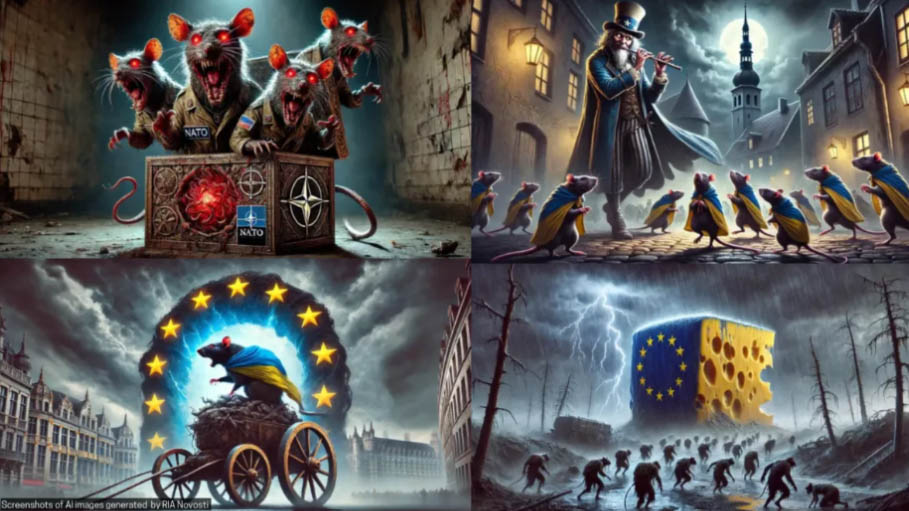
Brat za Brata’s depictions of a “real” Slavic identity are permeated by an apparently innocent, friendly atmosphere. They nevertheless fit into a wave of other AI-generated far-right images promoting strict nativism. Russian state media, which love AI-generated propaganda, regularly attack the legitimacy of international democratic institutions, especially in connection with Ukraine’s membership in the EU. In a series of provocative images published by RIA Novosti, rats with demonic red eyes and bared fangs are crammed into a box labeled “NATO.” Others, bearing the Ukrainian flag, follow the Pied Piper of Hamelin or lead a peasant revolt beneath an arch made of EU stars.
Although no individual social media post may be capable of changing public opinion, together they can be a highly effective ideological tool. The true potential of AI-generated images lies in their ability to gradually radicalize and polarize identity and create myths. “If you do not build a grand narrative, if you only say something here and something there, but never allow the whole dangerous picture to emerge,” then it is “difficult to apply the laws we commonly have in Europe against hate speech…, because everything remains merely implied,” says philosopher of language Tomáš Koblížek.
Controversy is therefore also provoked by content that does not openly promote a pro-Russian narrative. The widely available children’s series Masha and the Bear on Netflix, for example, recently encountered opposition in Ukraine and Great Britain because it compares its bear, a “kind-hearted giant,” to Russia.
Opening up the information space to a broad spectrum of pro-Russian narratives can be an exercise in soft power. By avoiding exclusively political and polarizing opinions, soft power complements traditional diplomacy and communicates through civil society channels.
Some propaganda images are deliberately non-confrontational, whether they feature the bear from a children’s cartoon or the “Disney-style” Brat za Brata posts on Facebook. Non-offensive depictions spread without obstacles. The extensive production of AI-generated far-right content saturating the online environment is increasingly becoming part of the mainstream. The use of this extremist symbolism is condemned and in some countries is even illegal, but newly created content arising from an ideological background is perceived as mild if it does not depict violence directly. Nationalist groups and political parties conceal racist, homophobic and patriarchal meanings in softened visual narratives. Outwardly, they thus appear normative and bypass the restrictions of digital platforms.
When the integrity of political reality disintegrates piece by piece, beginning with small communities and seemingly innocent channels, it opens the way for similar tactics that can influence the electoral process without oversight. Political actors use AI not only to create content, but also to collect data from which they construct detailed psychological profiles of voters for highly personalized campaigns. Covert operations producing large quantities of AI-generated content also enable politically motivated creators to discover which topics and narratives work best. The occasional spread of fear is considered part of the game, especially before elections, just to remind everyone who is supposedly enemy number one. Satire and the use of humor, however, are also proving particularly effective.
How funny are deepfakes?
Caricatures are highly prominent in generative AI because it allows endless variations of people placed in imaginary scenarios to be created. The creation of deepfakes, for example based on images of the faces of real politicians, has sparked discussion about the ethical boundaries of such visual manipulation.
During the 2023 election moratorium, the legally defined period before elections when campaigning is prohibited, Slovakia was hit by a deepfake scandal. A recording falsifying a phone call between Michal Šimečka, chairman of the Progressive Slovakia party, and journalist Monika Tódová initially spread via Telegram. What was surprising a few years ago is now a normal part of the social media ecosystem. More recently, a deepfake video of current coalition politicians and an oligarch supposedly in prison went viral. It was created by an Instagram user and spread partly because opposition politicians shared it.
Slovak politicians tend to ridicule their opponents. Following these cases and new EU legislation that came into effect at the beginning of August 2026, they nevertheless began fighting deepfake videos. A complete ban and penalties ranging from a fine to imprisonment for up to two years are being considered. Experts have meanwhile expressed concern about assigning responsibility. They ask whether the greatest blame lies with those who enter prompts into AI or with the models themselves, and point out that finding the actual creator of harmful content is very difficult. In some cases, it is clear who posted the image, for example on the Brat za Brata Facebook page. Many accounts are anonymous, however, and AI-generated content often spreads through bot networks, dispersing responsibility one step further. In Europe, the Digital Services Act (DSA) governs content disseminated on large online platforms. Its application, however, is largely reactive and focuses more on the responsibility of social media platforms than on regulating the AI tools used to create misleading content.

Proposed legislation to protect digital identity may aim to protect people from misuse of their faces in deepfake content, but it addresses only part of the problem. First and foremost, it does not address the flood of AI-generated images across the political spectrum at all. Nor does it address so-called plausible deniability, through which people avoid responsibility for offensive behavior: “If someone accuses you, for example, of racism or homophobia, you can simply claim it was a joke,” says Koblížek. Nor does it ask whether generative AI would be equally effective if the prejudices on which AI users rely did not exist.
Reviving reactionary modernism
“If you look at how the German weekly tabloid Der Stürmer depicted Jews in the 1930s, it is very similar to how the AfD depicts migrants today using AI-generated images,” says political iconography researcher Jacopo Galimberti. Nazi images of idealized Aryan families can be compared with those created by Brat za Brata. Stereotyping is a common nationalist tool that is particularly effective in visual form because it exaggerates the differences between “the ideal” and “the other.”
Much of Nazi propaganda relied on figurative depictions of themes such as the traditional family. It used easily recognizable images without visual complexity, yet overflowing with civic pride. Machines were celebrated in the same way. The Nazis’ enthusiasm for technological progress was directed toward halting the alleged decline of Western culture and calling for a kind of spiritual awakening. After the war, Jeffrey Herf called this vision “reactionary modernism.” It was a movement paradoxically willing to use technological development in an effort to return to traditional nationalist myths and ideas.


Recent developments in digital technologies, including AI tools and their use, show parallels with the reactionary modernism of the twentieth century. “Technofascism” refers to an ideology of technological expansion over the democratic infrastructure of the state, giving large technology companies decision-making roles in government under figures such as Peter Thiel and Elon Musk. The aesthetics of Tesla Cybertruck vehicles and trad wives (traditional wives) disturbingly approach the Nazi regime’s obsession with military technology and racially pure families.
What has changed, however, is the participatory aspect of generative AI, which turns every consumer into a content creator. Nazi propaganda was organized for the masses, not by the masses. Joseph Goebbels saw film as the main medium for spreading National Socialist ideology and used its entertaining character to develop wartime propaganda. Films from that period, such as popular comedies, seemingly told apolitical stories while depicting racist policies. Film’s influence remained so crucial to the regime that even several months before Germany’s surrender, people were still being “recruited” as extras for the last National Socialist productions.
Today’s generative AI goes a step further than involving civilians as extras on the big screen. It offers consumers full participation and customization in content creation and gives them control over their visualizations on a small screen. Since creation is free, AI-generated images feed popular forms of propaganda. Provocative content can now go viral with the help of automated bot networks that boost posts in users’ feeds and disguise them as clickbait. Members of Brat za Brata from Revúca, a town of 10,000 inhabitants in central Slovakia, need neither a producer nor a local audience. With a few clicks, they can visualize all their ideas about identity and power structures and convey them to a network of users who willingly consume nationalist messages.
“Enshittified” reality of platform realism
Online AI-generated content is relatively new, but already widespread. It is created in a clear and colorful palette with a recognizable visual character and has already earned a scholarly term: “platform realism.” The term was introduced by Jacob Birken and further developed by Roland Meyer. It refers to features of generative AI such as legibility, plausibility and a structurally nostalgic relationship to past media. Meyer emphasizes that the very origin of generative AI products already separates them from reality as we know it, beginning with the way LLMs process prompts. Meyer explains: “Despite the popularity of the term ‘prompt engineering,’ their function is not to execute a precise program, but to provide fuzzy parameters that narrow the possible results and guide the model toward a certain area within an apparently infinite statistical space of possibilities.” In the end, the user has to try repeatedly until they obtain an image they like. It is essentially a process of waste, both in terms of resources and because it floods online space with visual waste, nostalgia and clickbait.
In attempting to analyze this new reality, researchers draw on numerous fields, from philosophy and sociology to studies of information processing and information systems. They draw on Jean Baudrillard’s concept of simulacra and hyperreality. His theory describes how representations can be perceived as more real than reality itself. He uses Disneyland as an illustration, showing how hyperreality replaces reality beyond the amusement park. Baudrillard argues that we have already gone beyond this point: the “real world” is now full of simulacra, making it almost impossible to find any “real” representations.
The simulacrum of a new level is an autonomously generated reality approximated from our knowledge archives. The creation of art, or in this case propaganda, which previously required human imagination, has been reduced to a series of prompts for AI models. And representations of the real world around us have been replaced by entirely artificial images.
In line with the media theory of philosopher Marshall McLuhan, according to which technology is an “extension of consciousness,” AI appears to provide Brat za Brata members with their dream reality. AI-generated images may even alter their self-perception, assuming that these aesthetic choices shape their perception of reality. Philosophers Philippe Lacoue-Labarthe and Jean-Luc Nancy write in their 1990 essay The Nazi Myth that “mythical power is the power of the dream, of projecting an image with which one identifies.” The tools for depicting and communicating identity have changed dramatically, but the old myth of Slavic unity persists and, thanks to groups such as Brat za Brata, is endlessly exaggerated. Creating images with seemingly endless possibilities, however, brings significant pitfalls.
“Machine learning operates through correlation and analogy, in a way that is closer to alchemy than to science based on cause and effect,” says digital media artist Hito Steyerl. “There is an affinity between magical thinking and elements of machine learning. But large corporations obviously promote this magical atmosphere only to sell their products. They are not magical at all; rather, they are so-called enshittifying, turning everything into rubbish.”
Strategic pollution of large language models
LLMs learn from the virtual archives we provide them, which are dominated by the West. Once patterns are recognized, they can be reproduced en masse in infinite variations. The prevailing information is therefore distorted.
“When you think about the question of responsibility, there is often a tendency to shift attention to the AI tools themselves. We talk about what AI has brought us, whether or not it denies the Holocaust. But responsibility actually lies with the creators of specific content or the providers of the AI model, and these responsibilities may differ,” says Koblížek.
Technology is developing faster than regulation. The pace and complexity of LLM development are at a level where it is impossible to keep track of whether models are deliberately trained to spread a particular rhetoric or whether those responsible have simply failed to prevent such distortions. Online space is shared by ordinary users and fake websites mass-producing content whose target audience is other bots serving future content creation. And as Koblížek notes, far-right groups are eager for their material to become part of the LLM environment: “Extremist groups are actively working to make this content available online, even if it receives few views, simply so that it is there as a potential source for AI training.”
Given the way it works, generative AI also tends to reinforce sexist and racist images already present in the virtual archives that serve as LLM sources and that far-right actors search for. “It allows the right to evoke a nostalgic, timeless past that never existed outside the images used to train the software,” says Meyer. The reciprocal mechanism of supply and demand works. Add a format that is easy to share online, and the propaganda machine is born.
In some cases, we see politicians with different political views also jumping on social media trends and generating their own content mocking their opponents. “Liberals, progressives and leftists, however, have generally been restrained in their public use of AI, not only because of the models’ widely known biases, but also because of the massive exploitation of human labor and creativity, as well as natural resources, associated with training AI models. For the right, therefore, adopting a recognizable AI aesthetic or ‘slop’ is also a way to provoke and troll their opponents,” Meyer adds.
Soon we may be discussing not only the generation of new images, but also the protection of the integrity of the past, which can easily be changed in an Orwellian manner. The US government has already begun: it is removing images of women, LGBTQIA+ people and people of color from its military websites. Meyer warns of “digital forgetting.” In other words, we should not be so confident in the “complete availability of the past.” “This not only breeds widespread distrust of any visual evidence, but also creates misleading expectations about what historical documents should look like,” he says. When we delete originals from our archives, they may remain only as shadows in LLM training material.
Museums and public institutions sometimes use generative AI themselves to fill historical gaps and revive the past. According to Meyer, “such speculative uses are often misleading. They tend to reproduce existing clichés about the past and about how it should be depicted, rather than opening up a new perspective on history.”
Institutions face the task of keeping ideas about truth alive, raising public awareness and helping to define principles of good practice in the use of AI. Regulating technology at the pace at which it develops will remain a permanent challenge.
AI-generated content from groups such as Brat za Brata can be produced endlessly. In the meantime, it may reach a saturation point and eventually persuade only those already convinced, or simply tire out its viewers, just as other forms of propaganda did before it.

We publish this text in cooperation with Eurozine

This article was published with the support of the ZEIT-Stiftung Ebelin und Gerd Bucerius Foundation.