Jon Stewart: “Capitalism leads us to see each other as competitors. But that is at odds with our natural feeling of love and affection for others.”
Kapitál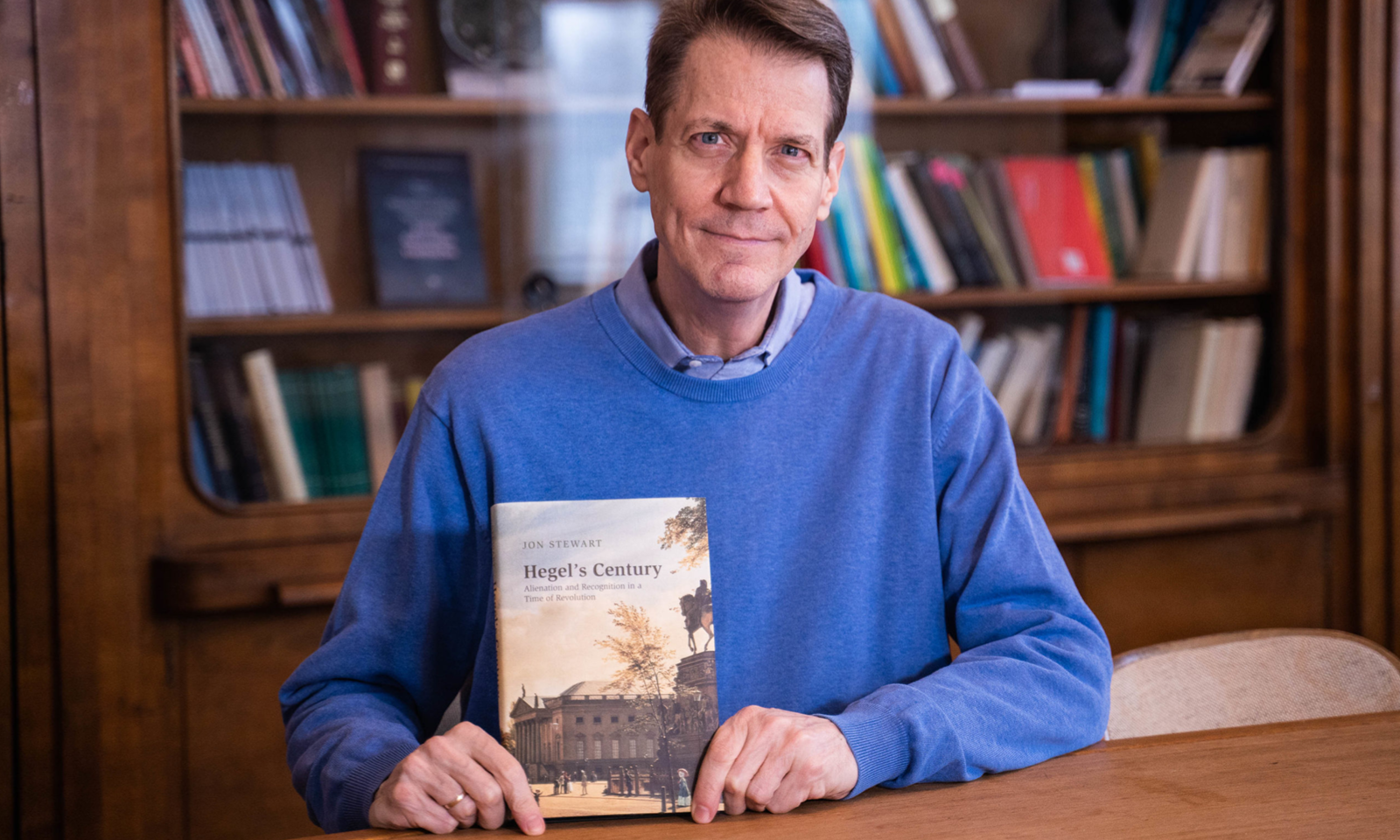
What meaning does human life have in a world where traditional answers have lost their self-evidence? In an interview with Peter Daubner, American philosopher Jon Stewart explores the roots of modern nihilism and reflects on the tension between humanity’s cosmic insignificance and the infinite value of human life. He discusses Marx’s theory of alienation, the critique of capitalism, and the need for radical thinking. He also addresses Søren Kierkegaard’s relationship to existentialism, changing conceptions of humanity, and the ecological crisis in the Anthropocene.
What meaning does human life have in a world in which traditional answers have lost their self-evidence? In an interview with Peter Daubner, American philosopher Jon Stewart explains the roots of modern nihilism and reflects on the tension between the cosmic insignificance of human beings and the infinite value of their lives. He addresses Marx’s theory of alienation, the critique of capitalism and the need for radical thinking. He also discusses Søren Kierkegaard’s relationship to existentialism, changing ideas about humanity and the ecological crisis in the Anthropocene.
In your book A History of Nihilism in the Nineteenth Century: Confrontations with Nothingness (2023), you examine the roots of modern nihilism. You approach nihilism as a broad cultural problem that affects philosophy, poetry, drama and religious thought, placing it in the context of the development of Enlightenment science, the emergence of a secular worldview and the subsequent “crisis of meaning.” Why did the question of the meaning of life become such an urgent problem in nineteenth-century Europe, and why does it still trouble us today?
It is an important question because many people today struggle with feelings of meaninglessness, despair and nihilism. In my book, I tried to show that there were specific socio-historical reasons why this problem spread throughout nineteenth-century Europe. Our cultural situation today differs considerably from that of the nineteenth century, but the problem persists and takes various forms. Before the Enlightenment, Christianity played a central role in Europe. It provided fundamental points of orientation for different areas of life. At the centre of every town and village stood a church. Religion offered people a firm worldview that provided them with comfort and stability. The rise of Enlightenment science in the eighteenth century, however, called all of this into question. The Enlightenment critique of Christianity undermined basic beliefs such as the existence of God, the immortality of the soul and salvation. When people in the nineteenth century lost these basic points of orientation, many experienced an intense sense of meaninglessness or nihilism. In the eighteenth century, it was asserted with great confidence that science would replace religion. These expectations were never fulfilled, however, because it quickly became clear that science could not provide answers to the deepest human questions, such as the question of meaning. Since the religious worldview had been disproved and the scientific worldview offered no substitute for it, people in the twentieth and twenty-first centuries were left to rely on themselves in their search for meaning.
Against this background, what can we say about the meaning of human life in the twenty-first century?
For the reasons I have just mentioned, it is difficult to answer this question. It can no longer be answered generally by appealing to a shared worldview or common foundation. It seems impossible to find a universally accepted view of what this meaning consists in or might consist in. Science cannot help us here either. This leads me to conclude that the question of meaning is largely a personal one.
How do you approach this question personally? Where do you find meaning in your own life?
If the question concerns me personally and my own life, I think the answer must be dialectical. On the one hand, from the vast perspective of the universe, my life is infinitely small and insignificant. From this perspective, it does not matter at all whether I live or die, or what I achieve in life. On the other hand, from a narrower, personal perspective, my life has infinite value because it is mine and it is the only life I have. This means that for me, everything I do is important in one way or another. The art lies in being able to hold these two contradictory perspectives together harmoniously and not becoming a victim of a one-sided view. If a person regards the macro-level perspective as the only valid one, they risk falling into despair and nihilism. If, however, they regard the narrower, personal perspective as the only valid one, they risk slipping into a sense of their own importance, egoism, vanity and arrogance, not to mention self-deception. I think we should strive to preserve the truth of both perspectives, because they can naturally correct each other and help us maintain the balance and realistic image of ourselves that we need in life.
You describe a balance between our cosmic insignificance and the infinite value of our own lives. How do you try to maintain this balance in moments of loss, failure or despair?
At such moments, a dialectical approach can provide a certain kind of comfort. If I experience a major failure or fiasco, I may feel emotionally devastated and fall into depression. If, however, I retain an awareness of my own insignificance from the perspective of the universe, then my failure or fiasco—regardless of how great it was—does not actually matter at all. I therefore have no reason to torment myself with it endlessly. I should simply try to learn from it and move on.
In your book Hegel’s Century: Alienation and Recognition in a Time of Revolution (2021), among other things, you examine various forms of alienation in Marx’s Economic and Philosophic Manuscripts of 1844. How did Marx understand alienation in the nineteenth century, and how should we understand it today?
As the Economic and Philosophic Manuscripts show, Marx was inspired by Hegel in developing his theory of alienation. Hegel speaks of how the human spirit “externalises” itself through work, thereby creating the whole of human culture. When people create something in the world, they transfer part of themselves into the external sphere. What was initially an idea in a person’s mind becomes reality: the idea takes form in space and time and thus moves from the mind into the world. Marx developed this idea in his analysis of labour during the Industrial Revolution. He compared the traditional work of an independent craftsman with work in a factory, which became predominant in his time. The craftsman creates a product of his own choosing. He does so in the way he considers best. He uses his own tools and production methods. When it is finished, the product belongs to him, and he can decide what to do with it. This model corresponds to Hegel’s idea. The craftsman can truly see himself in the product of his labour. The product represents his inner self in the external world. In this sense, the craftsman identifies with the product of his labour, which is the exact opposite of alienation.
How does this relationship between workers and the products of their labour change with the rise of factory production?
In factory work during the industrial era, the situation looks quite different. People are forced to take jobs in factories because there are few other employment opportunities for those without advanced formal education. For a fixed wage, they must then produce a product determined by the factory owner. They are forced to work with the tools and machines provided by the owner instead of being able to choose the means of production themselves. The result is unhealthy and dangerous working conditions that a worker would never choose for himself. When the finished product is complete, it belongs not to the worker but to the factory owner. Marx points out that in this model the worker’s relationship to his product is completely different from that in the previous model. The factory worker cannot identify with his product because it does not belong to him. He did not design it or create it using his own tools and means. The product therefore appears to him as something alien, not as part of himself. The factory worker is alienated from his own product. He cannot see himself in it. He is the opposite of the craftsman, who identifies with his product.
To what extent does Marx’s analysis still help us understand alienation today, and in what ways does it need to be reconsidered?
I have always considered this analysis insightful, and I think we can learn a great deal from it. The question of alienation is more complex today. In my view, however, Marx’s analysis remains relevant to us in many respects, because most of us are ultimately wage workers. We sell our time and energy, while the product of our labour belongs to our employer. Our contemporary capitalist economy is nevertheless very different from the economy of Marx’s time; indeed, it has become far more complex. Marx could hardly have imagined the enormous volumes of capital that can be created simply by moving money around without any actual labour being involved. I am pleased that scholars today are working to update Marx’s theory so that it better corresponds to our present economy. In this way, his penetrating insights can be preserved while also being extended into new areas that he could not have imagined in his own time.
Can Marx be considered a radical philosopher?
Marx was certainly regarded as a radical philosopher in his own time. Anyone who openly calls for revolution and advocates the complete replacement of a socio-political system must be considered a radical. I think we need radical philosophers who force us to think critically about our institutions and practices, which we usually take for granted. We need radical thinkers such as Marx to draw attention to the injustices in our contemporary world, so that people cannot look away and pretend that these injustices do not exist. If we want to fulfil our ideals, we still have a long way to go. The first step is to name the many problems that need to be addressed.
You claim that we need radical philosophers who challenge what we take for granted. Which assumptions underlying contemporary capitalism most urgently need to be questioned?
That is a big question that we could discuss for a very long time. I think most people today take it for granted that capitalism is the only viable economic system and that we must therefore continue with it, whether we like it or not. This way of thinking is questionable, because there are potentially many other economic systems that could work much better but will never be given a chance. Another unexamined assumption is that poverty is inevitable and that nothing can be done about it. The first part of this claim is true in a certain sense: poverty is indeed inevitable under the capitalist system. It is a natural consequence of a system based on the accumulation of wealth. The capitalist system, by its very nature, creates a large class of poor people. Another type of economy based on principles of equality could quite possibly eliminate poverty. Another unquestioned assumption is that capitalism is a fair system that promotes healthy competition and rewards hardworking people with success. That is simply a myth. Capitalism does not offer equal conditions for everyone, because some people begin with an enormous advantage by coming from a wealthy family. They did not earn this advantage through hard work or through any skill or ability acquired by their own efforts. They received it at birth. The result of this inequality is exactly what we would expect: people from wealthy families tend to succeed within the system, while the cycle of poverty is perpetuated among the poorest. I will stop there, but many more examples could be given.
You are an expert on the Danish philosopher Søren Kierkegaard, who places at the centre of philosophical inquiry the individual who makes decisions, experiences anxiety and love, bears responsibility and searches for the meaning of life. Can Kierkegaard be considered the founder of existentialism? Does his philosophy remain a source of inspiration today?
We often encounter such claims in introductions to philosophy or existentialism. Kierkegaard was indeed long regarded as the founder or father of existentialism. This seemed self-evident: if existentialists such as Sartre said so, it must have been true. Over the last two or three decades, however, scholars working on Kierkegaard have begun to question this designation. In 2011 I published a book entitled Kierkegaard and Existentialism. In its preface, I tried to examine this question briefly. While preparing it, I became even more aware of how complex the problem is. Once one begins to investigate it, it breaks down into several distinct questions.
What problems are involved?
To claim that Kierkegaard was the founder of existentialism, we must determine precisely what existentialism represents as a school of thought. Even apart from Kierkegaard’s relationship to it, however, it turns out that existentialism cannot be defined. Many of the best-known existentialists rejected the label. Moreover, they often disagreed with one another, and it proved impossible to identify a set of doctrines that they all shared. Most contemporary attempts to define existentialism point instead to common areas of interest, such as freedom, anxiety and individuality. None of these themes, however, defines anything precisely by itself, because they would apply equally well to many other philosophers from other periods. Without a definition of existentialism, therefore, it is impossible to say whether Kierkegaard was its founder.
What other problems did you discover?
To claim that Kierkegaard was the founder of existentialism, we must also determine precisely what it means to be the “founder” or “father” of existentialism. Does it mean that Kierkegaard formulated a set of doctrines later existentialists adopted? Or, conversely, that the key theses of existentialism can be derived from Kierkegaard? If so, Kierkegaard cannot be the founder of existentialism, because many of his views are in direct opposition to those of the existentialists. For example, he would have rejected Sartre’s famous claim that “existence precedes essence,” which is often used as the very definition of existentialism.
How, then, would you describe his relationship to thinkers associated with existentialism?
Without many qualifications and exceptions, it is impossible to claim that Kierkegaard was the founder of existentialism. The nature of his thought and the history of its reception are simply too complex. It is more accurate to say that many authors associated with existentialism read some of Kierkegaard’s works and were inspired by some of his ideas, which they then developed in their own ways. This inspiration does not mean that they were Kierkegaardians or that Kierkegaard was an existentialist. These questions must be examined separately for each author. The history of philosophy, unfortunately, rarely provides simple and unambiguous answers.
Does Kierkegaard’s philosophy remain a source of inspiration today, independently of his influence on existentialism?
There is no doubt that it does. The field of Kierkegaard studies has grown enormously over the last three decades. People from around the world, with very different backgrounds, religious beliefs and interests, continue to take an interest in Kierkegaard and draw inspiration from him. This is also true of important philosophers such as Jacques Derrida, Sylviane Agacinski and Jürgen Habermas, who have written significant works about him. It should also be noted that the growing interest in Kierkegaard’s thought is not limited to philosophy but extends into several other fields, including psychology, religious studies, literature, drama and the visual arts.
You are an expert in philosophical anthropology. Can you tell us something about your work on the question of what a human being is?
I am very interested in philosophical anthropology, and it is currently one of the main areas of my research. In a recent manuscript of mine, which is now under review, I argue that the idea of the human being or humanity in general is precisely that—an idea. This means that it is not something absolutely given but a product of human thought. Human thought, however, has naturally changed radically over time. This suggests that the conception of what it means to be human has also changed. Our current view of what a human being is differs considerably from conceptions in antiquity.
How do you trace these changing understandings of what it means to be human?
In my work, I try to trace these changes over time in order to understand how our modern view of humanity arose. My methodology consists in examining different cultures, which naturally reflect the ideas of their time. Through these ideas, it is possible to understand how ancient peoples thought about themselves. This includes questions such as how people imagined their relationship to nature or to the gods. On the basis of these differences, we can identify what these peoples considered characteristic of human beings.
What is at stake in these definitions of humanity, especially in relation to human rights?
This is a very important question today because our modern understanding of human rights is connected with it. To be entitled to these rights, a person must be a human being. If someone is not human, they have no rights. History is a sad story of the suffering, exploitation, subjugation and enslavement of people who were regarded as less than human. In my view, it is essential to regard every human being as something sacred and irreducible. Every person should have the same rights as everyone else. This view, however, did not always exist. Historically, it emerged only relatively recently. I therefore want to trace the story of how we arrived at it over the course of millennia.
How does your research relate to contemporary efforts to extend rights to beings other than humans?
I am also very interested in the recent trend seeking to extend rights to the non-human other. I consider this a very important development.
Does the ecological crisis in the Anthropocene require us to reconsider what it means to be human, and especially the idea that human beings occupy a privileged position in nature?
Yes, the environmental crisis requires us to begin thinking radically differently about ourselves and our relationship to nature than we have in the past. It has long been clear that human beings are necessarily connected to the Earth. We need what the Earth provides in order to exist. We need a healthy environment to live. The Earth and its products are not something we can exploit indefinitely. Our economic system is based on the principle of growth. It cannot grow without limit, however, because it depends on the planet’s finite resources, which will one day be exhausted precisely because they are finite. The exploitation and destruction of nature cause many problems: by-products of production processes have polluted water, soil and air. This has brought us into the dangerous, even critical situation in which we find ourselves today.
Finally, as a historian of philosophy, I would like to ask you: What can the history of philosophy teach us about hope without encouraging naïve optimism or resignation?
I firmly believe that the history of philosophy can teach us a great deal not only about hope but also about many other things. It can remind us of the power of human action when it is accompanied by critical thinking. We are free and can largely determine our own destiny. I believe that if we cooperate, there is room for rational hope. Our economic system once again leads us to view one another as competitors and rivals, which is in direct conflict with our natural feeling of love and affection for others. It overlooks the fact that the human species survived not through competition but through cooperation and mutual assistance. Without it, humanity would have become extinct long ago.

The text was produced with the support of the Friedrich Ebert Stiftung, representation in the Slovak Republic